

How Dirk Nowitzki's New Shot Release Will Help His Production
Speed and strength have never been the calling card of Dallas Mavericks superstar Dirk Nowitzki. Footwork, craftiness and one of the deadliest jump shots ever have carried him for 16 NBA seasons and will one day lead him into the Hall of Fame.
Without superior athletic gifts, Nowitzki has also relied on a constant tinkering of his game in the offseason to keep defenders off-balance. According to Nowitzki, via ESPN.com's Marc Stein, the latest adjustment is a quicker jump shot release.
In his earlier days, Dirk was a pure catch-and-shoot big that stretched immobile centers and power forwards all the way to the perimeter.


After earning respect as a shooter, the closeouts tightened. Dirk responded in kind by developing a pump-and-go game, drawing defenders in the air and deftly slipping to the rim or pulling up from the mid-range area.
Then came the matchup changes. His mobility and ball-handling were largely unheard of for a 7-footer, but his lack of physicality left him incapable against quicker forwards. He couldn't blow by them and they could contest his jumpers, leaving him without an offensive response despite a clear height advantage.
That's when the post-up game first began to appear. If defenses threw smaller players on him, he responded by walking them down to the block and calling for the ball. His arsenal of quick spins, face-up jumpers and one-legged fadeaways left defenders guessing.
It's largely why Miami struggled to contain him in the 2011 NBA Finals, and how he willed an inferior roster to an upset and the NBA championship.
Chris Bosh was quick enough to handle Dirk, just not long enough. Udonis Haslem was certainly strong enough, but his lateral quickness was poor. LeBron James had the speed and strength, but he was only 6'8".
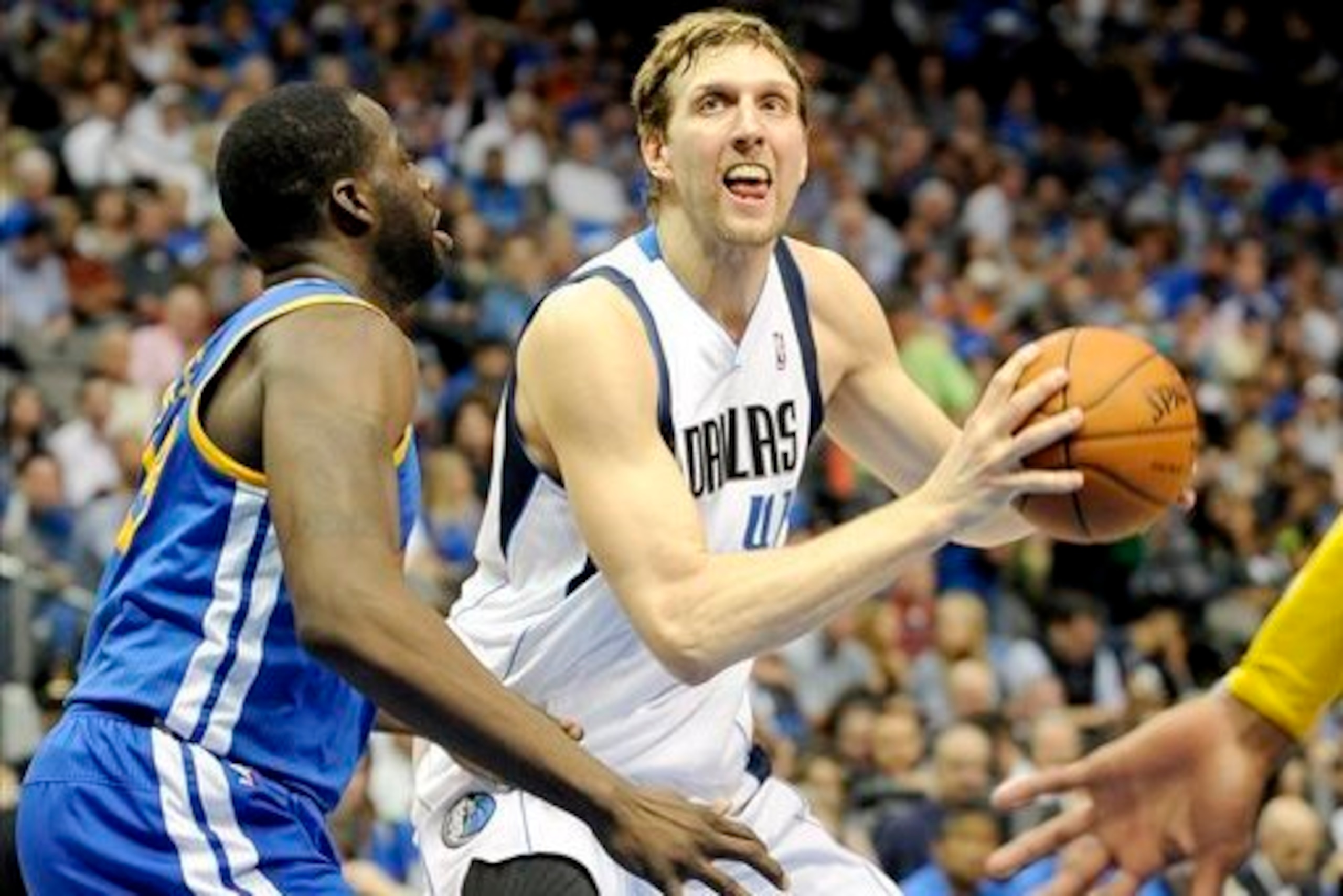
Now at 36 years old, Dirk is fine-tuning his skills to match his diminishing athleticism. No longer able to deal with the brutal physicality of the post or the growing speed of today's bigs on a nightly basis, he's looking for a new edge.
A quicker release might just be that answer.
Last season, Dirk was his usual self: 21.7 points per game on 49.7 percent shooting from the field and 39.8 percent from three-point range. But his total threes per game ticked up significantly to 4.1, the highest total since his early days in the league when he was primarily a spot-up shooter.
That was due to the physical toll of his offensive burden over the years—he's been a primary scorer and creator for more than a decade. Now he's reverting to his less demanding roots by hoisting up more threes. After once shedding the comfort of the three-point arc to evolve as a scorer, he's finally reversing course.
But if the Mavericks hope to achieve anything significant before Dirk retires, he'll need to find that careful balance between reducing his burden while not losing his role as a primary threat.
Nowitzki, after all, is the crucial piece to any Dallas championship puzzle. Saving his legs is a worthwhile goal in the long run, but regular-season success and comfortable playoff seeding still require his playing at full throttle.
The Western Conference is too talented for anything less than his best.
That dilemma will be partially solved by a stronger roster, according to Mavs Moneyball:
"What can you say that hasn’t already said about Dirk? Another healthy year will hopefully not see any decline in his play and, with Chandler Parsons, Mark Cuban says the scoring burden should be distributed even more evenly. Still, Dirk has been working this summer on a faster release, exemplifying the Larry Bird-like work ethic he’s always had. With more firepower behind him that perhaps he's ever had, Dirk should be well rested without having to carry the team.
"
The quicker release can also play a large role. One of Dirk's favorite moves, the fadeaway jumper from the post-up position, is an impressive feat that appears largely non-contact. He's jumping away from his defender to create separation.
In this case, the victim is Markieff Morris of the Phoenix Suns.
But that is only set up by drives to the basket to loosen up the defense.
Earlier in this particular game, Dirk was dominating Phoenix's defense by barreling his way to the rim as a response to Phoenix's ball pressure.
In the post-up below, notice how Channing Frye is all up in Dirk's face when he turns toward the rim. Frye is all but daring him to put the ball on the floor.
It's plays like these that create the requisite room for his jumper.
In this case, Dirk shakes off Frye only to find himself relatively free. Better defenses send multiple defenders at Dirk and force him to be a distributor, making him power through multiple bodies and extra layers of contact.
We can safely assume that Dirk isn't looking to absorb this type of beating on a nightly basis, especially if he plans to last 82 games and (hopefully) through multiple playoff series.
With less room to shoot, then, he's left with two options: Take more difficult jumpers or change his timing.
The classic high-arcing, high-release Nowitzki jumper is beautiful to watch but time-consuming to complete. His height and fadeaways counter this effect, but the growing athleticism among NBA bigs is cutting into his leeway.
Nowitzki's tedious shooting process mostly derives from his prolonged release. It's easy for him to launch the ball with just a flick of the wrist, so he tends to hold off doing so until he's leaning well away from his defender.
The drawback is that defenders can put him in compromising positions by occupying the space he's leaving and leaping to contest from that spot. That's what Kawhi Leonard does here against Dirk's one-legger, nearly blocking the shot by simply sliding closer to Dirk as he evacuates.
Dirk's mastery of this particular shot is unparalleled, but it's hardly the bread and butter of a high-functioning scorer. In small doses, it can keep defenders close and open up driving lanes. As a main offensive course, it doesn't work.
Release the shot quicker and Dirk might have something more sustainable. Not only would it cut down on the pure distance of the shot, it would throw off a defender's timing.
Remember that the fadeaway is drawn out, allowing defenders to time up contests easily. If he's launching it a tick sooner or at different intervals, mistimed jumps or non-contests will become more frequent. In best-case scenarios, he'll draw fouls from overzealous leapers.
Then there's the pick-and-pop with Monta Ellis, another key area of scoring for Dirk that could use a faster trigger. Defensive bigs tend to stay with Dirk when he floats out to three-point line after picks, and he's left with very little room to shoot the ball.
Five years ago, he used one explosive dribble to blow by players sticking him too closely. Dirk's activity level on offense has understandably dropped off with age, and he's no longer craving that kind of action at the rim.
Firing the ball a bit quicker is the natural solution. Notice the rhythm here, from the catch to the gather and finally to the shot. It's slow. He drops the ball to his knees before starting his upward motion, an unfortunately common tactic that can mean the difference between a shot going up or not.
Hurrying this process up without losing technique is any shooter's goal, and there's little doubt that Dirk can fix it.
As for the specific techniques of his improvement, we'll only know those once the season comes around. Most likely, we'll see him keep the ball high on the catch to cut down on the gather time.
To be clear, there is virtually nothing wrong with Dirk's jump shot. This type of modification is only the slightest of changes that even Dirk acknowledges might not be noticeable, per Stein:
"I don't think, to the naked eye, you would see it. I don't know if the [average] fan will see the difference. But I'm always trying to get better, and this is just a little tool for me to shoot a little quicker. We'll see how it works during the season.
"
If he pulls it off, it will be reflected most clearly in his shot selection. We might see a new type of fadeaway or a less calculating post move. We might see him try to get his shot off quickly and quietly, before his defender is ready and before the help can rotate.
It certainly won't reshape his game, however, and it won't lift his scoring to new heights.
What it will do is allow him to sustain a high level of play for at least a year or two more.

.jpg?w=2560 "Injury-stricken Seahawks signing veteran RB")
.jpg?w=2560 "2 NFL Officials Suspended")

.jpg?w=2560 "Mahomes' Wife Trolls Kubiak 💀")
.jpg?w=2560 "Viral Rams Coach Vid 🖕")