Complete Preview for the New York Rangers' 2014-15 Season
There's no worse experience for a professional hockey player than losing in the Stanley Cup Final. Sure, there's a feeling of accomplishment that comes with getting farther than 28 other teams, but there's just nothing that compares to the pain in your stomach after falling four or fewer wins from your childhood dream.
Or so I'm told.
Who do you think felt worse after their final game of the 2013-14 season—Buffalo Sabres players or New York Rangers players?
.jpg?w=2560 "NHL Trade Grades Connor Hellebuyck")
Are Stanley Cup hangovers real or imagined? Just like real-life hangovers, there's no way to determine the severity of your hangover until it descends upon you in the morning. Did you drink a lot of water before going to sleep? Did you pop an aspirin or six before hitting the sack? Did you supplement your liquid diet with two slices of pizza at 3 a.m.?
In the case of the Rangers, who lost in five games to the Los Angeles Kings, their offseason was the equivalent of waking up after drinking 30 beers and chasing it with a bottle of cinnamon whiskey. There's no way there won't be some level of sickness in store for them in 2014-15, but some people are better equipped than others to get through a day (or season) with a throbbing headache and nausea.

What We Learned in 2013-14
There isn't too much that we learned about the Rangers in 2013-14 that can be applied to 2014-15 because there were so many changes to the forwards this summer.
Four forwards—one-third of the team's regular forwards—left the Rangers either via free agency (Benoit Pouliot, Brian Boyle, Derek Dorsett) or were handed an amnesty buyout (Brad Richards). The top line of Rick Nash, Derek Stepan and Chris Kreider (obviously line combinations are fluid) remains untouched, but the Rangers lost their No. 2 center, a third-line winger and two-thirds of what was arguably the best fourth line in the NHL last season.
For a team that thrived on its scoring depth during the second half of the season and the playoffs, those are significant losses.
| Chris Kreider | Derek Stepan | Martin St. Louis |
| Carl Hagelin | Derick Brassard | Rick Nash |
| Mats Zuccarello | J.T. Miller | Lee Stempniak |
| Tanner Glass | Dominic Moore | Matthew Lombardi |
| Ryan Malone, Oscar Lindberg, Jesper Fast |
Mats Zuccarello was primarily a third-liner and led the team in scoring with 59 points. Richards and Pouliot finished third and seventh on the team in scoring with 51 and 36 points, respectively, while Boyle was the Rangers' top penalty killer and won 52.9 percent of his draws. Dorsett is probably the easiest to replace, but it's harder than some think to find a fourth-liner who can be a positive possession player and doesn't take an abundance of bad penalties.
The backbone of the Rangers was their defense; it was the fourth-best in the NHL and finished in the top five in goals against for the fourth consecutive season. There was reason to believe that going from John Tortorella's "Lay Down in Front of the Goaltender and Block All the Shots" system to Alain Vigneault's "How About We Skate and Attack" system would lead to more goals allowed, but the Rangers went from allowing 2.25 goals per game in 2012-2013 to 2.32 goals per game in 2013-14.
What wasn't expected was the Rangers dipping from 2.62 goals per game (15th) to 2.61 goals per game (18th) after the Tortorella/Vigneault swap. Some of that scoring malaise can be credited to Rick Nash putting up 39 points in 65 games and not looking right after an early-season concussion. Some of it can be attributed to the Rangers adjusting to a new system. And some of it can be attributed to the Rangers simply lacking talented scorers.
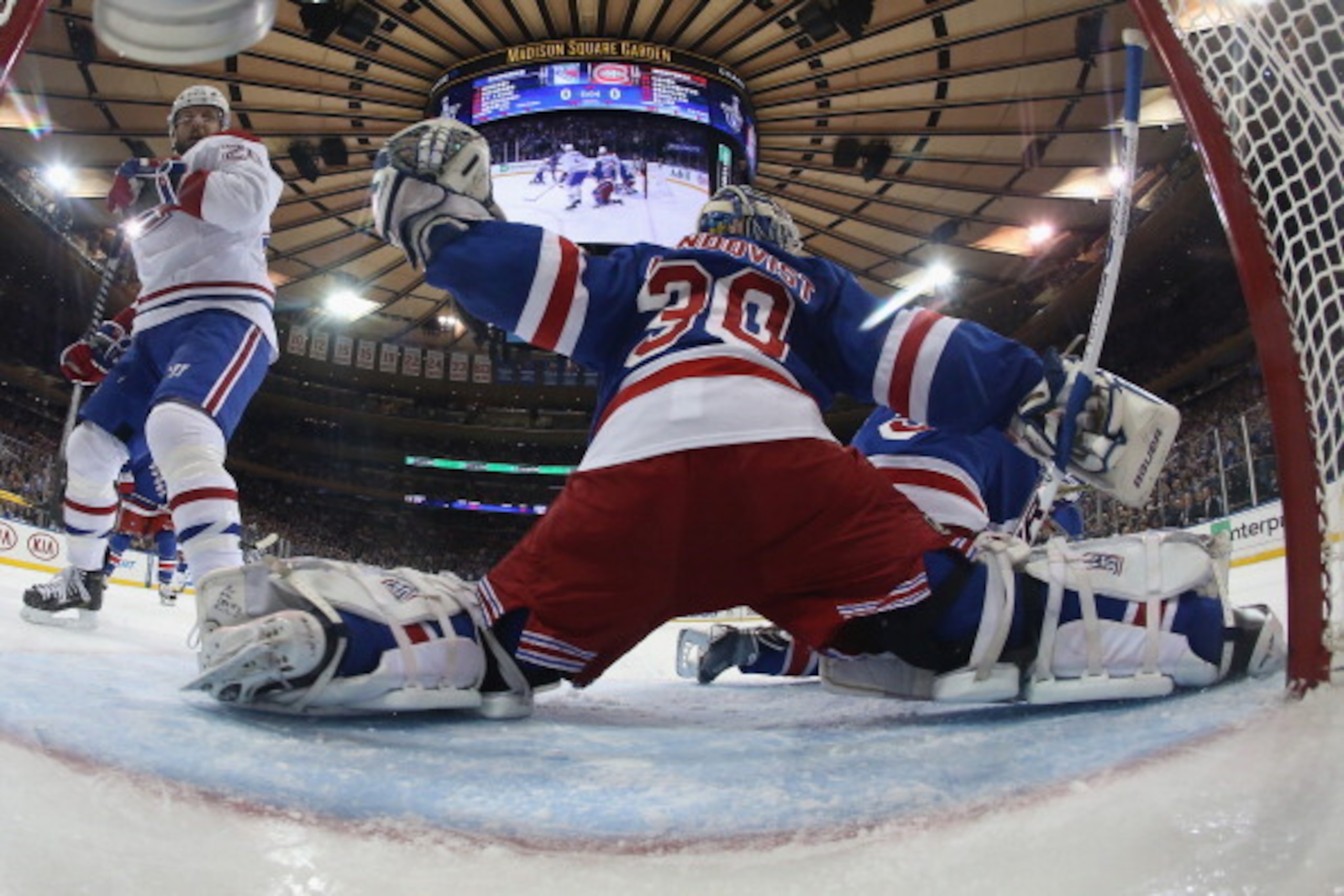
Henrik Lundqvist was the backbone of the team's success, as usual, and that's unlikely to change in the upcoming season.
Outlook for 2014-15
It's muddled without question.
The Rangers are downgrading across the board with all of their forward replacements. Tanner Glass and Matthew Lombardi are not as useful as Boyle and Dorsett. Lee Stempniak is not the same caliber of player as Pouliot. And with the buyout of Richards, that means Derick Brassard will be promoted to the second line, leaving an inferior replacement (maybe J.T. Miller, maybe prospect Oscar Lindberg) on a third line that will be unrecognizable to the one that was iced last year.
Ryan Malone, who was bought out by the Lightning in the wake of a cocaine arrest, has a chance to make the team. Should he do so, he will likely find himself on the left side of the third line, bumping Zuccarello to his more comfortable right side, which would send Stempniak to the fourth line and either Glass or Lombardi to the press box.
The Rangers also added free agent Kevin Hayes, a talented player out of Boston College who could be anything between a useful third-line right wing and a prospect who spends the season in the AHL.
Brassard was fantastic on the third line last season, delivering 18 goals and 45 points in 81 games. He was rewarded with a five-year, $25 million contract, a fair deal but one that was made possible by him producing in sheltered minutes while Richards and Stepan faced tougher competition. There may not be a player, outside of Lundqvist, who will have a bigger say in the Rangers' success this season than Brassard on the second line, and, in turn, the production of whoever wins the third-line center job.
And with Stepan likely out for all of October with a fractured leg, Brassard's play will be even more important.
It won't take much for the Rangers to dip into the bottom third in league scoring this season.
| Ryan McDonagh | Dan Girardi | Henrik Lundqvist |
| Marc Staal | Dan Boyle | Cam Talbot |
| John Moore | Kevin Klein | |
| Matt Hunwick, Mike Kostka |
The beauty of a worst-case scenario that sees the Rangers' scoring go dry is they have one of the game's best goaltenders and top defenses that can carry the team into the playoffs.
Quietly, the Rangers' biggest loss this summer was Anton Stralman's decision to sign a five-year, $20 million deal with the Tampa Bay Lightning. The Rangers offset that loss by signing 38-year-old Dan Boyle to a two-year, $8 million contract.
In simpler terms, the Rangers decided to absorb the same cap hit on an older defenseman who is more productive offensively instead of locking up one of the best possession defensemen in the league, although Stralman had just 13 points in 82 games last season. But it's fair to wonder how much Boyle will produce at his advanced age, especially with him no longer quarterbacking a power play that features Joe Thornton, Joe Pavelski, Patrick Marleau and other players who are more offensively gifted than anything the Rangers boast on the man advantage.
Even with the belief that Boyle is an inferior product (at the same price) to Stralman, the Rangers still have one of the better defense corps/goaltending combinations in the NHL.
Ryan McDonagh will be a Norris Trophy finalist one day. While Dan Girardi's decline during the 2013-14 season is worrisome, he's steady enough when playing next to McDonagh. Marc Staal is one of the best second-pairing defensemen in the league and will be fine playing next to Boyle. Kevin Klein brought stability when he arrived from Nashville in the Michael Del Zotto trade and makes a fine bottom pairing with John Moore.
With Lundqvist as the last line of defense, the Rangers could still miss the postseason following a trip to the Stanley Cup Final. After all, before their Cup run, they only finished six points clear of the ninth-place Washington Capitals, one of the many non-playoff teams that greatly improved this summer while the Rangers took a step back.
Rangers fans may not want to hear it, but their favorite team has a lot in common with the 2013 New Jersey Devils, who missed the playoffs after an unexpected trip to the Stanley Cup Final in 2012. Both the Rangers and Devils lost to the Kings and did so with first-year coaches. Both the Rangers and Devils lost key players that summer (Zach Parise bolted for Minnesota).
The big difference between those teams is the goaltenders; while the Devils were starting a declining Martin Brodeur, the Rangers have Lundqvist in his prime.
If the Rangers can overcome their hangover, it will be because Lundqvist and his endorsement deal with Advil.
All statistics via NHL.com. All contract information via CapGeek.com.
Dave Lozo covers the NHL for Bleacher Report. You can follow him on Twitter: @DaveLozo.


.jpg?w=2560 "NFL House in Paris Closes for Protests")
.jpg?w=2560 "Trevon Diggs Cut by Seahawks")