

Will Miguel Cabrera Suffer Similar Post-30 Downfall as Albert Pujols?
In oh-so-many ways, Miguel Cabrera's career has mirrored that of Albert Pujols.
For one, Pujols is right-handed; so is Cabrera. Pujols was a highly rated prospect who broke into the major leagues playing third base and outfield before settling in at first base; ditto, Cabrera. And Pujols enjoyed immediate, overwhelming success in his first full season—at the tender age of 21—triggering a decade of incredible, consistent production in which he hit for both league-leading average and power.
Guess what? Same goes for Cabrera.
TOP NEWS

The Worst Player on Every Team of 2026 Season 😞

Playoff Predictions Entering Last Week 🔮
.png?w=2560 "MLB Power Rankings")
New Rankings with 1 Week Left 📊
These two will forever be linked as the best hitters of their generation, thanks to all of the above, as well as the overlapping of the first halves of their multiple-MVP-winning, eventual Hall of Fame careers.

But now that Cabrera has turned 30 (last April) and is starting the second act, will he continue to mirror Pujols?
That, in fact, wouldn't be such a good thing.
Pujols, who turned 34 earlier in January, started to dip just after he hit the big three-oh. As a 31-year-old in 2011, he got off to a slow start (.755 OPS through May) and then fractured his wrist on a collision with a runner at first base that (somehow only) cost him about two weeks in late June into early July.
Pujols' production picked up from there, and he ended up hitting .299/.366/.541 overall, fantastic numbers by just about any measure—except Pujols'. To wit, that was the first time in his career that Pujols' average dropped below .312, the first time that his on-base percentage fell below .394 and the first time that his slugging percentage slipped under .561.
In other words, it took until his 11th season at age 31 for Pujols to look human (ignoring that whole superhuman recovery time).
From there, the decline was on in full force.
Of course, there are factors other than age that contributed to Pujols' drop-off. He left the St. Louis Cardinals—the only organization he'd known—and signed with the Los Angeles Angels as a free agent in the winter of 2011, switching teams and leagues for the first time in his career.
Pujols also had knee surgery last offseason and continued to battle chronic foot pain that wound up costing him the final two months of the 2013 season and only now feels back to normal.
Here's where it should be pointed out that despite all those recent injury issues to his lower half, Pujols has a much different body type from Cabrera. Both are preternatural hitters with big, strong frames, but Cabrera is definitely heftier and huskier. That generally doesn't age as well or as gracefully.
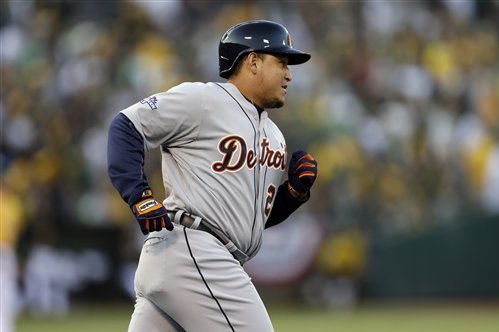
To this point, though, that hasn't hindered the Detroit Tigers star. After all, he's coming off back-to-back MVP seasons that were arguably the best two campaigns of his career.
Still, Cabrera began dealing with lower-body ailments—same as Pujols—midway through last season. Between problems with his hip, his abdomen and his groin, this was the first time in Cabrera's 11-year career that he has endured any real injury issues over an extended period, and his performance clearly suffered for it.
In particular, Cabrera was not close to himself over the final month of the 2013 regular season and throughout the playoffs while battling through a groin tear that eventually required surgery. Across September and October, he managed exactly four extra-base hits over 32 games.
| 2001 | 161 | N/A |
| 2002 | 157 | N/A |
| 2003 | 157 | 87* |
| 2004 | 154 | 160 |
| 2005 | 161 | 158 |
| 2006 | 143 | 158 |
| 2007 | 158 | 157 |
| 2008 | 148 | 160 |
| 2009 | 160 | 160 |
| 2010 | 159 | 150 |
| 2011 | 147 | 161 |
| 2012 | 154 | 161 |
| 2013 | 99 | 148 |
| *Debuted June 20 |
While Cabrera now says he's ready to go, per Bob Wojnowski of The Detroit News, his health and production in 2014—his age-31 season—will be very much worth keeping tabs on to see if there's any residual effect.
Remember, the first noticeable drop-off happened for Pujols at the exact stage of his career at which Cabrera is right now: at the age of 31 with 10 full seasons under his belt and fresh off an injury.
Just because Cabrera's career has mirrored Pujols' in a number of ways to this point, does that mean Cabrera is destined for a similar steep post-30 decline? Certainly not.
Then again, injuries and age do catch up with even the best of the best, so a fully healthy 2014 season from Cabrera would go a long way toward avoiding what could otherwise become very real concerns, especially after what he went through late last year.
The fact that Cabrera, who has spent the past two seasons at third base, is switching back across the diamond to first base, a less-demanding position, could help his cause going forward. That's the plan, according to Tigers general manager Dave Dombrowski, via Jason Beck of MLB.com:
If you think the Pujols-Cabrera comparison is over, well, there's still one more eerie equivalent. Cabrera's current contract concludes after 2015, at which point he'll have one of the all-time great resumes of any player in baseball history, and because of that, he'll be able to command a massive multi-year, nine-figure deal while entering his age-33 season and the decline phase of his career.
Funny, but almost that exact same situation applied to Pujols after 2011. (Pujols, though, was turning 32, a year younger than Cabrera will be.)
Despite intense pressure to pay whatever it took to keep their biggest star—the best player in the entire sport at the time—the Cardinals, of course, wound up not re-signing Pujols, who got $240 million over 10 years from the Angels. Upon reflection, St. Louis actually has been better off for it.
There's still time for the Tigers to decide on Cabrera's future, but if the outcome from Pujols and the Cardinals provides any guidance, the Tigers will want to take a good, long look—in the mirror.
To talk baseball or fantasy baseball, check in with me on Twitter: @JayCat11.
.jpg?w=2560 "Rams troll Jameis, Giants on social media")

.jpg?w=2560 "WWE Raw Live Grades 🔠")
.png?w=2560 "Davante's MONSTER MNF 🤯")

.png?w=2560 "McVay's Funny Travel Quote 🤣")