

The 10 Best Pitchers from Japan in MLB History
Regardless of which lucky team ends up signing Masahiro Tanaka in the coming weeks, the prized starter will become the 60th Japanese-born MLB player once his first pitch whizzes toward the strike zone in April.
How he fares at baseball's highest level is uncertain. His supreme statistics last season—24-0 with a 1.27 ERA for the Rakuten Golden Eagles of Nippon Professional Baseball (NPB)—would seem to indicate that he is on the threshold of MLB stardom.
But statistics accumulated on the other side of the Pacific aren't always an accurate predictor of MLB performances. Daisuke Matsuzaka went 17-5 with a 2.13 ERA in his final season for NPB's Seibu Lions, but he could only recreate such success for one season for the Boston Red Sox during an underwhelming career.
Hideo Nomo, on the other hand, proved his dominance for NPB's Kintetsu Buffaloes would not be lost in translation for an MLB club. Nomo struck out more than 700 batters over the course of his first three seasons with the Los Angeles Dodgers in the mid '90s and also tossed two no-hitters.
In preparation for Tanaka's arrival, here is a list of the best Japanese pitchers to play in the MLB. The list is liable to change in the coming years, as half of it is comprised of active players. Only performance in the MLB was considered in the rankings, and starters were valued higher than relievers. Other factors were postseason success, personal awards and overall influence on the MLB's increasingly global brand.
As for Tanaka, we can only wait and see if he climbs this list during his career and how high he ultimately rises.
Honorable Mentions
1 of 11
Shigetoshi Hasegawa
Shiggy leads all Japanese-born players with 517 career appearances. He was a key member of the bullpen for both the Los Angeles Angels and the Seattle Mariners. His best season came in 2003, when he served as Seattle's closer over the second half of the season and picked up 16 saves while pitching to a 1.48 ERA.
Hideki Okajima
Given his bizarre no-look delivery, how Okajima's pitches even reached their intended targets is a mystery. Yet the lefty reliever enjoyed three overpowering seasons as the Red Sox's setup man and picked up a World Series ring in the process.
Akinori Otsuka
Although he only played in four seasons for the Padres and Rangers, Otsuka claims the third-best ERA amongst Japanese-born pitchers (2.44) and he saved 32 games for Texas in 2006. He also won a World Baseball Classic title in 2006 as the closer for Japan's championship squad.
10. Tomo Ohka
2 of 11
Tomo Ohka was never a truly dominant pitcher, as his career 1.39 WHIP can attest to. But he was one of the longest-tenured Japanese-born players to compete in the MLB. Among pitchers, only Hideo Nomo's 12 seasons top Ohka's 10, and Ohka's 178 starts place him third in the same cohort.
Ohka's best effort came in his 2002 campaign. Pitching for the Montreal Expos, he picked up 13 wins and was seventh in the National League with an ERA+ of 134.
Ohka might have secured a higher ranking if he'd been able to bolster his resume with some October success. However, he was usually stuck on mediocre or poor teams, and he never logged a postseason inning.
9. Masanori Murakami
3 of 11Masanori Murakami only pitched in two seasons for the San Francisco Giants in the 1960s. However, he was effective in his limited playing time, finishing with a 3.43 ERA over his 54 career appearances. He struck out 100 batters in 89.1 innings for an impressive 10.1 K's per nine innings.
Murakami's import, though, is on account of the groundbreaking nature of his career. By joining the Giants in 1964, he became the first Japanese player to compete in the MLB. He was so successful in the U.S. that San Francisco tried to extend his American career beyond the original agreement. After two seasons, however, he returned to pitching for his original team, the Nankai Hawks of NPB.
It would be several decades before another Japanese player would join an MLB team, but these days, Japanese players taking their careers across oceans to play American baseball is a yearly occurrence. They have Murakami to thank for initiating such a movement.

8. Kazuhiro Sasaki
4 of 11
Kazuhiro Sasaki picked up a Rookie of the Year Award in 2000 when he saved 37 games for the Seattle Mariners in his first season in the MLB. A year later, he saved 45 more games as a member of a record-breaking Mariners team that finished with 116 wins.
His rookie record of 37 saves would last until 2010, and by the time he retired after the 2004 season, Sasaki had accumulated 129 career saves, the most by far for a Japanese-born player. He also made two All-Star teams.
Sasaki's legacy probably would have been significantly improved if that 2001 Seattle team hadn't flamed out in the American League Championship Series against the New York Yankees. If he'd been able to help the Mariners win their first World Series championship, he'd probably jump a few spots in these rankings.
7. Daisuke Matsuzaka
5 of 11
Daisuke Matsuzaka became the center of the baseball world in the 2006 offseason. His domination in the Japan leagues and wild speculation about his supposedly unhittable pitch—the gyro ball—created a wave of excitement surrounding his transition to the MLB. He secured mega-agent Scott Boras to represent him and extracted over $100 million from the Red Sox when including their $51 million bid just to have the chance to sign him.
But Matsuzaka never really lived up to his high expectations. His career ERA+ of 100 describes him as an average pitcher, and his repertoire on the mound has regressed to glorified batting practice in recent years.
Still, Matsuzaka struck out over 200 batters and won a World Series for the 2007 Red Sox. He also finished fourth in Cy Young voting the following year after going 18-3 with a 2.90 ERA. He's stayed around long enough to place third amongst Japanese-born players in wins (53) and strikeouts (642) and could conceivably add to those totals in 2014.
6. Takashi Saito
6 of 11
Takashi Saito leads all MLB players from Japan with an impressive career ERA of 2.34. He is also second in career games with 338, making his stingy statistics all the more impressive.
Saito never started a game and played a variety of roles coming out of the bullpen. He appeared in 72 games for the Dodgers in his 2006 rookie season and finished eighth in Cy Young voting after striking out 107 batters in 78 innings.
The following year, Saito served as the closer for Los Angeles, saving 39 games while logging a minute 1.40 ERA. The performance earned him a spot on the 2007 NL All-Star team.
Saito sports a 1.69 ERA over 10 postseason appearances with four different clubs. He proved to be remarkably durable, pitching in 30 games with an ERA+ of 197 at 41 years old for the Brewers in 2011.
5. Hisashi Iwakuma
7 of 11
Hisashi Iwakuma has only pitched in the bigs for two seasons, but his excellent 2013 showing has him shooting up these rankings. Last season, he led all American League pitchers in WAR (7.0) and finished with the sixth-best ERA+ at 138. He finished third in Cy Young voting.
Despite Seattle's feeble offense, which finished last in the AL in average and 12th in runs scored, Iwakuma still managed to salvage 14 wins. With the Mariners' revamped offense that now features boppers Robinson Cano and Corey Hart in the heart of the lineup, Iwakuma could threaten 20 wins in 2014.
In fact, the Mariners' bright outlook for 2014 could push them into the postseason, where the duo of Iwakuma and ace Felix Hernandez would give the M's a chance against any foe.
Iwakuma is 32, which isn't that old for a player whose fellow countrymen often don't start their MLB careers until their mid-30s. If he can avoid a letdown in the next several years, Iwakuma may retire as one of the three best Japanese pitchers to play in the MLB.
4. Koji Uehara
8 of 11
Koji Uehara's career statistics don't really distinguish him from his compatriots that preceded him. He and fellow relievers Saito and Otsuka all have career ERAs within a tenth of a run of each other. Uehara has the fewest appearances and has less saves than the other two.
But a closer examination of his career reveals his ability. His career K/BB ratio of 8.74 more than doubles that of anyone else on this list. Over 175 games in the past three seasons, Uehara has a 250 ERA+ and a 0.64 WHIP.
Most important for his high ranking, though, is his 2013 performance for the Red Sox. He took over the closer role in late June and responded by allowing only two earned runs for the rest of the season and finishing with 21 saves. His mastery helped Boston win the AL East and earned him Cy Young and even MVP votes.
Little changed for Uehara in the playoffs. In 13.2 innings, he allowed a single earned run and saved seven games. The image of him bouncing off the mound, fists held high, after recording the final out in the Red Sox's first World Series-clinching victory at home in nearly a century, has its place in Boston sports lore.
3. Hiroki Kuroda
9 of 11
Hiroki Kuroda has quietly had an effective career as a starter. Despite finding little luck in the win-loss category, he's made at least 31 starts in five of his six MLB seasons, and he's never finished with an ERA north of 3.76. Among active pitchers, his career ERA of 3.40 puts him ahead of the likes of Justin Verlander, Tim Hudson, Cliff Lee, CC Sabathia, Max Scherzer, Jon Lester and Chris Carpenter.
Although he will turn 39 in February, Kuroda has exhibited the durability of a much younger pitcher. He has thrown 623 innings the past three seasons and in the process recorded his three best seasons of ERA+.
Even though he's only been pitching in the MLB since 2008, Kuroda places second among Japanese-born players in starts, innings pitched, wins and strikeouts. Several more seasons could see him break personal benchmarks, such as 100 wins, 1,500 innings and 1,000 strikeouts.
Kuroda has pitched in three League Championship Series but has never made the World Series. As a member of the Yankees for at least one more season, he has a decent opportunity for October glory, but that window is fast closing. Ring or not, though, Kuroda will go down as one of the best Japanese pitchers in the history of the sport.
2. Yu Darvish
10 of 11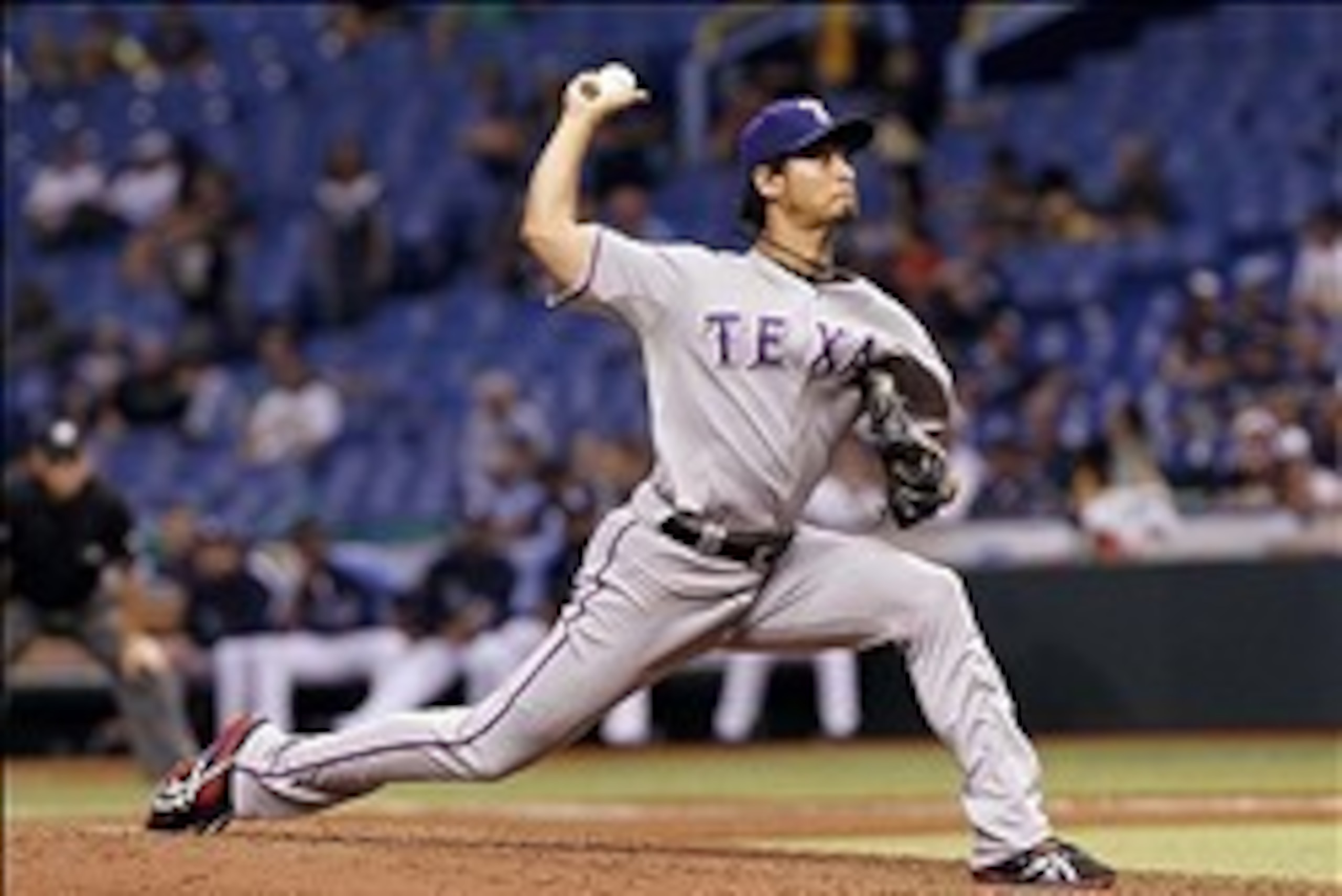
Yu Darvish has had perhaps the most auspicious start to his career of any pitcher from Japan. Whereas the majority of Japanese pitchers have small frames and begin their MLB contributions at the tail end of their careers, Darvish is still only 27 and stands 6'5".
In only two seasons, he has made two All-Star teams, finished in the top 10 of Cy Young voting twice—including a second-place finish in 2013—and struck out nearly 500 batters.
His 277 K's in 2013 were the most by anyone in baseball since Randy Johnson whiffed 290 in 2004 and were more than any other Japanese-born pitcher every accumulated in a single season.
Darvish sports the body to withstand a heavy workload. Several more impactful seasons will see him climb the strikeout ranks of pitchers not only from Japan, but anywhere else as well.
Darvish twice missed throwing a no-hitter in 2013, including being an out away from a perfect game against the Houston Astros in April. His plus fastball and wide repertoire of off-speed pitches make him a consistent threat to hold a team hitless.
It would be no surprise if, by the time Darvish retires from MLB baseball, he has claimed the title of the greatest Japanese pitcher to ever play in the U.S.
1. Hideo Nomo
11 of 11
There's not much debate about who's the best pitcher from Japan in MLB history. No other Japanese-born pitcher is within 100 starts, 50 wins or 1,000 strikeouts of Hideo Nomo's cumulative career totals.
Nomo also has a collection of single-season achievements. He led the National League with 236 strikeouts in his rookie season during 1995, which helped him earn Rookie of the Year honors. The following season, he finished fourth in Cy Young voting and threw a no-hitter against the Colorado Rockies at Coors Field, a site known to be a hitter's paradise.
Nomo bounced around the league for several years before returning to prominence in 2001 for the Red Sox. He again led the league in strikeouts with 220—becoming one of only a handful of pitchers to lead both the AL and NL in strikeouts—and threw his second no-hitter against the Baltimore Orioles.
Nomo was even a serviceable batter in his National League days, cracking four home runs over the course of his career.
After 12 seasons in the bigs—the most ever by a Japanese-born player—Nomo hung up his cleats. But his successful transition to American baseball helped pave the path for subsequent Japanese players.

.jpg?w=2560 "Mahomes Told Teammate to Leave Meeting")
.jpg?w=2560 "🚨 Week 8 AP Top 25 Poll")
.jpg?w=2560 "Baker Gets Glove From Rays 🧤")

.jpg?w=2560 "NFL investigating Eagles")
.jpg?w=2560 "Updates from EVERY NFL Game 🏈")

.jpg?w=2560 "CFP Bracket After Week 8 🏆")
.jpg?w=2560 "Steelers Roll Saints in Paris")