
MLB Faces Uncertain Next Generation of Aces as 4 Future Hall of Famers Wind Down
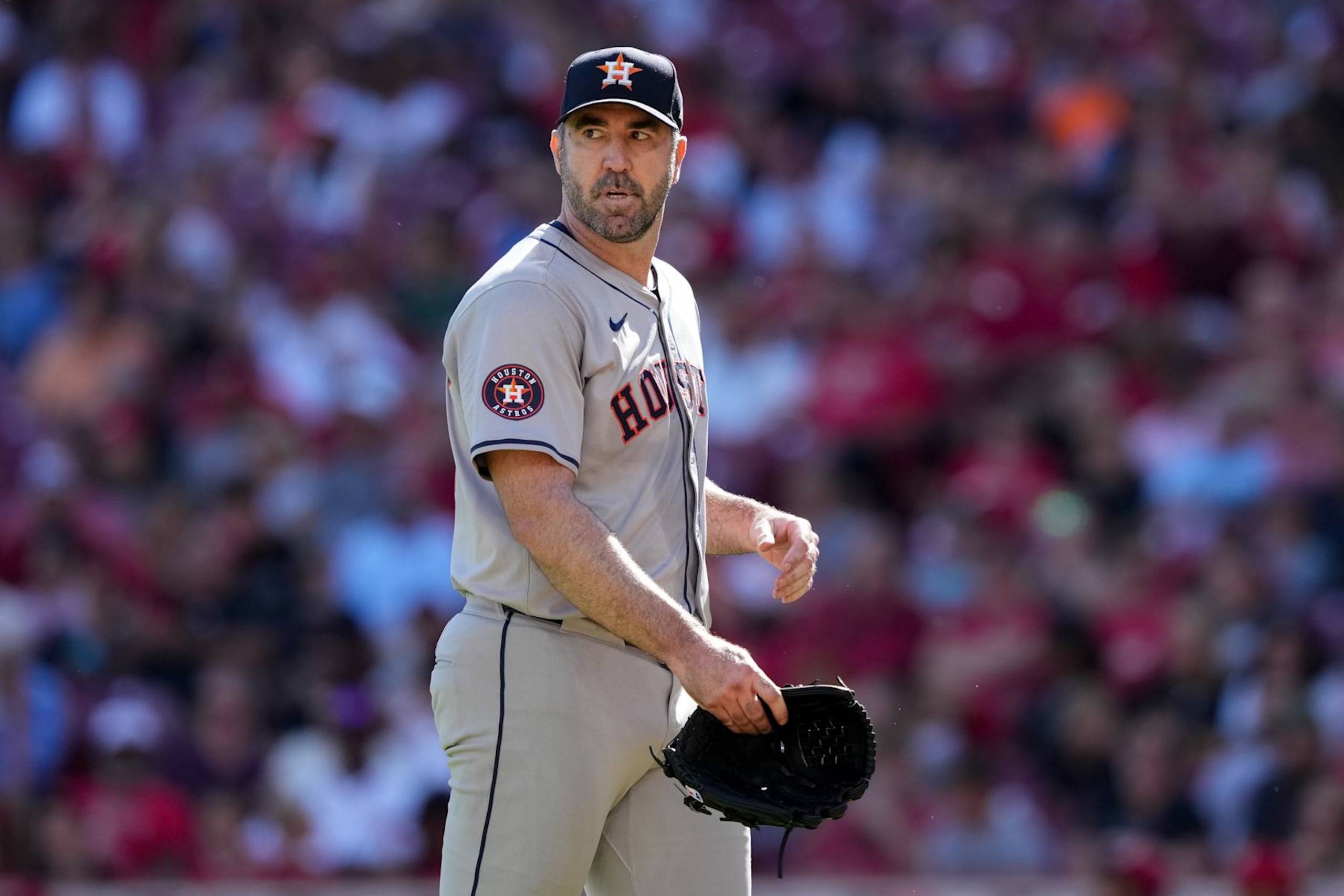
We've come to it at last. The moment when it finally seems like Justin Verlander is washed.
Inevitable, perhaps, but it feels more ominous than it should under the circumstances.
In case anyone needs an update on what Verlander has been up to, it's not pretty. The veteran has given up 19 runs in four starts since coming off the injured list on Aug. 21. He now has a 5.30 ERA, his highest for a season in which he's made at least 10 starts.
TOP NEWS

Realistic MLB Trades That Could Happen In 2026-27 Offseason ✈️
Brewers Stun Padres in Game 2 😧

Players Who Were Worse Than You Think in 2026 ⚾
There are only two full weeks left in the regular season, which is likely to end with the Houston Astros atop the American League West. And with the rest of their rotation on fire, there would seem to be a chance of Verlander not being a part of it come October.
As jarring as that would be, it would feel like a fitting end to a season in which future Hall of Fame pitchers fading from relevance has been a consistent theme.
It's also been a rough one for Clayton Kershaw, Max Scherzer and Jacob deGrom. The first two barely have more combined starts (15) than Verlander (14) has on his own, while deGrom will finally return from his second Tommy John surgery on Friday.
This year won't mark the end of the line for all four of these guys. But it feels like some sort of end, anyway, and it's hard to say with any certainty that their shoes will be filled.
Verlander, Kershaw, Scherzer and deGrom Were the Next Generation
It just feels like ace generations come in waves, doesn't it?
Even if you only go as far back as the 1990s, you can see practically see handoffs happening at various points. Like, for example, from Roger Clemens, Greg Maddux and Tom Glavine to Pedro Martinez and Randy Johnson. And then to Roy Halladay, CC Sabathia and Zack Greinke.
I'm aware of the awkwardness inherent in saying that Verlander, Kershaw, Scherzer and deGrom were the next wave. Verlander debuted in 2005, whereas Kershaw and Scherzer debuted in 2008 and deGrom didn't come along until 2014.
What the four of them undeniably did, however, was own the 2010s.
There were 18 Cy Young Awards handed out between 2011 and 2019, and they won 10 of those. It's a big reason why all four give off future Hall of Fame energy, with only deGrom's candidacy coming with a question mark in place of an exclamation mark.
But there's at least a fair discussion to be had there, if for no other reason than he's been granted GOAT status in the best of times.
Right now, though, the best of times for these guys feels like forever ago. Whereas they once combined for 26.4 fWAR at their peak in 2018, this year their total output is 1.7 fWAR.
The 36-year-old Kershaw's contract with the Los Angeles Dodgers has a player option for 2025, but he's previously talked about retiring if he doesn't feel like he can be an above average pitcher. Verlander, 41, and Scherzer, 40, are both free agents this winter, and only one of them has committed to continue pitching.
As for deGrom, he has three years left on his contract with the Texas Rangers. But he just turned 36 on June 19, and the history of pitchers who've had Tommy John twice isn't inspiring.
This is therefore a good time for one of those handoffs, but there's a problem.
Where Is the Next Generation?
Out of the top 25 starters on the fWAR leaderboard for 2024, only three are 25 or younger. Which would be shocking if it wasn't par for the course.
Since MLB's 30-team era began in 1998, the last six seasons are also the six worst seasons for 25-and-under starters in terms of fWAR. Whereas they did so only once between 1998 and 2021, 25-and-under starters have accounted for under 20 percent of all fWAR produced by starters in each of the last three seasons.
This is most notably a scarcity problem. As recently as 2008, 25-and-under starters accounted for 32.9 percent of all starts. That rate is now at 22.4 percent in 2024.
If you want definitive answers for where all the good young starters have gone, I can't help you. I can only present these three theories:
1. Teams Don't Value High School Pitchers Anymore
In the past, it wasn't uncommon for teams to gobble up high school pitchers early in the draft. An average of 10 prep arms went in the first round between 1998 and 2018.
By contrast, a total of 27 prep pitchers have gone in the first round since 2019. That's 4.5 per year, and it took until the No. 24 pick in this year's draft for a prep arm to finally come off the board. That's a record low.
This equals fewer opportunities for phenoms to shoot through the minors and debut in the majors at, say, 20 or 21. Like, for example, Sabathia, Greinke and Kershaw were able to do.
2. It's the Injuries
If I told you that Tommy John surgery, specifically, was a big problem for young pitchers, you'd probably believe me just based on anecdotal evidence.
It's nonetheless about as bad as you'd think, at least insofar as Jon Roegele's Tommy John database is instructive. It only counts operations reported by the media, but it shows that amateur and minor league pitchers account for more surgeries than major league pitchers.
Of course, there are more amateur and minor league pitchers out there than there are major league pitchers. But it's still far from the best-case scenario here: Pitchers get to the majors first, and then blow out their elbows.
3. Teams Can Now Mass-Produce Pitching Talent
For anyone unfamiliar with the term "Borg," they're Star Trek villains whose gimmick is absorbing the distinctive qualities of individuals into a collective of warrior drones.
Now that I've said that, I can say this: Pitchers are basically Borg now.
Seemingly every pitcher in MLB today has good stuff, particularly where velocity is concerned. It's a team-driven revolution and its success rate only seems to be getting better. Heck, even Aaron Civale and Frankie Montas only needed minor tweaks to start thriving as Milwaukee Brewers.
Granted, teams still need to cultivate young pitching. But in an environment where the youngest, freshest arms aren't necessarily the best bets for good pitching at any given moment, it makes sense that there would be an opportunity vacuum for those arms.
At Least There's Paul Skenes
On the plus side, arguably the best pitcher in MLB right now is a 22-year-old rookie.
Though fWAR doesn't value him as highly, Paul Skenes is only the fourth 22-or-younger pitcher since 2004 to achieve a 5-rWAR season. And since he debuted for the Pittsburgh Pirates on May 11, his 2.10 ERA is better than anyone's.
All this is happening just a year after the Bucs chose Skenes No. 1 overall, so he's almost certainly not a finished product yet. Such a notion only makes it more tempting to imagine his prime being on the level of a Verlander, a Kershaw, a Scherzer or a deGrom.
Other 25-and-under legacy ace candidates include Hunter Greene, who might have the best pure stuff of any starter, and Garrett Crochet, who is striking out 12.8 batters per nine innings. There's also Hunter Brown, who's rocking a 2.31 ERA.
Let's also not forget that the most expensive pitcher in history is likewise still only in his age-25 season: Yoshinobu Yamamoto.
He came to the Los Angeles Dodgers with a sub-2.00 ERA in seven seasons in Japan. A rotator cuff strain cost him about three months, but he still has a 2.34 ERA if you take out his rough opening act in Korea way back on March 21.
Others who deserve name-drops include Tanner Bibee, Bryce Miller, Bryan Woo and Grayson Rodriguez. On the prospect front, there's Jackson Jobe and the newly promoted Kumar Rocker, who may yet live up to the sensational hype he had in his heyday at Vanderbilt.
Granted, simply listing off names of guys who could form MLB's next generation of aces is no guarantee that the formation will actually happen. Past results never guarantee future performance, and these guys barely have past results as it is.
Still, hope will do whenever certainty is lacking. Perhaps it's not the case that there is no bright future for all of ace-dom after Verlander, Kershaw, Scherzer and deGrom.
It may be that it's just not in focus yet.
Stats courtesy of Baseball Reference, FanGraphs and Baseball Savant.



.jpg?w=2560 "NFL investigating 2 referees for separate viral exchanges")
.jpg?w=2560 "OBJ Calls Out Giants 😳")


.jpg?w=2560 "Tyreek makes another cryptic post amid Chiefs rumors")
.jpg?w=2560 "Ward Nearly Walks Out of Presser 😳")