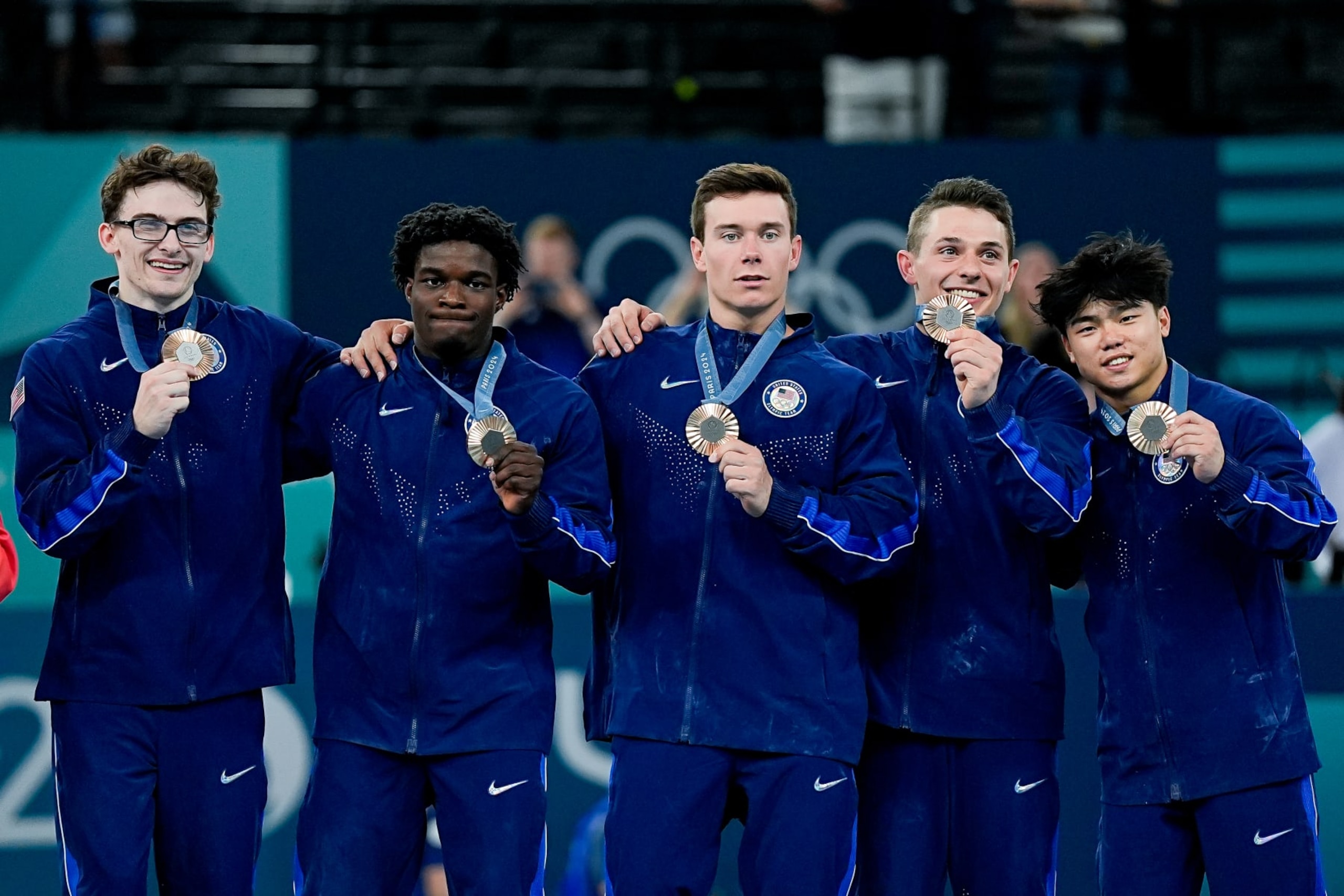

US Men's Gymnastics Team's First Medal Since 2008 Shows Culture Change Is Paying Off
The United States men's gymnastics team won a bronze medal in the team final Monday, its first team Olympic medal since 2008 and the product of a major culture change in the sport.
From Paul Juda's triumphant vault in the first round to pommel horse specialist Stephen Nedoroscik's 14.866 final routine, and from Brody Malone's redemptive high bar performance after two falls in qualifications to Asher Hong's and Frederick Richard's heroics across four events apiece, the men looked stronger across the board than they have in years, even more so than when they won bronze at the world championships in Antwerp last year.



After the Tokyo Olympics in 2021, where the men's team placed a disappointing fifth, the men's elite program moved to centralize training for the men's team, just as the women's elite program, which has enjoyed considerably more international success over the last two decades, has done since 2000.
For many years, the elite men trained at the U.S. Olympic and Paralympic Training Center (USOPTC) in Colorado Springs. But in December 2022, the men's resident gymnastics program at the USOPTC ended, with most of the gymnasts moving to EVO. They included Malone and Nedoroscik, who are on the Paris team, and Shane Wiskus, one of the traveling alternates for the U.S. team. The head coach of the men's senior elite team at EVO, Syque Caesar, previously held the same job at the USOPTC and moved with his athletes.
The popularity of men's gymnastics in the U.S. is waning. There are only 15 men's gymnastics programs in the NCAA, compared to 81 for women. Only 319 men compete at the college level. Just 12,000 boys compete through USA Gymnastics club programs, compared to the 138,000 girls who do club gymnastics.
And yet, the men's gymnastics team in Paris is one of 14 U.S. teams comprised entirely of NCAA athletes. With the pipeline narrowing for young gymnasts to follow in their footsteps, USA Gymnastics (USAG) and the United States Olympic and Paralympic Committee (USOPC) have worked to incentivize continuing in the sport by funding the training for post-collegiate gymnasts and gymnasts who bypass college who move to Sarasota, Florida, to train at EVO, a gym that serves as the centralized training facility for the men's high-performance program. EVO pays the men to live and train at the gym.
Other national federations, including perennial Olympic powerhouses Japan and China, fund their men's gymnastics teams, and those athletes garner far more name recognition in their home countries than do the U.S. men.
Meanwhile, although women's gymnastics is the most-watched Olympic sport and the U.S. women's program has enjoyed considerable world and Olympic success over the last several decades, the men's elite program has languished in its shadow.
One reason for this disparity is simply that the men weren't winning medals, and the women were. After the Tokyo Olympics, where the men (including Malone, the only Olympic veteran on the Paris squad) placed fifth in the team final because their routines were at a six-point disadvantage to their closest rivals, USAG decided to incentivize difficulty to boost the men's international competitiveness. At domestic meets, bonuses were tacked onto scores to reward routines with more difficult elements. The bonuses were enough to counteract falls or out-of-bounds deductions.
Results were slow at first. The men's team placed fifth at 2022 worlds, considered a disappointment. Nedoroscik's gold medal on pommel horse at 2021 worlds was beginning to look like a fluke. One problem now was that despite the increased difficulty, the men were getting deductions for execution. Gymnastics scores factor in each in separate scores that are then added together for a total score. Execution scores are similar to the old-school perfect 10 system, in which gymnasts are deducted points out of 10 total based on how cleanly they perform a routine.
Prior to the 2023 world championships, the difficulty bonuses were halved, to give athletes a fairer idea of how their routines would score internationally; they were cut again before Olympic Trials this year. Attention focused on execution.
At 2023 worlds, the men won a team bronze, and Frederick Richard, a member of the Paris team, won bronze in the all-around. Khoi Young, an alternate on the Paris team, won two silver individual medals on pommel horse and vault.
That's when they knew they had a real shot at medaling in Paris. And they went for it.
.jpg?w=2560 "Rams Eagles Football")
.jpg?w=2560 "Texans-Mixon Released Football")
.jpg?w=2560 "Grading WWE Raw 🔠")
.jpg?w=2560 "2 NFL Officials Suspended")

.jpg?w=2560 "Mahomes' Wife Trolls Kubiak 💀")

