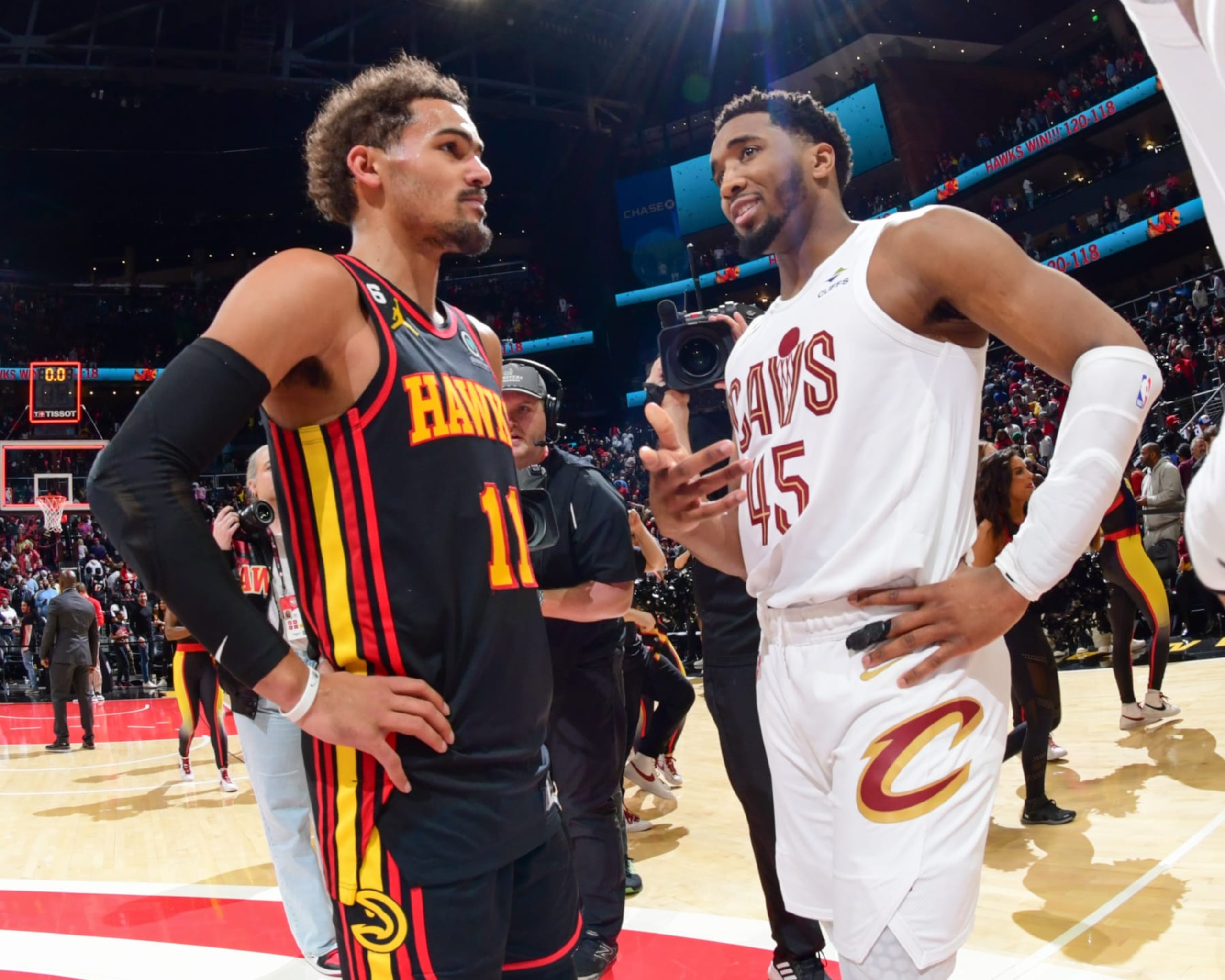

Are Lakers Better Targeting Trae Young or Donovan Mitchell for Eventual Trade?

The Los Angeles Lakers may attempt to add a third star alongside Anthony Davis and LeBron James by the start of next season.
And no, it isn't Zach LaVine who they have in their sights. They're aiming higher.
According to ESPN's Dave McMenamin, the Lakers "have discussed internally the possibility of packaging three picks, along with players they already have on their books, to pursue a bona fide star, such as Donovan Mitchell of the Cleveland Cavaliers or Trae Young of the Atlanta Hawks."
Cobbling together three first-rounders would force L.A. to wait until the summer before they pursue Mitchell or Young. And that makes sense—not just because the Lakers' best offer improves on draft night, but because neither star appears gettable at the moment.
Still, L.A. is operating on the timeline of a 39-year-old LeBron. Waiting on a glitzier pursuit threatens to squander another year of All-NBA-caliber play from him as well as AD. Can the Lakers afford to stand pat for the sake of the bigger picture? What does their best, most aggressive trade package look like right now? How about over the summer?
And who, in theory, is the better fit beside LeBron and AD: Mitchell or Young?
Let's explore!
Donovan Mitchell's Fit in L.A.
1 of 5
Donovan Mitchell's impending 2025 free agency (player option) will render him less appealing to teams unsure whether he'll re-sign for the long term. The Lakers will not be among them.
Cliche though it's become to note, Los Angeles is a market in which players want to live. The Lakers will have no bones about forking over their best assets for a soon-to-be free agent. Mitchell's contract is actually part of his appeal. He's on the books for roughly $7 million less than Trae Young this season and next, which makes it easier to match salary in prospective deals.
Mitchell also satisfies at least one of the Lakers' two biggest needs: from-scratch shot creation. Almost 66 percent of his made baskets are going unassisted this season, which would easily rank as the largest share among all L.A. rotation players. His off-the-dribble three-point efficiency has admittedly fallen off, dropping to 34.8 percent. But that would still represent a massive upgrade for the Lakers offense.
Nobody on the team attempts even half as many pull-up triples per game as Mitchell. And among the four players hoisting at least one off-the-bounce three a night, not one is knocking them down at a clip better than 32.9 percent.
Whether Mitchell adequately fills Los Angeles' second-biggest void is debatable. The front office has long lusted after another primary initiator. The Lakers clearly want to reach a point in which LeBron isn't the end-all, be-all creator. Though Mitchell has ratcheted up his playmaking complexity, he isn't accustomed to driving offenses with his initiation. He is first and foremost a bucket-getter.
That's fine! Mitchell would still immediately become the second-best passer in the Lakers' rotation. And while his minutes without Darius Garland and Evan Mobley weren't so hot last year, Cleveland's offense ranks inside the 89th percentile of efficiency during Spida's (mega-extended) solo stretches this season.
Trae Young's Fit on the Lakers
2 of 5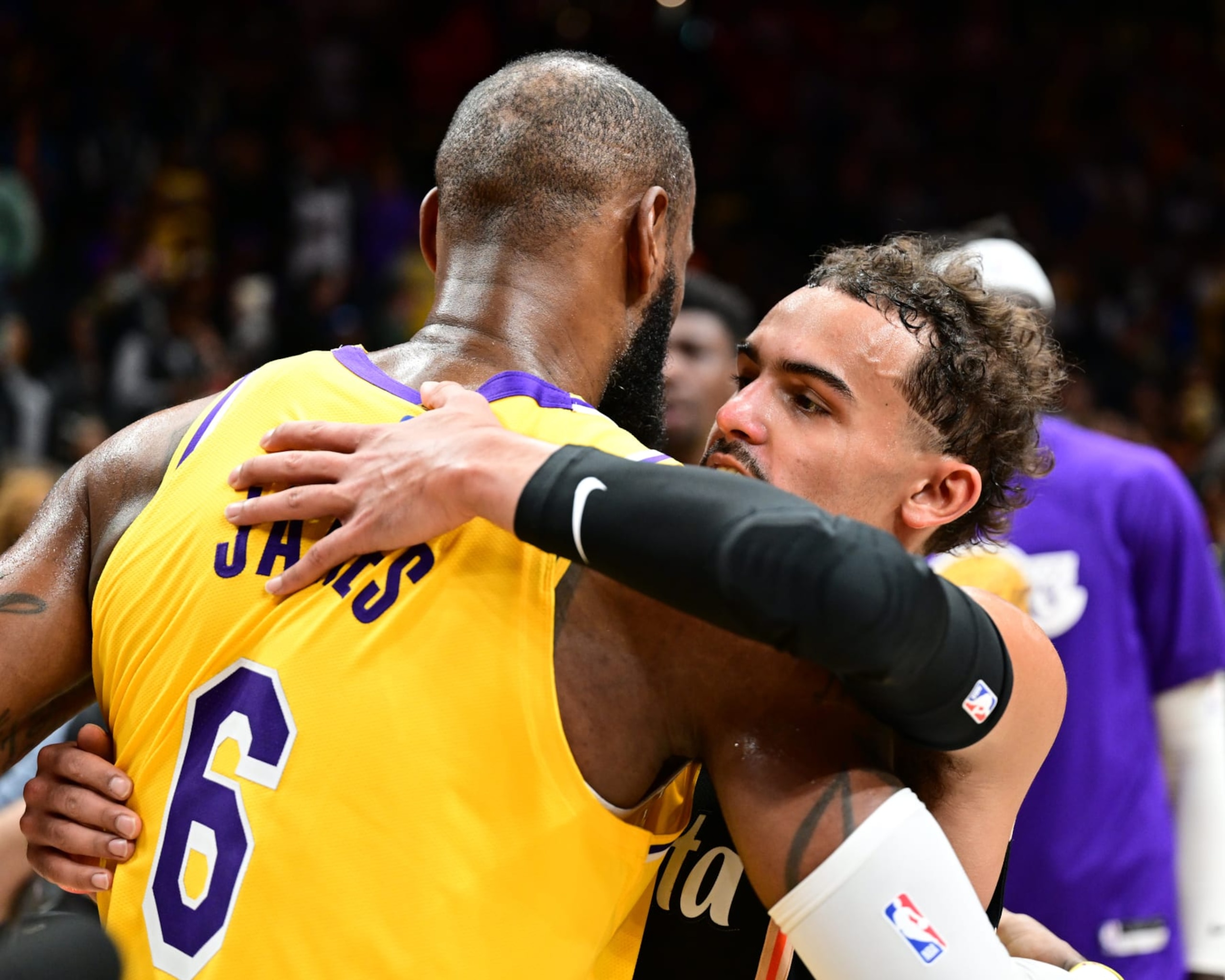
Matching Trae Young's $40-plus-million salary will be more difficult for the Lakers whether a deal materializes ahead of Feb. 8 or over the offseason. It is, however, far from impossible.
L.A. has four mid-end salaries it can use to step-ladder its way to various scenarios: Rui Hachimura (two years, $35.3 million remaining), Austin Reaves (three years, $41.8 million remaining; 2026-27 player option), D'Angelo Russell ($18.7 million player option for 2024-25) and Gabe Vincent (two years, $22.5 million remaining).
Timing of a Young trade will still matter more than a Mitchell deal. The Lakers lose one of their best salary-matchers over the offseason if Russell declines his player option. But Jarred Vanderbilt starts counting for $10.7 million against the books once the league calendar flips. Even if Atlanta and L.A. need to rope in third- and fourth-party facilitators, the logistical challenges are hardly insurmountable.
Prioritizing Young over Mitchell would say a lot about the Lakers' intentions. Young is far more ball-dominant. Over 72 percent of his made baskets are going unassisted—and that's a massive downtick compared to seasons past. Look at the share of Young's buckets that have been self-created:
Integrating that much ball dominance into the fold will be a challenge. But it serves the Lakers' purpose of landing someone who can alleviate the burden placed upon LeBron James.
For all his flaws, Young remains a transcendent passer, at pretty much every level of the floor. He ranks first in assists thrown at the rim and sixth in dimes thrown to corner-three shooters, according to PBP Stats. Luka Dončić is the only other player to place inside the top 10 of both categories. The Lakers almost assuredly wouldn't have to worry about their offense cratering whenever they stagger LeBron and Young—a big freaking deal when it comes to optimizing (and surviving) the regular-season gauntlet.
What Can the Lakers Offer the Hawks and Cavs RIGHT NOW?
3 of 5
First thing's first: Put on your reality-check caps. The Lakers are not among the NBA's most asset-rich teams. They do not have the benefit of dictating engagement terms in negotiations.
Every non-LeBron James and non-Anthony Davis asset must be on the table in prospective talks. That includes Austin Reaves, who McMenamin noted the team has "no desire" to move.
From there, the Lakers' best offer will shift depending on the time of year. Salary-matching will vary, too.
Donovan Mitchell is earning $33.2 million this year and $35.4 million next season. Assuming L.A. remains in the same salary-cap band, it'll need to send out somewhere between $27.5 million (this year to stay under hard cap) and $28.2 million (offseason) to get him.
Trae Young is making $40.1 million this season and $43 million in 2024-25. Assuming once again the Lakers stay in the same salary band, they'll have to send out somewhere between $34.4 million (this year to stay under hard cap) and $34.2 million (offseason).
Here's what an L.A. offer for each player could look like right now:
- For Donovan Mitchell: Jalen Hood-Schifino; Austin Reaves; D'Angelo Russell; 2026 first-round swap; 2028 first-round swap; 2029 first-round pick; 2030 first-round swap
- For Trae Young: Max Christie; Jalen Hood-Schifino; Austin Reaves; D'Angelo Russell; 2026 first-round swap; 2028 first-round swap; 2029 first-round pick; 2030 first-round swap
Rui Hachimura could be subbed in for Russell if Atlanta or Cleveland isn't angling for more immediate salary relief. Christie could be worked into the Cavaliers deal, as well.
Any present-day permutation is a modest offer—at best. Mitchell or Young could demand a trade to the Lakers, specifically, and these packages would likely still get beat by other suitors. That might change over the summer.
Speaking of which...



What Can the Lakers Offer Atlanta and Cleveland OVER THE SUMMER?
4 of 5
The New Orleans Pelicans own the Lakers' 2024 first with the right to defer until 2025. Once they make the call, L.A. can send out the remaining asset to Atlanta or Cleveland. (Note: If the Pelicans defer until 2025, the Lakers would need to move their 2024 first after making the selection.)
Here's what an offer could look like for each star after this season:
- For Donovan Mitchell: Jalen Hood-Schifino; Maxwell Lewis; Austin Reaves; one of Rui Hachimura, D'Angelo Russell (player option must be exercised) or Jarred Vanderbilt; 2024 or 2025 first-round pick; 2026 first-round swap; 2028 first-round swap; 2029 first-round pick; 2030 first-round swap; 2031 first-round pick
- For Trae Young: Rui Hachimura or D'Angelo Russell (player option must be exercised); Austin Reaves; Jarred Vanderbilt; 2024 or 2025 first-round pick; 2026 first-round swap; 2028 first-round swap; 2029 first-round pick; 2030 first-round swap; 2031 first-round pick
These don't have to be the exact terms. Gabe Vincent can be worked into either scenario. Maybe L.A. gets away with excluding Reaves. Perhaps it's able to protect one or both of its future picks.
Regardless, the overarching point stands: The Lakers' best offers for Mitchell, Young and any other star look much better over the summer, when they can trade three firsts and three swaps as opposed to one first and three swaps.
Who's the Better Third Star for the Lakers?
5 of 5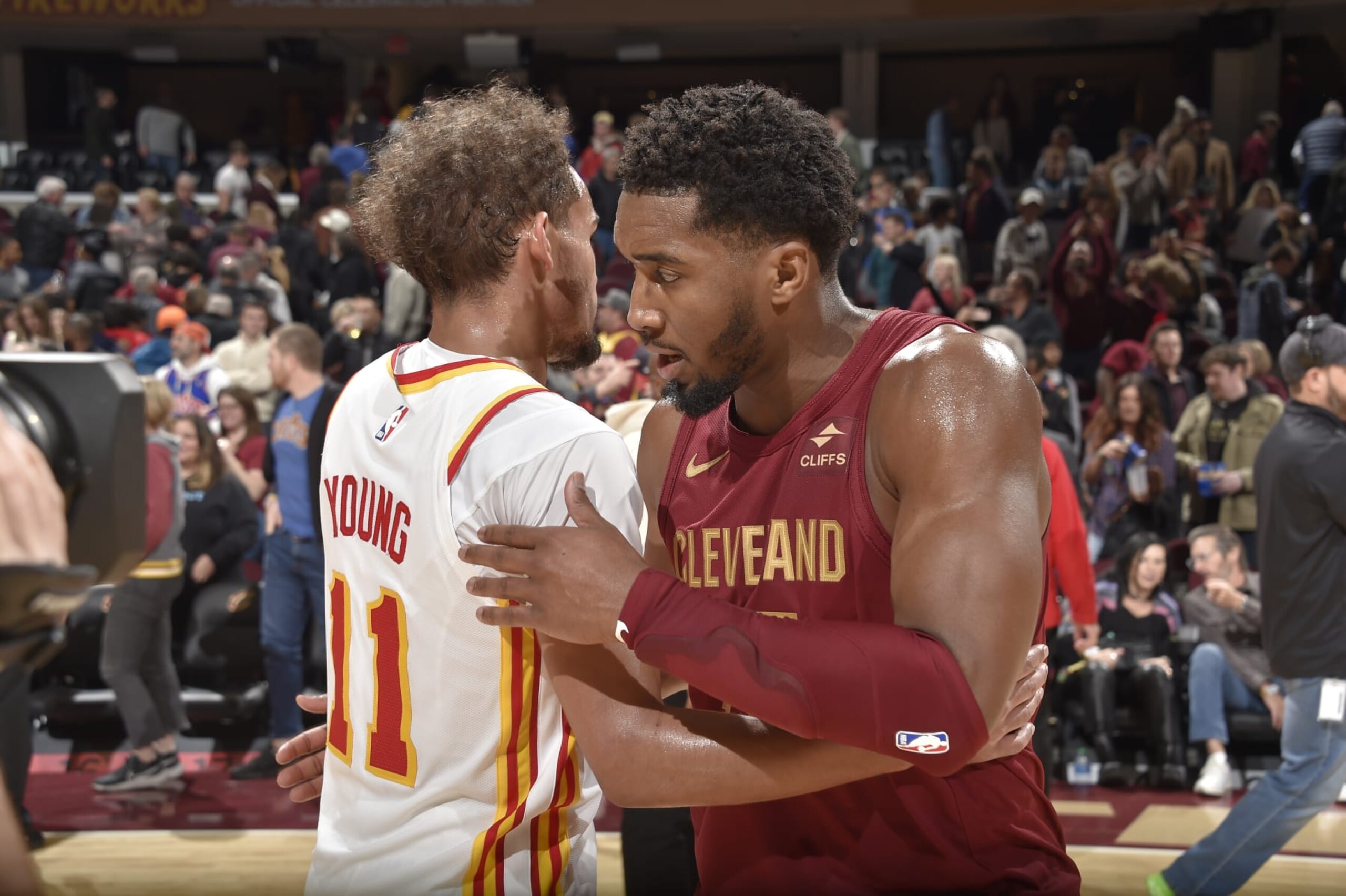
Let's go ahead and assume both Mitchell and Young are or become available. The better fit for the Lakers is...
Donovan Mitchell.
Targeting someone with more experience working off the ball who can also weaponize the offense entirely on his own is the better call by a comfortable margin. Young will no doubt lessen the workload upon LeBron James' shoulders, but the functional adjustment period stands to last a lot longer.
Mitchell, 27, is slightly older. The Lakers might prefer a 25-year-old Young's timeline when looking at the bigger picture and the long-term draft equity they're shipping out. But Mitchell may prove more gettable in the short term. His salary is easier to match no matter when L.A. deals for him, and his proximity to free agency (2025 for him; 2026 for Young) may curtail offers from other admirers and increase the appeal of the Lakers' top-shelf packages.
Granted, Young's salary and ball dominance could prove prohibitive on the larger trade market. It's not outside the realm of possibility that he nets the Hawks less than Mitchell gets the Cavs.
But to what end? How much less, exactly, could Young fetch? Would the Lakers get to spare Austin Reaves? A first-round pick? That's significant. If we're talking about preserving Jalen Hood-Schifino, some first-round protections, Jarred Vanderbilt or second-rounders, though, the stakes are too important for the Lakers to quibble over the marginal.
Both stars would seriously elevate Los Angeles' standing in the micro and macro. But if the Lakers are ever put in the (ultra-ultra-ultra unlikely) position of getting to choose, Mitchell is the cleaner fit.
Dan Favale covers the NBA for Bleacher Report. Follow him on Twitter (@danfavale), and subscribe to the Hardwood Knocks podcast, co-hosted by Bleacher Report's Grant Hughes.
Unless otherwise noted, stats courtesy of NBA.com, Basketball Reference, Stathead or Cleaning the Glass. Salary information via Spotrac. Draft-pick obligations via RealGM.
.jpg?w=2560 "Raiders Could Start Mendoza")

.jpg?w=2560 "Rodgers Iced Out on Plane 💎")
.jpg?w=2560 "🚨 Week 8 AP Top 25 Poll")
