Shohei Ohtani officially won his second AL MVP award on Thursday.
He becomes just the second unanimous AL MVP award winner ever.

Ohtani was such a runaway favorite for 2023 AL MVP honors that Vegas sportsbooks stopped taking bets for the award entirely for much of the season before briefly putting him back on the board late in the year.
His odds: -20,000
Put in more straightforward money terms, someone would need to bet $200 in order to win $1 betting on Ohtani to win, and arguably not since Barry Bonds at his peak has a player more clearly been the best in baseball.
The two-way superstar has taken the league by storm with his all-encompassing contributions and unique skill set that makes him one of baseball's elite hitters and elite starting pitchers.
His 2023 ended prematurely, but he still put together the best all-around season of his career just in time to hit the free-agent market, and in the process joined Joe Morgan (1976), Andre Dawson (1987), Robin Yount (1989), Barry Bonds (1992), Alex Rodriguez (2007) and Aaron Judge (2022) as the only players to win MVP in a contract year.
Now the question is, did baseball fans just witness the greatest MVP season in MLB history?
Let's dive in.
Ohtani's Best Season

First things first, let's establish that this season was better than Ohtani's previous AL MVP campaign when he won the award unanimously in 2021.
Here are the offensive numbers:
- 2021: 157 OPS+, .257/.372/.592, 80 XBH (46 HR), 100 RBI, 103 R, 26 SB, 4.9 WAR
- 2023: 184 OPS+, .304/.412/.654, 78 XBH (44 HR), 95 RBI, 102 R, 20 SB, 6.0 WAR
Here are the pitching numbers:
- 2021: 23 GS, 9-2, 3.18 ERA, 1.09 WHIP, 44 BB, 156 K, 130.1 IP, 4.1 WAR
- 2023: 23 GS, 10-5, 3.14 ERA, 1.06 WHIP, 55 BB, 167 K, 132.0 IP, 4.0 WAR
With his work on the mound essentially amounting to a push, his far superior offensive numbers make his 2023 performance the better season by far, and he actually led the American League in home runs, on-base percentage, slugging, OPS+ and total bases.
The fact that he led the league in home runs without playing after Sept. 3 speaks to just what a dominant offensive season he was having before he was shut down with elbow and oblique injuries.
A higher strikeout rate and a career-best .184 opponents' batting average is also ammunition enough to also say his 2023 pitching season was superior to his 2021 performance on the mound.
It can be definitively said that Ohtani's 2023 season was the best of his two MVP campaigns. Now let's open up the conversation to some other recent standouts.
Best of the Modern Era?
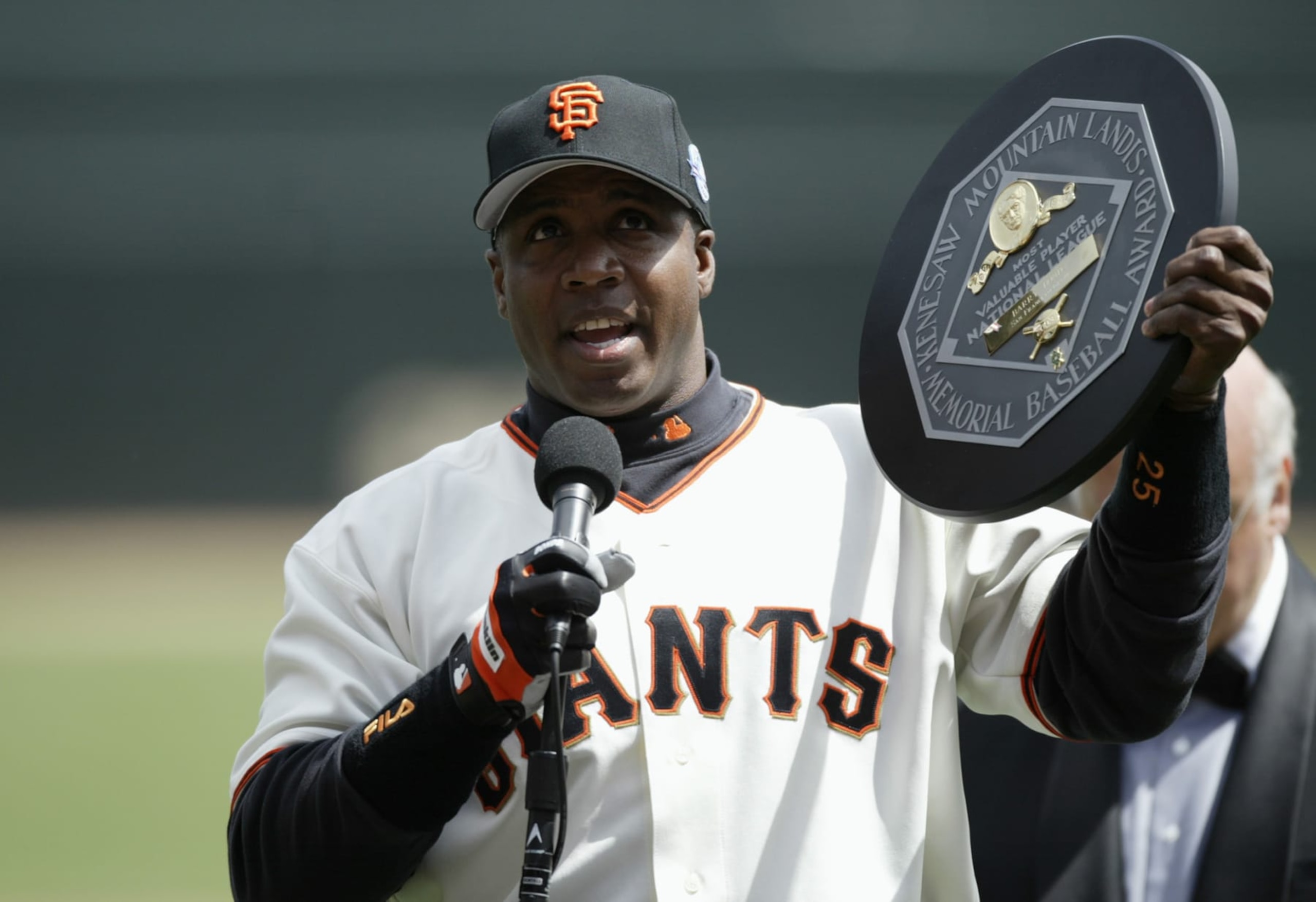
Right around this time last year, Will Leitch of MLB.com underwent the massive project of ranking every MVP winner in baseball history.
His choice for the No. 1 spot was Barry Bonds in 2001.
That was the season when he set the single-season MLB records for home runs (73) and slugging percentage (.863) while posting a 259 OPS+ and a career-high 11.9 WAR, kicking off a run of four straight NL MVP wins.
It's hard to argue with the sheer dominance of that performance, and Bonds also checked in at No. 3 in the rankings for his 2004 season when he tallied 232 walks (120 intentional) and an absurd .609 on-base percentage with opposing teams choosing to simply not let him beat them.
It's interesting to note that Bonds also failed to carry his team to the playoffs in each of those seasons, which will be an obvious point of contention for those who feel Ohtani's performance is watered down by playing for a non-contender.
A few other non-Bonds seasons that are worthy of discussion: Cal Ripken Jr. (1991), Albert Pujols (2009), Miguel Cabrera (2012), Mike Trout (2016) Aaron Judge (2022).
Ripken revolutionized the shortstop position, and 1991 was the best season of his career as he hit .323/.374/.566 for a 162 OPS+ with 46 doubles, 34 home runs, 114 RBI and while leading the AL in offensive WAR (9.2), defensive WAR (3.5) en route to a career-high 11.5-WAR season. He may not have been a two-way player, but his combination of offensive and defensive skills was unmatched across baseball.
Pujols won three NL MVP awards and finished in the top 10 in voting every year over the first 11 seasons of his career. He was the best hitter of his era at his peak, and he was very much at that peak in 2009 when he hit .327/.443/.658 with 45 doubles, 47 home runs, 135 RBI and more walks (115) than strikeouts (64) while posting a career-high 9.7 WAR.
Cabrera won Triple Crown in 2012 but arguably had better all-around seasons at other points in his career. Trout had the best of his three MVP seasons in 2016, and Judge captivated the sport with his 62-homer season last year.
Still, none of these seasons quite stack up to the all-encompassing impact that Ohtani provides, and the steroid cloud hanging over Bonds makes it difficult to want to crown him as the best of the best in the MVP conversation.
Let's take it back even further.
Best of All-Time?

The MVP award as we know it today began in 1931, with that marking the first year that the Baseball Writers' Association of America voted for the winners.
As a result, peak Babe Ruth during the 1920s is not part of the discussion here. Otherwise, his vaunted 1920 season would be a strong contender for the title of best ever. No player in baseball history had ever hit 30 home runs in a season before Ruth launched 54 homers with an .847 slugging percentage that year and completely reshaped the sport.
Instead, the highest-ranked MVP season on Leitch's list prior to the past 25 years belonged to St. Louis Cardinals ace Bob Gibson, for what many consider to be the greatest pitching season in baseball history in 1968.
The Hall of Famer finished 22-9 with a 1.12 ERA, 0.85 WHIP and 268 strikeouts in 304.2 innings, tossing 28 complete games and 13 shutouts in 34 starts. He also went 2-1 with a 1.67 ERA and 0.82 WHIP in three World Series starts that year, all of which were complete games as well.
The height of the mound was lowered from 15 to 10 inches following that season, and while a dip in offensive production was the biggest reason for the change, Gibson's standout performance is often credited with inspiring the decision.
Gibson was an 11.9-WAR player that season, matching 2001 Bonds in a tie for the third-highest WAR total among MVP winners.
The No. 1 spot on that list belongs to Carl Yastrzemski for his 12.4-WAR season in 1967.
The longtime Boston Red Sox star won the Triple Crown that year while leading the American League in batting average (.326), on-base percentage (.418), slugging (.622), OPS+ (193), hits (189), home runs (44), RBI (121), runs scored (112) and total bases (360).
Hall of Famers Brooks Robinson (7.7) and Al Kaline (7.5) finished second and third in the AL in WAR, meaning Yastrzemski was roughly five wins better than any other player in the league that year.
Also worthy of a mention here is New York Yankees legend Mickey Mantle, who won back-to-back AL MVP awards in 1956 and 1957.
- 1956: 210 OPS+, .353/.464/.705, 52 HR, 130 RBI, 132 R, 11.2 WAR
- 1957: 221 OPS+, .365/.512/.665, 34 HR, 94 RBI, 121 R, 11.3 WAR
One of the most talented players the game has ever seen at his absolute peak.
Still, no one on this list ever impacted the game in quite the same way that Ohtani did during the 2023 season.
He may not have been as good as 2001 Bonds offensively or 1968 Gibson on the mound, but it's fair to say he was 75 percent of both those legendary seasons, and that's something we have never seen before on a baseball field and may never see again.
Even with almost an entire month on the sidelines to close out the year, Ohtani produced the greatest MVP season we have ever seen in 2023, and now he's available to the highest bidder in free agency.
Where he decides to sign will reshape the MLB landscape for years to come, and while he won't pitch in 2024 after undergoing elbow surgery, his offensive production alone will put him among the MVP front-runners again next year.


.jpg?w=2560 "Rodgers Iced Out on Plane 💎")
.jpg?w=2560 "Mahomes Told Teammate to Leave Meeting")
.jpg?w=2560 "🚨 Week 8 AP Top 25 Poll")


.jpg?w=2560 "Raiders Could Start Mendoza")
.jpg?w=2560 "Lamar Being Out Shocked Ravens")