

Biggest Winners and Losers of 2023 NBA Playoffs' 1st Week
Seven days' worth of NBA playoff basketball is in the books, and, well...good lord.
This year's postseason has already featured a little bit of everything, both good and bad, even glorious and icky. Blowouts, crunch-time epics, marquee injuries, stompings and suspensions, comebacks, fake comebacks, 3-of-19 heroicism, possible upsets, permanent-marker chalk, whatever the hell is happening in Atlanta—you name it, this year's playoffs are probably delivering it.
Making it this far into the first round is always clarifying. We not only have a firmer hold on entire series, but the short- and long-term implications of what's happening take a more discernible shape.
This, naturally, means it's time for Bleacher Report's Grant Hughes and Dan Favale to spotlight the biggest winners and losers of the postseason so far.
Emphasis on so far. These selections can change as the playoffs journey on. That's the beauty of postseason basketball. Small-sample takes are equal parts necessary and fungible.
Entering games Sunday, though, these players, coaches and teams have gained or squandered more credibility than anyone—for reasons that go beyond the series score.
Winner: Mike Brown
1 of 10
Through the first two games of their series against the defending champs, the Sacramento Kings outschemed, outworked, outexecuted and outplayed the Golden State Warriors en route to a potential first-round upset* absolutely nobody saw coming.
A defense that stunk all year looked impenetrable, as the Kings brought a level of physicality and grit they never consistently showed during the season. They forced Golden State, practitioners of The Beautiful Game, to play ugly basketball. Stephen Curry had to grind for every inch of space, and in perhaps the most surprising twist of all, it was the young Kings who sped up a veteran group that always found ways to play at its own pace against theoretically superior competition over the past decade.
Brown, a six-year assistant on Steve Kerr's staff, is uniquely positioned to know what bothers the Warriors most. And his ability to get his team to play with shocking force and focus in executing a picture-perfect game plan deserves major kudos. What Brown did in those first two games, whether you want to call it tactical or motivational, bordered on coaching genius.
And if you think the Kings' show-stopping effort is really more about De'Aaron Fox leveling up on the biggest stage or Domantas Sabonis finding ways to survive on defense against an attack that everyone thought could exploit him, well...doesn't some credit for that go to Brown, too?
The Warriors took care of business in Game 3 in San Francisco, where they posted the third-best home mark in the league. But whatever happens in Game 4, the best Golden State can hope for is a 2-2 tie heading back to Sac for Game 5. Framed another way, the unanimous Coach of the Year has the upstart Kings one win away from pushing the seven-time champs to the brink of elimination.
*If that's even the correct term for a No. 3 seed dispatching a No. 6 seed.
—Hughes
Loser: Trae Young
2 of 10
Trae Young's broad ineffectiveness isn't the only reason the Atlanta Hawks have been on the wrong end of one of the first round's most lopsided series. But his wayward shooting, defensive invisibility and failure to galvanize the team like a true leader should can't be overlooked. In order for the Hawks to have a chance against the Boston Celtics, Young had to be the best player on the floor more often than not.
His 32 points in a surprising Game 3 win were an example of Young's ability to fill that role occasionally, but 26.3 percent three-point shooting and 14 turnovers to go with 23 assists for the series just isn't cutting it.
The Hawks tried everything to improve themselves this past season, changing coaches and shaking up the front office in hopes of recapturing the vibe that propelled them to the 2021 Eastern Conference Finals. Young was brilliant during that run, roguish and villainous in all the best ways. Now, only two years later, Young's brashness is diminished, he is less productive and, critically, those deficits are bleeding into the rest of the roster.
It's harder than ever to imagine how Atlanta can build a real winner around this version of Young. Considering the changes it made over the course of the year, it may not even want to try anymore. Other options—ones that do not involve Young—are available, and the front office has the go-ahead to pursue them, per The Ringer's Kevin O'Connor.
Realistically, the Hawks were dead in the water against Boston from the start. A team that floated around .500 for a historic chunk of its season had no chance against a Celtics squad that finished with the best net rating in the league and was the East's representative in the 2022 Finals. New head coach Quin Snyder also had no real opportunity to install schemes that might have given Atlanta a marginally better shot at being competitive.
Still, Young's play in this series exists in conjunction with the season of turmoil that preceded it. The max contract means no pity is allowed, but there's just no way to spin these playoffs and their impact on Young's career trajectory in a positive way.
—Hughes
Winner: Brook Lopez
3 of 10
Can someone finish second in Defensive Player of the Year voting and still be wildly underrated?
Asking for Brook Lopez.
Sure, his staunch rim protection garners near-universal adulation, but he's so much more, at both ends, than point-blank contests. He has the stances necessary to handle possessions outside his comfort zone, and more critically, Milwaukee's base defense holds up even when he plays without Giannis Antetokounmpo.
Lopez has only reinforced his value on the less glamorous end during the playoffs. The Milwaukee Bucks defense is far from perfect at the moment. Uncharacteristically hot perimeter marksmanship by the Miami Heat hasn't helped. Lopez, for his part, has struggled to generate as many denials at the rim. But he's nailing the Bam Adebayo assignment. Miami as a team is averaging a paltry 0.92 points per possession whenever BroLo registers as a defender on its big man.
After a relatively quiet offensive outing in Game 1, meanwhile, Lopez blew the doors off the Heat during Milwaukee's Game 2 shellacking without Antetokounmpo. The Bucks made it clear early on they were going to play through their 7-footer—who, on a national level, is too often boiled down to a floor spacer when in all actuality, he's so much more. Lopez responded to the extra volume with 25 points on a 12-of-17 clip that saw him slither in for dunks and push shots and even finish off a (low-key trademark) outside-in drive.
Big men who protect the rim, space the floor and open up so many offensive options inside the arc remain exceedingly rare. You can count them on one hand. Lopez, at age 35, ranks among these scant few—and is now more than ever speeding toward what should be a hefty payday in free agency.
—Favale



Loser: Minnesota Timberwolves
4 of 10
Falling down 3-0 to the Denver Nuggets is a big-time L for obvious reasons. But this isn't the plucky Brooklyn Nets struggling to get a single win versus the Philadelphia 76ers. Nor is this a typical eight seed falling to a first-place behemoth.
The Minnesota Timberwolves were reimagined with the intention of being great. They are instead galaxies away from being light years away from great.
On the heels of an all-out beatdown in Game 1, Games 2 and 3 saw the Timberwolves put up an actual fight. Cool. Moral victories don't count this time of year. And outside of some Anthony Edwards prolifics, Minnesota hasn't exactly looked convincing.
Spacing continues to be wonky when two (or all three) of Rudy Gobert, Karl-Anthony Towns and Kyle Anderson share the floor. The Wolves offense lacks both urgency and deliberate cadence. They aren't taking care of the ball. They don't seem especially interested getting back in transition. They are getting destroyed during the minutes Nikola Jokić doesn't play. Towns is up and down. Denver's defense has guarded Gobert like an afterthought.
Hopeless romantics will gesture, aggressively, toward #thecaveats. Minnesota has dealt with absences galore. Jaden McDaniels and Naz Reid are done for the season, and KAT missed most of the year. The Wolves also swapped out point guards at the trade deadline. Their five best players—Mike Conley, Edwards, McDaniels, KAT and Gobert—have logged a whopping seven games together.
Those excuses are part of this L. Feeling compelled to remake the roster midseason is nothing if not more evidence the Gobert gamble isn't panning out. And now, staring down a hapless first-round exit, Minnesota is left to ponder an existential question it has neither the clarity nor assets to adequately address: Where do we go from here?
—Favale
Winner: Kevon Looney
5 of 10
With Draymond Green suspended for the Warriors' must-win Game 3 tilt against the Kings, Kevon Looney's quiet contributions were perhaps even more valuable than Stephen Curry's deafening 36-point outburst.
Golden State's iron-man center collected nine of his game-high 20 rebounds on the offensive end, turning the tide in a possession battle that went decidedly Sacramento's way in Games 1 and 2. His stolid execution and clever positioning helped short-circuit the Kings' typically electrifying handoff game, and he managed that while functioning as a hub in a tweaked Dubs offense that required him to operate much further out on the floor than most centers would prefer.
Looney's facility with the ball in space, screen-setting and low-mistake passing produced nine assists in Game 3. A Warriors offense that couldn't find any room to operate in the first two games of the series was suddenly flowing freely.
Oh, and Looney was also the last and only line of interior defense, a role he handled admirably while also wrangling bull-rushing All-Star Domantas Sabonis.
Golden State isn't better without Green, but Looney's play in that Game 3 victory validated his status as the team's unsung hero and may have offered proof of concept that one-big lineups are the way forward against Sacramento.
—Hughes
Loser: Lakers Guards
6 of 10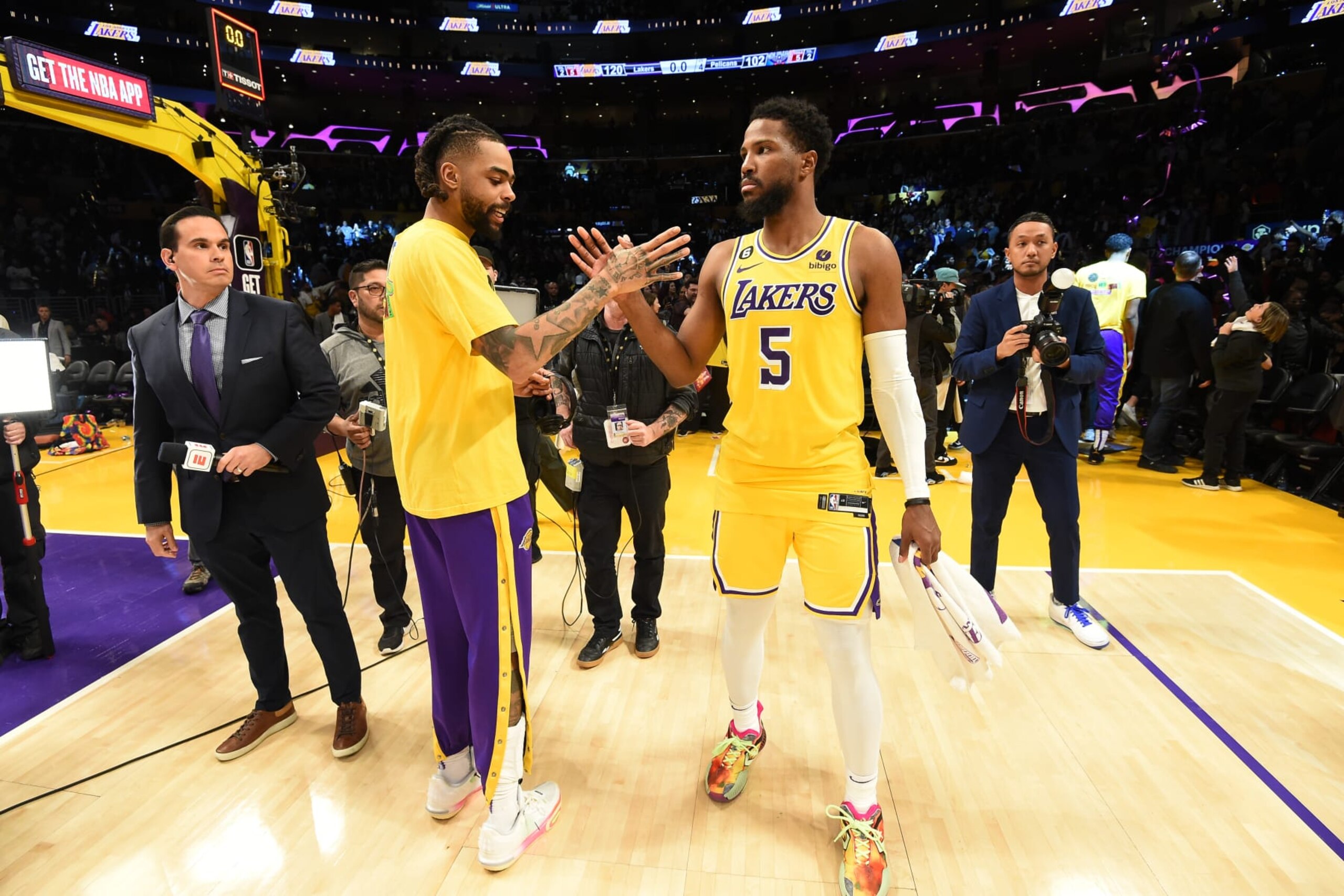
It has not been a banner start to the playoffs for most Los Angeles Lakers guards.
D'Angelo Russell has provided next to no punch. He's shooting under 36 percent on twos and less than 29 percent from deep, all while getting harder and harder to stash away on defense.
Malik Beasley has, somehow, been much worse. His outside volume is valuable in theory. But some of those looks have to go down. They're not. Through Games 1 and 2, he went 1-of-5 from distance. The fact he's "only" launched five treys is an indictment itself. He has been so bad that even ever-forgiving head coach Darvin Ham can't justify playing him more than 10 to 12 minutes per game. Beasley is getting burned on defense by everyone from Desmond Bane to Luke Kennard to David Roddy.
Dennis is going through it himself. He still brings some defensive activity but is shooting poorly from, well, just about everywhere. And he hasn't been able to generate nearly as much dribble penetration against the Memphis Grizzlies defense.
Troy Brown Jr. is more of a wing on this team, but I'm looping him in here, too. He's offered nothing on offense and not enough on defense. Ham needs to stop using him and Beasley together...yesterday.
Perhaps everyone—or at least someone—will start playing better. For anyone who doesn't, the timing isn't great. DLo, Schröder and Brown are all free agents, and Beasley's team option suddenly no longer feels guaranteed to get exercised.
—Favale
Winner: Jamal Murray
7 of 10
Though the Denver Nuggets at large are pretty big winners, celebrating the entire team invariably gives too much credit to this sad and sorry iteration of the Timberwolves. It's best to focus on Jamal Murray instead.
Because he's officially back.
This isn't just about his 40-point detonation in Game 2, though that's certainly part of the equation. It's about...everything.
Murray's shot-making is once again big-time. He's hitting 50 percent of his mid-range jumpers (6-of-12) and 72.2 percent of his looks inside the restricted area (8-of-11). Even after belching up a 1-of-6 clip from downtown in Game 3, he's still nailing 42.3 percent of his triples for the series.
His chemistry with Nikola Jokić remains divine. His role as a playmaker remains streamlined, but his passing off screens, from inside the paint and on the run is quick and precise. His defense is getting the job done; he is super active contesting passes and has helped make Anthony Edwards uncomfortable on occasion as the primary or trapping defender. Denver is winning the minutes Murray plays without Jokić.
The list goes on. And on. And every standout item or moment ferries us to the same, undeniable conclusion: With this version of Jamal Murray, the Nuggets are capable of beating everyone.
—Favale
Loser: Availability
8 of 10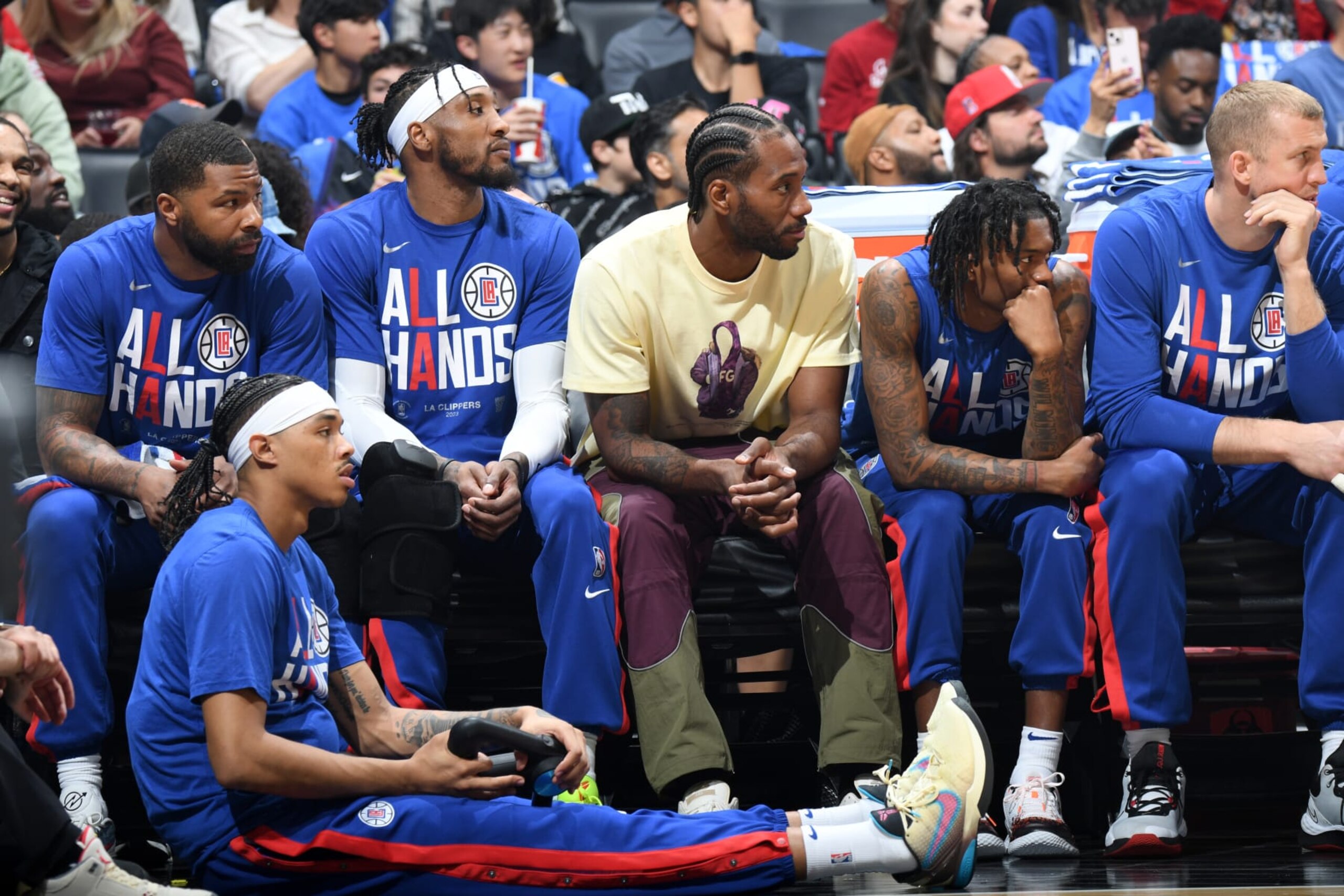
Injuries are part of the NBA season—playoffs included. But, like, this year's list of mission-critical names on the shelf feels atypically, overwhelmingly long.
Paul George has yet to play for the L.A. Clippers because of a sprained right knee. After turning in two masterpieces against Phoenix, Kawhi Leonard has joined him on the sidelines through Games 3 and 4, also because of a sprained right knee.
Ja Morant is dealing with a right hand injury that's already forced him to miss time for the second consecutive postseason. Giannis Antetokounmpo sat out against Miami with a back contusion. Tyler Herro is done for the year—or at least until the NBA Finals—after undergoing right hand surgery.
Because, apparently, this is the Postseason of Sprained Right Knees, Joel
Embiid wasn't available for Philly's Game 4, series-clinching sweep over Brooklyn. This seems more precautionary than damning; he may be ready to rock for the second round. But, uh, it's not exactly great news. Especially with James Harden battling Achilles issues.
Absences from Jaden McDaniels (fractured right hand) and Naz Reid (fractured left wrist) have accelerated the Timberwolves' hopelessness. Cameron Payne's lower back injury is contributing to a Phoenix offense that, despite its star power, has looked choppy against a short-handed Clippers squad. These are smaller-scale issues. But they matter.
Once more: Injuries are unavoidable. Stars miss important games. It happens. But the number of marquee names currently on the shelf, while not exactly inciting an asterisk onslaught, is a flat-out bummer.
—Favale
Winner: The Devin Booker-Kevin Durant Pairing
9 of 10
It shouldn't come as any great surprise that two of the most scalable superstars in the league have meshed perfectly with such limited reps. But the synergy between Devin Booker and Kevin Durant has been one of the significant storylines of the 2023 postseason.
Yes, the Phoenix Suns have depth issues. And yes, they're benefitting from an LA Clippers team that, after spending the season load-managing stars to avoid exactly this predicament, is dealing with injuries to both Paul George and Kawhi Leonard.
But that doesn't detract from the symbiotic dominance we're seeing out of KD and Booker, with the Suns stars most recently combining for 61 points in Game 3—all on a collective 50 percent from the field and 60 percent from deep (6-of-10).
So far, Booker has been the more productive of the two. He racked up 38 points in Phoenix's series-evening Game 2 win as he and the rest of the Suns combined to shoot a preposterous 21-of-29 from mid-range. The three-time All-Star followed that up with 45 points on a cool 62.1 percent from the field in Game 3.
It was telling that he so readily credited Durant, who had eclipsed 25 points in all three contests and was shooting 51.0 percent for the series, after that incendiary Game 3 effort.
"You can't leave [Durant], obviously. He draws a lot of attention," Booker said. "A lot of the buckets I scored, I went right to him right after and said, 'You opened that up.'"
Good luck to the Clippers, who must know that any attention diverted from a scorching Booker will only result in Durant catching fire.
—Hughes
Loser: The Rules
10 of 10
If you love nothing more about the NBA playoffs than litigating the difference between kicks, stomps and cup-checks, and if your chief source of pleasure in life is hypothesizing about the position of the charge circle, you've really had a banner week. But also: What's wrong with you?
And also (also): What's up with the rules?!
Draymond Green's ejection for stepping on a downed Domantas Sabonis (a very bad thing to do in a basketball game, to be sure) might not have earned him a one-game suspension if not for his "history of unsportsmanlike acts" and, probably, Commissioner Adam Silver's personal witnessing of Green going full wrestling heel during and after the ensuing ejection process.
That's not to say the suspension was indefensible, but it is problematic if the league is now giving weight to multiple factors that had nothing to do with the act it's punishing.
Add to that the difficult-to-grasp disparity in penalties for Joel Embiid's kick of Nic Claxton netting only a flagrant 1, James Harden's ejection for a much gentler but more problematically aimed shot at Royce O'Neale and then Claxton's "two post-dunk flexes is too many" ejection (all in the same game!), and it has never been harder to know what kind of conduct will get you busted most severely by the league.
Some of this is actually serious—especially the block-charge conundrum. We need to figure out how to keep superstars from getting undercut and injured.
But more broadly, rules work because they're clear, consistent and, ideally, logical. They take extraneous factors and subjectivity out of the equation. If Infraction X is committed, Consequence Y follows. So far in these playoffs, the rules have felt more like loose guidelines with way too much room for interpretation.
—Hughes




.jpg?w=2560 "Jonathan Taylor Landing Spots 📍")


