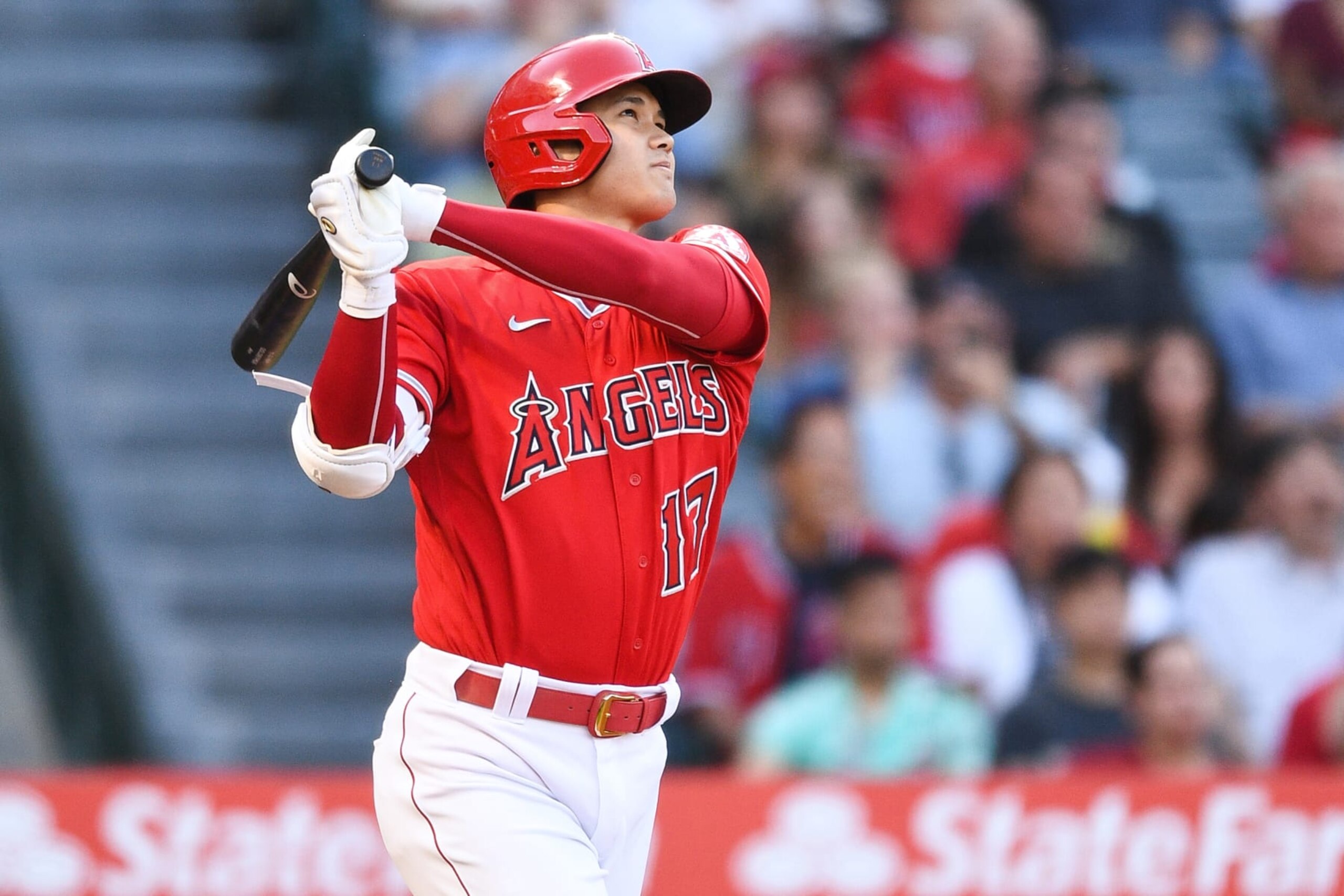

Aaron Judge Is 2022 AL MVP, but Shohei Ohtani Remains MLB's MVP
Congratulations are in order for Aaron Judge, who has officially been named the American League MVP after clubbing a league-record 62 home runs in 2022.
Now then, let's talk about Shohei Ohtani.
Though the Los Angeles Angels' two-way superstar fell short of making it two AL MVPs in a row Thursday, it says a lot that the voters were impressed enough by his 2022 season to deny Judge a unanimous vote. He arguably deserved as much, given that he led the AL in a lot more than just home runs for a New York Yankees club that won 99 games.
TOP NEWS
Brewers Up 2-0 on Dodgers in NLCS 🍻

Ranking Top 25 Trade Chips For Offseason 🔢
New Truths from NLCS Game 2 🧐
There's thus room to read the fact that Ohtani, 28, was able to secure two first-place votes as a contrarian counterrevolution, but we'll instead read it as a kind of acknowledgment that, while Judge may be the American League's MVP for 2022, Ohtani's value remains as unfathomable as it is unrivaled among all players in Major League Baseball.
It's Not Just That He's a One-of-a-Kind Player
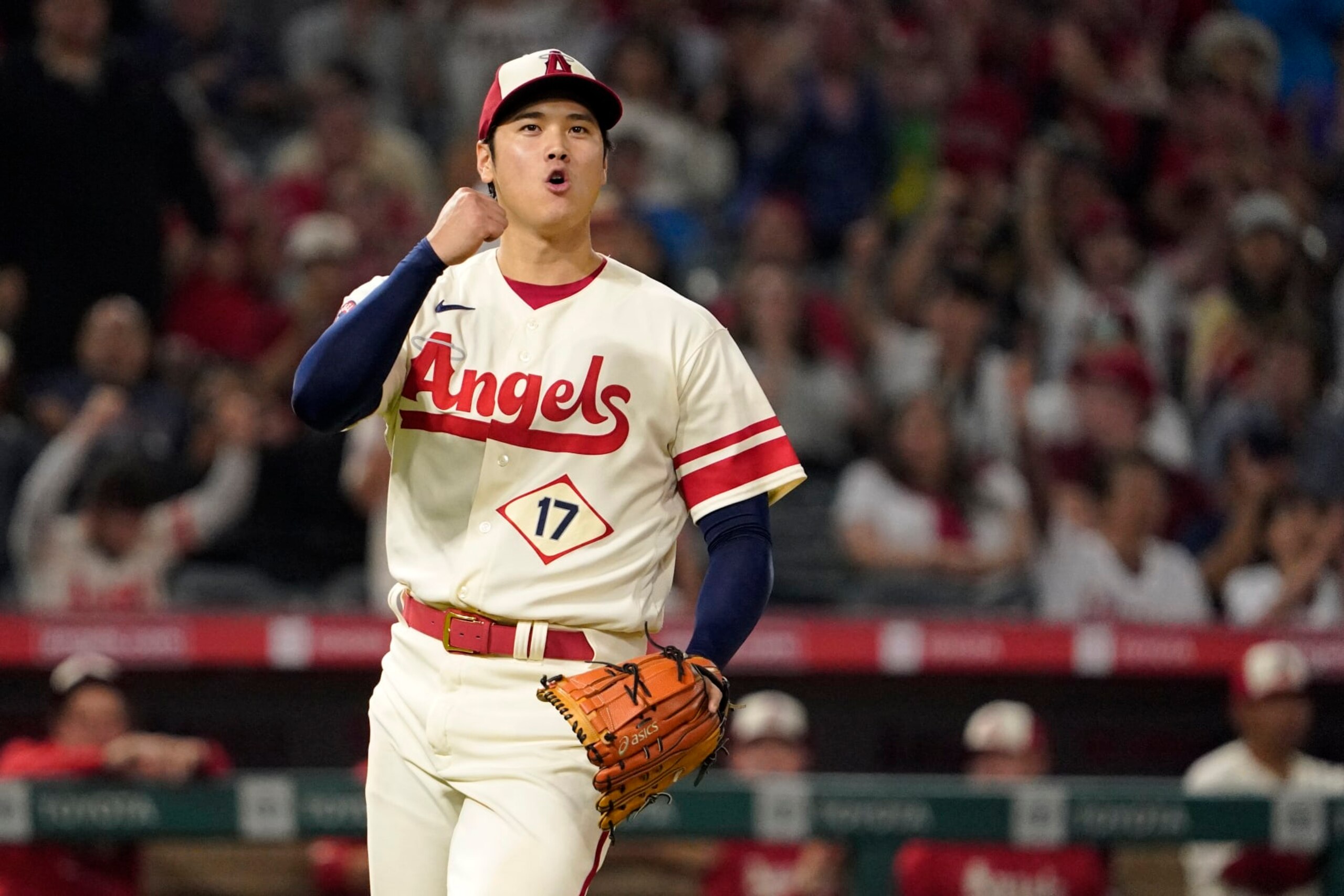
There were serious arguments taking place in 2021 about whether the season Ohtani was having was the greatest ever, and yet it doesn't feel like a hot take to posit that he was as good, if not better, in 2022.
He didn't lose much as a hitter, going from a .965 OPS and 46 home runs in '21 to an .875 OPS and 36 home runs in '22. He otherwise gained a whole lot as a pitcher, going from a 3.18 ERA over 130.1 innings in '21 to a 2.33 ERA over 166 innings.
By OPS+ and ERA+ over the last two seasons, Ohtani has been 52 percent better than the average hitter and 55 percent better than the average pitcher. If we were back in 2012-13, this would be like if Buster Posey and Justin Verlander were the same person.
That's bonkers! And you know what else is bonkers? That as preternatural as Ohtani's talent might seem to be, he actually does have to work on his craft.
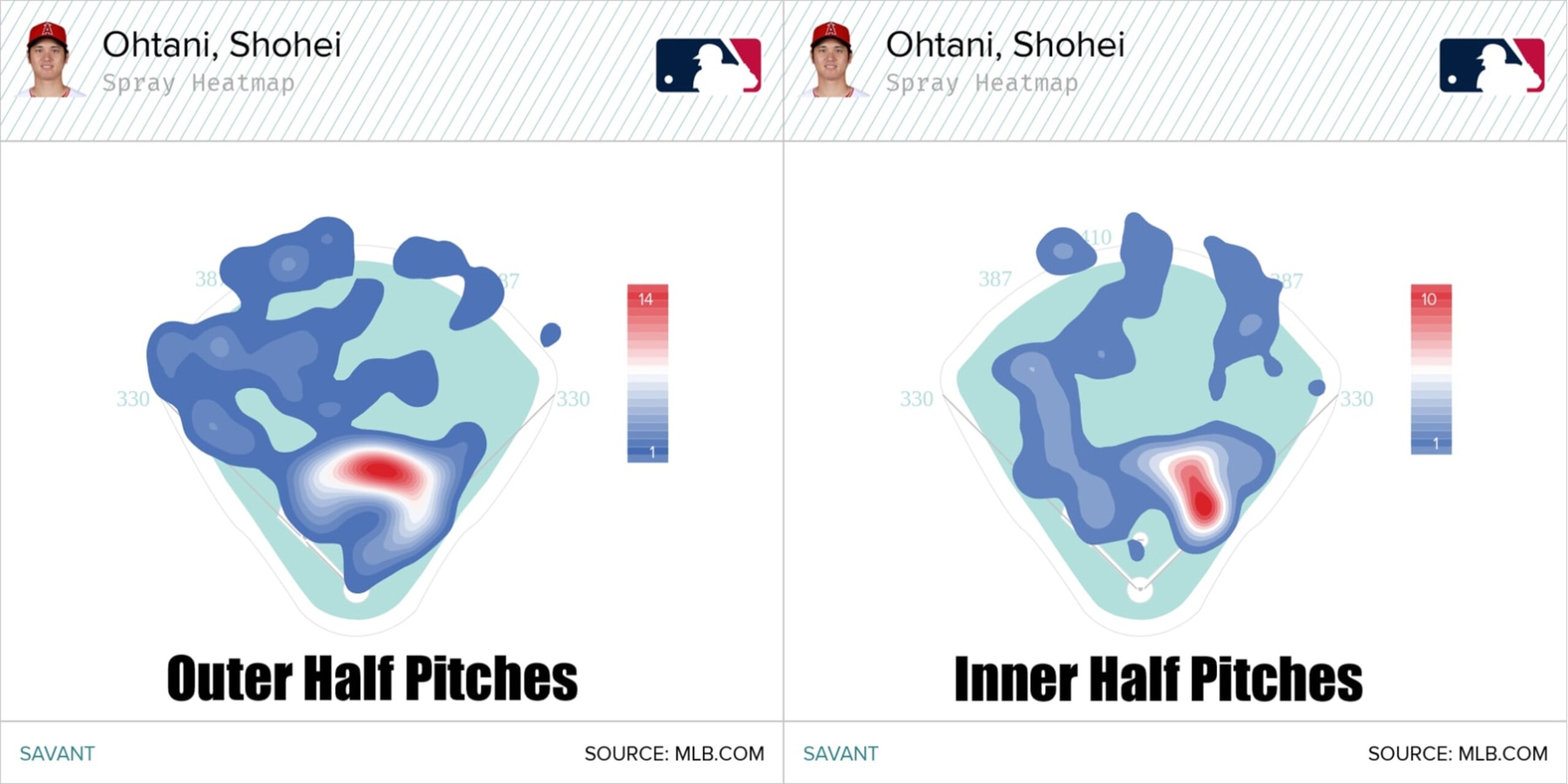
Take his batting average, for example. He upped it from a modest .257 to a much stronger .273 from 2021 to 2022, in part because he greatly expanded his plate coverage. The left-handed swinger's average against inner-half pitches dropped by 13 points, but his corresponding 39-point rise against outer-half pitches more than made up for that.
At work was a master class in hitting the ball where was pitched, as he favored his pull side on inside pitches and more so went up the middle and the other way on outside pitches:
On the other side of the ball, it's remarkable that Ohtani made such huge strides as a pitcher even as his signature pitch betrayed him. His splitter had a minus-12.7 run value in 2021. In 2022, that diminished to minus-1.7 percent.
Ohtani survived by leaning more on his slider, which had the second-best run value of any pitch of 2022. He also leaned less on his four-seam fastball, so much so that it was neither his primary pitch nor even his primary fastball by the end of the year.
To the latter end, Rob "Pitching Ninja" Friedman did a fine job of encapsulating the story of how Ohtani suddenly pulled a sinker out his back pocket:
Did it work? Yes, it worked. By September he was using it to hold hitters to a .182 average. By contrast, his four-seamer never had a monthly average below .226.
This is all to say that Ohtani is settling into a groove not unlike the one that Angels teammate Mike Trout was in during his MVP-winning heyday. His greatness might seem like a set-it-and-forget-it thing, but anyone who pays closer attention will see something even more special at work.
It's How Often He's a One-of-a-Kind Player
Ohtani's talent alone makes it hard to look away from him, but let's also grant that it's often literally impossible to not pay attention to him.
There's obviously more than two players on the diamond at any given time, but everything revolves around just two of them: the batter and the pitcher. They dictate the action. Nothing can happen unless they make it happen.
About this, nobody knows better than Ohtani.
For every other player in the majors, seasonal participation in batter-pitcher matchups is measured in hundreds. Ohtani pushes into the thousands. Between his plate appearances and batters faced, he was involved in 1,171 batter-pitcher matchups in 2021 and an even more astonishing 1,326 in 2022.
That's 2,498 instances in which he's been at the center of the action over the last two years. That's 711 more than the next guy, the equivalent of how many trips Josh Donaldson took to the plate in his MVP-winning season in 2015.
His star is always super-duper bright and hot, with a gravitational pull so strong that the baseball universe basically revolves around him.
Is It Possible Ohtani Is Underrated?
If we can highlight an opinion without necessarily endorsing it, we'd like to point to what CC Sabathia said about Ohtani and the MVP on MLB Network in September:
"He's the best baseball player to ever play baseball," the former ace said. "He's the MVP every year that he's healthy. He continues to get better as a pitcher. You've gotta give him the MVP."
Judge's winning of the AL MVP naturally proves that it is possible for Ohtani not to be the MVP every year he's healthy. There's more than one reason for that, but it bears noting that two of the biggest ones are outside Ohtani's control.
For one thing, he can only do so much about the Angels' record. Perhaps he would have fared better in the AL MVP voting if the Angels had recorded 89 wins instead of 89 losses, but, hey, it's not his fault that most of the other 25 guys on the roster stunk up the joint.
For another thing, wins above replacement doesn't value Ohtani as much as he deserves.
It's not that WAR doesn't value Ohtani to a great degree, as he ranked first in MLB 9.0 rWAR in 2021 and second to only Judge with 9.6 rWAR this season. It's nonetheless been noted—including by Tom Tango in 2018 and MLB.com's Mike Petriello this year—that WAR isn't really built for players like Ohtani.
To use Judge's 2022 season as an example, WAR mostly weighed his merits as a hitter, where he was obviously excellent, and as a fielder, where he was solid at a premium position (center field) and a lesser position (right field). Even without getting into the specific numbers, it makes sense that WAR would value a player like that so highly.
With Ohtani, WAR effectively sees him as two different players: a pitcher and a designated hitter. Though he indeed is these things, the DH aspect is an issue because that part doesn't see Ohtani as contributing to his team's run prevention even though, in reality, that's half of his job description on days he pitches.
Of course, pointing out the roadblocks between Ohtani and MVP consideration is easier than solving them. It's up to the Angels to build a more competitive team around him. As to the WAR problem, hey, if MLB can conjure an "Ohtani rule," then maybe the WAR masters can do so with an "Ohtani adjustment."
In the meantime, let's settle for agreeing that the intuitive sense of Ohtani's value is the best sense of it. He may not be the best player in baseball in any given season, but he is the best at any given moment on any given day.
Stats courtesy of Baseball Reference, FanGraphs and Baseball Savant.


.jpg?w=2560 "WWE Raw Live Grades 🔠")
.jpg?w=2560 "Commanders OL HEATED After Tie ▶️")
.jpg?w=2560 "49ers LB Suspended for Headbutt")