
Awful Rougned Odor Call a Reminder of How Badly MLB Needs Automated Strike Zone

The New York Yankees have nobody but themselves to blame for the three-game sweep they suffered at the hands of the archrival Boston Red Sox over the weekend.
Well, OK, maybe themselves and umpire Gabe Morales.
With the score knotted 4-4 and runners at first and third and two outs in the bottom of the ninth inning Sunday, Morales made this strike call on a 3-2 curveball from Red Sox closer Matt Barnes to Yankees pinch hitter Rougned Odor:
TOP NEWS

Brewers Complete Comeback In Game 2

World Series Game 2 Highlights 🎬
Miz Trades Cards With Kid 🥹
Though that call isn't the reason the Yankees lost 6-5 in 10 innings, it marked a significant moment. If Morales had called that pitch a ball, the Yankees would have had the bases loaded and could have won the game without the benefit of a hit.
And let there be no mistake about it: That pitch should have been called a ball. It was not only outside the strike zone but also way outside it. Among left-handed batters, Statcast marks it as the second-most outside pitch to be called for a third strike all season.
It's understandable that third base coach Phil Nevin and bench coach Carlos Mendoza got themselves tossed after voicing their displeasure, and likewise that there was outrage all over social media. Including from one prominent former Yankee:
As for how Major League Baseball might ensure that such an incident can't happen again, there's no time like the present to reconsider the possibility of robot umpires.
Or, in more technical, slightly less ominous terms: an automated strike zone.
In Defense of Human Umpires
This is where it's only fair to point out that human umpires have hard jobs.
They not only require having intimate knowledge of a dense rule book but also keen situational awareness and extraordinary physical and mental stamina. Whereas players get a chance to rest and regroup every half-inning, umpires have to remain on the field and on their feet for more than three hours for an average game.
And despite what happened Sunday, umpires are actually very good at calling balls and strikes.
In 14 seasons since the pitch tracking era began in 2008, umpires have cut down on the frequency with which they call both strikes outside the zone and balls within the zone:
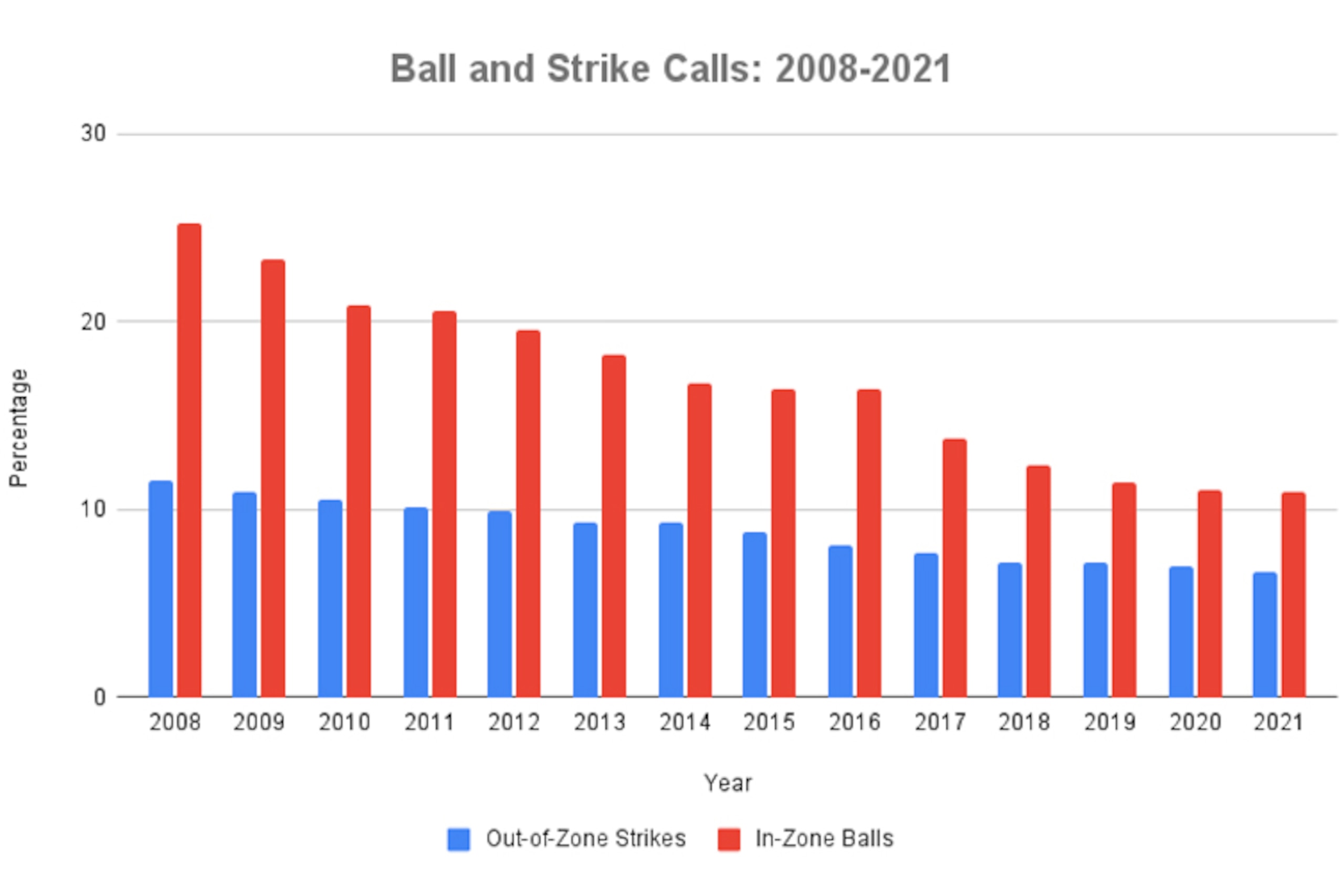
Because they previously didn't have the means to assess their accuracy on balls and strikes, umpires used to make bad calls all the time. By that same token, though, it also makes sense that the bad calls have been evaporating ever since said means became available in 2008.
But because neither the rate of strikes outside the zone nor that of balls within the zone is at zero, umpires obviously still aren't perfect. What's more, the reality that both percentages have plateaued in recent years suggests umpires have already improved as much as they can.
Combined with the simple fact that the technology exists, this alone would be reason enough to think that it's just a matter of time before MLB implements an automated zone.
There's also, of course, what's happening in the minor leagues.
How's It Going in the Low-A Southeast League?
Specifically, an automated strike zone is in operation at eight of the nine ballparks used by the Low-A Southeast League. It's the first affiliated league to use an automated zone, effectively making it the canary in this particular coal mine.
Mind you, there's still a human umpire behind the plate. But with regard to balls and strikes, the Hawk-Eye tracking system makes the calls. Courtesy of an audio cue, the umpire merely announces the call.
It would be advantageous if we could compare the Southeast League's offensive environment to that of previous years, but that's not possible. Even setting aside that last year's minor league season was canceled, the Southeast League was previously a High-A league and thus populated with older, more experienced players than it has in 2021.
We can, however, compare offense in the Southeast League to the other two Low-A leagues in the East and West:

There's more power in the East and West, yet the Southeast League has a lower strikeout rate and a higher walk rate. Accordingly, hitters in that league are getting on base more often and scoring more frequently.
At least for now, this is a solid indication that an automated zone would favor hitters over pitchers. It also tracks with the advantage gap of missed calls at the major league level.
Though pitches in the zone get called as balls at a higher rate than pitches outside the zone get called strikes, that's because there are fewer takes within the zone. Overall, out-of-zone strikes outnumber in-zone balls 6,380 to 4,502 in 2021.
The thought of that advantage going away won't excite any major league pitchers, but hitters would naturally feel differently—and the league office might be more sympathetic to their cause. Because with the leaguewide batting average at an all-time-low-tying .237, more offense is precisely what Major League Baseball needs.
Beware Unintended Consequences
An automated strike zone sounds pretty good in theory. But lest anyone get too excited, suffice it to say that MLB has the right idea in experimenting with it in the minors rather than installing it in the majors.
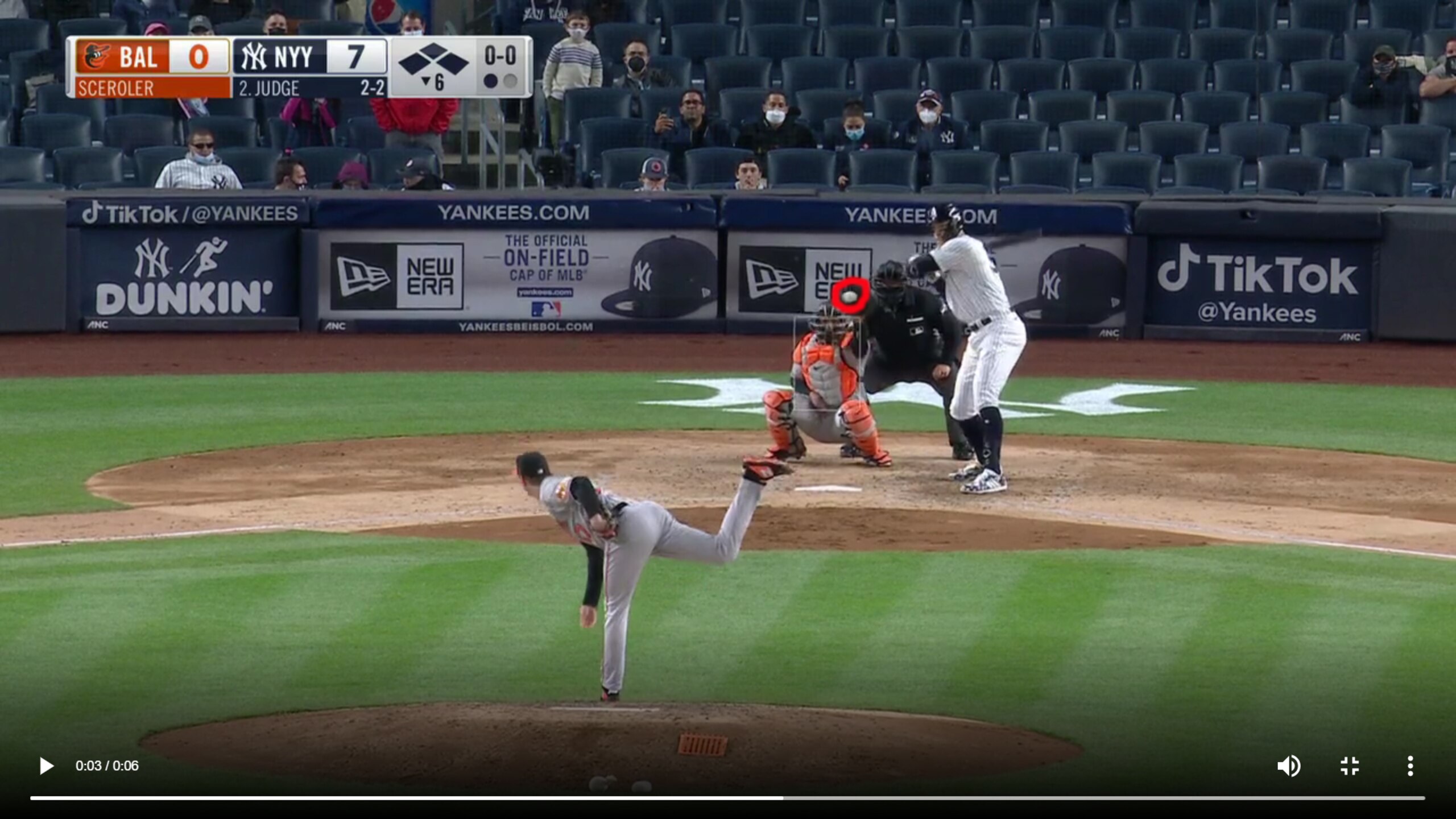
To wit, consider how this April pitch to Aaron Judge was apparently rightfully called a ball:
And how this May pitch, also apparently rightfully, to Ronald Torreyes was also called a ball:
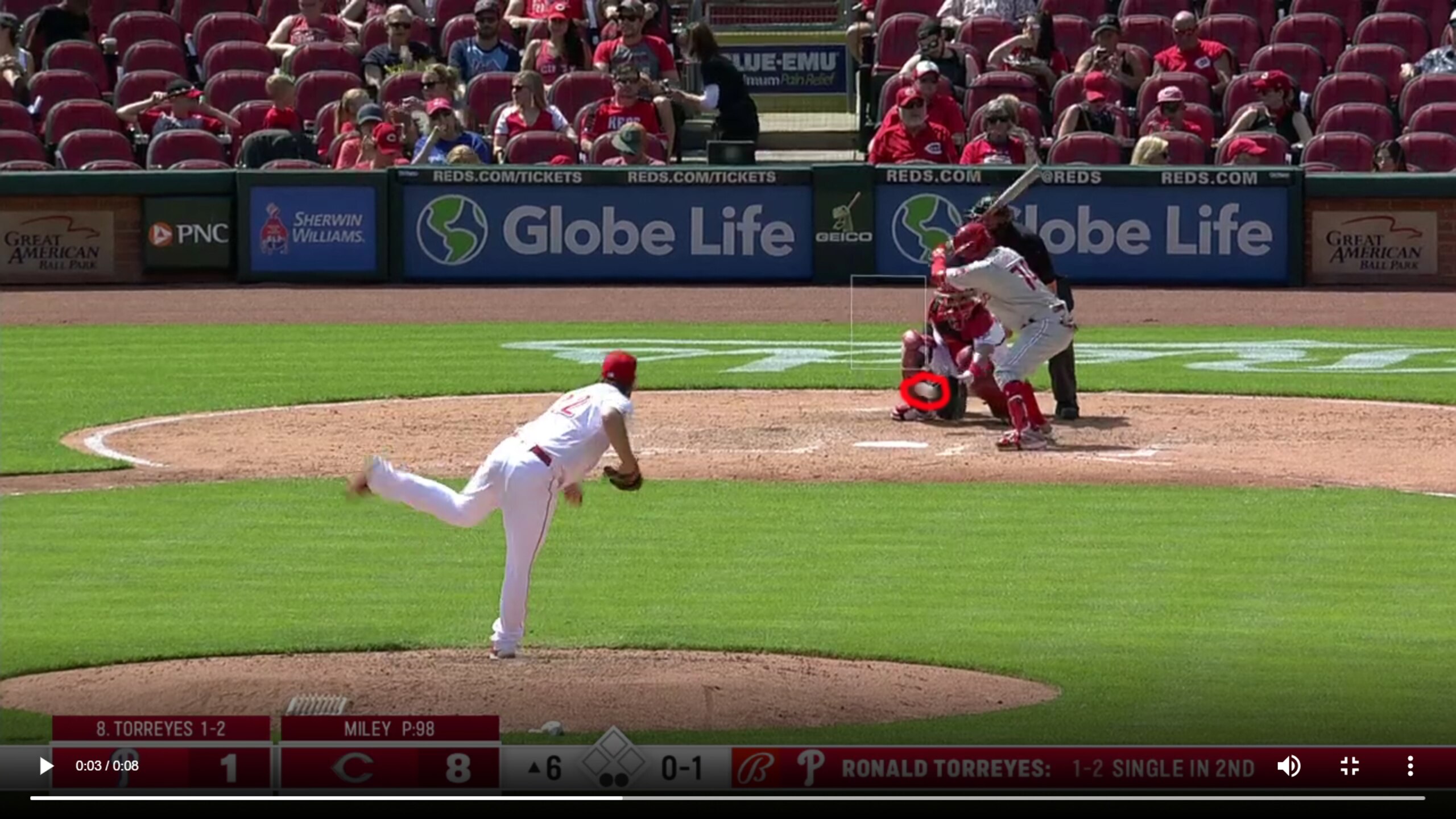
Even though both pitches missed the white squares superimposed for the TV broadcasts, they were technically in the strike zone, which is officially defined as "the area over home plate from the midpoint between a batter's shoulders and the top of the uniform pants—when the batter is in his stance and prepared to swing at a pitched ball—and a point just below the kneecap."
It's thus not hard to imagine what would happen if an automated strike zone was used in major league games, say, tomorrow. In no time at all, there would be mass confusion as the stark differences between the de facto strike zone and the actual strike zone came into focus.
You know, sort of like what occurred in the Arizona Fall League when it experimented with an automated zone in 2019. As Josh Norris of Baseball America wrote: "Hitters throughout the brief AFL season were getting rung up on pitches catchers were scooping out of the dirt as well as ones that crossed somewhere near the middle of a hitter's chest."
But that doesn't mean MLB should look to throw the baby out with the bath water. As Chris Marinak, the league's chief operations and strategy officer, hinted in March, there might be ways to bridge the gap between the strike zone as the rulebook knows it and the strike zone as actual people know it:
"There's a long history in the game of people just sort of just understanding by their eyes and their feel what's either a strike and what's not a strike. And I think we have a lot of work to do to decide what is the zone with this automated system. Is it more of an oval-shaped zone, which is more consistent with what's called today? Is it a square zone? Is it a three-dimensional zone? How does the zone shift from hitter to hitter? Is it literally the zone drawn every single pitch, as is written in the book, or is it a fixed zone that's based on your height as a hitter, no matter how much you sort of squat down or stand up?"
Ideally, the automated zone that would be introduced in the majors will feature the best of both worlds. It will have a human umpire's sense for a given hitter's strike zone but with a better eye for what's actually hitting or missing said zone.
In any case, there shouldn't be much doubt that an automated strike zone isn't so much a possibility as an inevitability. And while the game is sure to undergo drastic changes when it arrives, at least one of them will be for the better.
Egregiously bad calls such as the one that cost the Yankees on Sunday night? Yeah, those will be things of the past.



_0.png?w=2560 "Unranked Teams Cause Chaos in Rankings 📊")
.png?w=2560 "Week 8 Winners & Losers 📊")

.jpg?w=2560 "Jonathan Taylor Landing Spots 📍")



