
Pick Your Poison: The Worst Draft Selections by Pick 2005-2009
The NFL Draft is a gamble much like the game of blackjack. You can do the research, know the odds, and find yourself positions of great fortune, yet still end up with nothing to show for all your efforts. However, for most gambling enthusiasts no matter how many times the breaks fail to go their way, a few weeks or months away for the tables and they're ready to give it another go. The same goes for the NFL Draft.
Organizations and fans alike annually spend the weeks from late-January to late-April obsessing over workout numbers, character profiles, and rumors all in hopes of identifying the stars of tomorrow. Unfortunately, even with all the endless hours prep work some teams simply come up flat.
This list serves as evidence of how there's no such thing as the proverbial "sure thing" and that a franchise has an equal chance of coming out a draft looking foolish regardless of whether it has the first or the 32nd pick.
What follows is the worst draft pick at each draft position in the first round from 2005 to 2009. I have excluded 2010 because a single season is not enough time to properly judge whether a pick was great or a mistake. In making my selection I considered first and foremost the prospect's impact as a professional on the field in addition to the state of the selecting franchise at time of the pick, alternative options still on the board, and the effect the prospect ended up having on the franchise.
1. JAMARCUS RUSSELL (QB, LSU) – OAKLAND RAIDERS – 2007
1 of 32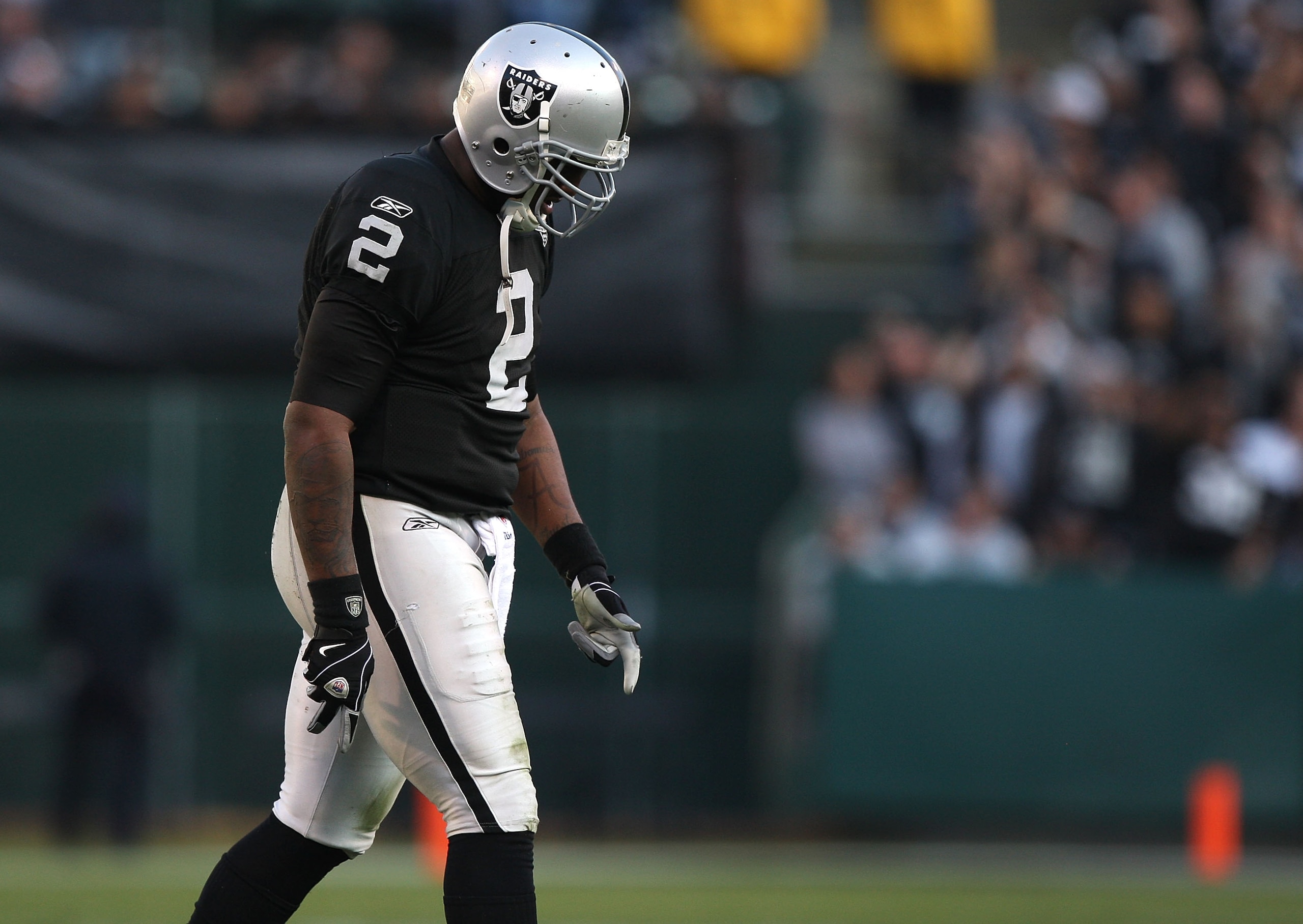
Not only was JaMarcus Russell the worst first overall pick of the last five years, I’ll argue that he was the worst first overall pick in the history of the NFL Draft.
Many highly drafted quarterbacks have not been able to adjust to the speed and the complexity of the NFL; what sets Russell apart is the fact that he never once showed any semblance of even trying to live up to his vast potential, setting the Raiders franchise back years in the process.
He was consistently over weight, never took a leadership role, and his work ethic was laughable. Worst of all, it was known that he had questionable character before Oakland drafted him—a fact that made then Head Coach Lane Kiffin firmly against the selection, but Al Davis overruled Kiffin and forced Russell upon him. This caused a rift between Davis and his young head coach that would eventually lead to Kiffin’s dismal departure.
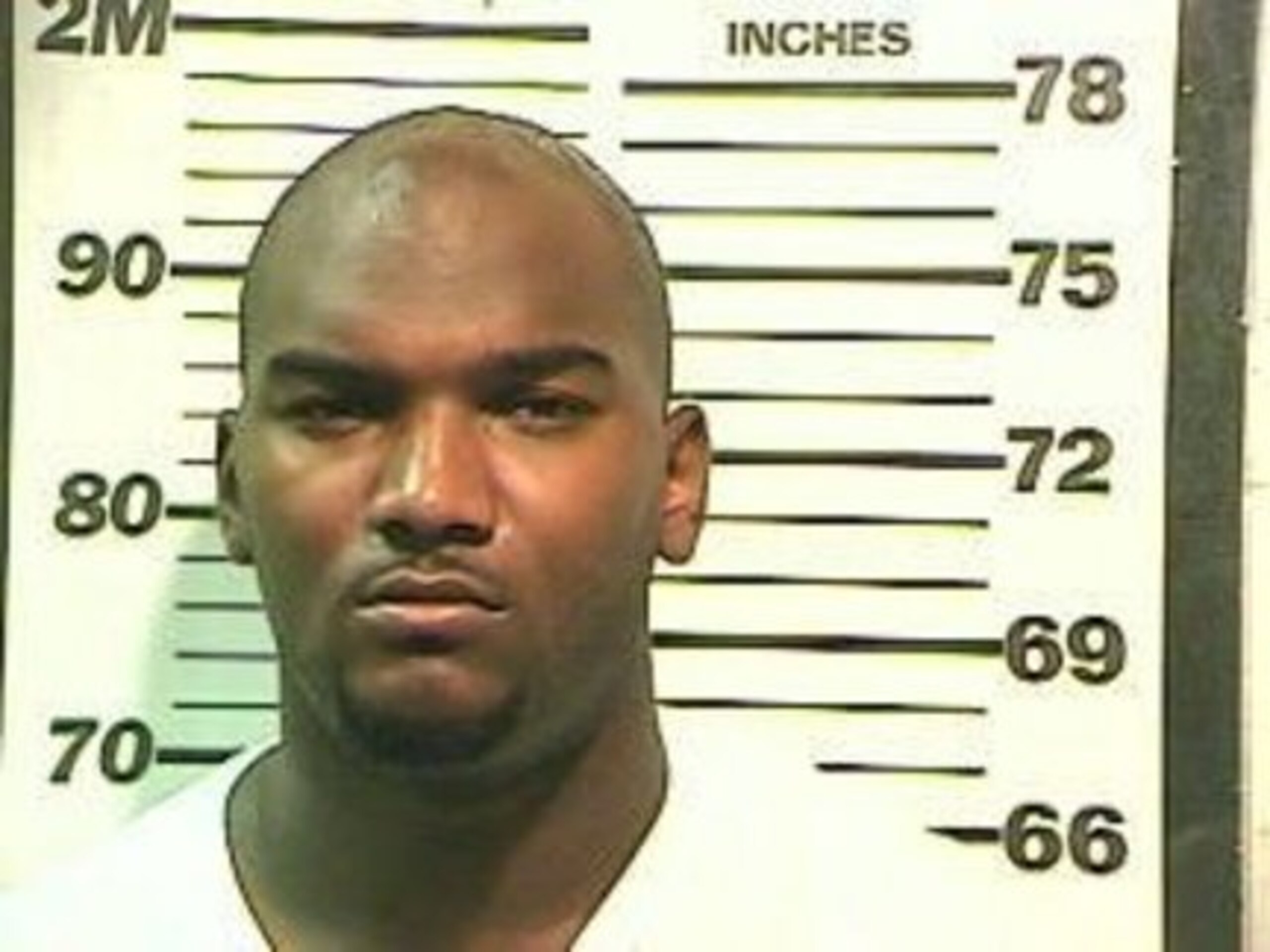
After years of laziness in Oakland, Al Davis finally gave up and cut Russell in the 2009 offseason. The likely nail in the coffin of his NFL career came shortly after the Raiders released him when he was arrested in his hometown of Mobile for possessing large amounts of codeine, the main ingredient in “purple drank.”
To think, if Davis had just stuck to his usual game plan of selecting the best athlete in the draft Calvin Johnson would be in silver and black today, not to mention Pro Bowlers Joe Thomas, Adrian Peterson, Patrick Willis, and Darrelle Revis where all top 15 selections at areas of need for Oakland at the time.
2. REGGIE BUSH (RB, USC) – NEW ORLEANS SAINTS – 2006
2 of 32
There were plenty of so-called experts and analyst that heralded Reggie Bush as a prospect who could change the way the running back position was played in the NFL or at the very least become the next Marshall Faulk.
Neither of those projections came true with Bush, who instead became not much more than a glorified change of pace back and return man in New Orleans. Granted at the time the Saints did need a running back after Deuce McAllister suffered a torn ACL in the fifth game of the season that sent him to the IR, but McAllister was a Pro Bowl back and only 26 years old at the time. A good back capable of providing insurance in the event that McAllister could not bounce back in 2006 could have been found in a later round—case and point, Maurice Jones-Drew was selected 60th overall.
Bottom line is this was a team that needed defense more than anything and chose to go with a luxury pick in one of its few areas of strength. Had New Orleans not been sucked into the unprecedented hype surrounding the Heisman winner they could've selected a defensive standout such as Haloti Ngata, who has become arguably the game's most complete defensive lineman with the Baltimore Ravens.
3. VINCE YOUNG (QB, TEXAS) – TENNESSEE TITANS – 2006
3 of 32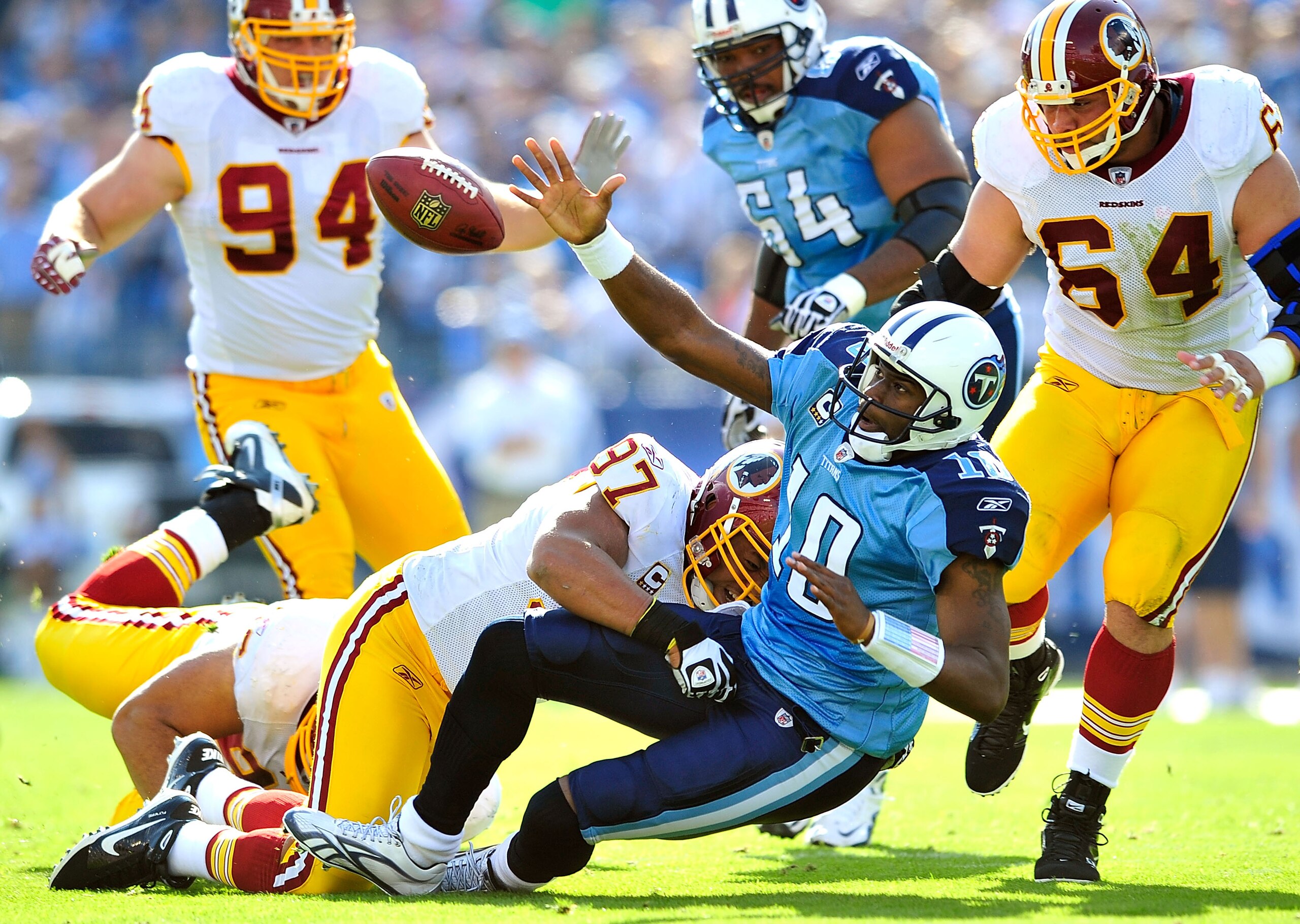
Yes, Vince Young made the Pro Bowl in 2006 and 2009, but look at his stats during those seasons.
In 2006 he threw 13 picks to only 12 touchdowns with a completion percentage just about 50 percent and a QB rating of 66.7. In ’09 he threw just 10 touchdowns and for only 156.6 yards per game. He’s a prime example of the tragedy of the fan vote.
The real Vince Young is arrogant, unstable, and far from a team leader. During his time in Tennessee Young pouted on the sidelines, flipped off fans, and there were even reports he was suicidal that were significant enough to prompt Head Coach Jeff Fisher,to call the Nashville police in 2008 after Young went missing following the season opener in which he hurt his knee.
Young’s defining moment with the Titans came this past season when he threw his shoulder pads into the stands following a benching in Week 11 and then proceeded to walk out on his team, or as he claimed to his coach, after the game. He has even lost his biggest supporter in Tennessee owner, Bud Adams, who has stated that the team will not be bringing the troubled passer back for 2011.
As a pending free agent there has not been much buzz surrounding Young, making it unlikely he’ll land another starting opportunity in the near future.
.jpg?w=2560 "Commanders 49ers Football")
.jpg?w=2560 "Colts Football")
.jpg?w=2560)
4. CEDRIC BENSON (RB, TEXAS) – CHICAGO BEARS – 2005
4 of 32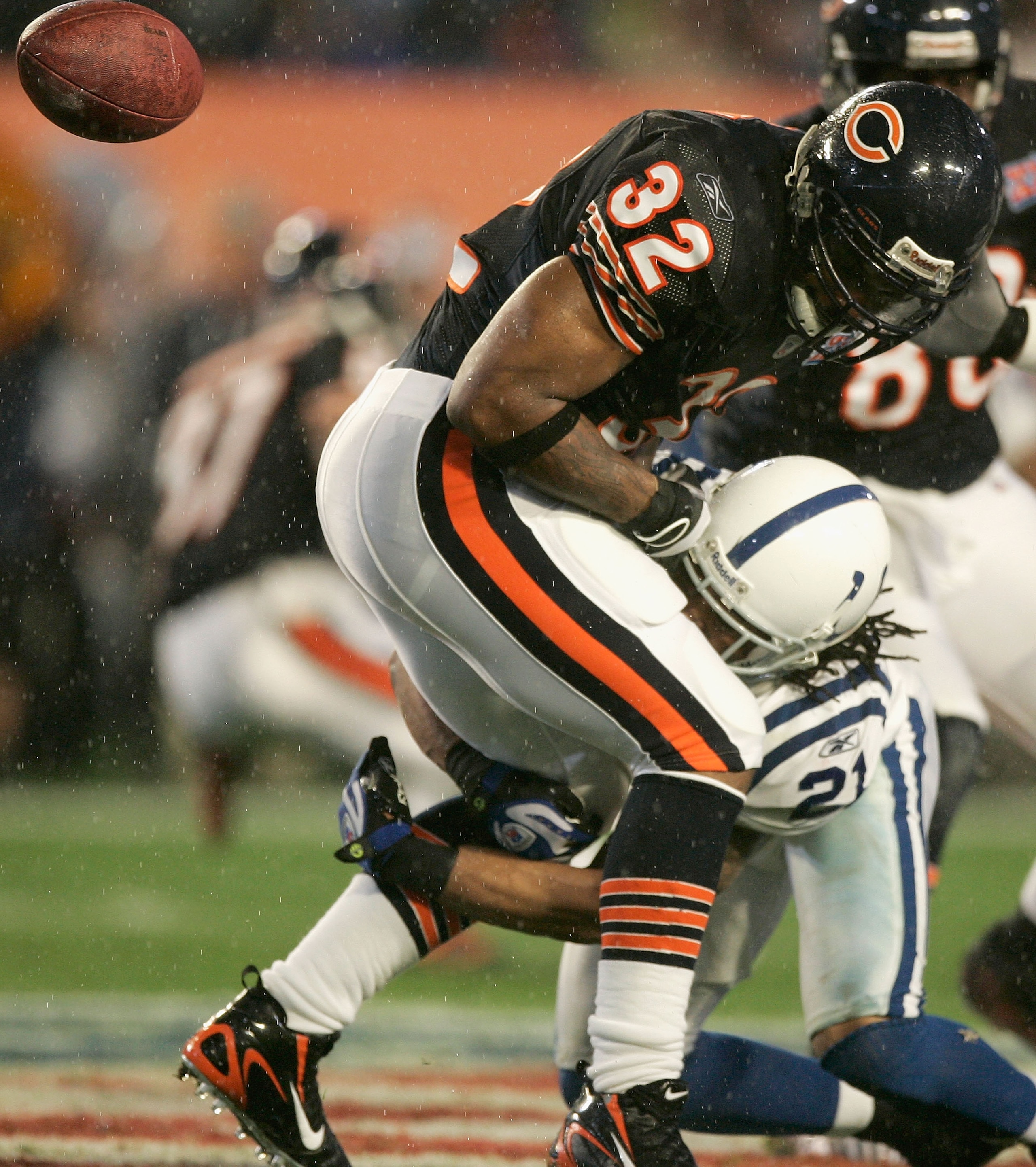
Cedric Benson has done a fine job resurrecting his career in Cincinnati, but the fact remains that his tenure in Chicago was a disaster and he has never performed like the fourth overall selection for either the Bengals or the Bears.
Benson spent his first two seasons in the Windy City stuck behind Thomas Jones, who experienced a career rival with Chicago after underachieving during his first five years in the league, most notably with the Arizona Cardinals. In his third year the Bears did not resign Jones when he hit free agency, in effect handing Benson the starting job despite him doing nothing at all to earn it and he rewarded them with just 674 yards and four touchdowns.
To add insult to injury Benson was arrested twice in just over a month during the offseason: once for operating a boat while intoxicated and resisting arrest and then for a DUI shortly thereafter. That was enough for General Manager Jerry Angelo to cut his losses and release Benson after just one season as a starter.
Even though he has since found some success with the Bengals he’s never been able to display the big play ability you’d expect from such a high draft pick, which is evident by his 3.7 career average and the fact that he has never scored more than seven touchdowns in a season.
Perhaps the worst part about the Benson pick was that the Bears passed on Aaron Rodgers who went to divisional rival Green Bay 20 picks later despite being a candidate for the 49ers with the first overall pick. Jerry Angelo had to think "what if" at some point during the 2010 AFC Championship Game.
5. LEVI BROWN (OT, PENN STATE) – ARIZONA CARDINALS – 2007
5 of 32
From day one I questioned Levi Brown’s ability to develop into a starting caliber left tackle in the NFL, thinking him more of a right tackle at best. Turns out I was wrong; Brown is not an NFL tackle period—regardless of what side he is playing on.
After spending his first three seasons on the right side surrendering 24 sacks, Arizona inexplicably moved Brown to left tackle in 2010 where he gave up seven sacks and graded out as the worst starting tackle in the entire league. With that in mind is it any wonder why Kurt Warner chose to retire before last season?
Despite recently coming to Brown’s defense, you know Head Coach Ken Wisenhunt wishes he could have this pick back with superstars like Adrian Peterson, Patrick Willis and Darrelle Revis all on the board at the time Arizona made its pick.
With just one more year left on his original rookie deal, which will incredibly pay him over $5 million, it’s a safe bet that his days in Arizona are numbered barring some miracle break out season.
6. ADAM JONES (CB, WEST VIRGINIA) – TENNESSEE TITANS – 2005
6 of 32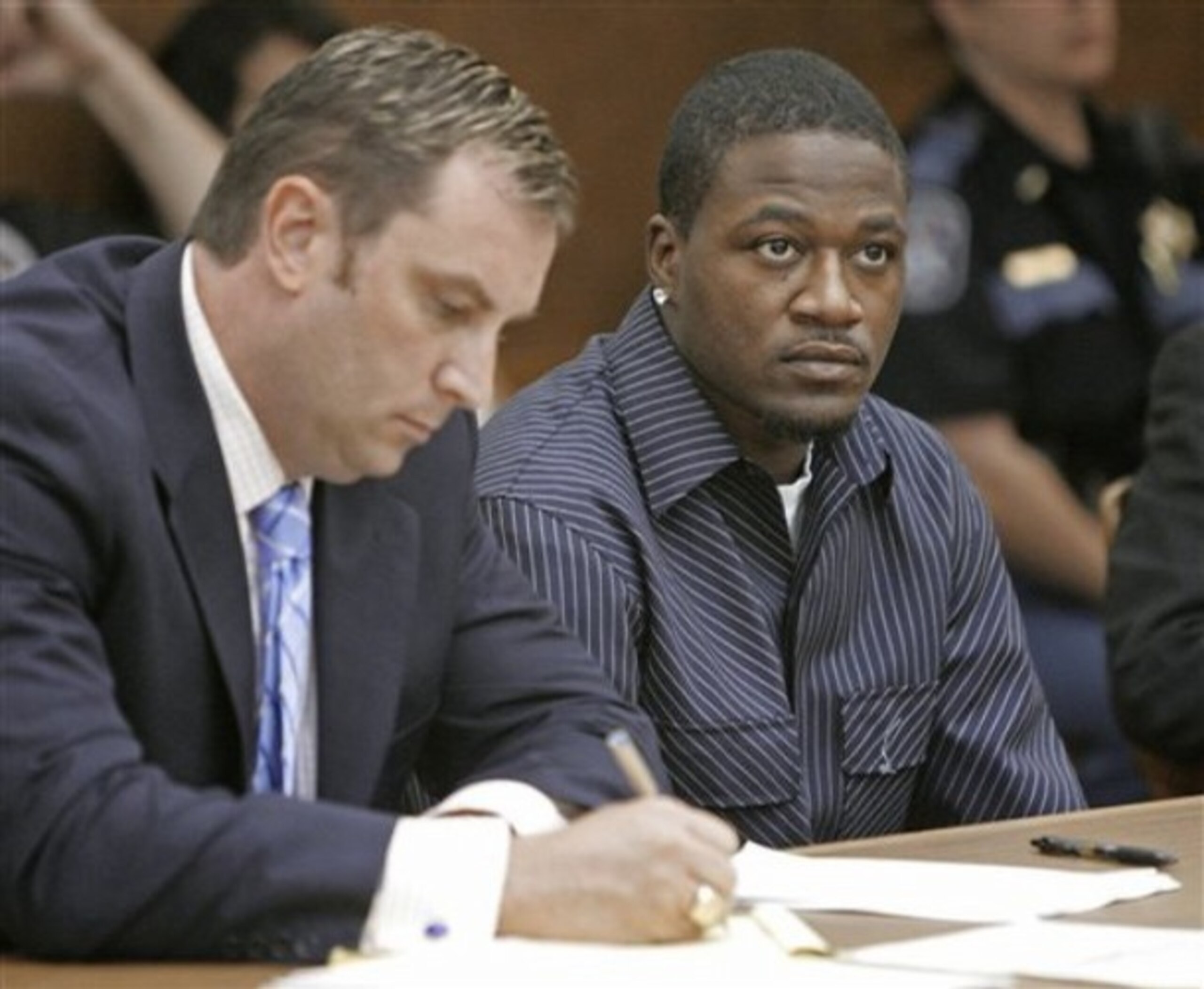
Where do you even begin in describing all the ways that Pacman Jones was a horrible draft pick?
The first red flag for the Titans organization should’ve been the fact the Jones was on probation when they drafted him for a fight he got into while attending West Virginia.
Things quickly spiraled out of control once Pacman reached the NFL. Before he even played a snap he was arrested for assault and felony vandalism stemming from an incident at a nightclub, a reoccurring theme in his off the field troubles. After his rookie year Jones was arrested three times—twice for instances occurring at nightclubs. He then received a one game suspension from the organization as punishment. T
hen came the infamous Las Vegas strip club incident in 2007 when an alleged member of Jones’ entourage fired a gun into a crowd of patrons following a dispute revolving around Jones' attempt to recollect the money he used to “make it rain.” NFL Commissioner Roger Goodell finally stepped in and suspended Jones for the 2007 season although he was never charged in relation to the incident.
After the suspension Jones was traded to the Dallas Cowboys where he lasted just one season. He now currently plays as a reserve corner for the Cincinnati Bengals. The saddest part about Pacman’s story is that he was a truly special talent on the field who could’ve become an All Pro had he kept his head on straight.
7. TROY WILLIAMSON (WR, TROY) – MINNESOTA VIKINGS – 2005
7 of 32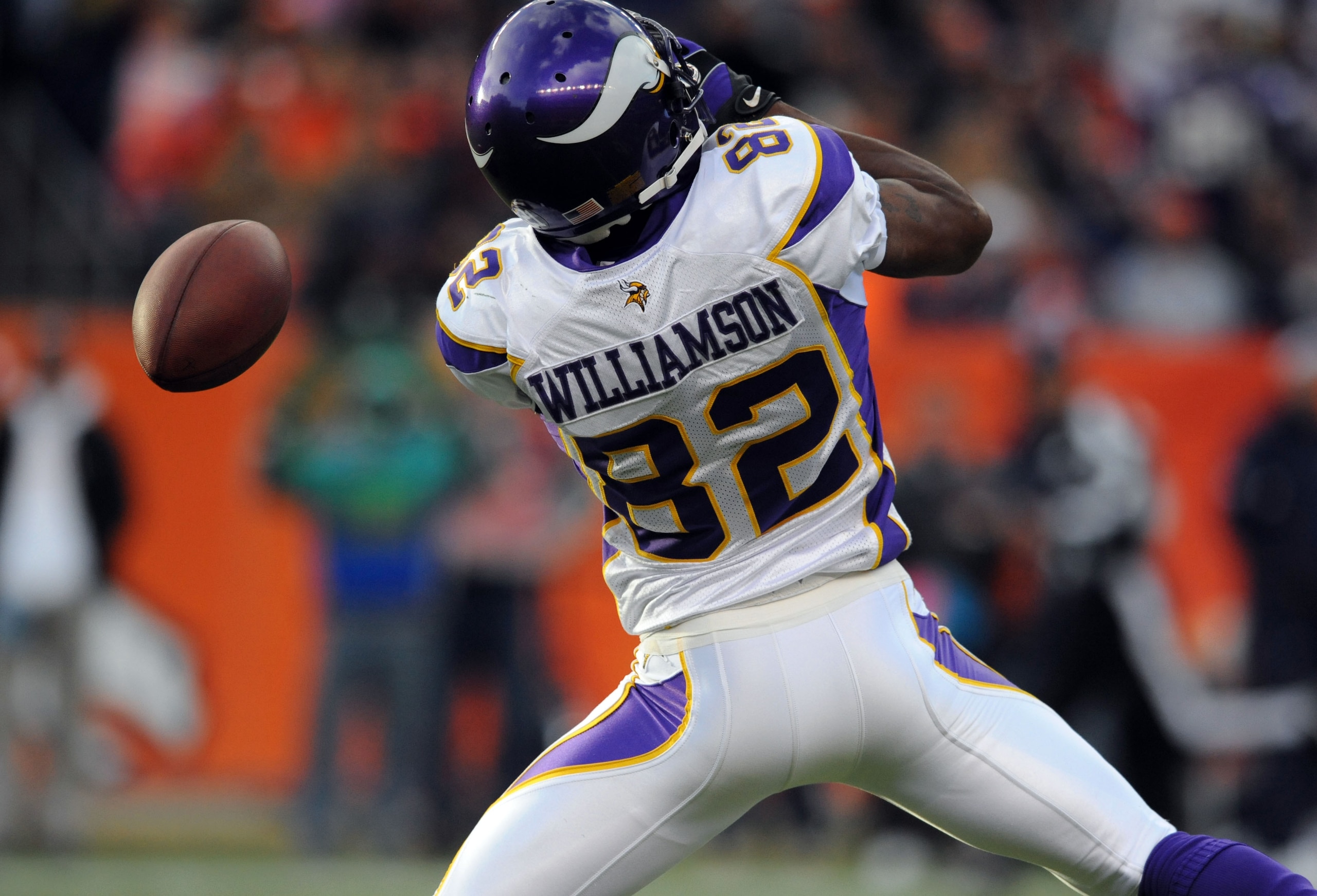
Notching over 1100 receiving yards and four touchdowns is a respectable stat line for a season, not a five year NFL career and especially not when you’re a former top 10 pick.
After trading a disgruntled Randy Moss to the Raiders during the 2005 offseason Minnesota was desperate for a deep threat at wide receiver and became captivated with Williamson after the South Carolina product posted a blazing fast 4.32 40 yard dash at the NFL Combine.
There was a big problem with Williamson’s game though and that was that he couldn’t catch. After three seasons of scarce production and frequent, at times crucial, drops, the Vikings traded Williamson to the Jacksonville Jaguars for just a sixth round pick. A change of scenery would prove to do little good and the Jaguars released Williamson just before the 2010 season after two seasons featuring a total of 10 games, eight catches, and one touchdown.
He has drawn little interest since and it’s likely he’s played his last down in the NFL.
8. DERRICK HARVEY (DE, FLORIDA) – JACKSONVILLE JAGUARS – 2008
8 of 32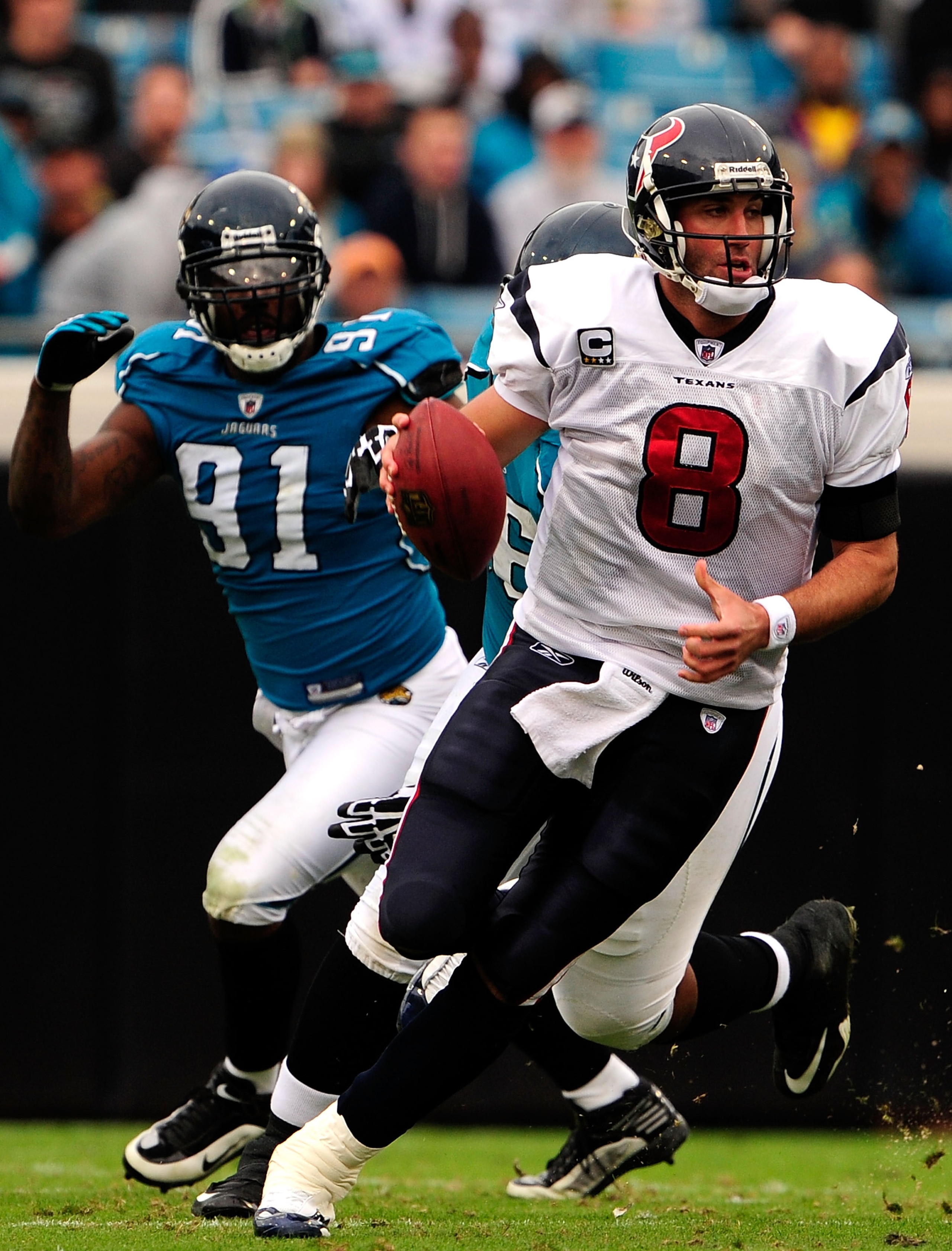
There are two particularly horrible eight overall selections between 2005 and 2009 and both happen to be defensive ends.
First there was the Atlanta Falcons’ selection of Jamaal Anderson in 2007, then a year later Jacksonville followed suit and selected Derrick Harvey out of Florida. What gives the Harvey selection the edge over that of Anderson is the fact that Jacksonville gave up the 26th pick as well as 23rd rounders and a fourth rounder to the Baltimore Ravens to move up to grab Harvey believing they were just a pass rusher away from being an elite NFL franchise.
The Jags immediately installed the former Gator into the starting lineup and after three seasons he has registered just eight sacks despite missing only a single game. Time is already starting to run out for Harvey. In 2010 he lost his starting job to fellow Florida alum Jeremy Mincey and the feeling is that the Jaguars will be looking to draft a pass rusher in the first round of the 2011 Draft putting his roster spot in further jeopardy.
Should the franchise find itself successful in landing a premier defensive end prospect in the upcoming draft it’d come as no surprise to see Harvey looking for a new team for the 2011 season.
9. TEDD GINN JR. (WR, OHIO STATE) – MIAMI DOLPHINS – 2007
9 of 32
After finishing 2006 averaging just 16.3 points per game, the Dolphins organization looked to give the offense a boost and chose Cam Cameron to be their next head coach after Nick Saban left the franchise for the Alabama job, in spite of his repeated denials of having interest in the position.
The hope was that Cameron could build an explosive attack in South Beach like the one he had operated in San Diego as the Chargers’ Offensive Coordinator. The popular choice was for Cameron to select Notre Dame's Brady Quinn to be his franchise quarterback and while he avoided making that mistake, he didn’t fare much better in over drafting Ted Ginn.
Although he was an explosive playmaker for the Ohio State Buckeyes, Ginn was pretty much exclusively a deep threat more suited for a slot receiver’s role in the NFL rather than that of a number one target. Cameron rolled the dice anyway and the results were not pretty.
Ginn lasted just three seasons in Miami recording only five touchdowns over that period. As bad as Ginn’s tenure with the franchise was though, Cameron’s was worse. Miami won only one game in 2007 and the coach was fired after just one season at the helm by a new regime headed by Bill Parcels who tabbed Tony Sparano as his choice to run the team.
10.MATT LEINART (QB, USC) – ARIZONA CARDINALS – 2006
10 of 32
Two former Trojans, quarterback Matt Leinart and wide receiver Mike Williams, have a case for being the worst 10th overall selection since 2005. The edge has to go to Matt Leinart over his former teammate simply because of the vast potential he had coming out of USC and the fact that Williams has shown some signs of life this past season with the Seattle Seahawks. Leinart shocked many when he chose to return to Southern Cal after his Heisman Trophy winning season for the 2005 National Champion Trojans even though there was talk of him being the odds on favorite to be the 1st overall pick in the 2005 Draft. After producing another Heisman worthy season as a senior, he finished 2nd to teammate Reggie Bush, he was heralded as the most NFL ready of all the 2006 quarterback prospects and Arizona fans thought they had the face of their franchise for at least the next decade when he fell to the Cardinals at the 10th pick. It was not to be though. Despite being given every chance to take hold of the starting job, Leinart was never able to throw for more touchdowns than picks in a season. He repeatedly battled injuries and seemed more interested in the off the field celebrity than on the field success. The nail in the coffin came during a 2008 preseason game against the Oakland Raiders in which Leinart threw three picks in a matter of minutes causing Ken Wisenhunt to bench him in favor of Kurt Warner and the rest is history. Warner went on to lead Arizona all the way to the Super Bowl in 2008 and back the playoffs in 2009 while Leinart was relegated to carrying a clipboard up until his release before the 2010 season. He now functions in the same capacity behind Matt Schaub in Houston and is unlikely to get another shot at a starting job in the NFL.
11. AARON MAYBIN (DE, PENN STATE) – BUFFALO BILLS – 2009
11 of 32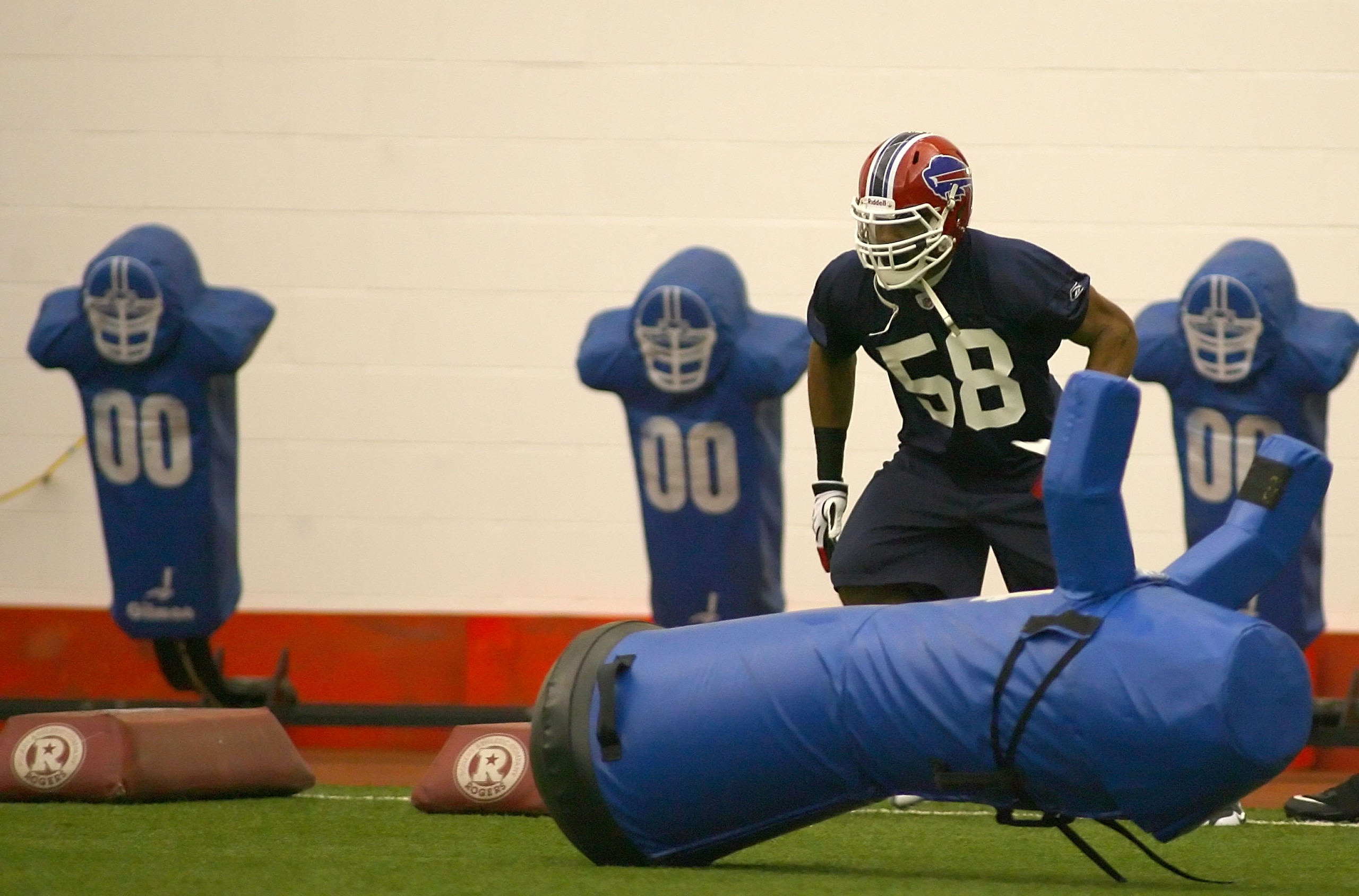
Aaron Maybin has the dubious distinction, along with the New York Jets' Vernon Gholston, of being a former first round selection to most quickly earn the bust label as a professional.
It was a given that Maybin was extremely raw coming out after just one successful season at Penn State and would likely take some time to get physically and mentally acclimated to the professional level, but his pure athletic talent was so great that it was thought that he could at least contribute as a pass rush specialist early in his career while he slowly developed into a three down defender.
That was simply not the case. In two NFL seasons Maybin has only 24 total tackles and not a single sack to his name. It was assumed that Buffalo’s switch to a 3-4 defense in 2009 would better suit his skills and result in a boost in his production, but he’s proven to be utterly ineffective regardless of whether he’s playing on his feet or with his hand in the dirt.
Recently his own head coach, Chan Gailey, threw Maybin under the bus when he stated that he just doesn’t see any spark from the young pass rusher in practices or in games. A statement like that is solid evidence that Maybin may not be in the Bills’ plans after 2011, or in the league at all for that matter. It doesn’t help Maybin’s case for not being an awful pick, at least for comparison's sake, when considering the Bills could have used the 11th pick on pass rushers Brian Orakpo or Clay Matthews or even better on quarterback Josh Freeman, who is showing signs of being a franchise signal caller in Tampa Bay.
12. LEODIS MCKELVIN (CB, TROY) – BUFFALO BILLS – 2008
12 of 32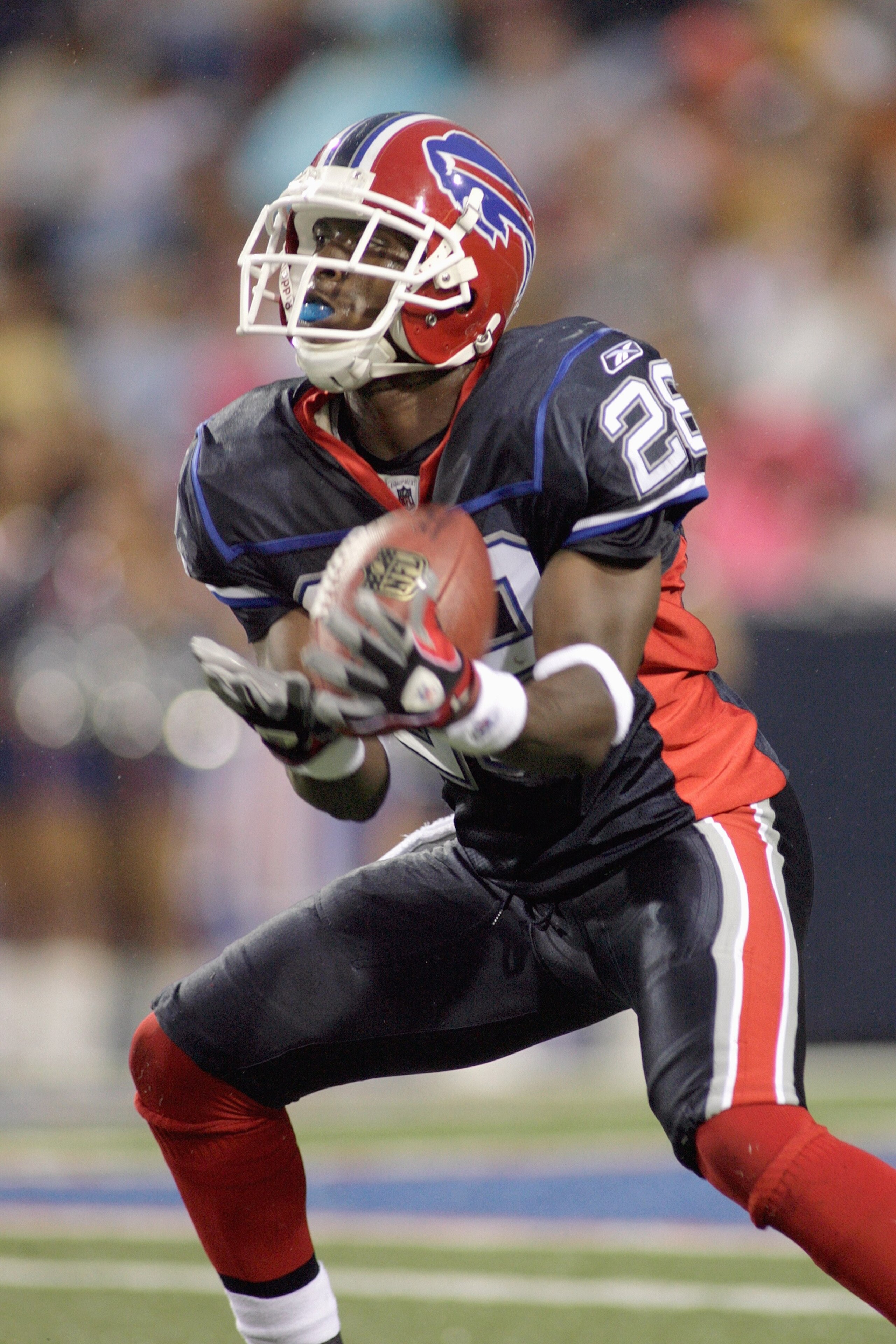
All NFL teams need a solid nickel or secondary corner and capable return man, but that’s not what you look for when making the 12th selection in the NFL Draft. That’s exactly what Leodis McKelvin has become for the Buffalo Bills.
In his two healthy seasons, his sophomore year was cut short by a broken leg suffered during the third week of the 2009 season. McKelvin has recorded four picks while displaying on again, off again coverage skills. Chan Gailey recently commented that he felt McKelvin “left something on the table” in 2010 and implied he’ll have to step it up in 2011 if he wants to remain the starter opposite Terrence McGee.
It’s not fair to label Leodis as a bust as he could still develop and has shown some flashes of potential. What is fair, though, is to say that Buffalo would’ve been much better off as an organization had they looked elsewhere, namely at left tackle where a future Pro Bowler Ryan Clady was still on the board.
Ultimately, 2011 figures to be the make or break year for McKelvin deciding whether he’ll be a difference maker or merely just another average corner.
13. ADAM CARRIKER (DE, NEBRASKA) – ST. LOUIS RAMS – 2007
13 of 32
St. Louis entered the 2007 Draft with the intent of improving the NFC’s worst run defense and the interior of the defensive line as a whole.To that end the organization selected Nebraska defensive end, Adam Carriker, with the 13th pick with the idea that Carriker was big enough at nearly 300 lbs. to be moved inside to defensive tackle.
Gifted with great strength and an impressive burst St. Louis Defensive Coordinator Jim Haslett attempted to use Carriker as a three-technique pass rusher that doubled as a capable run defender; however, Carriker could not adjust to playing inside and did not have the impact that was hoped for.
The team continued to rank amongst the worst run defenses in the NFL during his short three year stint, a year of which he did not play in any games due to shoulder injury suffered in the preseason. He also contributed only two sacks, both of which came during his rookie year.
He was traded to the Redskins in April of 2010 reuniting him with Haslett, now Defensive Coordinator in Washington, who admitted to not using Carriker in a manner that best suited his style of play in St. Louis and the former Cornhusker seems to have found a professional fit as a run stuffing end in a 3-4 scheme.
In hindsight the Rams’ defense would’ve been much better off with the addition of either Florida State’s Lawrence Timmons or Miami’s Jon Beason at linebacker or better yet future All Pro corner Darrelle Revis who went to the Jets one pick later.
14. CHRIS WILLIAMS (OT, VANDERBILT) – CHICAGO BEARS – 2008
14 of 32
Following the 2007 season, Bears' General Manager Jerry Angelo began the process of overhauling an aging offensive line. With that goal in mind Chicago selected Chris Williams out of Vanderbilt to add youth and depth behind aging veterans John Tait and Orlando Pace and to become the heir apparent at left tackle in place of the recently signed stop gap Pace.
During his rookie season Williams acted as a reserve swing tackle before stepping into the starting line up on the right side to replace Tait after the vet’s retirement following 2007. Shortly thereafter he was prematurely forced over to the ever-important left tackle spot due to Orlando Pace’s health and rapidly declining inconsistent play. Williams didn’t fare much better than Pace giving the Bears more of the same after he too battled injuries and spotty on the field performance. The experience didn’t prove beneficial either as Williams continued to struggle last season.
Realizing the he was not a legitimate solution at either right or left tackle Offensive Line Coach Mike Tice moved Williams inside to left guard with little success. Speculation is that he’ll receive one more shot on the right side in 2011. Failure to establish himself could put his roster spot in great jeopardy after the season.
Lucky for Williams he should have received a fine education from Vanderbilt because his career as an NFL lineman may not be a very long one.
15. TYE HILL (CB, CLEMSON) – ST. LOUIS RAMS – 2006
15 of 32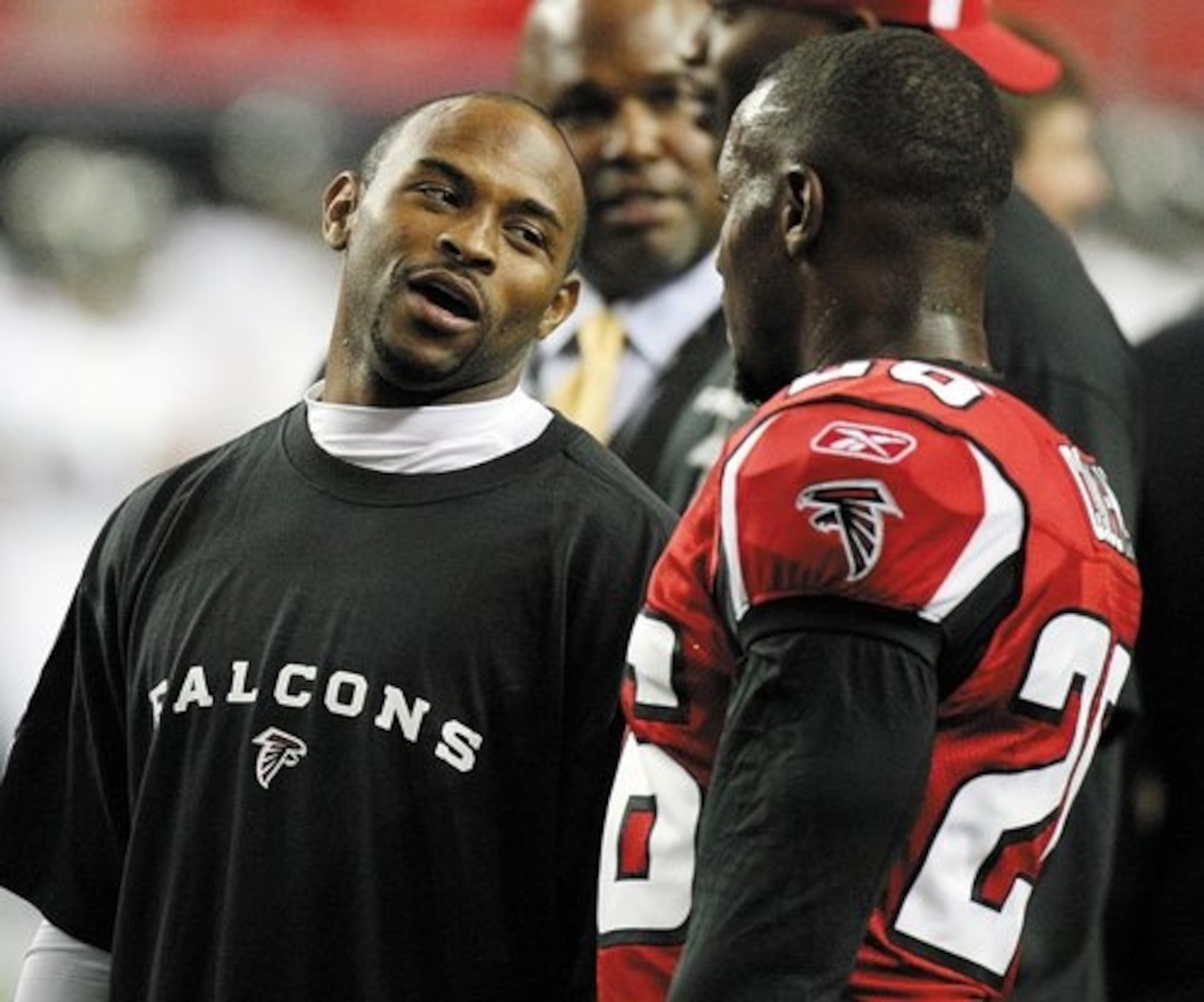
Scott Linehan did not experience much success with the draft during his short tenure in St. Louis with his first draft pick as a head coach being no exception.
Tye Hill’s career with the Rams got off to good start with him starting 10 games his rookie year and earning All-Rookie Team honors. He was on pace to becoming a solid primary NFL corner when injuries set in during his second year and it was all downhill from there. Hill finished his next 2 seasons on injured reserve, for a back injury in ’07, then for torn cartilage in his knee in ’08, playing in 12 games over that span. Unfortunately for Hill and the Rams the injuries prevented him from ever being able to build upon his promising rookie campaign.
He was traded to the Atlanta Falcons prior to the 2009 season for a seventh round pick and has since bounced around the league spending a year in Atlanta, Tennessee, who waived him before he played a single regular season, and most recently Detroit as reserve corner.
As a soon to be 29 year old free agent with trouble staying healthy, it’s debatable if he has a future in the NFL or if he has played his last down in the league.
16. TRAVIS JOHNSON (DT, FLORIDA STATE) – HOUSTON TEXANS – 2005
16 of 32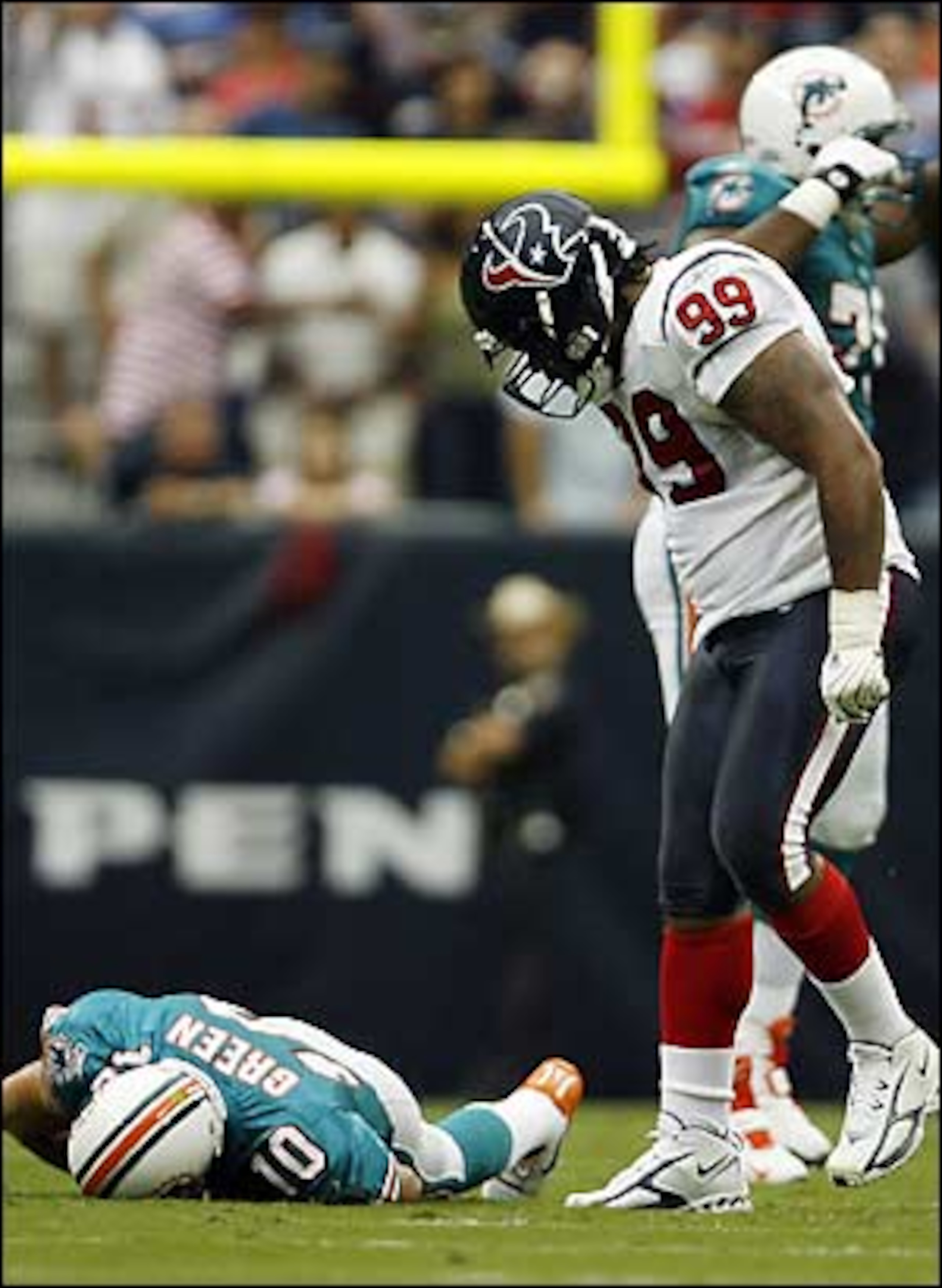
Dom Capers drafted Travis Johnson in 2005 hoping he would have the same type of immediate impact that his former Seminole teammate, Darnell Dockett, had a year earlier for Arizona. On the contrary, the Florida State alums could not have experienced more differing rookie years, and ultimately careers, in the NFL.
Johnson saw limited action as a rookie playing end in Caper’s 3-4 scheme, a position that he was ill suited for. There was hope that with Capers out as head coach new Defensive Coordinator Richard Smith bringing a 4-3 scheme to Houston that Johnson would break out in his second year with the Texans thanks to a return to his natural position inside at defensive tackle.
Those hopes were dashed after nine games when a calf injury ended his season prematurely. His next two seasons in Houston where characterized by laziness and more nagging injuries. The Texans finally gave up on the career underachiever after four years in which he produced just two sacks and traded him to the San Diego Chargers in August of 2009 for a sixth round pick.
In his 2 years in San Diego Johnson has recorded one sack, bringing his career total to three, and hasn’t started a single game. Johnson has become best known for taunting an unconscious Trent Green after the Dolphins’ quarterback attempted to block him in 2007.
Houston could’ve avoided a strike out with Johnson and hit a home run if only Dom Capers had been wise enough to finally move on from David Carr and select the Cal quarterback Aaron Rodgers who was unbelievably still available.
17. JARVIS MOSS (DE, FLORIDA) – DENVER BRONCOS – 2007
17 of 32
With starting ends Ebenzer Ekuban and Kenard Lang, both over 30 years old, and a young Elvis Dumervil not possessing the size of an every down NFL end, Denver needed a young, promising pass rusher.
Believing Jarvis Moss to fit the bill, Denver selected the talented former Gator to be the franchise’s future at the defensive end position. Far from a franchise cornerstone Moss didn’t even prove to be a competent start for Denver producing 3.5 sacks and a single start, coming during his rookie season, over the course of four years with the organization.
Moss never played a full 16 game season and only once appeared in more than 10 games. He went sack-less in his final two years after a move to outside linebacker in Mike Nolan’s 3-4 defense even though Elvis Dumervil was the focal point of opposing blocking schemes.
His unremarkable career as a Bronco, featuring total failure at two positions, came to an end this past year when he was released in November. He caught on shortly after with the Oakland Raiders where he has unsurprisingly remained a non-factor.
A wiser choice for Denver would have been to take Miami’s Jon Beason to replace Al Wilson at middle linebacker, who had just been released two weeks earlier and would eventually retire without playing another season.
18. ERASMUS JAMES (DE, WISCONSIN) – MINNESOTA VIKINGS – 2005
18 of 32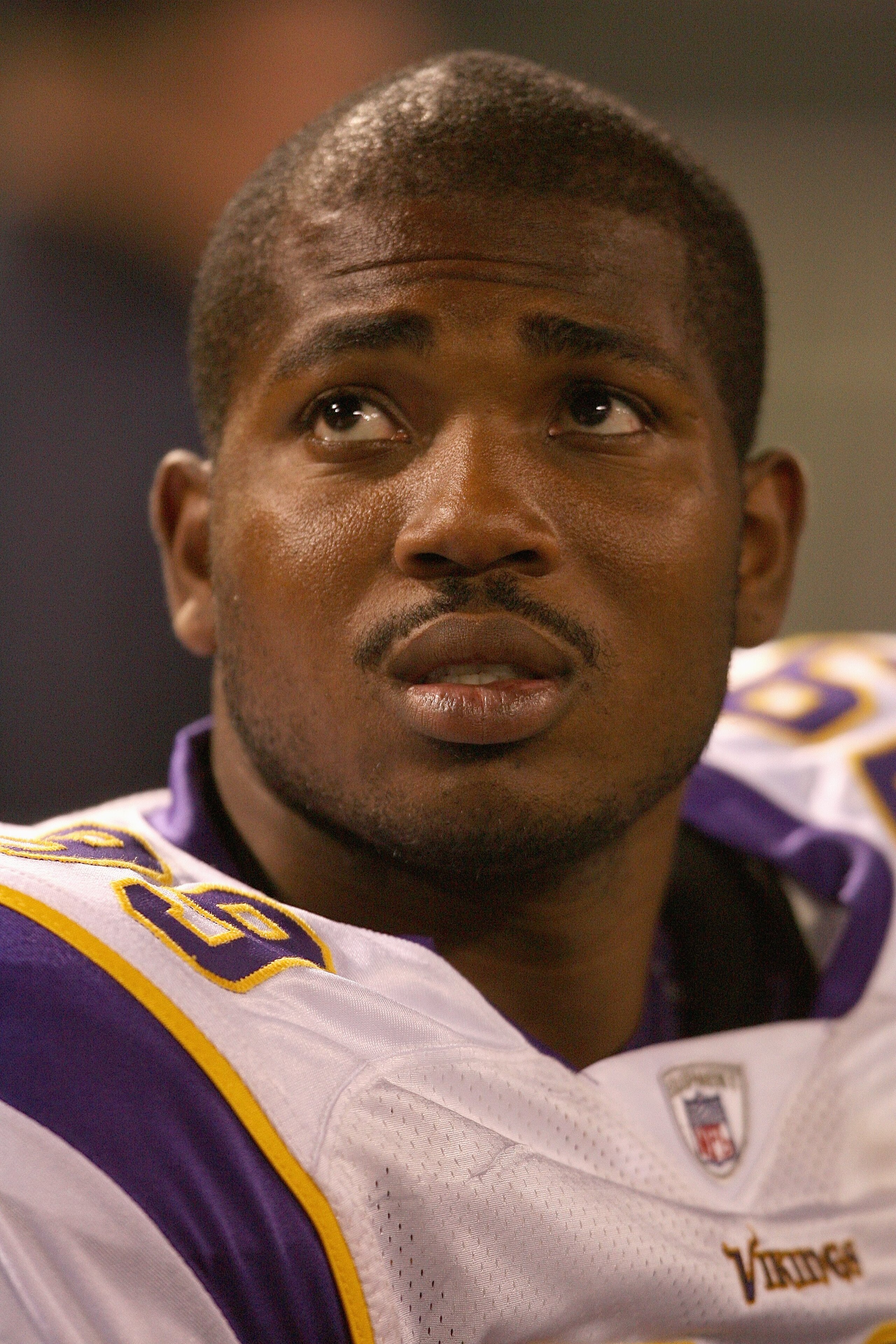
Eramus James was the NCAA’s most feared pass rusher in 2004 earning Big Ten Defensive Player of the Year as well as All-American honors and was considered the best pass rusher of the 2005 draft class.
Due to serious durability concerns he fell all the way to the 18th pick where the Vikings selected him to be a bookend across from Kenechi Udeze. After a respectable four sack rookie year those durability concerns proved to be well founded. In 2006 he tore his ACL and partially tore his PCL resulting in trip to the IR after two games. He then tore the ACL in his left knee for a second time in 2007 which resulted in three knee surgeries in just 12 months.
The Vikings waived James after his third season believing the he could not and would not ever be healthy enough to contribute and would have little burst left in the off chance that he was able to stay on the field.
The Washington Redskins took a chance on the then 25-year-old pass rusher in 2008 hoping he still had some explosiveness left after all the surgeries. In the end the injuries robbed James of his ability to beat linemen off the snap, rendering him incapable of making an impact.
In the three seasons since his rookie year he appeared in 13 games and recorded just a single sack. His NFL career drew to an unofficial close in September of 2009 after Roger Goodell suspended him indefinitely for a violation of undisclosed league roles, most likely the league’s substance abuse policy.
Most recently James found his way into the news for pleading guilty to an assault charge stemming from a November 2010 bar fight near his alma matter in Madison, Wisconsin.
19. ALEX BARRON (OT, FLORIDA STATE) – ST. LOUIS RAMS – 2005
19 of 32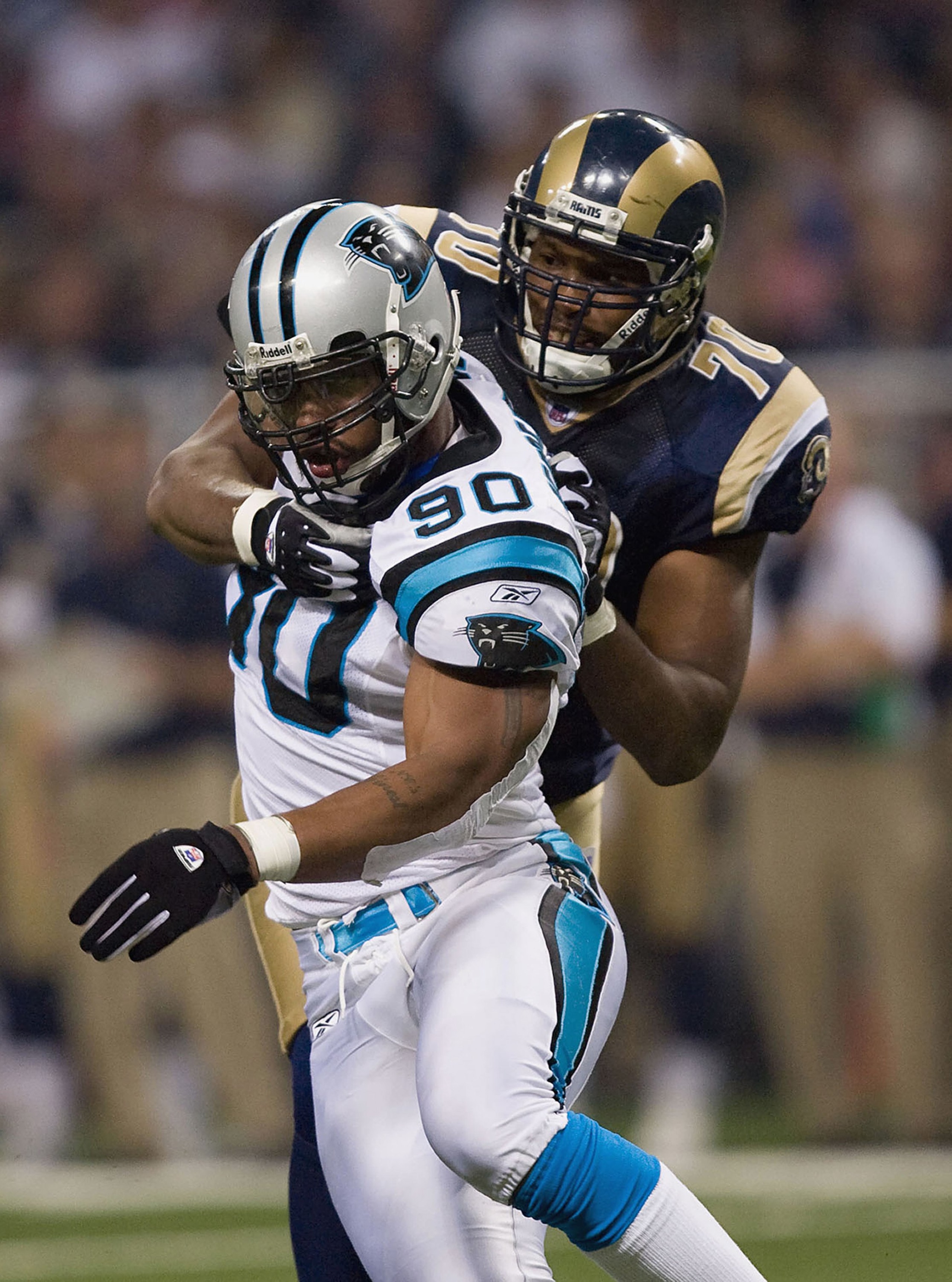
During the pre-draft workouts leading up to the 2005 Draft Alex Barron sure looked the part of a future NFL left tackle measuring in at 6’7, 317 pounds while running a 4.87 40-yard dash.
St. Louis bought into the act selecting Barron to be a bookend and heir apparent to an aging Orlando Pace on the left side. The relationship got off to a rough start when Barron staged a holdout before his first camp, but amends were made and he was able to win the starting job at right tackle as a rookie.
After three seasons on the right side, Barron was installed as Marc Bulger’s blindside protector when the Rams released Pace in 2008. Regardless of which side he was on Barron never could live up to his vast potential. In his five years as a starting tackle for the Rams he simply could not follow the rules with over 70 penalties being called against him, a mark bested only by Flozell Adams during that time frame. Even with all those penalties Barron could not gain a competitive edge against opposing pass rushers, giving up an inexcusably high 33 sacks over that same five year period.
The selections of Jason Smith in 2009 and Roger Saffold in 2010 and their subsequent success at the tackle spots made Alex Barron an expendable commodity in St. Louis. He was traded to the Dallas Cowboys for fellow first round bust Bobby Carpenter before the 2010 season. Neither prospect went on to turn their careers around.
20. AARON ROSS (CB, TEXAS) – NEW YORK GIANTS – 2007
20 of 32
After a promising 6-2 start in 2006 the Giants laid an egg with a 2-6 finish and a wild card round playoff loss to division rival Philadelphia. New York played inconsistently in all phases of the game over the later portion of the season with the pass defense being no exception. Veteran free agent signees R.W. McQuarters, Sam Madison and Will Demps did little to improve the secondary contributing average play at best.
Given that both McQuarters and Madison were over 30 years old at the time the G-Men went with 2006 Jim Thorpe Award winner Aaron Ross with their first pick expecting the youngster to develop into a future starter under the well experienced veterans, McQuarters and Madison. His development was sped up though when injuries forced him into the starting lineup as a rookie and it looked like the Giants hit a home run when he rose to the challenge picking off three passes that season.
After a solid sophomore campaign featuring a Super Bowl victory injury issues began for Ross. Hamstring issues cost all but four games in 2009 and second year corner Terrell Thomas stepped up in his place forcing a camp battle before last season for the starting spot opposite Corey Webster. The competition drew to a close when plantar fasciitis ended Ross’ preseason early leaving the job for Thomas.
Upon his return during Week 2 Ross was forced into a nickel role and that of a return man where he figures to stay barring an injury to Thomas or Webster. Despite two productive seasons you cannot argue that New York would have been best served by selecting Miami free safety Brandon Meriweather who has become a Pro Bowler for the Patriots and would have secured a position that continues to be a problem spot for the Giants even after the signing of high priced free agent Antrel Rolle last offseason.
21. MATT JONES (WR, ARKANSAS) – JACKSONVILLE JAGUARS – 2005
21 of 32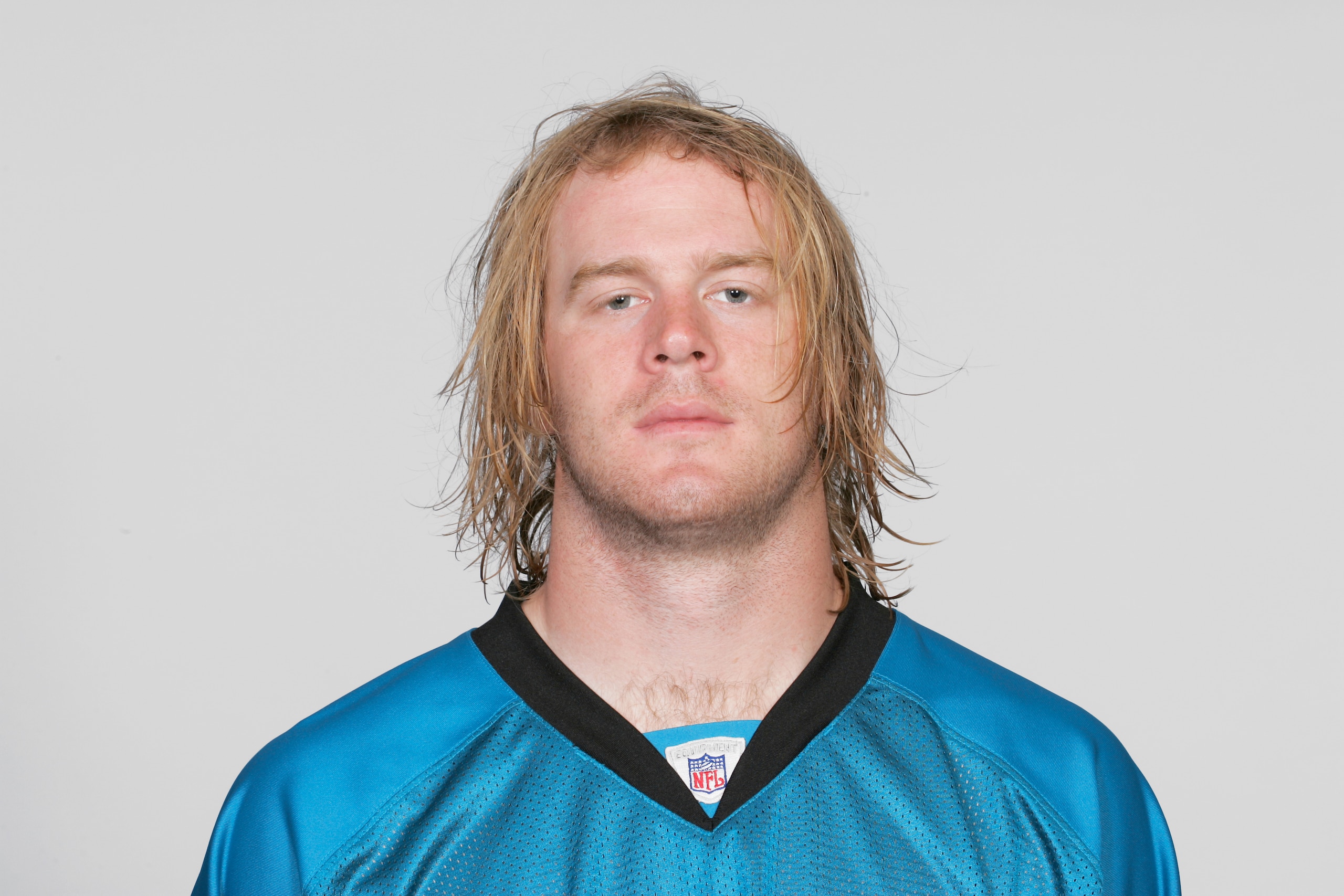
Despite just having selected wide receiver, Reggie Williams, a terrible pick in his own right the year before with the ninth overall pick, the Jacksonville Jaguars were just too enamored with Matt Jones’ unparalleled athletic ability and chose to ignore other areas of need such as tight end or corner, even with top prospects Heath Miller and Fabian Washington still on the board, and select the former Razorback QB with hopes of turning him into an NFL wide receiver.
The NFL Combine set the stage for Jones to give teams the idea he could make that change when he wowed scouts measuring in at 6’6 and 237 pounds with 4.37 speed and a 39.5-inch vertical leap. At that size and with that athletic ability it was thought that the former quarterback could become a game changing wide receiver at the next level once he learned to play the position.
Long story short he never did learn to play the position, at least not very well, not becoming a starter until his fourth season and never being more than a secondary target in a very bad wide receiving core. That was the least of Jones’ problems though.
In 2008 he was arrested for possession of cocaine and spent a short time in jail for violating his probation that resulted from that incident. The incident also earned him a three game suspension from the NFL and was a factor in the Jaguars decision to release him in an effort to rid their roster of players with questionable character under new General Manager Gene Smith.
He never caught on with another team after receiving the boot from Jacksonville, choosing to retire after a failed attempt to make the Cincinnati Bengals’ 2010 roster.
22. BRADY QUINN (QB, NOTRE DAME) – CLEVELAND BROWNS – 2007
22 of 32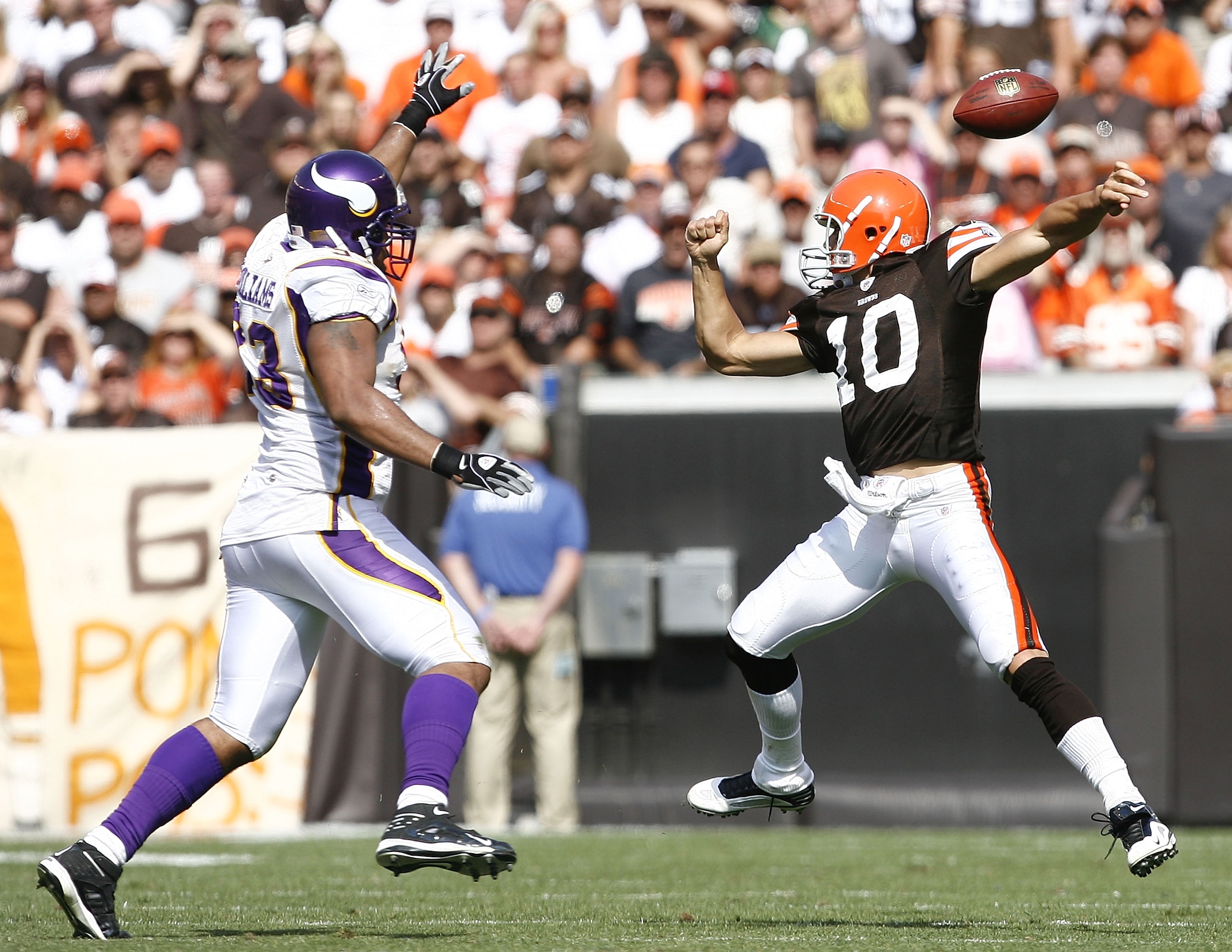
Figuring that he was a top 10 lock, the NFL extended an invite to Brady Quinn to attend the 2007 Draft, which, likely being under the same impression, he obviously accepted.
What followed was one of the most memorable and uncomfortable events in draft history. After the Miami Dolphins passed on selecting Quinn with the ninth pick, the television cameras fixated on the obviously distressed quarterback as he became visibly more distraught as each pick passed, until finally the Cleveland Browns traded their 2007 second rounder and 2008 first rounder to the Dallas Cowboys to move back into the first round to select the All-American passer at the 22nd pick.
The Browns organization thought it was the beginning of new era. General Manager Phil Savage proclaimed this draft would be cited as the one that turned the fortunes of the team. Quinn and the Browns did not live happily ever after though. His stint with the Browns got off to a bad start with a camp holdout that put him at a disadvantage in the competition for the starting quarterback job, which Derek Anderson secured during Week 2 en route to a Pro Bowl season.
Anderson entered 2008 as the starter off of the strength of his previous year, but struggled not far into the three games. He found himself again in competition with Derek Anderson for the starting job in 2009 under new Head Coach Eric Mangini. Although he won the battle he was benched by halftime in Week 3 in favor of Anderson and Mangini continued to go back and forth between the two until a foot injury landed Quinn on the IR.
After three seasons featuring 12 starts and only 10 touchdowns the Browns, more specifically new team president Mike Holmgren, had seen enough. Quinn was traded to the Denver Broncos for Peyton Hillis, a sixth round pick in 2011, and a conditional later rounder in 2012 in what is seen as one of the worst trades in recent memory—Hillis has become a workhorse feature back for the Browns while Quinn serves as a third string back up in Denver behind Kyle Orton and Tim Tebow.
23. FABIAN WASHINGTON (CB, NEBRASKA) – OAKLAND RAIDERS – 2005
23 of 32
Leave it to Al Davis to jumble what could have been one of the most fortunate moments in the history of the Raiders franchise.
Shockingly when the Raiders went on the clock for the first time in the 2005 Draft Cal’s Aaron Rodgers was there for the taken. With a 39-year-old Rich Gannon going on the IR during Week 3 and Kerry Collins tossing 20 picks in 14 games during the prior season the Raiders were in definite need of a quarterback and couldn’t have asked for a better prospect than Rodgers, who was a local product who many thought the 49ers should’ve taken with the first pick instead of Alex Smith.
Instead of selecting a potential franchise cornerstone for the next decade Al Davis stuck to his usual draft strategy and took Nebraska corner Fabian Washington based largely on the stunning speed he displayed during his pre-draft workouts.
Since then Aaron Rodgers has become a Super Bowl winning franchise quarterback for the Green Bay Packers and Fabian Washington spent three seasons with the Raiders before signing with the Baltimore Ravens where he has become a fringe starter in a weak cornerback core.
Al Davis’ 2005 blunder remains one of the most staggering displays of poor judgment in draft history, even by his standards.
24. PERIA JERRY (DT, MISSISSIPPI) – ATLANTA FALCONS – 2009
24 of 32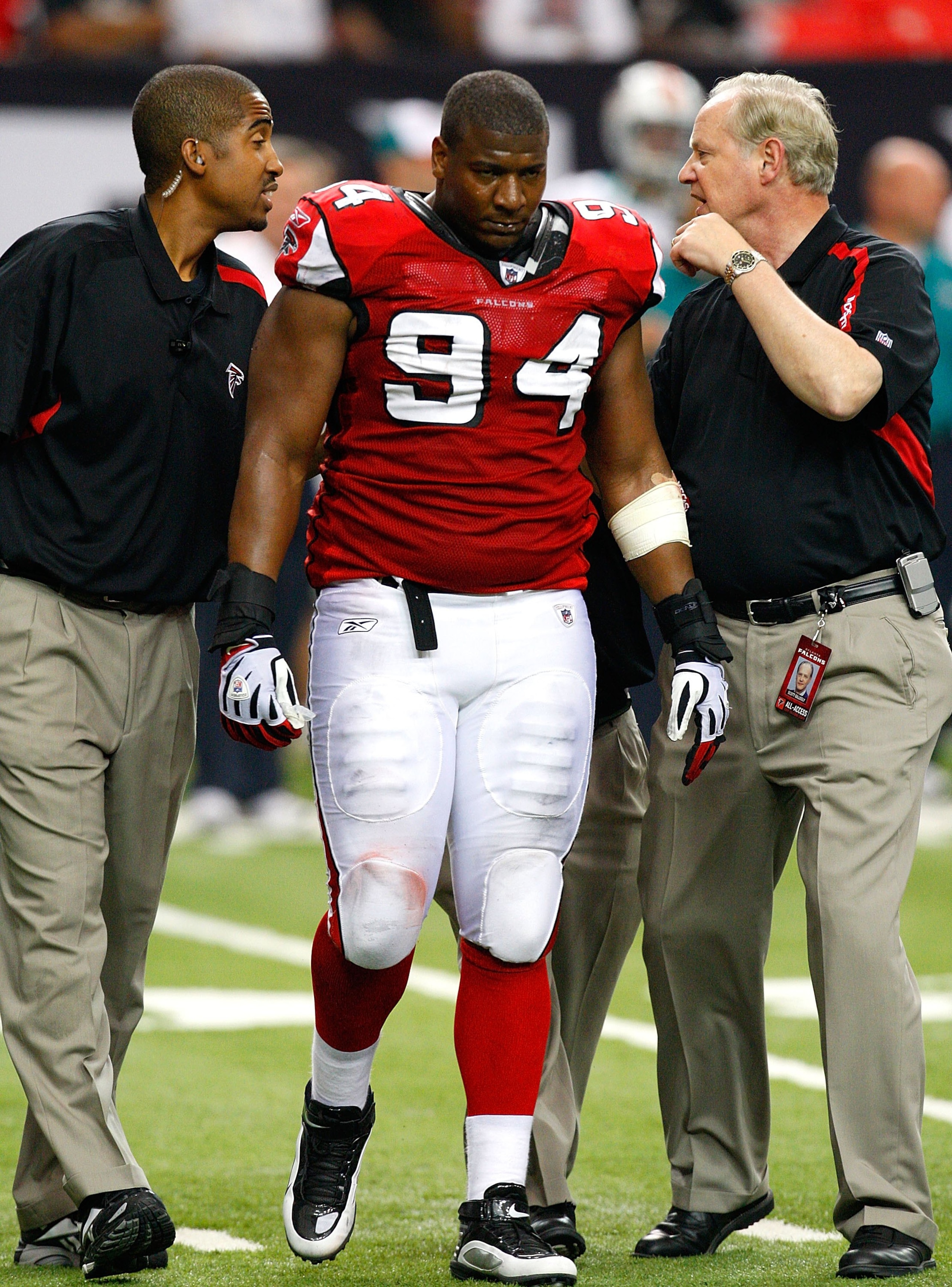
Peria Jerry is in danger of watching his NFL career end in disappointment before ever really getting a chance at success.
He came to Atlanta to help improve the struggling run defense and was ready to meet those expectations immediately earning a starting spot at defensive tackle before the end of training camp. He would not hold that spot for long though after a major knee injury suffered during the second game of the season landed him on the injured reserve list.
After having a successful surgery Jerry was ready to reclaim his starting spot during the Falcons' most recent training camp, but it was clear that he lacked the explosiveness and power he displayed as a rookie and as a result he failed to regain his position in the starting lineup. He was limited to only 15 to 20 snaps a game in 2010 as a situational player on passing downs amassing just nine tackles and two sacks by season’s end.
While it’s far too early to assume that Jerry’s explosiveness will not return and slap him with the bust label, based on 2010 things are not looking good even though Head Coach Mike Smith did recently give the former first rounder a vote of confidence. The 2011 season will likely ultimately prove whether Peria Jerry will ever be able to recapture that spark he showed in the preseason as a rookie or if that 2009 knee injury truly marked the beginning of the end of a short NFL career.
25. JASON CAMPBELL (QB, AUBURN) – WASHINGTON REDSKINS – 2005
25 of 32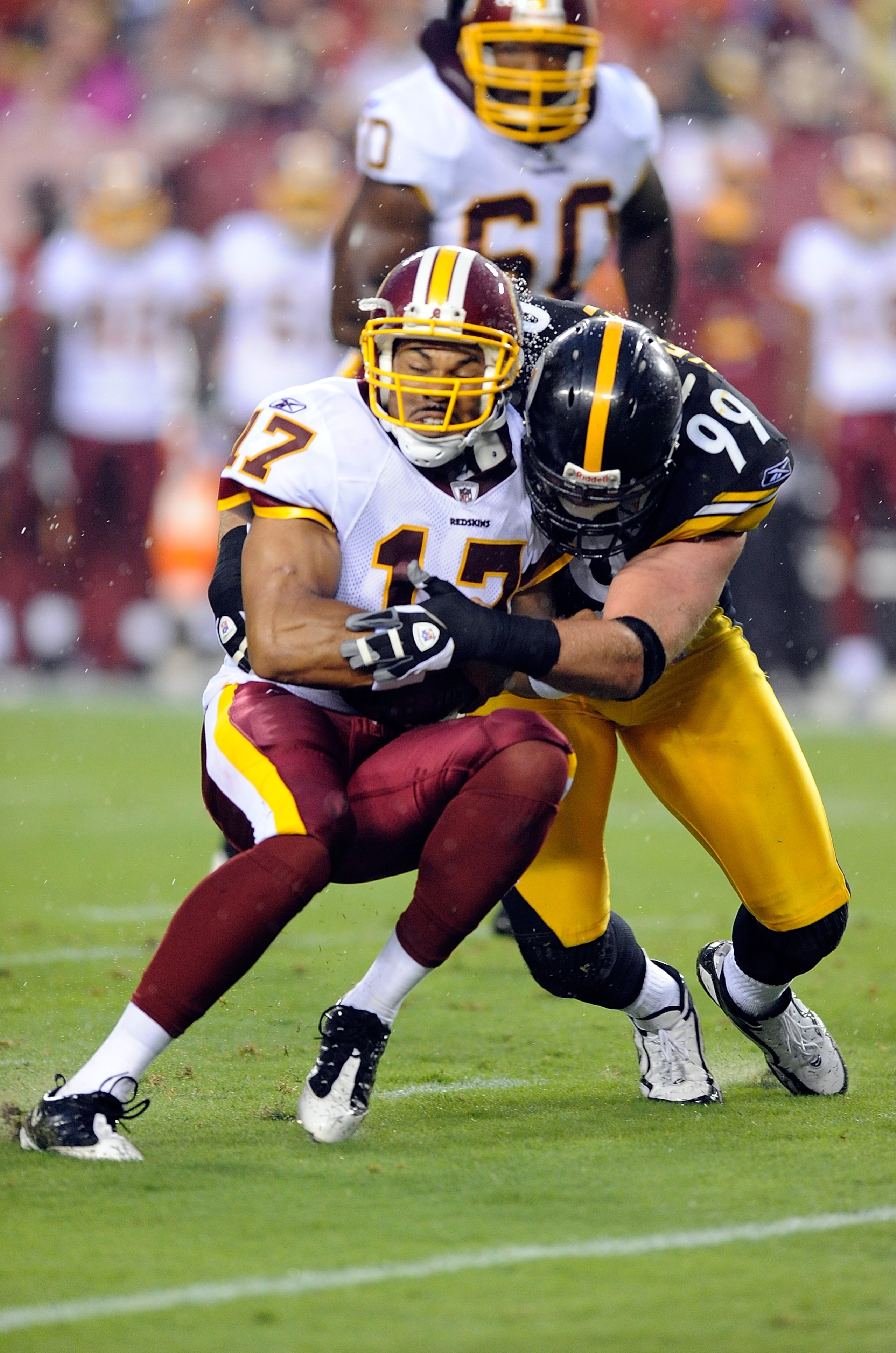
To Jason Campbell’s defense it's actually a testament to his talent and maturity that he has been able to develop into an NFL starter as he has spent his career in unstable organizations, first Washington and now with Oakland, that have done little to support him. Additionally, it’s more so the decision making process of the Redskins’ organization than Campbell’s play that make this a bad selection.
Washington actually traded up to this spot to select the Auburn quarterback in 2005. What is puzzling though is why they organization did not trade up higher to land Aaron Rodgers, who went 24th to Green Bay. It was debatable depending on whom you asked whether Aaron Rodgers or Alex Smith was the draft’s best quarterback prospect, but almost everyone had Campbell as a distant third behind those those— most did not even have him as a first rounder.
Ultimately, Campbell was solid albeit unspectacular in five years in Washington, with four as a starter. Owner Daniel Snyder always wanted an elite talent and that prevented Campbell from ever earning the full confidence of the franchise. Most notably the ‘Skins tried unsuccessfully to land Jay Cutler and Mark Sanchez before the 2009 season placing Campbell in a compromising position, which to his credit he handled like a professional.
He was moved to Oakland after Mike Shanahan brought in Donovan McNabb before the 2010 Draft and there his career appears to be continuing on the same steady, unremarkable path. All things considered Washington should have mustered up the necessary ammo to trade up high enough to land Rodgers and that is what truly makes this a poor pick.
26. JOHN McCARGO (DT, NORTH CAROLINA ST.) – BUFFALO BILLS – 2006
26 of 32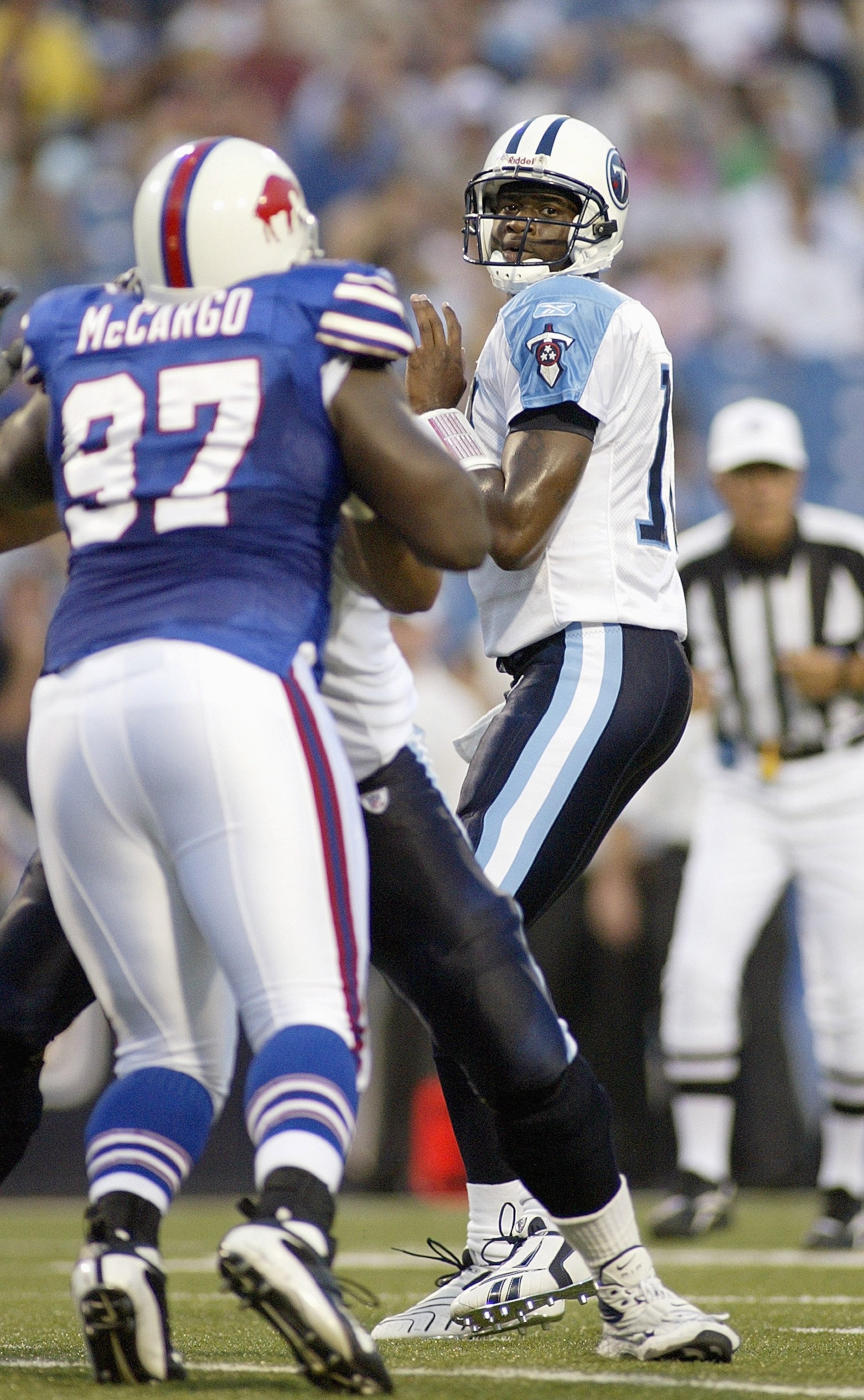
The end of the first round can be an exciting part of the draft with a few generally regarded top 15 or top 20 picks certain to slip through the cracks and a few prospect labeled as second rounders likely to get drafted earlier than expected. As a result some teams get lucky, some look ingenious, and some leave you just scratching your head, which the Bills did in 2006 when they traded their second and third round picks to the Chicago Bears to move back into the first round to select John McCargo.
Playing on the same North Carolina State line that featured fellow first rounders, Mario Williams and Manny Lawson, McCargo was generally seen as a late second to third round prospect who owed his production to those two talented ends flanking him. This is why it was so shocking to see the Bills trade up for him when they could have in all likelihood had him at a later point. Buffalo’s boldness failed to pay off.
McCargo has started all of one game in his five seasons with the Bills of which he played in more than 10 games just twice and only once played a full 16 game season, which happens to be the only season he managed to register a sack.
The organization tried to trade McCargo to Indianapolis before the 2010 season; however, a failed physical prevented the completion of the deal. He probably won’t be with the franchise much longer as he is a likely candidate to be released once a new CBA allows business as usual to get underway once again.
27. DONALD BROWN (RB, CONNECTICUT) – INDIANAPOLIS COLTS – 2009
27 of 32
It’s hard to label a prospect a bust after just two NFL seasons, but Donald Brown is absolutely shaping up to be one.
The Colts’ selection of the NCAA’s leading rusher in 2008 was questionable to begin with as he didn’t seem to fit well within the context of their offense. Brown didn’t have the size of a power back to compliment Joseph Addai, nor did he have the speed or skills as a receiver to take over Addai’s role as the feature back. As a result he has had a difficult time carving out a role for himself in Indianapolis despite have plenty of opportunities to assert his claim as the long term answer in the backfield.
He has shown poor vision, as is evident by his 3.8 yard average over two years, and hasn’t been able to stay healthy long enough to show that he can handle the rigors of a full NFL workload. The lack of confidence the Colts’ coaching staff has in Brown was made blatantly clear in the team’s playoff loss to the New York Jets when a healthy Brown did not take the field for a single snap.
With Brown failing to even show a glimpse of future feature back potential during his first two professional seasons, it’s likely the organization will resign free agent Joseph Addai this offseason once it is able to do so, leaving Brown to settle into a likely permanent backup role.
If the Colts truly wanted a back that would have allowed them to them move on from Addai after 2010, then they should’ve had selected Pittsburgh’s LeSean McCoy, who would’ve fit very well with the offensive scheme.
28. LAWRENCE JACKSON (DE, USC) – SEATTLE SEAHAWKS – 2008
28 of 32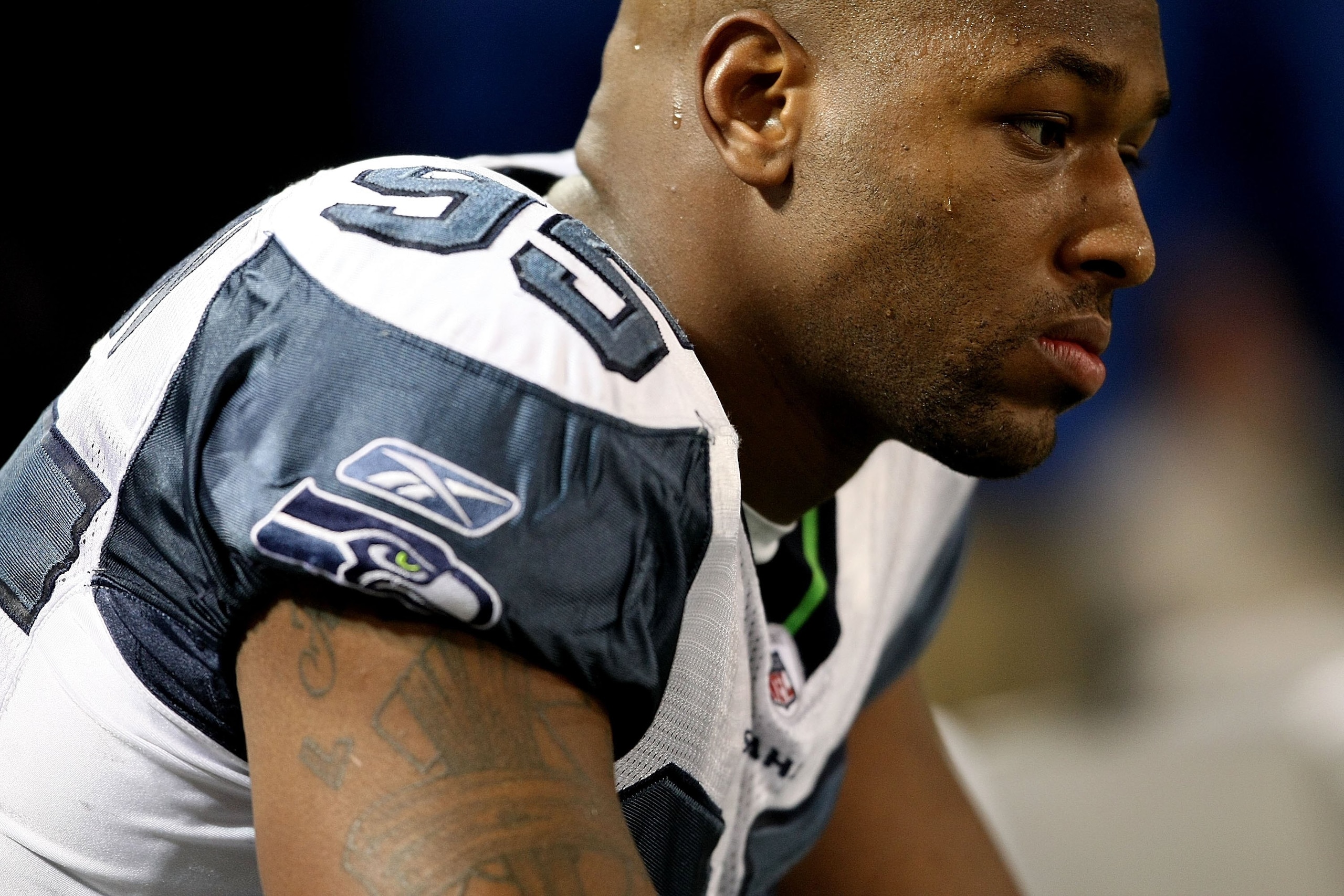
Lawrence Jackson was such a disappointment for the Seattle Seahawks that not even his old college coach Pete Carroll wanted to keep him on the roster, opting to jettison him to the Lions for a sixth round pick after he lost his starting job to Red Bryant, a defensive tackle, during Seattle’s 2010 training camp.
With 51 college starts under his belt only Phillip Rivers came to the NFL with as much experience. Needless to say, Jackson figured to be an immediate contributor at the next level. He did manage to secure a starting job as rookie, but struggled to get to the quarterback, garnering two sacks in 14 starts.
He retained his starting job his sophomore season with only slightly better results. Most thought the hiring of Pete Carroll would be a good thing for the former Trojan, instead it surprisingly lead to the end of his tenure with the franchise. He now plays in a reserve role for the Detroit Lions and actually had a respectable season with six sacks in limited action, not exactly first round pick production though.
The Seahawks would’ve been better off selecting Cal wide receiver, DeSean Jackson; Rutgers running back, Ray Rice; or any of the talent corners who went in the second round of the 2008 Draft.
29. KENTWAN BALMER (DT, NORTH CAROLINA) – SAN FRANCISCO 49ERS – 2008
29 of 32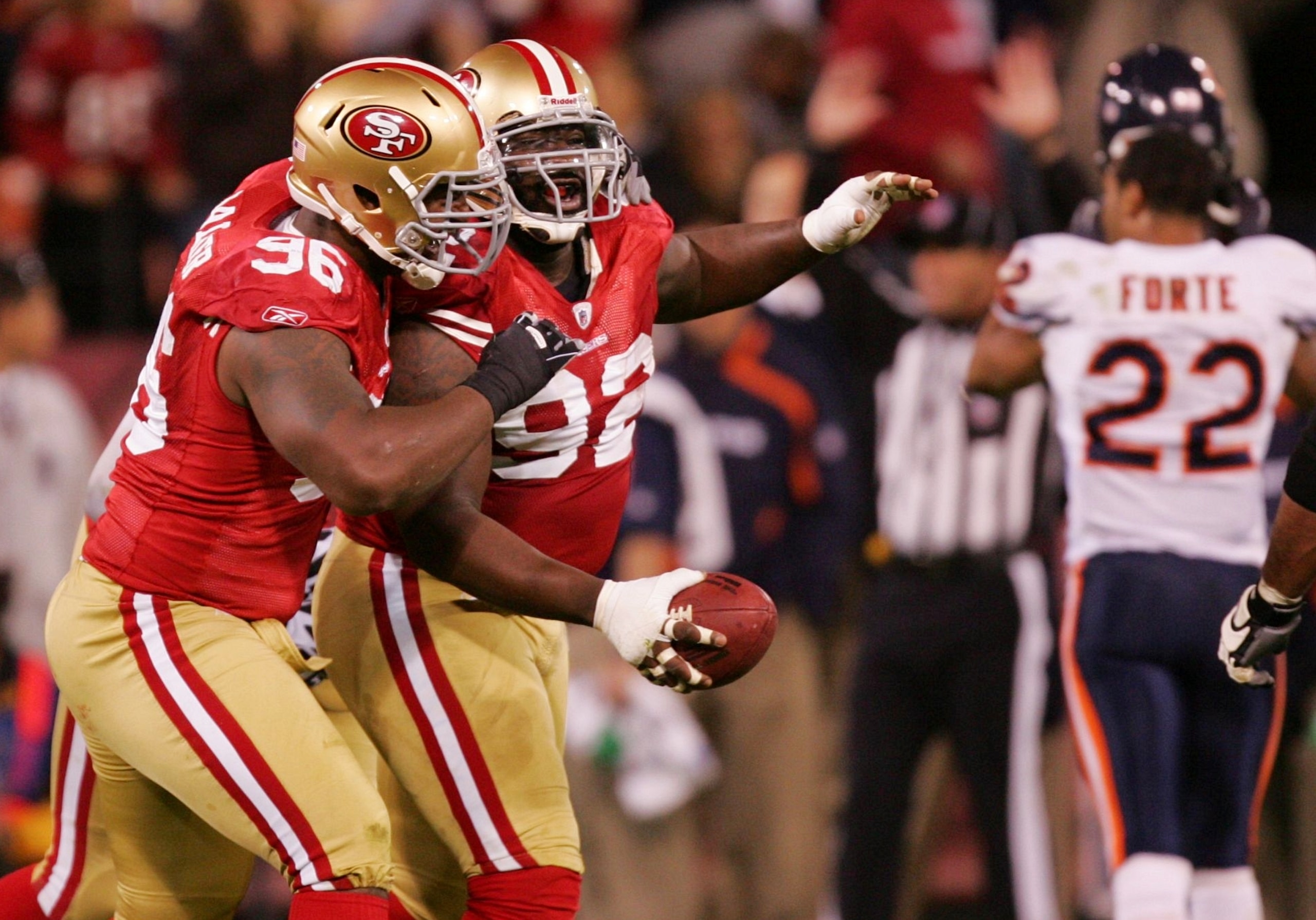
San Francisco Head Coach Mike Nolan needed to find an impact player in the 2008 Draft who could help cool the hot seat he was sitting on after three straight losing seasons in the Bay Area.
After passing for the fewest yards per game in the NFL in 2007 and scoring only 15 touchdowns through the air Nolan surprisingly, and foolishly, opted not to select potential big play wide receiver DeSean Jackson out of Cal, a favorite in the Bay Area for obvious reasons. Instead, he stuck to his defensive roots and selected North Carolina defensive tackle, Kentwan Balmer, with the intention of moving him outside to defensive end in his 3-4 scheme, the last of many draft miscues made by Nolan.
Balmer never started a game or registered a sack as a rookie, while Jackson became a starter and deep threat for the Philadelphia Eagles. As for Nolan, he was fired after a 2-5 start and replaced by Mike Singletary who finished the season 5-4. Balmer has failed to show any improvement from his rookie season and after three years he has yet to register a sack in a regular season NFL game.
His relationship with the organization soured during the 2010 offseason when Balmer missed several practices due to “personal issue.” As a result he was sent to the Seattle Seahawks for a sixth round pick in August after paying the 49ers franchise back $800,000.
30. CRAIG “BUSTER” DAVIS (WR, LSU) – SAN DIEGO CHARGERS – 2007
30 of 32
Phillip Rivers finished his first season as a starter with an impressive stat line and General Manager A.J. Smith entered the 2007 offseason looking to get his young quarterback a big play receiver to throw to.
At the time the San Diego wide receiving core featured two raw youngsters in Vincent Jackson and Malcolm Floyd and an aging veteran in Keenan McCardell, who would not return to the squad in 2007. Davis was a puzzling selection for a potential number one given that he was never particularly productive during his career at LSU and was not even the primary target on the team, playing second fiddle to Dwayne Bowe.
He went on to have an unimpressive rookie season in which he barely saw the field, snagging a pedestrian 20 catches in 14 games. His real issues would begin during his second year when his season ended after four games due to a groin injury. He then played in just one game in 2008 and only seven in 2010. His ineffectiveness has had a negligible effect on the franchise thanks to the big play ability of tight end, Antonio Gates, and the emergence of receivers, Vincent Jackson and Malcolm Floyd, making Davis, ironically nicknamed Buster, an expendable commodity for San Diego.
He’s under contract for 2011 and San Diego will try to get a late round pick out of him via trade if they can though the team will likely end up cutting him rather than pay the $840,000 he stands to collect. With A.J. Smith historically being among the best talent evaluators when it comes to the draft, Craig Davis stands as evidence that even the best GMs can make mistakes on draft day.
31. KELLY JENNINGS (CB, MIAMI) – SEATTLE SEAHAWKS – 2006
31 of 32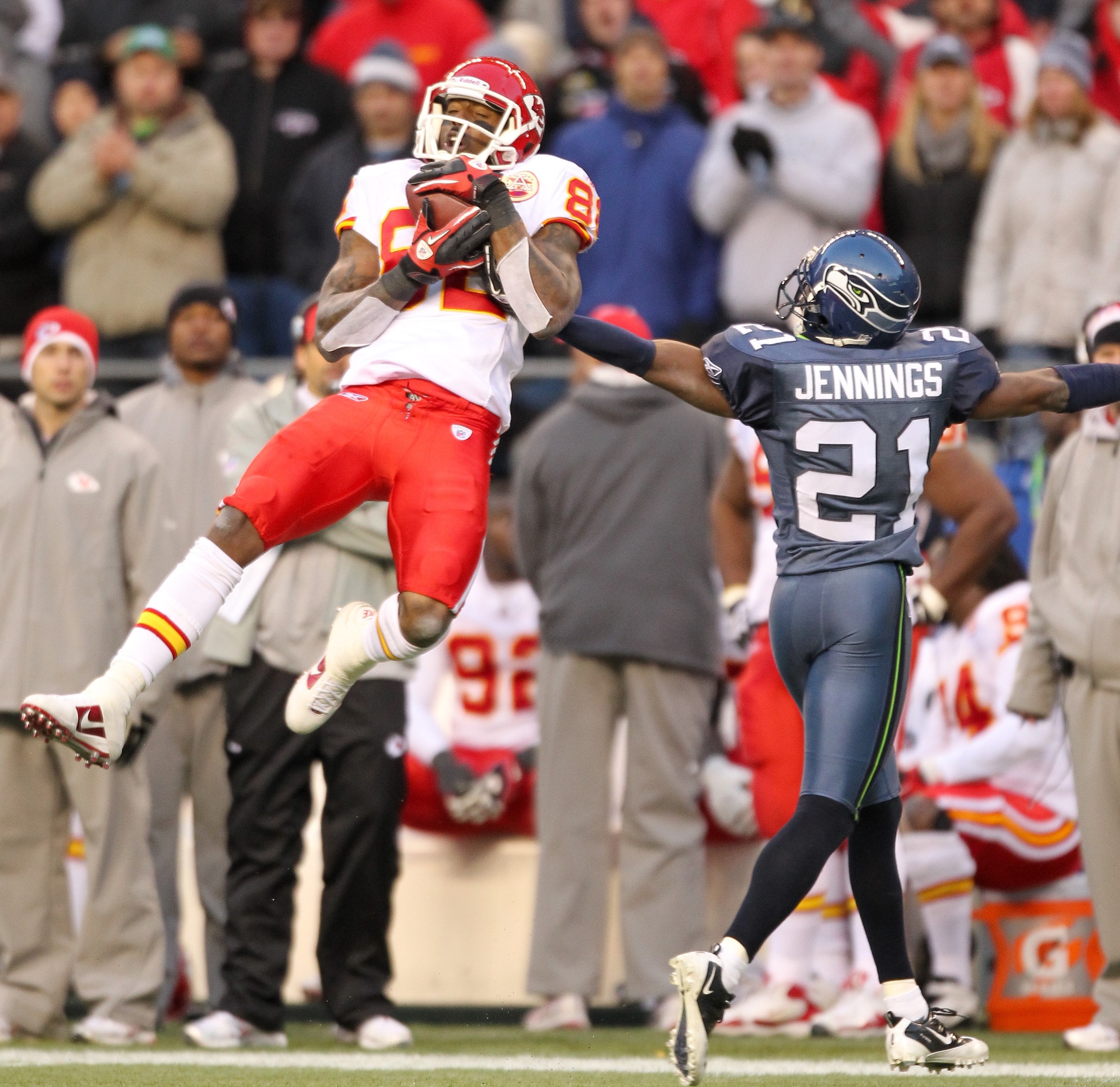
Coming off a crushing loss at the hands of the Pittsburgh Steelers, or the referees if you ask many Seattle fans or former Head Coach Mike Holmgren, in Super Bowl XL, Seattle needed an impact prospect from their 2006 first rounder—someone who could help them to another NFC crown and get the franchise its first Super Bowl title. Options included addressing the interior of the offensive line with Steve Hutchinson signing with Minnesota Vikings as a free agent; a back to spell Shaun Alexander who was averaging well over 350 touches a year, including the playoffs, over the previous three seasons; or a game breaker at wide receiver. Mike Holmgren ignored all those areas.
Instead, Holmgren opted to select a corner to fill in at the nickel back position and eventually become a compliment to Marcus Trufant. Jennings became both of those things for Seattle, he just hasn’t been very effective at either. He’s picked off a measly two passes in his five year career, one his rookie season and one this past year, leaving three whole seasons in between without a turnover.
Now at the end of his rookie contract it’s doubtful that he’ll continue his career as a Seahawk and will more than likely have to sign on somewhere else as nickel corner at best. Had Holmgren selected one of future Pro Bowlers Maurice Jones-Drew or Greg Jennings the Seahawks franchise would have found itself in a much more favorable position and potentially could’ve finally got that Super Bowl ring.
32. ANTHONY GONZALEZ (WR, OHIO STATE) – INDIANAPOLIS COLTS – 2007
32 of 32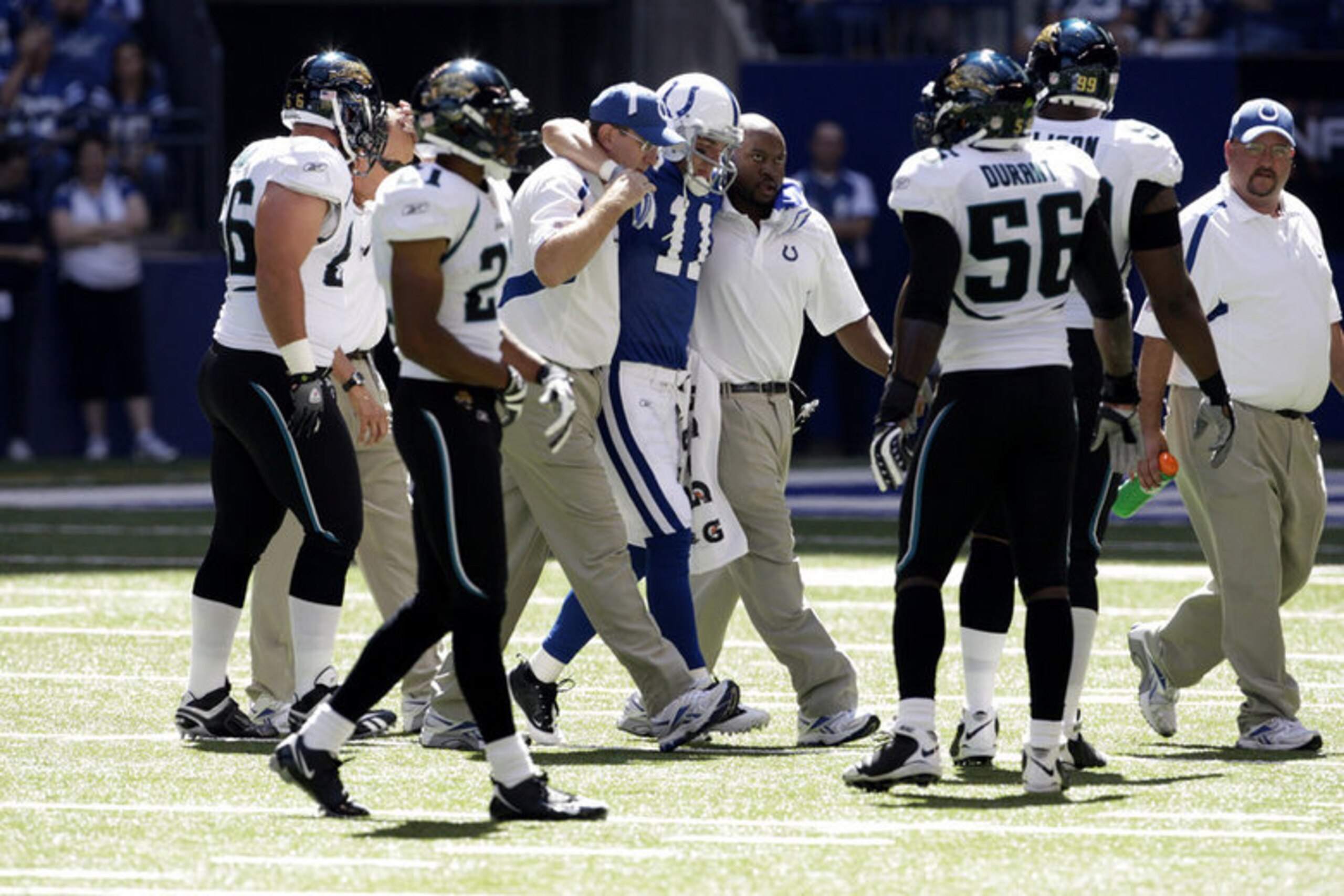
Winning the Super Bowl usually entitles a team to the luxury of simply selecting the best player available come draft day as Super Bowl champs tend not to have too many glaring needs. That was not so with the 2006 Super Bowl Champion Indianapolis Colts.
The Colts were atrocious against the run during their championship season giving up 173 yards on the ground a game. Fortunately for Indianapolis the rate that Peyton Manning and the offense were able to put points on the board often forced teams to abandon the run and take to the air in an attempt to keep pace. That being the case it came as a bit of a shock when Colts’ President Bill Polian selected Anthony Gonzalez, generally seen as a second round guy at the time, to add to a passing attack that was already the best in the NFL.
The former Buckeye did experience a moderate degree of success during his first two seasons and then injuries set in. In 2009, after earning the starting role opposite Reggie Wayne after Marvin Harrison was not resigned, Gonzalez injured his right knee in the first game of the season and was placed on the IR after making an unsuccessful attempt at a return that season.
During his absence wide receivers Pierre Garcon and Austin Collie stepped up to become major contributors in the Colts run to an AFC Championship. Consequently, when Gonzalez returned in 2010 he had to batte Collie to again be the slot receiver. The battle didn’t last very long due to Gonzalez suffering another knee injury, this time his right knee, ultimately allowing Collie to solidify his role as the third wide out.
Unfortunately for Gonzalez he is now an injury prone fourth receiver that carries a $1.11 million salary in 2011, the final year of his rookie deal, making him a candidate to be released once a new CBA allows franchises to again conduct business.
.jpg?w=2560 "DOLPHINS-AIKMAN")


.jpg?w=2560 "Malik Beasley Negotiating Plea Deal (AP)")

.png?w=2560 "Week 8 Winners & Losers 📊")
