

If Bears Pass on Mitchell Trubisky's 5th-Year Option, QB Competition Is a Sham
When the Chicago Bears traded for veteran quarterback Nick Foles earlier this offseason, they insisted it didn't necessarily mean they were ready to close the book on Mitchell Trubisky's time as the starter under center.
Well, actions speak louder than words—or in this case, inaction. With the deadline rapidly approaching to pick up the fifth-year option on the second overall pick in the 2017 NFL draft, there have been crickets from Halas Hall. If that continues and this winds up being the last year of Trubisky's rookie deal, then a clear message will have been sent:
The competition under center in Chicago really isn't one, and Trubisky's days with the Bears are numbered.
.jpg?w=2560 "Packers 49ers Football")
.jpg?w=2560 "Lions Cardinals Football")
.jpg?w=2560 "Steelers Browns Football")
The Bears have until May 4 to decide whether to pick up a fifth-year option that would pay Trubisky about $24 million next season. But ESPN's Adam Schefter tweeted recently that he's hearing the call has already been made.
If true, that doesn't give one the feeling that Trubisky is in Chicago's long-term plans. Or that he's being afforded a genuine opportunity to hold off Foles, who the Bears acquired from the Jacksonville Jaguars in March in exchange for a fourth-round pick.
Bears general manager Ryan Pace insisted otherwise early in April, stating that while the team wanted to create competition at the quarterback position, no decisions had been made regarding the young signal-caller the Bears traded up to draft in 2017.
"It's been a focus for us," Pace told reporters. "With the addition of Nick Foles, it's exactly what we talked about from the start. We've increased competition at a critical position and we talked to both players, and the way we view this is it's an open competition. And credit to both those guys for embracing it."
Head coach Matt Nagy echoed a similar refrain:
"What's important, and what you are going to find out in this process, is it's going to be real simple -- it's going to [be] very transparent and very honest. What I thought was really neat was when we talked to Mitch, which speaks to who he is. You could feel how much of a competitor [he is], and you know it, and you see it. He's a competitor. ... He understands that all he wants to do is be the best quarterback he can be for the Chicago Bears, and that's what he's going to do as we move on here."
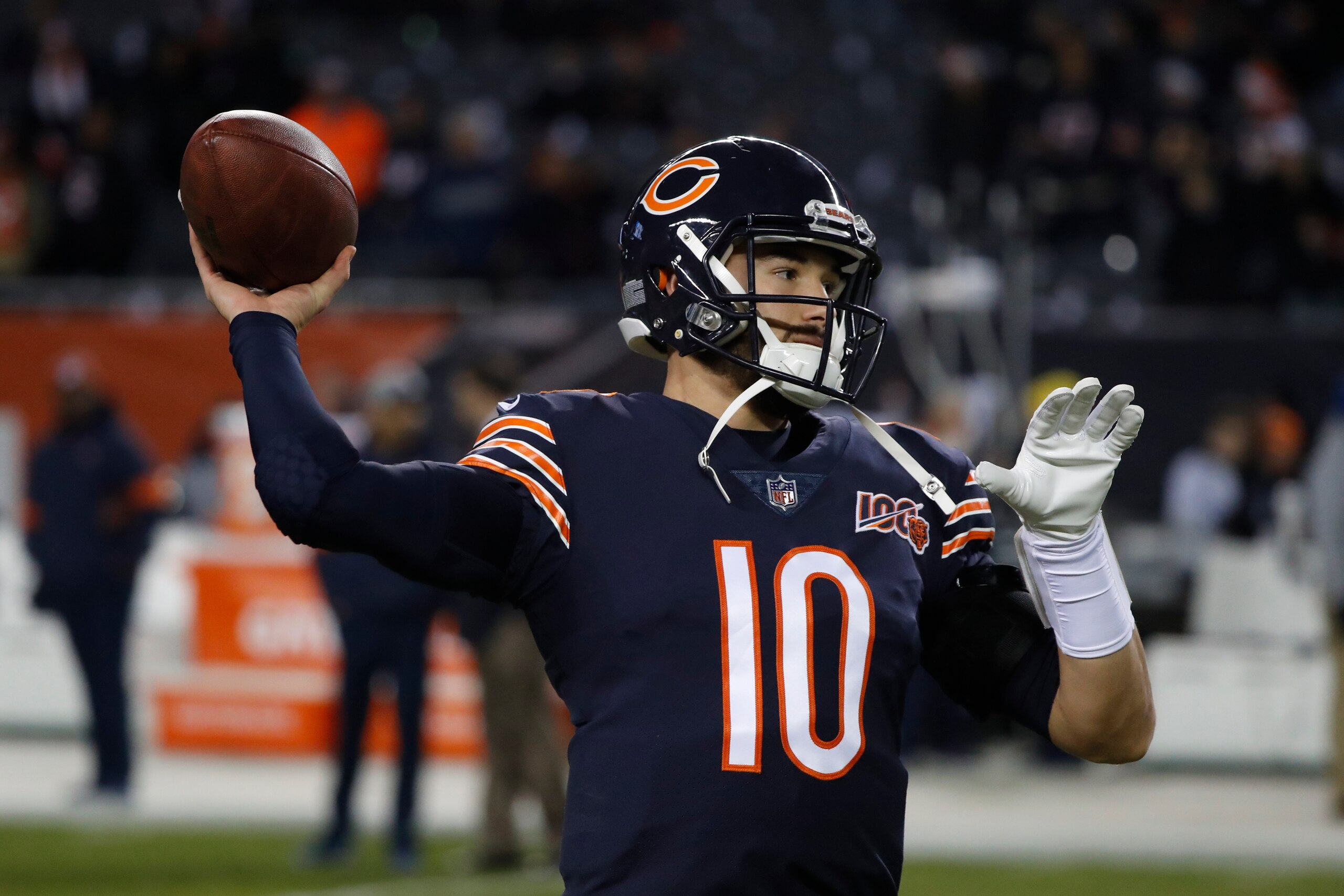
It's not that difficult to see why the Bears would want to at least increase their options at the game's most important position. After showing marked improvement during Chicago's run to the NFC North title in 2018, Trubisky took a substantial step backward in year three. His completion percentage, yards per attempt and touchdowns all dropped. His touchdown-to-interception margin fell from plus-12 to plus-7. His passer rating dipped by over 12 points, and his QBR free-fell to 39.5—28th in the NFL.
Most importantly, the Bears fell from 21st in the league in passing in 2018 to 25th last season and missed the playoffs. It was an ugly year all around.
Of course, it's not like Foles tore it up in Jacksonville last year, or he never would have been available in the first place. After signing a four-year, $88 million contract with the Jags, he broke his collarbone in his first game with his new team. He got back his starting job once healthy, but he was rusty and ineffective. After completing just half his passes for 93 yards with a pick in a Week 13 loss to the Tampa Bay Buccaneers, Foles was benched for good in favor of rookie Gardner Minshew II.
It was a continuation of what's been an up-and-down career for the 31-year-old. Foles has had success in two stints with the Philadelphia Eagles—he threw 27 touchdown passes against just two interceptions back in 2013 and led the Eagles on a magical run to a win in Super Bowl LII in 2017. But his time in Kansas City and St. Louis went quite a bit like that one season in Jacksonville.

Still, Foles told reporters that he's eager to try to get things back on track by competing with Trubisky to start for the Bears in 2020:
"It will be an open competition. I just want to go in there and do what's best for the team. Obviously, Mitch has been there for several years and knows this offense really well -- the Chicago version. I'll be competing, but it'll be a healthy competition. Mitch and I have already talked, and we want to start out on the right foot because ultimately it's about the Chicago Bears and not about the ego of the quarterbacks."
That's a lot easier to say when you know going into a test that it's going to be graded on a curve. And make no mistake—by passing on this option, the Bears will make it clear that's exactly what is going to happen.
For starters, the Bears wouldn't necessarily be married to Trubisky in 2021 even if the team did exercise his option. As ESPN's Dan Graziano reported, fifth-year options aren't fully guaranteed under the new CBA until the class of 2018 becomes eligible next year. Options being picked up for players drafted in 2017 (like Trubisky) are guaranteed for injury only. The Bears could pick Trubisky's option up and then punt next spring if he struggles in 2020.
What is guaranteed, however, is that the Bears could be on the hook for a fat chunk of cash if they try to move on from Foles in 2021.
Foles and the Bears restructured his contract upon his arrival in Chicago. Per Brad Biggs of the Chicago Tribune, performance escalators could grant the player both bonus money and the opportunity to void the deal. And his remaining guarantees of $21 million were spread out over the next three years. But according to Over the Cap, releasing Foles a year from now will cost the Bears at least $7.7 million in dead cap space—over $10 million if he's a pre-June 1 cut.
Is there a scenario in which the Bears might eat that $8-10 million and bring back Trubisky in 2021? Theoretically, sure—if Foles faceplants and Trubisky leads the Bears to the playoffs again, the team would have to consider using the franchise tag on him. But that tag was just under $27 million for 2020, and with Dak Prescott, Deshaun Watson and Patrick Mahomes all eligible for extensions between now and next year, it could rise considerably in 2021.

That the Bears (reportedly) aren't picking up an option that will pay at least $3 million less than that next year shows you how likely the team thinks that is.
Frankly, none of this is surprising. The writing was on the wall regarding Trubisky the moment the Foles trade was announced. You don't spend draft capital and substantial cap space on a Super Bowl MVP quarterback because you hope he'll "push" your young starter. You do so to replace him.
Passing on the option year only serves to reinforce that.
The Bears can talk about "open competition" until they are navy blue in the face. And they probably will—right up until Foles is announced as the starter sometime this summer.
But Pace and Nagy have already all but admitted that, barring disaster, he will be.
Because (in)actions speak louder than words.
.jpg?w=2560 "Seahawks Cardinals Football")
.jpg?w=2560 "Cam Ward Says He's Not A Loser")


.jpg?w=2560 "Chargers Fall to 0-5 🤢")