

What Really Matters at the NFL Combine?
NFL coaches, scouts, executives, owners, hopefuls and media across the country are flying into Indianapolis for one of the league's most overblown spectacles: the national scouting combine.
While the event continues to be a surprisingly popular draw for NFL fans desperate to find out more about the new crop of rookies, much of the real work of scouting is done well before hundreds of hopefuls don singlets and compete in what's jokingly called the "Underwear Olympics."
In fact, while exercise, nutrition and prep have taken leaps and bounds in the decades of combines run by National Football Scouting Inc., the workouts are largely unchanged. When players and agents are spending weeks and many thousands of dollars cribbing for a test they already know the answers to, how much do the results even matter?
TOP NEWS

New NFL contenders starting to emerge after Week 4
.jpg?w=2560 "Cardinals Giants Football")
NFL investigating 2 referees for separate viral exchanges
Buzz: Chiefs Reached Out to Tyreek
NFL Network will do its usual wall-to-wall broadcasting, and Bleacher Report will be all over the live coverage. But of all the numbers that will hit the scoreboard, of all the urgent scrawls of NFL and media scouts onto notebooks, of all the tippy-tapping thumbs on devices that will occur in Lucas Oil Stadium over the coming days, what really matters to NFL teams—and what should fans really pay attention to?
"The most important aspect of the combine," Phil Savage told Bleacher Report, "is the medical examination." Savage, a former NFL executive who now runs the Reese's Senior Bowl, has insight into the process from both sides of the operation.
"When you see a player mysteriously fall on draft day," Savage said, "it's usually because of a medical situation that was discovered at the combine. It's the first time that all 32 teams and their medical staff get a chance to examine these players."
Former Denver Broncos general manager and Bleacher Report special contributor Ted Sundquist agreed. Just as it made little sense for players to fly all over the country to get the same medical tests over and over, though, executives and coaches couldn't fly all over the country during the football season to interview college prospects.
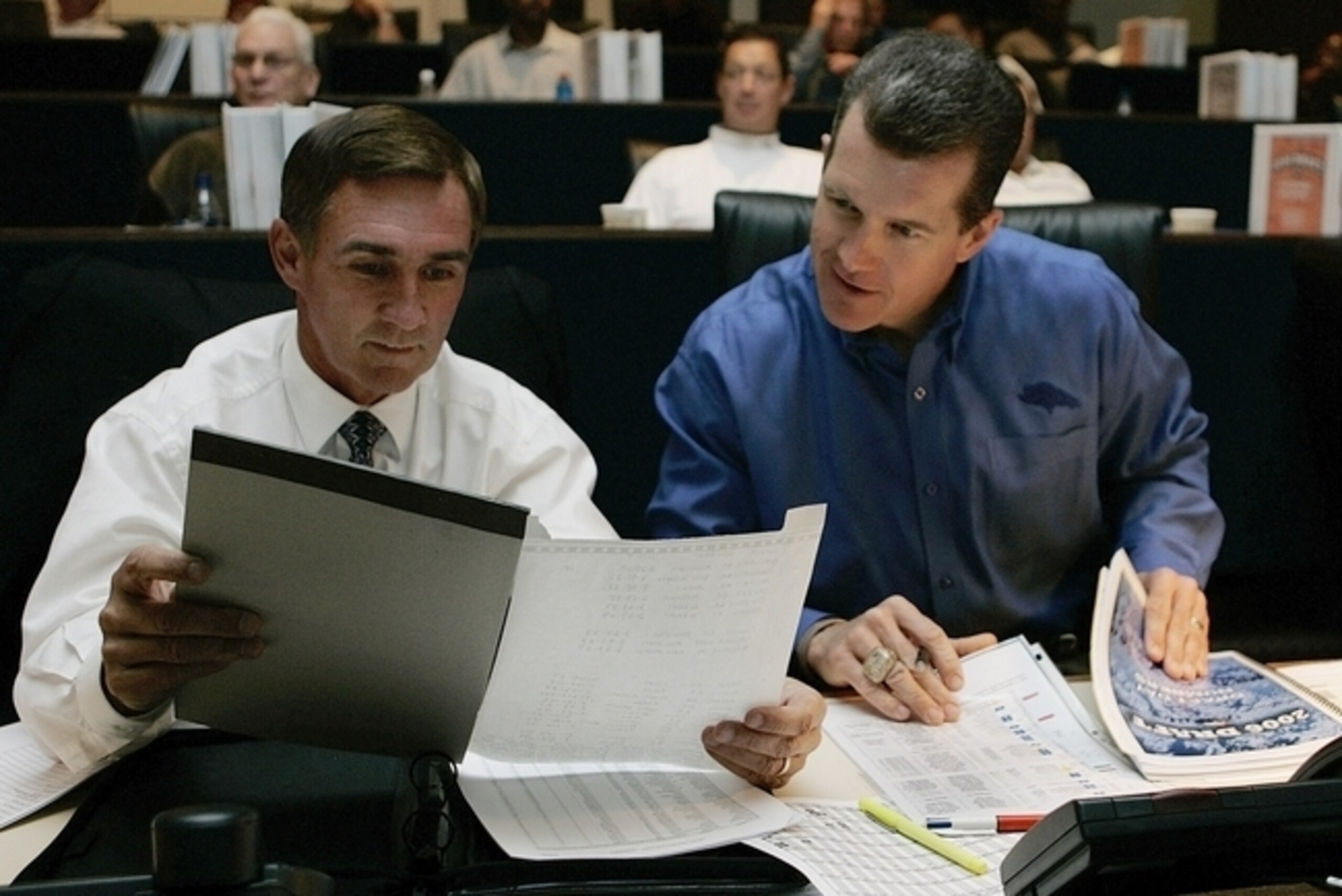
"When I first got into the league," Sundquist said, "it was extremely competitive—I mean extremely competitive—with regards to trying to get guys into your room and hold on to them to maximize your exposure to the guy. I mean, there were scouts literally fighting each other over players and who was going to go where next. There were teams that were blatantly abusive of the time; if they only have a couple of hours in the evening, and one club was keeping a guy for two hours and not letting them out of the room. The [New York] Giants used to have this 400-question test; it was ridiculous."
Today, the combine provides a standard workout and regulated team interview opportunities. But fans don't hear about any of the former unless there's a major problem, and they never hear about the latter at all.
What's most important about the on-field testing?
"It splits off into two different avenues," Savage said. "The seniors have been evaluated throughout the summer, all through the fall, in the all-star games, and hopefully the combine is a match for what you've already graded him at. In other words, if a player graded well, you hope he tests well. If you've graded a player poorly, you almost hope he tests poorly, because then it matches up with the narrative of where he fits on the board." Savage said seniors' grades should "be set in at least wet concrete."
"For the juniors, the combine is very important," Savage continued. "There's not as much information known of them. Everyone scrambles to get some tapes to watch and get an idea of what the player can bring to the table. So the combine can really impact a junior's grade and position on the draft board, much more so than the seniors who've been evaluated for the last nine months."
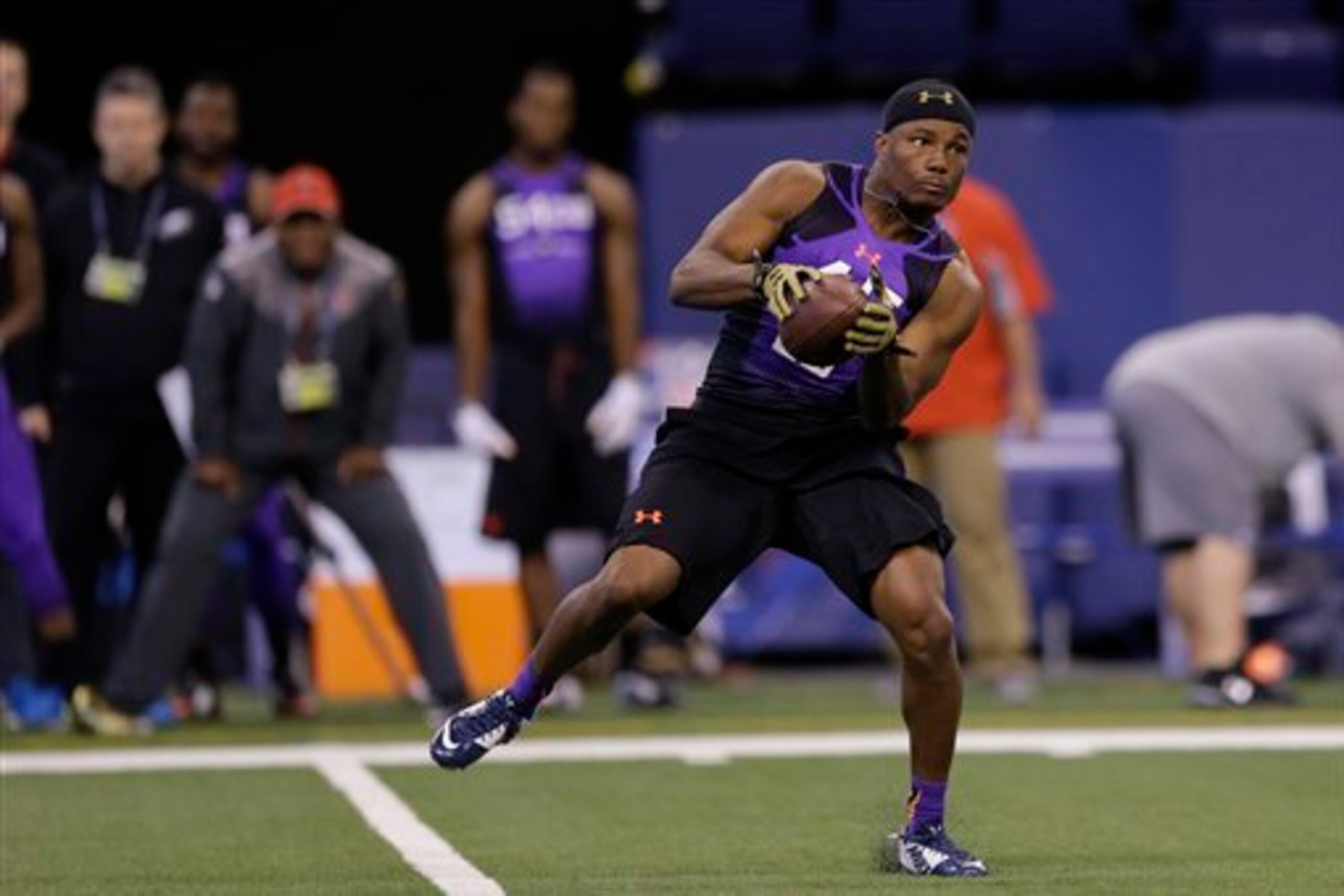
Once on the field, every position group goes through a battery of drills designed to reveal limitations. The offensive line's mirror drill and kick-step drill are personal favorites, because they so closely match what they're asked to do in games. What other drills are especially telling?
"I love the DB drill," Bleacher Report NFL Draft Lead Writer Matt Miller said, "where they have to mirror the ball movement. If you want to see if a player has stiff hips, watch that—because there's no way to hide it." Even better is the receivers' gauntlet drill, where they run from sideline to sideline and make catches on alternating sides of their body. "I think that's the best drill for your money, because you're putting them in a stressful environment, and it's all instinct and reaction."
In fact, that environment can rattle some players, as Savage explained.
"This is so different than any other event these players have ever participated in. They played in high school and college, and the major-school players played in front of huge crowds," Savage said. "At the combine, it is eerily quiet inside Lucas Oil Stadium. I think sometimes the players do get caught up in the magnitude of the moment. This is one of the last 40 times they'll ever have to run, and if they do really well they won't ever have to run another one in their lives. You look up, you see head coaches and general managers at the 10, at the 40, with stopwatches in hand and it's so quiet...I could see how that would be a very stressful situation."
Sundquist said the NFL Network's coverage, and by extension the NFL's imposition on the process, has dramatically changed the national conversation around the combine. The analysts largely lack front-office experience, so there are a lot of fan misconceptions about what the workout results mean.
"I don't really know where some of this street myth comes from," Sundquist said, "where a guy blows it out of the water at the combine and clubs jump all over him." He believes the cottage industry that's developed around the combine—agent recruiting, combine preparation, even performance apparel—is fueled far more by television hype than reality. "Sometimes," Sundquist chuckles, "I end up watching with the sound turned down."
He admits there have been cases where one team, or one decision-maker, clearly valued a player's workout performance too highly, but Sundquist said, "by and large, from my experience, the clubs don't fall for that."
Sundquist emphasizes that it's not NFL teams that are pushing for this. No NFL evaluator is trumpeting to the world that they'll draft guys higher. Players want to ace everything they have control over; agents want to tell players they'll help them ace all the drills; the league wants to see them put on a great show for NFL Network.
"I love the combine training facilities," Miller said, "because I want to see everyone put their best foot forward. But it is getting harder to tell, like, 'Is this guy really this athletic? Or has he been cutting weight for six weeks and running 40s every day?'"
"That's the real art of scouting," Savage said. "When you have good grades on a player, and he doesn't test well at the combine, to still believe and have a vision for how they might fit on your team. How do you marry those two things that don't line up. Then the other side of it is, you don't have good grades on a player and he tests out of the gym, what do you do with him? That's the tricky part of player personnel."
Miller concurs.
"My thinking about this has changed over the past two years," Miller said. "The job of evaluating players has gotten so much harder; every piece of information you can add into that, the better." Though Miller used to pooh-pooh workouts like the 40 with little in-game application, any opportunity for apples-to-apples comparison is invaluable. "Eventually you need something to differentiate those guys," Miller said, "so why not make it athleticism instead of something arbitrary?"
When it comes to gauging skill-position players, Bleacher Report Draft Analyst Jeff Risdon favors 10-yard splits and short shuttle times to the 40-yard dash.
"Look at Trae Waynes last year," Risdon said. "His short shuttle was slower than his 40. That's a stiff, straight-line athlete playing a position where fluidity is paramount."
Maybe one workout result can't paint a complete picture of a player—but there are many different composite numbers and bespoken benchmarks that correlate more strongly with potential. Risdon cited the Explosion Number developed by CBS Sports' Pat Kirwan to measure offensive and defensive linemen.
"Take the standing broad jump, bench press and vertical leap totals from the combine and add them up," Risdon said. "If the number is over 70, that's very impressive. It combines strength and initial explosive athleticism, which are critical traits for offensive and defensive linemen. That's far more important than 40 times and shuttle runs for the big guys."
"I definitely look at the Explosion Number," Miller said. "I'm the kind of guy who'll look at anything. As I said, I want as much information as possible." Miller also cited Nike SPARQ scores, MockDraftable.com's work in positional norms and any other one-number benchmark that helps separate signal from noise, and wheat from chaff.
"I know how people feel about the 40-yard dash," Sundquist said, "and this, that and the other—but the one thing it allows you to do is compare and contrast players from the 1980s and 1990s to 2016. The drills are the same drills, for the most part administered under the exact same situation and scenario, on the same schedule."
Sundquist acknowledges that combine training—and training overall—has made enormous strides since then, so the numbers don't always dovetail. But looking at proportions and trends across eras produces viable comparisons.
"If he's fast in a straight line but can't change direction," he said, a la Waynes above, "you're going to see that in proportion to 1990s numbers, just as you'll see it in 2016. If his [10-yard split] is not very good, and neither is his vertical jump, OK, so his lower-body explosion is poor. It's the same thing 30 years ago, for the guys then who had poor 10 times and couldn't vertical jump."
Sundquist pointed out the work of Joe Landers at Ourlads.com, a position-by-position study called "Relevance of the Combine," which found that NFL starters tended to perform above positional averages in different subsets of the standard workout battery. By comparing any player's numbers to historical norms, you can tell if he matches the profile of an eventual NFL starter.

"Does it work all the time? No," Sundquist said, and cited Jadeveon Clowney's incredible workout numbers as a counterexample. Despite knowing Clowney may have needed microfracture surgery, the Texans fell in love with the workout numbers and ignored the combine's most important information: the medical exam. After just 11 starts in two seasons, the 2014 No. 1 overall pick has just 4.5 sacks.
Despite outliers like Clowney, workout times can still be used to project future NFL success. In what might be the most comprehensive, rigorous analysis of combine data ever, Bill Lotter of the Harvard Sports Analysis Collective embarked upon an enormous three-part project called "The NFL Combine Actually Matters." Lotter performs a brilliant regression of per-position workout results against both eventual draft position and a player's production over his first three years.
If you want all of the incredible findings, and the real statistical proof of which drills are meaningful for which positions, click through. In the meantime, here are Lotter's headlining takeaways:
"• From combine stats alone, you can significantly predict how well a player will do in the NFL. It’s not an exact science, but to be able to say anything about how good a player will be from eight numbers, in such a complex game as football, is pretty amazing.
"
• The 40-yard dash is the most important drill at the combine. Really.
• The 40 isn’t the only thing that matters though. Weight and the three-cone drill follow next in overall importance. In general, weight is more important than height.
• The bench press is highly overrated and is the least significant factor. That being said, it’s not completely useless. Besides DTs, the bench press is most important for CBs. And WRs can expect the biggest movement up in the draft by benching well.
• In terms of predicting success, the combine is most important for DE, OLB and CB. It’s least important for WR and FS. WR was the only position for which the combine didn’t have significant predictive power.
• In terms of having an effect on draft position, the combine is most important for C, OLB, QB and CB. It’s least important for ILB and WR.
• NFL teams do a remarkable job in determining the importance of the different events per position. The factors that lead to actual success are the same that will lead to one getting drafted higher. But, NFL teams aren’t perfect. They tend to overvalue the 40 and the bench.
At the end of the day, Bleacher Report readers getting ready to sort through our comprehensive coverage and wade through hours of DVR'd workouts don't need to stress too hard about any of this.
"It's only here once a year," Miller said, "and it's so cool to see. Just ignore the old people who are going to say the combine doesn't matter, or it's a cattle call or whatever." Though he insists every drill matters to the people whose jobs are riding on getting evaluations right, the stakes for fans are low.
"Just have fun with it."
.jpg?w=2560 "Titans Giants Football")
.jpg?w=2560 "Dolphins Bills Football")




.jpg?w=2560 "Ward Nearly Walks Out of Presser 😳")