Todd Frazier's Dramatic Win Caps Successful Debut for New Home Run Derby Format
The 2015 Home Run Derby certainly had a great ending. When the final long ball landed in the stands of Great American Ball Park, it was local hero Todd Frazier who stood victorious.
There was more to this show, however, than just its great ending. The beginning and the middle were also something to behold. And altogether, Monday's 2015 Home Run Derby might have been the most exciting, dramatic and generally awesome entry into Major League Baseball's annual dinger-hitting contest that we've ever seen.
And for this, the credit is owed to the new format MLB dreamed up. Without it, we might not have gotten to see Frazier, the Cincinnati Reds' star third baseman, provide one of the great moments in Home Run Derby history with a walk-off blast that set the hometown crowd on a roar.
TOP NEWS

Breaking down why Brewers can stop Dodgers 3-peat
.jpg?w=2560)
Trent Grisham Landing Spots 📍

Each Team's Biggest Roster Hole to Fix in Offseason ⚾
If you missed it, it looked and sounded like this:
Now, if you did miss that, you might be befuddled by some of the things on the screen. What the heck is "Bonus Time," and why did Frazier have a 30-second time limit to hit that home run?
First of all, welcome back from whatever hole you just crawled out of. Second of all, those are aspects of MLB's new Home Run Derby format. This year, it was legitimately a whole new ballgame.
Major League Baseball has tweaked it here and there throughout the years, but before this year the Home Run Derby format revolved around two staples. One was the contestants hitting as many home runs as they could while avoiding non-homers ("outs"). The other was a fairly straightforward round structure: Whoever hit the most homers got to advance.
In late June, however, MLB announced that it would be trying something completely different for 2015.
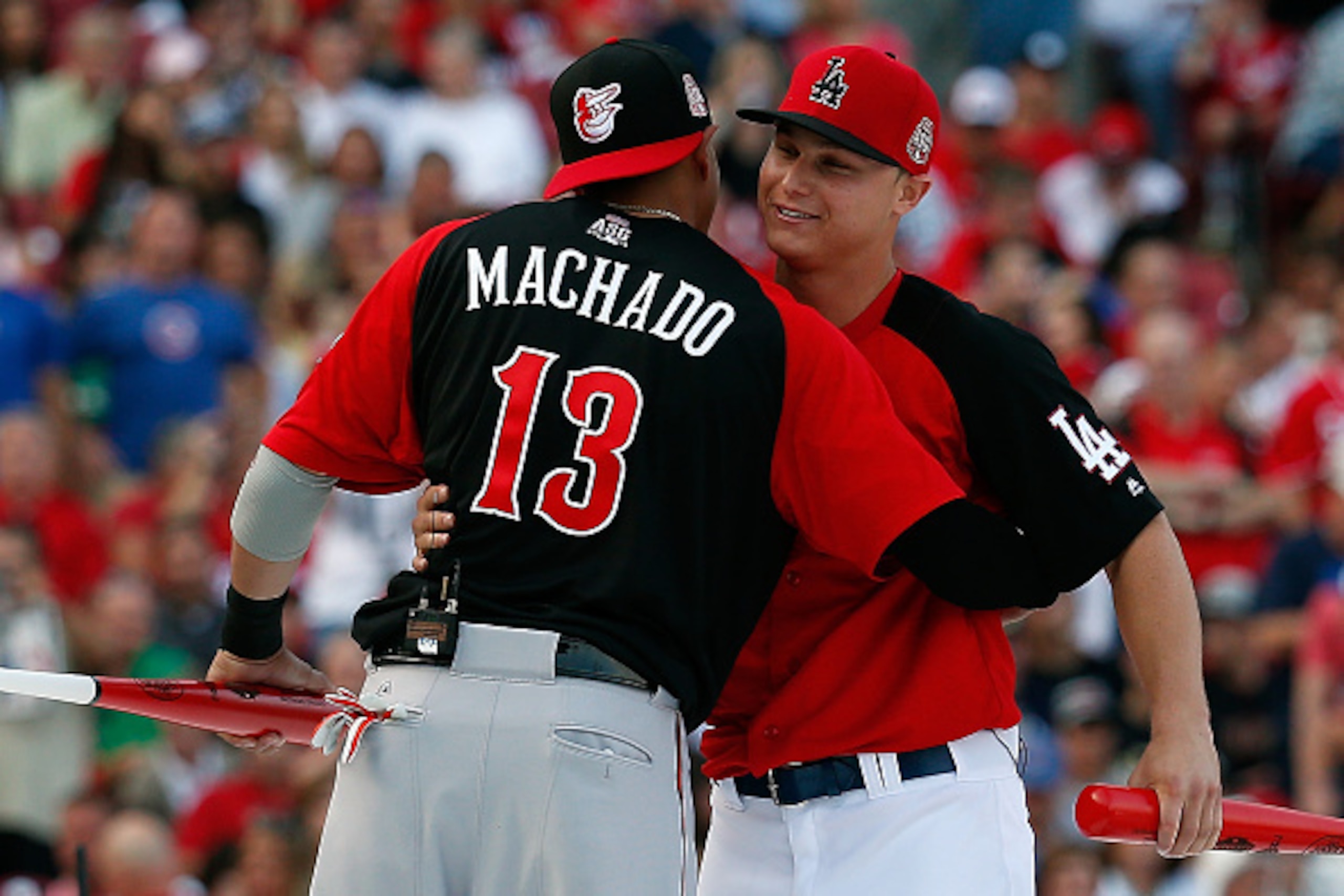
The new rules called for batters to hit as many home runs within a set time limit rather than a set number of outs, with the added opportunity to earn extra time by hitting the ball especially far. Another new rule called for a single-elimination tournament in which the contestants would square off against each other individually.
It's no wonder that MLB decided to make these changes when it did. As Craig Edwards of FanGraphs noted, ratings for the Home Run Derby took a notable dip in 2014. And even for those who tuned in, last year's derby was just another bland entry in a series that seemed to be getting blander every year. As an event, the Home Run Derby was sinking deeper into irrelevance.
But even despite that, MLB's attempt to spice things up with a new format drew just as much, if not more, skepticism than acclaim.
A common complaint was that though the new format was simple enough on the surface, the rules beneath the surface were too complex. To this end, MLB's cause wasn't helped when it made some last-minute changes to the new rules to ensure the event wouldn't run too long and overlap with some particularly bad weather circling the Cincinnati area.
So, when the event started, suffice it to say there wasn't much optimistic buzz in the air. Rather than something revolutionary, you got the sense that many were anticipating just another ho-hum dud.
But once things got going, it didn't take long for it to become apparent that this year's Home Run Derby was going to be anything but a dud.
Watching the batters fighting against their four-minute time limit was jarring at first. But the appeal quickly set in when Josh Donaldson had to race against the clock in his first-round matchup against Anthony Rizzo, ultimately topping Rizzo's eight homers with his ninth homer with 14 seconds left.
That, indeed, was some good drama. And rather than a one-time thing, that ended up being an appetizer for the entire course.
In the next matchup, Frazier mounted a furious comeback to match Prince Fielder in regulation time, and then beat him in bonus time. Albert Pujols then eliminated Kris Bryant at the buzzer of regulation time, and Frazier did the same to Donaldson in the semifinals to earn a trip to the final round. It looked like Pujols was going to do the same thing to Joc Pederson to earn his own trip to the final, but he couldn't come up with enough homers in extra time after mounting a furious rally in regulation.
Thus was the Home Run Derby, littered with drama even before it got to the final showdown between Frazier and Pederson, and their battle managed to heighten things even further.
Pederson set the bar high with 14 home runs, and Frazier seemed doomed when he had just five home runs about midway through his four minutes. But then he reeled off nine home runs in short order to tie Pederson, and he beat him with his first swing in his extra 30 seconds.
Through it all, there was genuine pressure with each second gone by and with each swing taken. For the first time in who knows how long, the new format made the Home Run Derby feel less like several hours of glorified batting practice and more like what it's supposed to be:
An actual contest.
And as a bonus, it went by very quickly. As Eric Fisher of the Sports Business Journal noted:
This, surely, is another reason why the 2015 Home Run Derby felt so much more engaging. Past renditions of the Home Run Derby moved along at a snail's pace, and in doing so managed to do the unthinkable: make home runs boring. This year's derby didn't do that.
And you know what the best part is? It didn't have to sacrifice home runs to do so.
As ESPN Stats & Info noted, there were more home runs hit in the 2015 Home Run Derby than in any other derby before it. And when compared to last year's derby at Target Field, the difference is especially striking:
Much more drama? A lot less time? A lot more dingers? This is where one plays the ol' "What's not to like?" card.
And in this case, this is anything but one man's opinion. The Home Run Derby was a hit with pretty much everyone. Including Tampa Bay Rays All-Star right-hander Chris Archer, who tweeted:
Donaldson, the Toronto Blue Jays star third baseman, was also a fan, telling Richard Griffin of the Toronto Star, "I thought it was great. As a participant, it was probably a little fatiguing, but at the same time I thought it was a very nice format. I think overall, everybody enjoyed it."
Also approving were Matt Snyder of CBS Sports and Ted Berg of USA Today, as well as a guy who's seen a few Home Run Derbies in ESPN.com's Jayson Stark:
And last but not least, it seems the new Home Run Derby was also a hit with the fans. This is according to an informal poll conducted by ESPN.com's Buster Olney, anyway:
One thing is for sure: All of this is music to the ears of MLB.
MLB took a risk with the overhaul that it made to the derby format and would have been in a tough spot if it had resulted in yet another dud or, worse, a total disaster. The league would have either had to go try something else or go back to the way things were, neither of which would have been appealing.
Instead, MLB's gamble paid off. And for all we can say about how and why it paid off, in the end it's quite simple.
For a couple of hours on a midsummer night, it was a blast to watch some of the game's best hitters go at it in a frenzy of dingers. For the first time in a long time, the Home Run Derby was fun again.
Stats courtesy of Baseball-Reference.com and FanGraphs unless otherwise noted/linked.
If you want to talk baseball, hit me up on Twitter.

.jpg?w=2560 "Cam Ward Says He's Not A Loser")
.jpg?w=2560 "🚨 Texans Trade for MHJ")
.jpg?w=2560 "Grading MHJ Trade 📝")
.jpg?w=2560 "Chargers Fall to 0-5 🤢")

.jpg?w=2560 "MHJ Bought Own Jugs Machine")