

One of a Kind but a Consummate Teammate, Ken Stabler Makes His Final Play Count
The first time I met Ken Stabler, some years ago, we shook hands and then he said, "Well, you're not very handsome."
I laughed. He chuckled. We then spoke for an hour. That was his sense of humor (or truth-telling). One Stabler story I read told of how he skipped practice on Veterans Day because "I'm a veteran." He didn't mean because he was a military veteran. He wasn't.
By now, in the wake of his death July 8, you have heard many of the Stabler stories, including the truly bizarre ones. There were other times I saw Stabler—including once when he gave me the middle finger, then smiled. And then we talked some more. He was always a jokester but also, without question, the friendliest superstar player I ever met.
.jpg?w=2560 "49ers Giants Football")
.jpg?w=2560 "Commanders Vikings Football")
When I'd ask Stabler about the 1970s and if the drinking and carousing was as notorious as everyone said, he'd always reply, "Hell yes." But he would quickly add, "You have to understand the times."

The NFL in the 1970s was dramatically different than now. It was like Mars. It was like another universe. The Pittsburgh Steelers were among the highest-paid teams in the sport, and a "better-paid" Steeler made $22,000 a year. Players were so strapped for cash they carpooled to games and had offseason jobs. They played a nasty six-game preseason schedule essentially for free.
We now know the horrific toll concussions have on the mind, but then (and for years afterward) concussions were called getting dinged. Players would get knocked out cold and then return to the game a play or two later. Brain trauma was grotesquely minimized.
They played with broken bones and damaged internal organs. If you didn't, you were considered soft. Science has since caught up to the violence football does to the body. We now know what players did then (and perhaps even now) could create irreversible damage to the brain.
Stabler would tell me players from that era weren't stupid. Even if it was on some instinctive level, more than a few believed the violence they were undergoing had to have some type of lasting effect. This is perhaps why he joined in a concussion lawsuit against the league. In it, Stabler and others contend, as have hundreds of other players, the NFL knew more about the chronic traumatic encephalopathy (CTE) crisis than it let on. The NFL has denied this. Recently, a nearly $1 billion settlement was reached between the NFL and various plaintiffs.
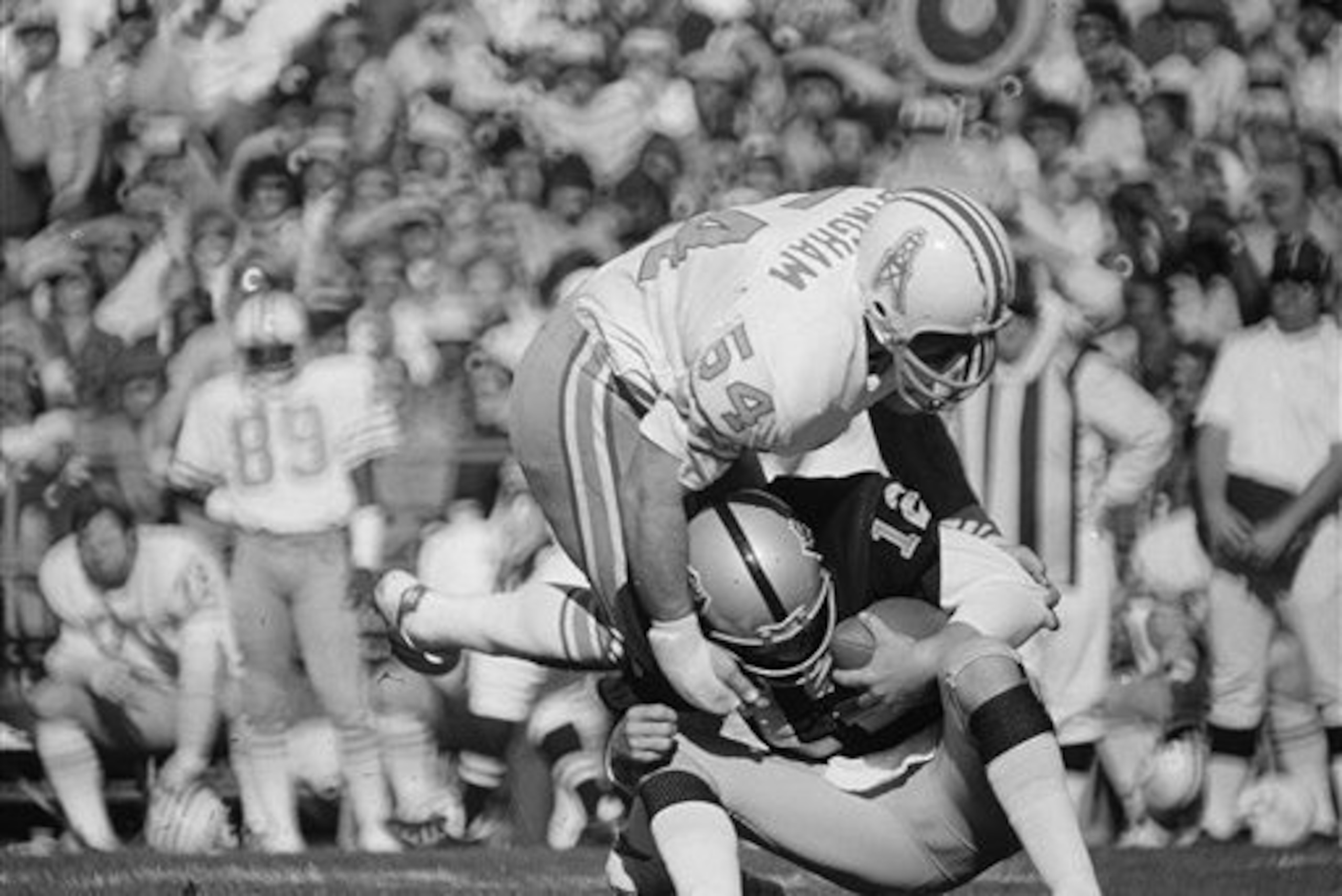
So the drinking, the smoking, the women-chasing served almost as a form of self-medication. If they were going to play a horribly violent sport, they were going to enjoy themselves along the way. This philosophy extended to how Stabler played on the field. There was a sort of gorgeous recklessness to how he mastered the quarterback position, mixed with a rare left-handed precision.
Those of you reading this who have a vague familiarity with Stabler have to understand that in some ways the game you watch today could not have evolved into what it is now without him. Stabler and the Raiders changed the sport for the better, giving it attitude, making it—to use the language of the day—less square. Stabler and the Raiders were fun, swashbuckling and tactical.

Yet every quarterback from the 1970s who won a Super Bowl is in the Hall of Fame except for Stabler. This isn't just criminal. It shows a fundamental ignorance of his importance to history.
"He should be in the Hall, and I believe that he eventually will be," former Raiders executive Amy Trask told me. "I am sad and sorry that he wasn't inducted during his lifetime, so that he could experience and enjoy that moment."
But Stabler's contribution to the sport doesn't end with what he did on the field or even with his death.
Stabler died of colon cancer. But along with what his foundation will do to fight that disease, his name will carry on in the battle against football's biggest problem. Stabler's family announced his brain and spinal cord would be donated to Boston University's research center that studies CTE in athletes. It's perhaps the most important endeavor related to football the sport has ever seen. It is the NFL's version of the moon landing.
Once, Stabler helped save a franchise. Now, even when he's gone, Stabler might one day help save lives.
CTE, as the Washington Post's Sally Jenkins once wrote, is the black lung of the NFL. CTE, by far, is its greatest threat. There are many other threats—domestic-violence arrests, the NBA, arrogance—but none bigger than CTE.
One of the most underrated moments in recent league history, a time that will go down in football infamy, came in September 2014. That was when the NFL, after years of saying otherwise, stated in federal court documents, via the New York Times, one-third of its retired players would develop long-term cognitive issues at much younger ages than the general population. One-third.
There are few, if any, other professions where a business says one-third of its retired employees will suffer from horrific brain diseases at notably younger ages than the general population. It's a rather remarkable piece of information.
This is why what Stabler did is so important, and selfless, and in many ways typical Stabler. For all of his robust living, he was actually the consummate team pro. He was selfless and welcoming to almost everyone. The fact that Stabler, in his death, would also donate his mind to be examined so that others could possibly be helped, is again typical Stabler.
"He wanted to make a difference in the lives of others in both life and death," part of the family statement read.
As we have watched football and played fantasy and ogled the monstrous ratings, more players, very quietly, have donated their minds to scientific study. It goes beyond players who were recently in the game like Junior Seau. There are now names from many different generations of players.
As of September 2014, the Department of Veterans Affairs' brain repository in Bedford, Massachusetts, reported that 76 of the 79 brains of deceased NFL players had CTE, as PBS noted. Also, researchers, as of that 2014 date, had examined the brains of 128 football players. These players were from the professional, semi-professional, college or high school level. Of those 128 players, "101 of them, or just under 80 percent, tested positive for CTE."
The names confirmed to have had the disease span the entire NFL continuum. They are names like Hall of Famer Lou Creekmur, who played in the 1950s. John Mackey, who played in the 1960s. Or Dave Duerson, who played mostly in the 1980s, and Andre Waters, who played in the '80s and '90s.
Stabler is another link in a long chain of trying to understand exactly what this disease does.
So as training camps begin and another season arrives, remember a great man, who should be in the Hall of Fame for what he did on the field and off.
On it, he is remembered for a 53-yard touchdown run for Alabama against Auburn in 1967. He is the man who was the NFL's MVP just seven years later. Few players were involved in more historic plays.
The other part of Stabler's legacy is just as vital and selfless. All of it is typical Stabler.
Mike Freeman covers the NFL for Bleacher Report.
.jpg?w=2560 "Commanders Cowboys Football")

.jpg?w=2560 "WWE Raw Live Grades 🔠")

.jpg?w=2560 "🚨 Puka Out for MNF")