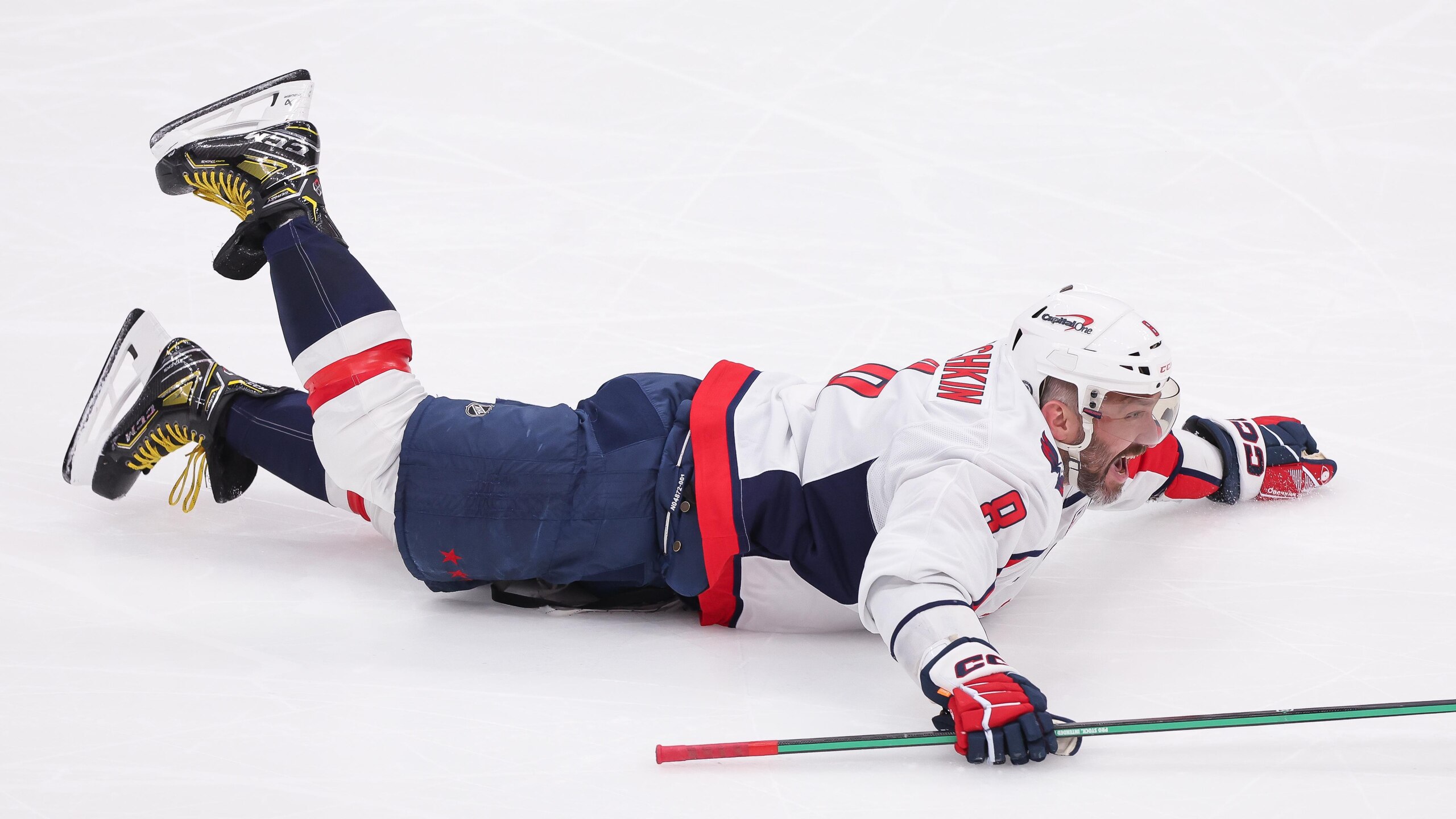

Alex Ovechkin Breaking Wayne Gretzky's Goal Record Shows Nothing Is Impossible
Wayne Gretzky, to fans of a certain age, was a perpetual source of astonishment.
He reached Canada’s hockey radar as a 10-year-old. He had 110 points in the old WHA during the season in which he turned 18. And by the time he was 21, let’s just say he was pushing things to a place no one had imagined, let alone seen.
Well, he’s not so alone in the stratosphere anymore.
TOP NEWS
Re-Ranking Top Free Agents 🛒
Grades For Every Team's Prospect Pool 🔠
Canes Troll 3 Philly Teams 😅
When Alex Ovechkin beat New York Islanders netminder Ilya Sorokin with a power-play wrist shot from the top of the left face-off circle to get to 895 and officially nudge Gretzky off the top line of the all-time list, it was the pinnacle (for now) of a two-decade journey that began when he arrived from Moscow as the top overall pick in 2004.
"I could tell you first hand how hard it is to get to 894," Gretzky said at the post-goal celebration at center ice in UBS Arena on Sunday. "So 895 is pretty special."
Ovechkin spoke broken English and was a 20-year-old fish out of water when he got started in the U.S. capital, but anyone who knew a hockey stick from a pretzel stick could tell he was exceptional.
Maybe it was his willingness to mix it up. Maybe it was a wicked one-timer that, even in primordial stages, was lethal. Or maybe it was the sheer giddiness he got from playing.
A Calder Trophy and the predictable run of All-Star nods and other hardware followed.
And by the time he finished his fifth NHL season and had already amassed 269 goals—an annual average of nearly 54—perhaps the most optimistic Capitals fan may have whispered among friends that he’d someday make a run at Gretzky’s high-water mark.
But it still seemed so far away.
Because Gretzky finished his career in 1999 with 894 goals. Which, at the time, was 93 more than the No. 2 man on the list, Gordie Howe, who’d played in nearly 300 more games.
Let that sink in for a Ruthian minute. That’s 93 more goals than a guy called “Mr. Hockey” in what amounts to three-and-a-half fewer seasons.
So it was no wonder, as a 38-year-old Gretzky left Madison Square Garden that spring and made post-retirement rounds in Edmonton a few months later, that no one in their right statistical minds anticipated it’d be a conversation we’d have again.
Ex-teammate Mark Messier was the next-nearest active player at the time, and he was 284 goals behind and already running on fumes on a career that ended in 2004.
For a player to even approach the record—let’s say, to get as far as Howe had gone—he’d have to average 40 goals per season for 20 years, in a league where scoring 40 even a handful of times provides fast-track consideration for the Hall of Fame.
Forget kind of doubtful or even highly unlikely.
This was full-on impossible. Or, if you prefer, IMPOSSIBLE.
And given the nightly pounding Ovechkin put his body through—yielding averages of 206 hits and 31 blocked shots per season—it was a reach to think he’d be much more than a bruised, battered husk by the time he got within legitimate conversational distance.
Gretzky, who was no physical force, was hardly the player at 38 that he’d been at 18 or 28, missing 35 games in 1992-93 after back surgery and never scoring more than 25 goals after a 38-goal, 130-point last stand with Los Angeles in 1993-94.
And Howe, though a marvel for playing effectively into his 50s, scored in the 20s and teens more often (six times) than not across his final nine NHL seasons, earning his eventual place in history as much by high-end longevity as high-end production.
The Russian machine, though, has (almost) never broken.
Ovechkin has been just as remarkable for his durability as his production, playing in no fewer than 72 games in any of his first 19 seasons, outside of schedules impacted by labor strife (2012-13) or COVID-19 (2019-20, 2020-21).
He scored no fewer than 31 goals in any full season and arrived this fall having passed Howe for second place. Ironically, his first major injury occurred as the Gretzky chase kicked into gear, coming when he fractured his left leg in a collision with Utah’s Jack McBain in November.
It’s a season-wrecker for many. Ovechkin missed a month.
And just to remind folks who they were dealing with, he scored four times in his first five games back and hadn’t stopped—netting at least one in 23 of 42 post-injury games through Saturday.
In fact, this record-breaking season had already been among the best of his career, with 41 goals in 60 games translating to a per-game rate of 0.683—still within reasonable distance of 2007-08 and 2008-09, when he was a youngster at 22 and 23 years old, respectively, and averaged .752 over 161 games.
These days, in case you didn’t know, he’s 39.
It’s translated to the bigger picture, too, helping Washington to both the league’s best record and genuine love from DraftKings, which ranks its title chances second only to defending champion Florida in the East.
Given that the Caps were swept last spring, and their offseason moves, while prudent, were hardly transcendent, it’d be easy to tag the 2024-25 ascension with words like surprising, unexpected and even remarkable, regardless of when it ends.
Still, even if you’re not sold on a deep run for them, we’ll go ahead and bet there’s now one specific word you’ll think twice about using for as long as Ovechkin is involved.
Go ahead. We dare you.
.jpg?w=2560 "AD Trolls Bears WR on IG 😂")
.jpg?w=2560 "Viral Dan Campbell Presser 💙")
.jpg?w=2560 "Report: Steelers WR to Miss 'Weeks'")
.jpg?w=2560 "Buzz: MHJ Hired Agents for Trade")
.jpg?w=2560 "Cam Ward Says He's Not A Loser")

.jpg?w=2560 "Chargers Fall to 0-5 🤢")
