No Ceilings: Andrew Wiggins' Offense Could Defy Projections Next Season
Andrew Wiggins, of the Minnesota Timberwolves, is the NBA's Rookie of the Year. It was an up-and-down season, but respectable per game averages—16.9 points, 4.6 rebounds, 2.1 assists, 1.0 steals—and a mountain of breathtaking highlights—were enough to seal the deal.
Wiggins received 110 of a possible 124 first-place votes but his selection was not a slam dunk for many fans and analysts.



By many comprehensive metrics, Wiggins was a below-average player as a rookie and the debate between quantitative and qualitative perspectives has swirled around him all season long. Regardless of where you sit on the analytic spectrum between numbers and the eye-test, the fact remains that Wiggins is just 20 years old and will almost certainly be better next season.
Improving is what young players do.
And even for those fans and analysts who focus on comprehensive metrics, there are several reasons to think that Wiggins could be vastly improved next season.
Role and Support

Neil Paine of ESPN's FiveThirtyEight has, probably, unintentionally, become the face of analytic criticism against Wiggins. His unfortunately titled December article—Forget The Next LeBron James, Andrew Wiggins May Not Be The Next James Posey—turned the volume up on the conversation.
The hyperbolic headline overshadowed what was, at that point, a fairly reasonable and measured analysis. To summarize, Wiggins' efficiency numbers were very pedestrian and didn't necessarily imply the same level of future stardom that gushing scouts and viral highlight clips did. This echoed similar concerns that were heard as Wiggins entered the draft after a statistically underwhelming season at the University of Kansas.
In evaluating Wiggins, the dichotomy is between the impact of visuals like this:
And analysis like this (from the Paine article mentioned above):
"At the end of the season, then, our best guess is that Wiggins will have posted a -2.9 SPM in about 2,400 minutes.
While that means Wiggins is no longer in Adam Morrison territory, not many players with a -2.9 SPM their rookie season end up having great careers. A sampling of players in that range as rookies includes Ben McLemore, Anthony Johnson, Gordan Giricek, Kevin Edwards and Vernon Maxwell, with Glen Rice and Rex Chapman representing the absolute best-case scenarios.
"
His numbers improved somewhat by the end of the season, but not enough to completely quiet the critics. Box Plus-Minus is a box-score-derived estimate of a player's net impact per 100 possessions. This metric estimated Wiggins' value to be -2.3 points per 100 possessions. A BPM of 0.0 represents an average player.
However, the nature of Wiggins' statistical struggles this season makes his rookie campaign seem a little less dire. The biggest statistical knock on Wiggins was that he played a fairly large offensive role and was not very efficient—43.7 percent from the field and 31.0 percent on three-pointers.
However, both his large offensive role and relative inefficiency may have been somewhat situational. Neil Paine wrote about Wiggins again at the end of this season, touching on why this point is important:
"Although he determined that per-possession efficiency was the best measure of a team’s offensive prowess and developed equivalent efficiency metrics for individual players, Oliver also posited that a player’s offensive efficiency was prone to changes based on how much of a scoring workload he took on.
That theory, which has largely been borne out by subsequent studies, implies that a player’s efficiency numbers aren’t even close to being all his own — and that, crucially, high scorers such as Wiggins represent the group most centrally affected by such interplay between teammates.
"
In other words, scoring efficiency, particularly for high-usage scorers, is extremely sensitive to the other players on the court. It is a special trait to be able to maintain scoring efficiency as usage increases. It is rarer still for a player to hold that line when they're playing with ineffective teammates. Playing with them for the first time only makes things harder.
To describe Wiggins' teammates as ineffective this season is perhaps even too charitable. Paine also notes in his article that by Statistical Plus-Minus, Wiggins played with the ninth-worst set of teammates of any Rookie of the Year winner since the NBA-ABA merger.
All three of Mo Williams, Corey Brewer and Thad Young were traded during the season. Nikola Pekovic, Ricky Rubio and Kevin Martin missed a combined 154 games due to injury. Even Shabazz Muhammad went down with a season-ending injury just as he was starting to take off.
Wiggins was left playing an assortment of developing young players and fringe talents who may not be long for the NBA. While giving so many minutes to these young players may prove to be good for the Timberwolves in the long run, it undoubtedly left Wiggins in a situation where he was asked to do more than he may have been ready to do. That in turn depressed his statistical performance.
Nearly a third of his shot attempts were pull-up jumpers and just 15.9 percent were catch-and-shoot, according to NBA.com. More than two-thirds of his shots—69.3 percent—were taken with a defender closer than four feet. The NBA classifies those shot attempts as being defended "tightly" or "very tightly."
Not having teammates who could help carry the load on offense meant his shot selection was forced towards inefficiency out of necessity. He was usually the team's best offensive option so he was forced to take all the tough shots.
Wiggins appears to like his team's core. Speaking at his Rookie of the Year press conference to the Associated Press, via ESPN, he said, "I don't believe there's any curse or nothing like that, we just needed the right pieces. I feel like now we've got them. We've got a nice young core."
Another high draft pick, some health for Pekovic and Rubio, and a free agent or two will put Wiggins in a much more advantageous situation next year.
Age and Experience

Using statistics to project a player's development is tricky business and there are no sure things. However, two factors have reliably shown to be good indicators of future growth—age and minutes played. Here's Andrew Johnson of Nylon Calculus explaining two statistical models he built to project the improvement of this year's rookie class:
"For both models the most important predictor was rookie production. In the AWS Efficiency model that was followed by pre-NBA production then, closely behind, by age. Unsurprisingly, in the AWS Production model time played as a rookie was a much more significant factor as the second most powerful variable just ahead of pre-NBA production and age. A minor factor in both models was the player’s three-point shooting rate, indicating that perimeter players should see slightly more growth from the their rookie year controlling for pre-NBA production and age.
"
The value of age is pretty obvious—it implies more space between a player and their hypothetical prime. Players also tend to improve most during their first few seasons in the league.
Minutes played is a bit of a catchall. It represents experience and opportunities for repeated practice—the kind of repetition that's needed for development. It also implies that a player is productive, as you usually don't keep playing if you're hurting your team.
Both of Johnson's models liked Wiggins' potential for development and those two factors were a big reason. With a total of 2,969, Wiggins played the seventh-most minutes ever by a rookie age 20 or younger. The names above him are LeBron James, Shaquille O'Neal, Derrick Rose, Elton Brand, Carmelo Anthony and Antoine Walker—are pretty good company.
Athleticism
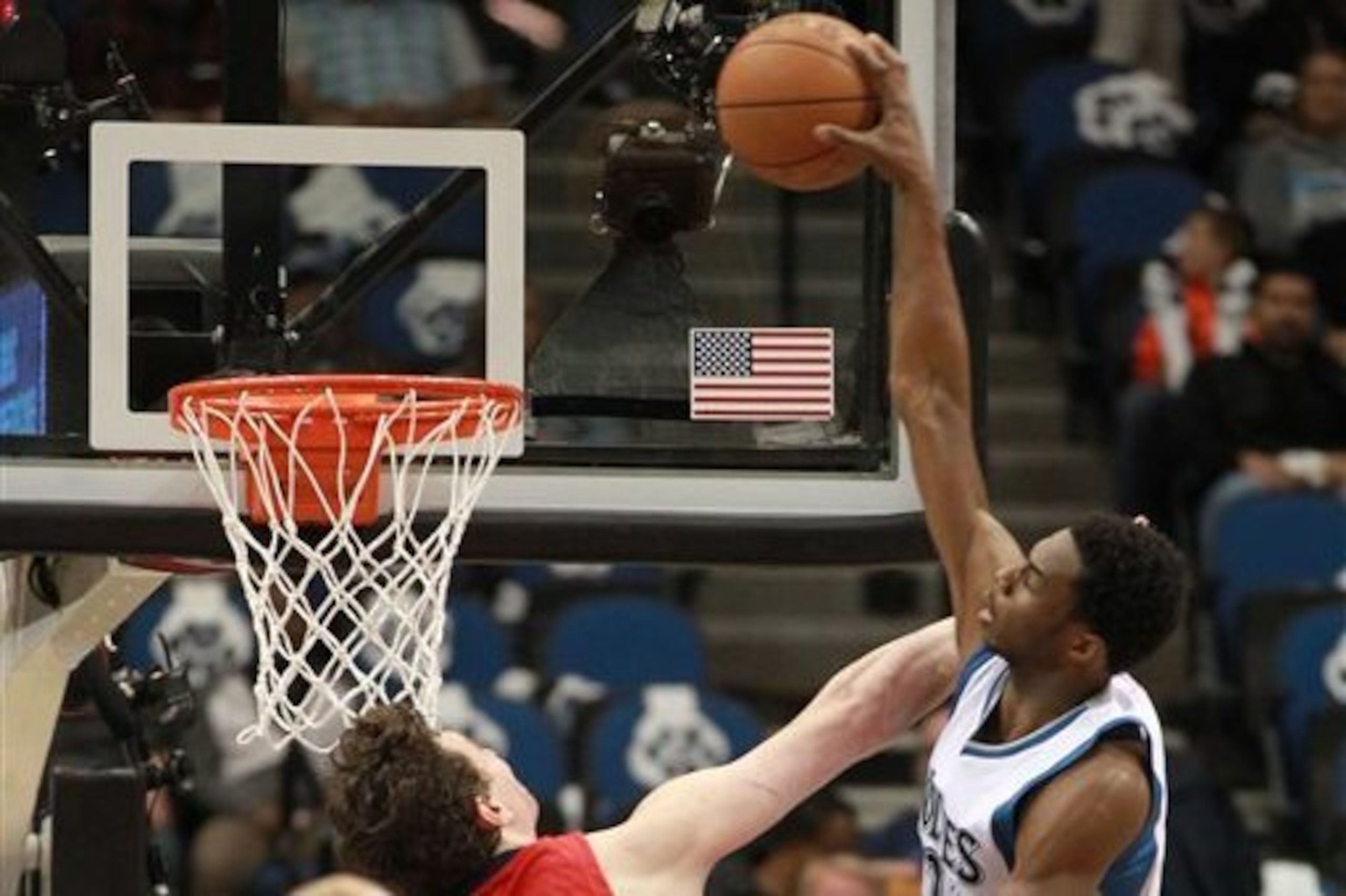
While some people see Wiggins' extreme athleticism as obscuring or inflating his true level of performance, there is also every reason to think it speaks to his potential to grow.
Some of the most interesting research on the relationship between athleticism and potential was done by Layne Vashro at CanisHoopus. What Vashro found was that, in evaluating potential, the value of athleticism is directly related to skill. This is a no-brainer for anyone who watched Stromile Swift or Tyrus Thomas, but it's nice to have it reinforced with some research.
The most interesting part is that the relationship is not linear. In other words, the more skilled you are, the more athleticism amplifies your abilities. Vashro actually used Wiggins as an example in his article because his statistical model (based on the same type of efficiency statistics that didn't love Wiggins this year) saw Wiggins as only moderately skilled before his rookie season.
We're measuring skill with statistical performance so our perception of Wiggins may even be a little lower than his actual present levels, given the role and lack of competent support. Connecting that to Vashro's findings, the takeaway is two-fold. Wiggins' insane athleticism means he has potential to improve. It also means that improvements in skill areas may be even more important for leveraging his physical tools. We may see that skill improvement simply by having him surrounded by better teammates and not having to carry such a large load.
Defense has not entered into the discussion much here because statistics don't do a great job evaluating it. However, everything that we've said about development and offense is true on the other side of the ball as well, even if we can't measure it as well.
Age, experience and athleticism all imply that Wiggins will continue to improve as a defender. Better teammates will make things easier on him and allow his skills to shine on defense as well.
Trying to figure out exactly what Andrew Wiggins will be next season, and in the future, is a difficult task. There are no certain answers.
What we do know is that he played with disastrously bad teammates while carrying more and different responsibilities than he was perhaps ready for so early. Although he struggled with efficiency, in that situation he was able to contribute enough on the quantity side to win the Rookie of the Year Award.
Statistical projections lean heavily on past production, which is why questions about Wiggins persist. And yet, his age, experience, athleticism and the context of that production imply that in his case it may not be the best measure of what he is headed for in the long-term.
Wiggins is going to get better, and he seems ready to break some of our statistical models along the way.

.jpg?w=2560 "Raiders Could Start Mendoza")

.jpg?w=2560 "Rodgers Iced Out on Plane 💎")
.jpg?w=2560 "Packers Safety Slams Refs 🤬")
.jpg?w=2560 "🚨 Week 8 AP Top 25 Poll")