Draft Profile: Michael Crabtree
Don't forget to join sportsloungecentral.com
With the 2009 NFL Draft entering minds, the first player you think of when you hear wide receiver is Michael Crabtree.
After just two years of college at the University of Texas Tech, the sophomore decided to enter the 2009 NFL Draft (we’ll have to wait a few years before we judge that decision).
TOP NEWS

New NFL contenders starting to emerge after Week 4
.jpg?w=2560 "Cardinals Giants Football")
NFL investigating 2 referees for separate viral exchanges
.jpg?w=2560 "Hill Injury Update Football")
Report: Chiefs Contact Hill's Agent
Crabtree has always been a sure bona fied top five pick until his ankle injury that caused him to miss the combine and pro day, thus meaning that he would not be able to please the NFL GM’s that wanted to see his 40 time.
After watching the 2009 playoffs, many fans wondered how their favorite team can get a Larry Fitzgerald, and many have proclaimed Crabtree as the next Larry Fitzgerald or Andre Johnson.
Standing at 6'1 3/8" and 215 pounds, he is the most physically gifted wide receiver in this year's NFL Draft. He also had the longest arms at the combine for a wide receiver, measuring in at 34 ¼ inches. This was a big plus for him, considering that he cannot clock in a 40 time until after the Draft.
Pros:
1. Both years at the University of Texas Tech, Crabtree managed to win the Biletnikoff Award, witch is rewarded to the top wide receiver in college football, named after Raiders' own Fred Biletnikoff, a member of the Pro Football Hall of Fame. He looked physically stronger than any other player in a secondary he faced during his 2007 and 2008 seasons, in which he led the nation in yards both seasons. The thing about Crabtree is that he’s not a trouble-maker, something you look for when your about to spend millions on a player; he’s just a good kid.
2. Crabtree is a former quarterback with great vision and a cunning way to get open and create a passing lane for his quarterback. At the same time, he has amazing hands and long arms, which allow him to go over defenders to make the reception. He’s not a burner, but he has game speed to blow right by slower defenders. The sure thing we know about Crabtree is that he has good hands and he rarely ever drops a ball.
3. If he can get down the playbook and the routes of a NFL system, then he has the potential to be a top five wide receiver or even a Larry Fitzgerald or Calvin Johnson. He has all the tools to become a big, physical wide receiver that can turn a five yard pass into a 20 yard gain as a very versatile wide receiver that can break tackles and is hard to bring down. He has a good stiff arm and can catch the fade route. He can be a huge redzone threat for any offense and he proved this in college with 22 touchdowns in 2007 and 19 touchdowns in 2008. No one can hide the fact that Crabtree destroyed defenses and it was nearly impossible to stop him when he was fully healthy. Take a look at these stats:
Stats Overview Receiving Rushing Fumbles
YEAR REC YDS AVG LNG TD ATT YDS AVG LNG TD FUM LST
2007 134 1962 14.6 75 22 0 0 0.0 0 0 0 0
2008 97 1165 12.0 82 19 2 1 0.5 3 0 0 0
Cons:
1. As much as I don’t like the 40 times and feel that game speed on tape is the best way to judge speed, you have to consider all angles when you're about to spend millions of dollars on a player that hasn’t seen a day in the NFL. Crabtree has yet to run a 40 time for NFL GMs and coaches, which is a problem considering the speculation that Crabtree won’t be running any faster than a 4.5. Will that affect his game in the NFL? Will he be able to create separation at the next level? As I stated before, we won’t be able to see him run a 40-yard dash until after the NFL Draft.
2. Texas Tech’s offense doesn’t require their wide receivers to run a full route tree, this means that he has little experience of running NFL routes that teams will need him to run regularly. Depending on how complex the offense is, Crabtree might have a tough time learning the playbook; without learning the playbook he wouldn’t be able to be a full-time starter early on in his career. This could cause teams to pass on Crabtree and go in a different direction. How will Crabtree do without the spread offense? Will he be able to produce in a real NFL offense where they're not regularly throwing the ball 50 to 60 times a game? Those are questions that Crabtree will have to face until he steps on the field for week one of the 2009 season. When Crabtree is drafted, he will become the go-to guy. He will be man whom the quarterback will look at with 1:50 left on the clock and a 3rd and 10; will he be able to produce under pressure as the No. 1 receiver?
3. The University of Texas Tech play in the Big 12 Conference, where the likes of Sam Bradford, Colt McCoy, Chase Daniels, and more destroyed defenses. The stats Crabtree put up could largely be part of the 442 times Graham Harrell threw the ball in the spread offense. The defenses that Crabtree play are nothing like the defenses in the SEC and other big-time defensive conferences; could this affect how teams look at him? With 56,333 screaming fans in attendance for the Texas Tech vs. Texas game, Crabtree had his biggest moment in his NCAA career. If you re-watch the catch that brought Texas Tech a victory over Texas, you will see that it might have been more a mistake by the Texas safety instead of a great play by Crabtree. You can see the CB intentionally shadowing Crabtree to attack the ball underneath; this is perfect play by the cornerback, but it was the safety that blew the coverage by doing the same exact thing as the cornerback instead of staying behind the play to make the safe tackle. The safety also failed to make the tackle on Crabtree after he made this mistake. Crabtree ran the route six yards short of the endzone and therefore, the safety wasn’t in position to make the tackle. Instead, Crabtree made the crisp turn and broke the tackle for the easy touchdown.
Potential Draftees:
Oakland Raiders
If he lasts until the seventh pick in the NFL Draft, then the speculation is that he will be on the next flight to Oakland. As much as the Raiders like to take defensive lineman and offensive lineman, we have to look at the wide receiving corps JaMarcus Russell had last year:
Javon Walker - 8 games, 15 receptions, 196 receiving yards, 1 touchdown
Ronald Curry - 13 games, 13 receptions, 181 receiving yards, 2 touchdowns (Cut)
Chaz Schilens - 16 games, 15 receptions, 226 receiving yards, 2 touchdowns (rookie)
Johnnie Lee Higgins - 16 games, 22 receptions, 366 receiving yards, 4 touchdowns
His best receiver was his tight end, Zach Miller, who had 778 receiving yards on 56 catches and 1 touchdown.
The Raiders signed Khalif Barnes to start at left tackle and traded with the Miami Dolphins for Samson Satele to play center. Although they only signed Barnes to a one-year contract, it would create time for the Raiders to select a franchise left tackle in the 2010 draft.
Jacksonville Jaguars
When you’re the Jacksonville Jaguars and you have cut your top three wide receivers, you know you are in trouble. If they don’t take a wide receiver with this pick then Dennis Northcut and Troy Williamson will be their top two wide receivers. Wide receiver is a must in this year's draft and expect them to either get Jeremy Maclin or Michael Crabtree in the draft. Dennis Northcut is much more suited in the slot or as a No. 2 wide receiver. Let’s takes a look at the wide receivers on roster:
Dennis Northcut - 14 games, 44 receptions, 545 receiving yards, 2 touchdowns
Troy Williamson - 8 games, 5 receptions, 30 receiving yards, 1 touchdown
Mike Walker - 9 games, 16 receptions, 217 receiving yards, 0 touchdowns (rookie)
Matt Jones, Jerry Porter, and Reggie Williams were all cut.
Cincinnati Bengals
This is unlikely, considering they signed Laveranues Coles and spent a second round draft pick on Jerome Simpson last year. They still have Chad Ocho Cinco, but that’s the reason why they are on this list. Reports are that Chad Ocho Cinco is on the trade block and could be joining a new team in the next few weeks; if he is traded, then don’t be surprised to see the Bengals look at Crabtree as a potential draftee. Coles would become the No. 1 wide receiver with Michael Crabtree as the second wide receiver and then either Chris Henry or Jerome Simpson in the slot; the odd man out is Andre Caldwell.
Cleveland Browns
They don’t seem too satisfied with Braylon Edwards; he has recently been put on the trading block. Don’t be surprised to see Edwards traded for a first round pick and the Browns going with Michael Crabtree. Without Edwards, that receiving corps is in shambles and with Winslow’s recent trade to the Bucs, the offense would be lagging in the firepower department. Reports also say that Brady Quinn could be moving for a first round pick. If this were to happen, Mark Sanchez would leap over Crabtree on the Browns' board, unless this pick is in range where Josh Freeman could become the next Cleveland Brown. Let’s take a look at the Browns receiving core without Edwards:
Donte' Stallworth - 11 games, 17 receptions, 170 receiving yards, 1 touchdown (Legal Troubles)
David Patton - 5 games, 11 receptions, 162 receiving yards, 1 touchdown
Syndric Steptoe - 16 games, 19 receptions, 182 touchdowns, 0 touchdowns (rookie)
With Isaac Bruce completing retirement the 49ers are in need of a wide receiver. Crabtree would work perfectly in the 49ers West Coast offense, which is also pass-happy. I’m aware that Mike Singletary would much rather take a defensive player and build around the defense, but at the same time, Shaun Hill will need some type of offensive weapon next year. If they were to add Michael Crabtree to an already good receiving core, they might be one of the better offenses next year, depending on if the offensive line can hold up. If you add that type of playmaker to any offense, your whole offense will have an easier time playing. For example, Frank Gore would be able to face less eight in the boxes with a dangerous wide receiver like Crabtree on the outside.
Potential Trade-ups:
Philadelphia Eagles
I’d like to start this by taking a look at all ten of the Eagels' draft picks:
Round 1, No. 21 Round 5, 153 & 157 & 159
Round 2, 53 Round 6, 194 & 195
Round 3, 85 Round 7, 230
Round 4, 121
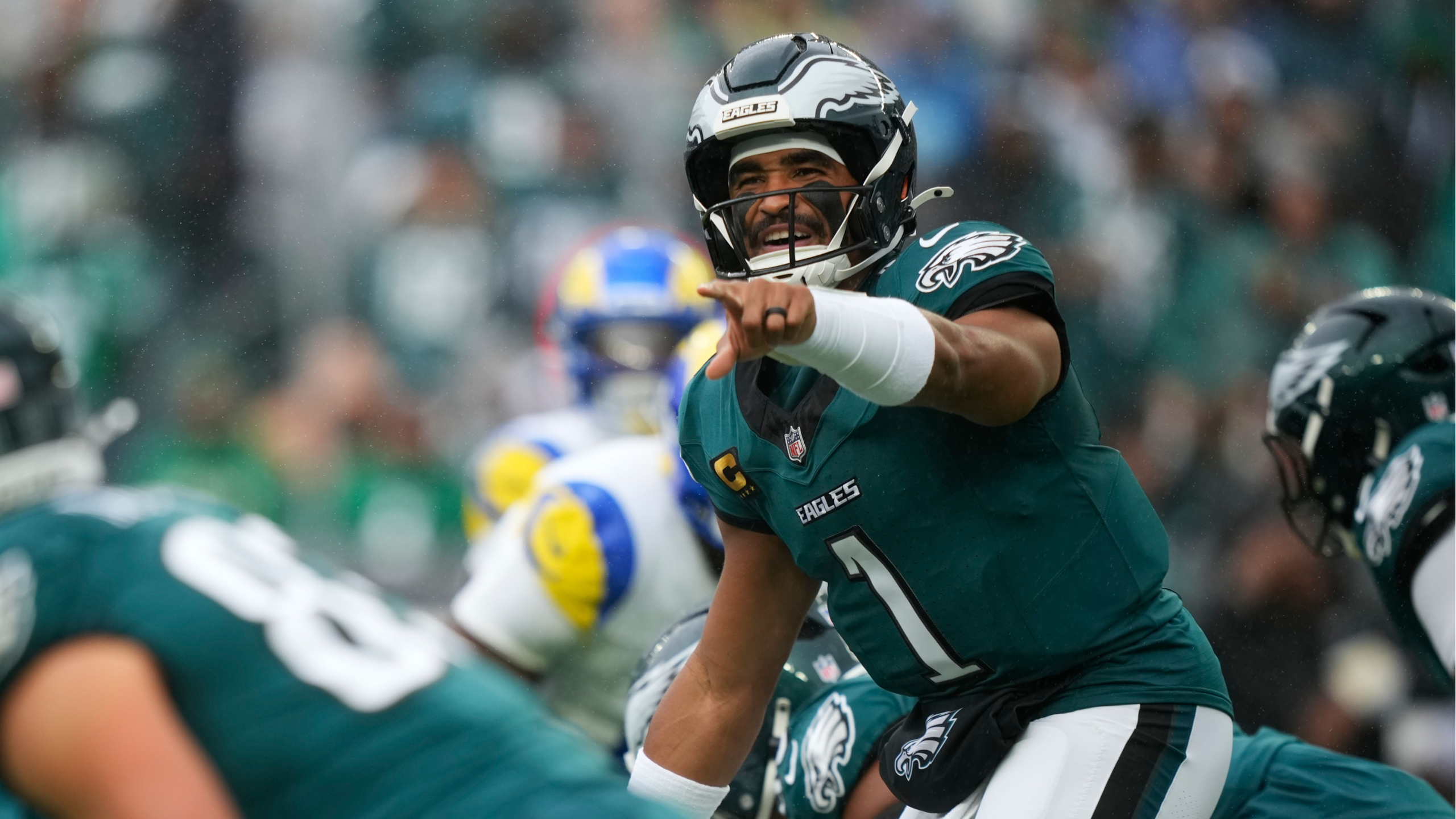
The Philadelphia Eagles have a need for a big-time playmaker at wide receiver; we’ll see if the Eagles' front office will pull the trigger, but with teams like the Rams, Browns, Jaguars, and Chiefs all looking to trade back, it is a real possibility. They already have two starting wide receivers in DeSean Jackson, who was their second round selection last season, and Kevin Curtis, who missed seven games due to a groin injury. Both of these wide receivers are deep threats but lack the big red zone threat that the Eagles have always had trouble with.
.jpg?w=2560 "Titans Giants Football")
.jpg?w=2560 "Dolphins Bills Football")