

2011 Stanley Cup Playoffs: Pittsburgh's Acquisitions Key to Lengthy Postseason
Change is the only certainty in the NHL's salary cap era. Dynasties are harder to come by as teams are forced to make difficult financial and personnel decisions each year, but sustained success can still be had by the clubs which are best able to maneuver within the system.
The Pittsburgh Penguins have been one of the most consistently successful clubs since the salary cap was enacted at the beginning of the 2005-06 season, with five straight postseason appearances and counting and a Stanley Cup win to their credit.
Pittsburgh fell short of a third straight finals appearance last spring when their defense faltered in the semifinals round against Montreal. Over the summer and throughout the course of the season, General Manager Ray Shero brought in a number of new players to help ensure the team doesn't endure another quick postseason departure.
Seven starters from last season's playoff roster were lost to trade or free agency. Filling in for the departed and for missing starters Sidney Crosby, Evgeni Malkin and Matt Cooke are ten starters who were not with the club a season ago.
In the midst of their first round match with a very capable Tampa Bay Lightning team, Pittsburgh will continue to rely on its new acquisitions—acquisitions which have arrived via trade, free agency or minor league call-up—to carry them into the next round.
Missing from the list are Dustin Jeffrey (undisclosed injury) and Mike Comrie (healthy scratch).
Given the injury situation in Pittsburgh, these ten players will be instrumental to the Penguins' success this spring.
10. RW Chris Conner
1 of 10
The diminutive right winger got his first call-up with the Penguins during the 2009-10 regular season but spent most of the year with AHL affiliate Wilkes-Barre Scranton. Since an early call-up this season, Conner has played 60 games with Pittsburgh in a third-line role.
Conner's recall was initially a move to replace the injured Mike Comrie and to help spark the Penguins out of an early funk. Conner's arrival coincided with the beginning of the Penguins' 12-game winning streak that ran through most of December.
The 27-year-old winger has 15 points in those 60 games—seven goals and eight assists. Three of those seven tallies are game-winners.
Conner is counted on to be aggressive on the back-check like all players are under Dan Bylsma's system, and is a plus-five on the season.
Conner is one of the fastest skaters on the roster, and has spent the last few weeks on a line with fellow speedsters Maxime Talbot and Pascal Dupuis. The line is counted on to create offensive zone pressure and is excellent at cycling the puck.
If the Penguins make it to the second round, Conner may lose his everyday spot to Matt Cooke, who would return from his conditional suspension and take an important role on the penalty kill and on the third line.
9. RW Arron Asham
2 of 10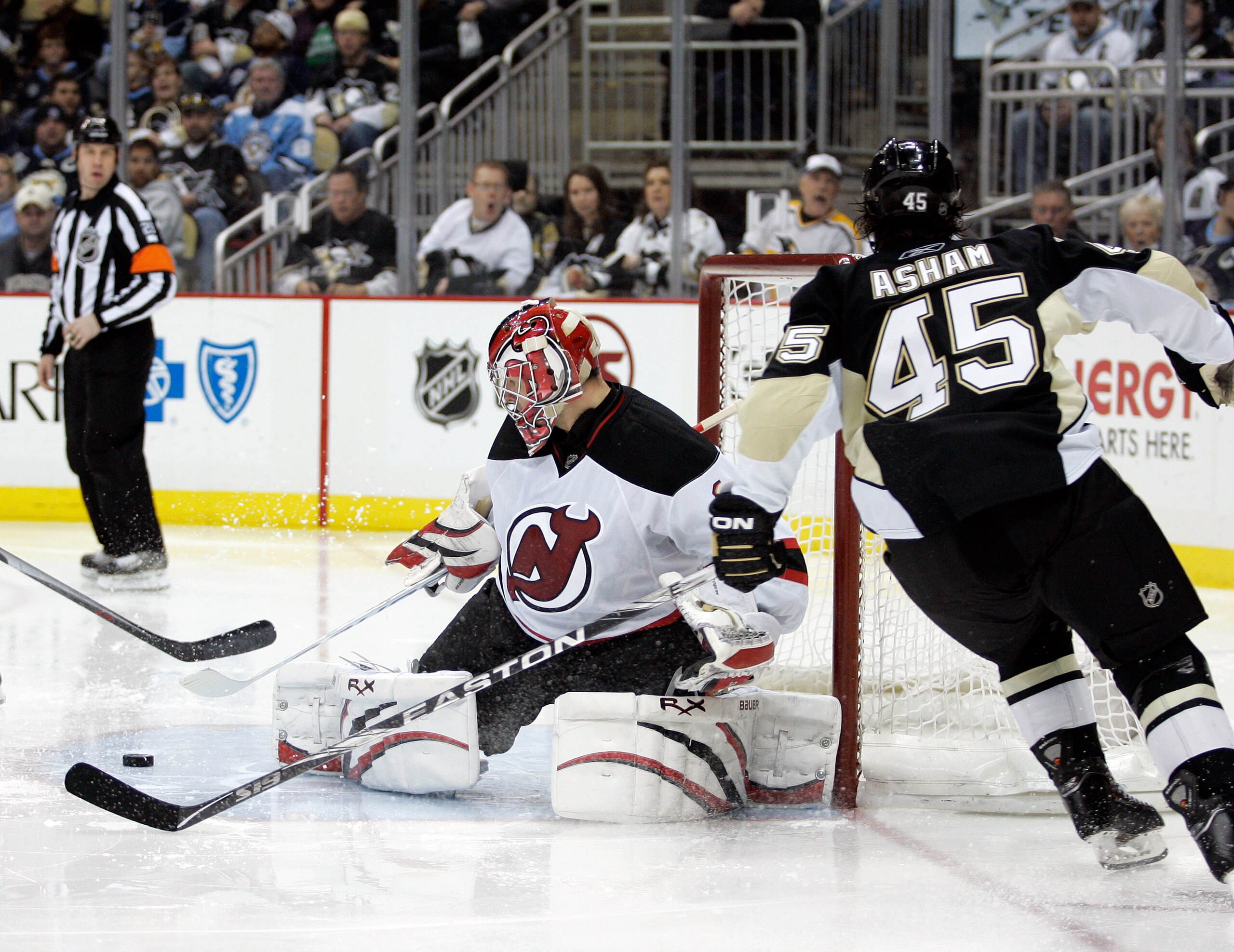
Acquired via free agency late last summer, the former Flyer was brought in by Shero to add some sandpaper to a club which lacked physicality and grit.
Asham has been injured sporadically throughout the year with nagging shoulder problems and a concussion. Despite playing only 44 games in the regular season, Asham showed the value of his postseason experience by scoring the second goal of Wednesday's game in Pittsburgh.
The right winger accounted for only 11 points during the regular season, but with the injuries to Pittsburgh's big two, all forwards are being counted on to provide platoon scoring.
Playing fourth-line minutes, Asham and linemate Craig Adams have accounted for half of the team's goals through the first two games of the Tampa series.
Asham combines fourth-line grit with a goal scoring touch, and may be counted on to keep scoring as the team searches for offense from any line that will provide it.
(Given the time of this writing, allow a last-second revision for his first period one-timer off a feed from Mike Rupp in Game 3. Very nice goal, and an excellent example of how valuable playoff experience is.)
8. D Deryk Engelland
3 of 10The Penguins have platooned the roster spot for the sixth defenseman all season. Deryk Engelland, an AHL veteran, got his chance to fill the spot throughout the year along with Ben Lovejoy and Matt Niskanen.
The defenseman has only 10 points in 63 games this year, but is counted on to be a solid presence on the blueline and provide grit under Dan Bylsma's crash-bang system. Engelland is third on the team with 123 PIM.
Engelland has been scratched in each of the first three postseason games, and has been the odd man-out on most nights since Niskanen arrived late in February.
Despite the platoon role, the 28-year-old secured his first multi-year deal at the NHL level this season, signing a three-year extension in January. Engelland made his mark at the pro level with no-nonsense defensive play and quickly established a reputation as a fearless and dangerous fighter.
With Engelland's signing (and the remaining term of Matt Niskanen's deal with the Dallas Stars), each of Pittsburgh's seven NHL defenseman is signed through next season.

7. D Matt Niskanen
4 of 10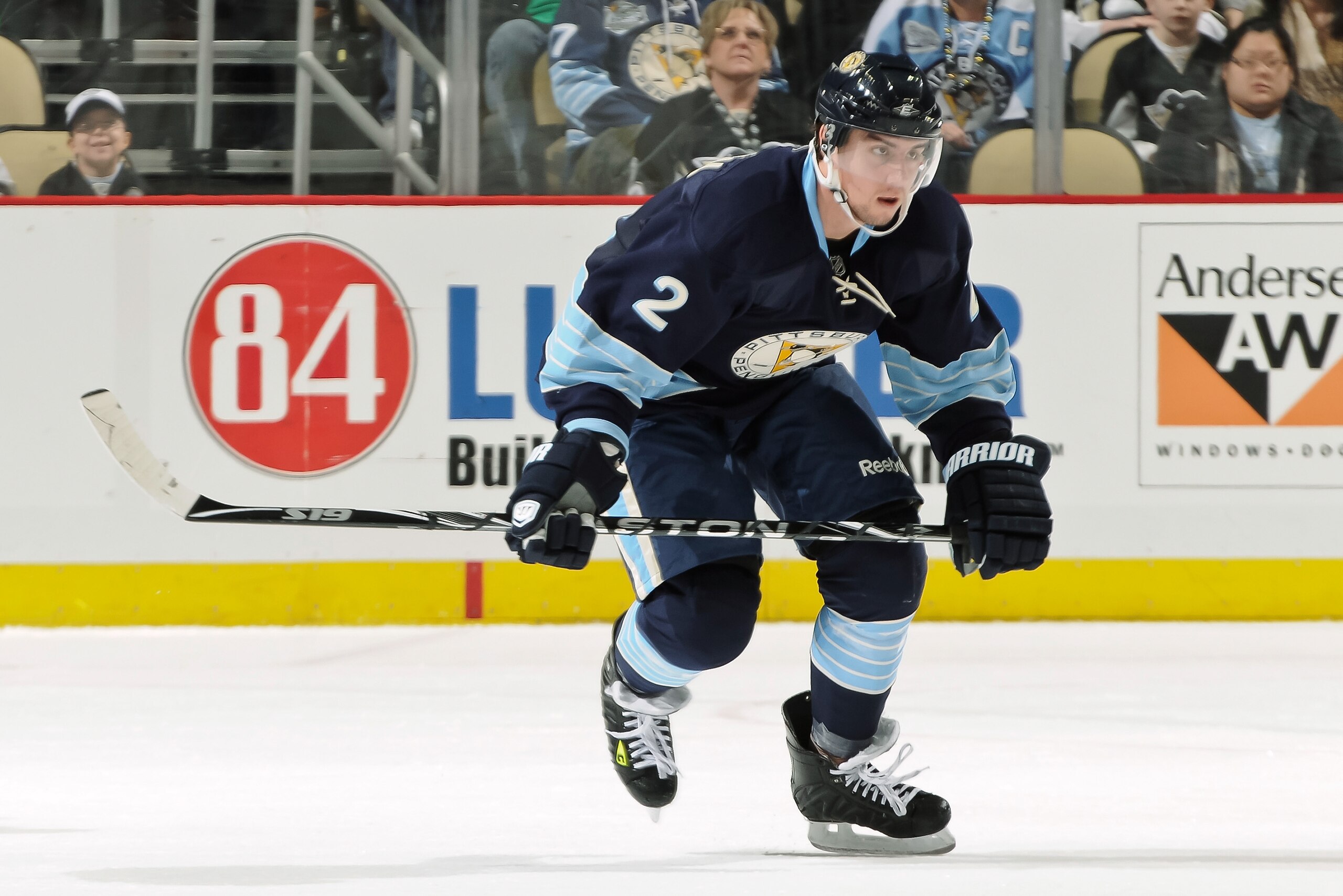
Acquired as part of the deal that sent puck-moving defenseman Alex Goligoski to Dallas, Matt Niskanen has assumed a role in the rotation of Pittsburgh's third defensive pairing.
Heading into the early parts of the postseason, Niskanen adds an experienced NHL presence to the unit, where he's shared time with rookie Ben Lovejoy.
Niskanen was seen as an afterthought in the deal (James Neal being the prized acquisition), but has acquitted himself nicely in 18 games with Pittsburgh.
Like his partners on the third pairing, Niskanen is counted on to make smart, fundamental plays in the defensive zone and to quickly move the puck to the Pens' forwards—namely, to avoid mistakes.
Niskanen had fallen out of favor in Dallas, where many thought he was rushed into an NHL role before his development had run its full course. He's looked comfortable in Pittsburgh, avoiding costly mistakes and transitioning smoothly into the Pittsburgh system.
Niskanen has a goal and three assists in 18 regular season games with the Pens and is a minus-1 through the first two postseason games. He'll be counted on to continue playing solid, mistake-free hockey throughout the postseason.
6. D Ben Lovejoy
5 of 10
Like Engelland, Ben Lovejoy was signed to a three-year deal to help fill the defensive vacancies after last season. Lovejoy signed a two-way deal prior to the beginning of free agency last summer.
As with Engelland and Niskanen, Lovejoy helps to round out a defensive roster which lost Sergei Gonchar, Mark Eaton, Jordan Leopold and Alex Goligoski from last year's postseason unit.
Lovejoy has been solid enough to appear in each postseason game, and tallied 18 points in 47 regular season games, including three assists in the final game against Atlanta.
A solid all-around player, he is neither exceptional offensively nor a shutdown player defensively. However, he's played well enough under the current staff to earn a (mostly) permanent roster spot, and has never been a liability on the blueline.
In 61 career games at the NHL level, Lovejoy is a plus-19, a very solid number for a third-pairing defenseman. Like Niskanen, he'll be counted on to play smart, fundamentally-sound hockey and to help spring the forwards in the transition game.
5. C Mark Letestu
6 of 10
A strong performance in training camp earned Letestu a spot in place of the injured Jordan Staal on the third line, and a solid first few months of his rookie campaign earned him a three-year, one-way deal in January.
Letestu was excellent in the third line role through the first half of the season. Like most of Pittsburgh's forwards, he missed parts of January and February due to injury. When he returned, he found himself in a top-line role with Sidney Crosby and Evgeni Malkin shelved long-term.
Along with Jordan Staal, Letestu is one of the last of Pittsburgh's healthy centers (Malkin, Crosby and Dustin Jeffrey are all gone indefinitely).
Letestu sports a respectable 14 goals and 13 assists in 64 regular season games and 10 shots on goal in the first two postseason games.
However, respectable won't be good enough from Letestu, who now anchors a line between the Penguins' best two wingers in James Neal and Alex Kovalev.
The line has shown flashes of chemistry in their games together, but haven't been anything resembling a true scoring line. Letestu's relative inexperience plays into that, as well as the lack of familiarity between the linemates—he joined the club for good at the beginning of the season, while Neal and Kovalev came in the week prior to the trade deadline.
If Pittsburgh is going to go deep into the postseason—or at least deep enough to see Sidney Crosby return—Letestu will have to improve on an already impressive first full year.
4. RW Alex Kovalev
7 of 10No one has ever questioned Alex Kovalev's abilities—at 38, he is still one of the league's most skilled players—but his work ethic and ability to cooperate with coaches have made him a problematic star throughout his career.
Kovalev enjoyed his first tenure in Pittsburgh and the team was on his short list of trade destinations as the 2011 deadline approached. Still a fan favorite in Pittsburgh, Kovalev was a no-brainer deal in one of the final days of free agency. The Penguins landed the former winger and much-needed skill player for a seventh-round pick.
Ideally, Kovalev would be a complementary scorer on this club, but the injury situation has made him one of Pittsburgh's best offensive options.
Kovalev isn't as fleet of foot as in his first go-round with the team, but his skill has accounted for any lack of aggression under the Bylsma system.
Playing on a line with James Neal and Mark Letestu, he has provided a little scoring, including a number of shootout winners and the game-winning goal in Game 1 against Tampa. He'll be asked to increase his output as the postseason progresses.
Kovalev is not signed past next season. Nearing 40, he won't get anything approaching the five million he receives in the final year of his current deal. If he's willing to take a hometown discount, Kovalev could be an intriguing option alongside either of the big two centers, especially Evgeni Malkin, who has struggled in the absence of good scoring wingers over the last few seasons.
3. D Paul Martin
8 of 10
Pittsburgh's offseason focus was squarely on defense. The team let go of four defensemen from the 2010-11 season after the unit ranked 20th in the league in team defense. Pittsburgh's defensive breakdowns were largely responsible for the Game 7 meltdown against Montreal.
Having missed on Dan Hamhuis, Shero immediately snapped up Paul Martin, one of the most sought-after defensemen of his free agent class. The team solidified its defensive core by inking the big blueliner to a five-year, 25 million-dollar deal.
Martin was seen as a defensively-sound player whose offensive skills would come to the fore in Pittsburgh after spending five seasons in New Jersey's no-fun defensive schemes. In 77 regular season games with the Pens, Martin is a plus-9, playing mostly with fellow newcomer Zbynek Michalek.
For his career, Martin is a plus-64. Though he's been capable of creating offense with first passes out of the zone, Martin has been a mostly defensive presence for Pittsburgh, accounting for half of the team's best shutdown pair.
Martin brings experience and composure to a blueline which had been exposed by top-end talent. In his first year, the Penguins improved from 20th to seventh in team defense, and were ranked as high as second in that category prior to the injury plague.
Martin is going to be one of the team's most important players this spring. Pittsburgh has been defensively sound all season, and the focus on goal prevention will increase throughout the playoffs as the team struggles with its lack of scoring depth.
2. LW James Neal
9 of 10
Pittsburgh's biggest trade catch since acquiring Marian Hossa in 2008, James Neal has been...well, he'll get there.
Neal is seen as a long-term option at left wing and the much-heralded "scoring winger for Sidney Crosby." Through his short tenure with Pittsburgh, Neal has been kept mostly off the score sheet, playing on a line with Letestu and Kovalev.
He is seen primarily as a scorer, but his style of play makes him a perfect example of a "Dan Bylsma player." Neal is big, extremely physical and tenacious when playing away from the puck. He has created a number of scoring chances in his 22 games with the club and has been otherwise good defensively.
Through his three seasons in the NHL, Neal has played alongside talent such as Brad Richards, Brendan Morrow and Loui Eriksson. He has never been the go-to scorer, and was thus able to add complementary offense to the tune of 20 or more goals in each of his three seasons.
Right now, Neal is one of Pittsburgh's best offensive options. After Kovalev, he possesses the best pure shot of Pittsburgh's healthy forwards.
Neal isn't playing on the line Shero imagined when he traded for him, but his acquisition was a long-term move. Eventually, Neal will play alongside Crosby or Malkin.
But he probably won't play alongside either of them this postseason, and this team still has its sights set on winning the Stanley Cup. Neal will have to dramatically increase his output, and soon, if the team is going to advance into the second round.
1. D Zbynek Michalek
10 of 10
No one could pronounce his name when he arrived in town, and fans knew nothing about the former Phoenix Coyote other than that he was the nice consolation signing to having missed out on Dan Hamhuis.
After a full season and a handful of playoff appearances, Michalek has proven to be Pittsburgh's best defensive defenseman, and maybe one of the best pure defensive players in the NHL.
There isn't a stat that can begin to capture what Michalek means to this team. Pittsburgh signed him to a five-year, 20 million-dollar deal over the summer, a fine payday for a defenseman who had been almost anonymous after spending his whole career in the desert.
In his first season with Pittsburgh, Michalek registered five goals, 19 total points and an even rating, numbers that are absolutely pedestrian.
Numbers don't tell the story of his play, though. Michalek is one of the best shot-blockers in the game, and his abilities have been instrumental in establishing the best regular-season penalty killing unit in the NHL.
Michalek's arrival, among other circumstances, helped Pittsburgh finish first on the penalty kill for the first time in team history—dating back to 1967.
Michalek led the NHL in blocked shots in 2008 with 271 in 82 games. He led all Penguins with 149 blocked shots in 2010-11 despite playing just 73 games.
His presence in front of the net has certainly helped Marc-Andre Fleury to his best season as a professional, clearing out bodies and pucks from the front of the net. His willingness to throw his body into the path of the puck has taken away countless scoring chances. He has stifled unlimited short passes that would otherwise go through the slot and make for easy scoring chances. The list of little plays that he makes could go on forever.
Michalek is the type of defenseman a team signs to shutdown opposing stars, and Michalek has drawn assignments against the likes of Alexander Ovechkin and Ilya Kovalchuk, players for whom the Penguins had no answer a season ago.
Don't think for a second the Coyotes don't miss him. Ilya Bryzgalov was a Vezina finalist with Michalek in front of him. After taking Detroit to seven games a year ago, the Coyotes now look like prime candidates for a first round sweep. Without him, the Coyotes have had no answer for Pavel Datsyuk and the rest of Detroit's offensive attack.
The playoffs are won with defense, and Michalek has quietly been Pittsburgh's best blue line option. If the injury-ravaged team manages to make a long postseason run, Michalek will have been instrumental to its success.
.jpg?w=2560 "NHL Trade Grades Connor Hellebuyck")



.png?w=2560 "Week 8 Winners & Losers 📊")

.jpg?w=2560 "Malik Beasley Negotiating Plea Deal (AP)")
.jpg?w=2560 "Jonathan Taylor Landing Spots")
