

NFL Playoffs 2020: Overtime Rules, Bracket and Postseason Format
As the NFL's popularity has increased both substantially and rapidly, there is a risk in assuming everyone knows the format and rules of the playoffs.
Given that the regular season has a few different rules than the postseason, though, the league can be confusing. Whether you're just learning the sport or simply need a refresher, we're breaking down the basics of the four-quarter, 60-minute game.
From how 12 teams reached the playoffs, how they'll advance and what happens if overtime is needed, we have you covered.
.jpg?w=2560 "Packers 49ers Football")
.jpg?w=2560 "Lions Cardinals Football")
.jpg?w=2560 "Seahawks Cardinals Football")
NFL Playoff Bracket
Postseason Format
The NFL is separated into the AFC and NFC, and both include four divisions. Whichever team owns the best record in each of those eight divisions will automatically qualify for the postseason.
Plus, the AFC and NFC team holding the best record earns a first-round bye and home-field advantage for the playoffs. The second-best record also has a first-round bye, while the third- and fourth-best records play at home in the Wild Card Round.
And that's where the postseason begins.
In both conferences, the two non-division winners with the best records also qualify for the playoffs. They'll be on the road during the Wild Card Round, which is Jan. 4 and 5 in 2020.
The winners advance to the Divisional Round, where the four teams with a first-round bye await. How those matchups are determined may seem complicated—the top-seeded team hosts the worst remaining seed—but should be clear with examples.
This season, the Baltimore Ravens are the No. 1 seed in the AFC. If the No. 6 Tennessee Titans defeat the No. 3 New England Patriots, the Ravens will host Tennessee. But if New England wins, Baltimore will host either the No. 5 Buffalo Bills or No. 4 Houston Texans.
So, the No. 2 Kansas City Chiefs will host the Patriots if New England wins or either the Bills or Texans if the Titans win.
In the NFC, the San Francisco 49ers hold the No. 1 spot. Should the No. 6 Minnesota Vikings upset the No. 3 New Orleans Saints in the Wild Card Round, the 49ers will host Minnesota. If the Saints win, though, San Francisco will play either the No. 5 Seattle Seahawks or No. 4 Philadelphia Eagles.
The Green Bay Packers will host the Saints if New Orleans wins or the Seahawks or Eagles if the Vikings win.
While the winners of Divisional Round games advance to the AFC and NFC Championships, the winners of that round continue on to Super Bowl LIV on Sunday, Feb. 2.
Overtime Rules
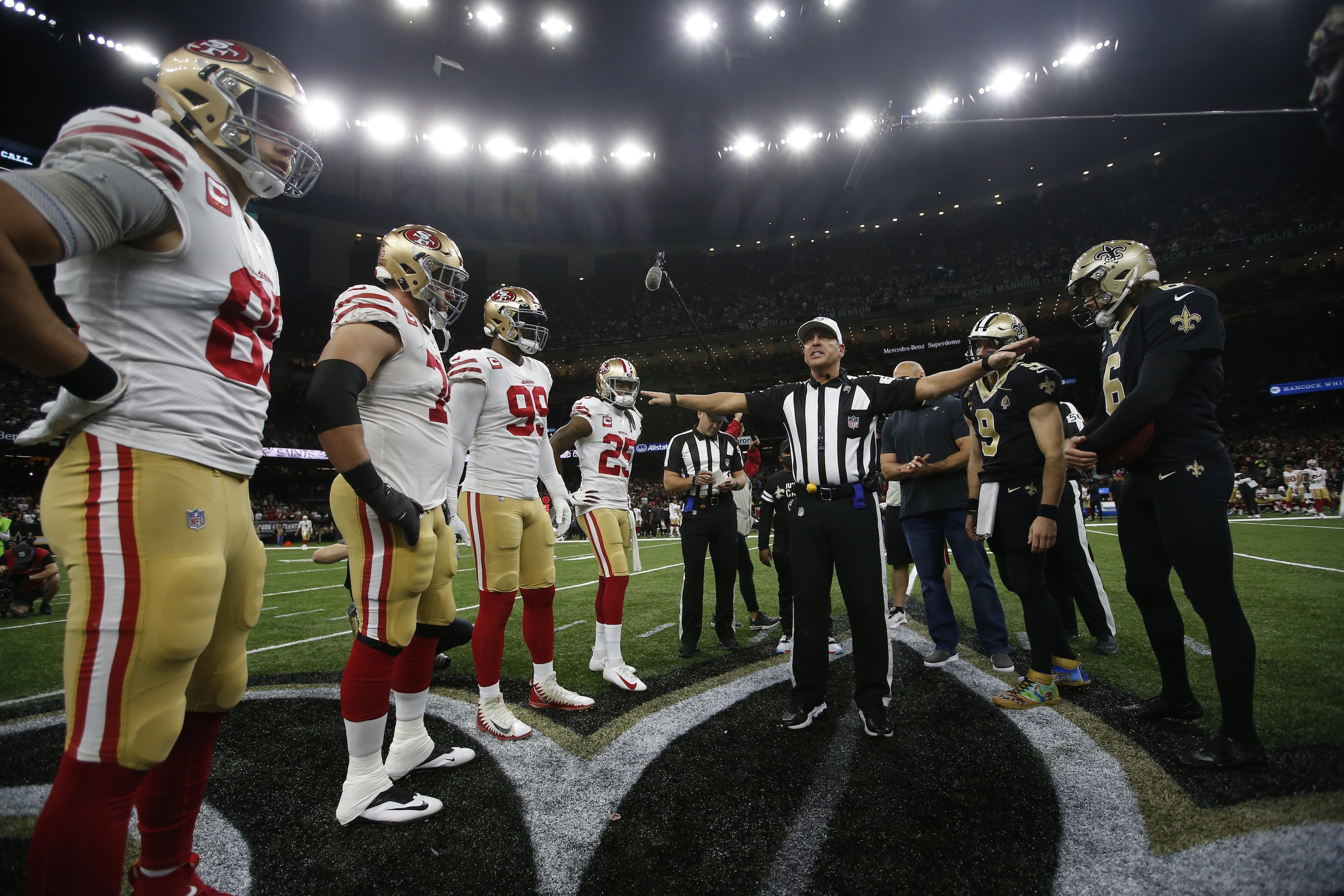
The NFL utilizes two significant changes for overtime in the playoffs compared to the regular season.
First, the extra session is 15 minutes instead of 10. And second, the game cannot end in a tie. If a score remains tied after 15 minutes, there is a two-minute break before the next period begins—with no halftime break after a second overtime.
One important note is play resets at the conclusion of an overtime period. The offense must try to score on that final possession because a kickoff will occur at the beginning of each overtime.
The rules are otherwise consistent with the regular season; overtime begins with a coin toss and uses a sudden-death format, with one exception on the opening drive.
If a touchdown or safety is scored on that initial possession, the game is over. If the offense kicks a field goal, the opposing team has an opportunity to either score a touchdown and win or kick a field goal to extend the game.
Follow Bleacher Report writer David Kenyon on Twitter @Kenyon19_BR.
.jpg?w=2560 "Steelers Browns Football")
.jpg?w=2560 "Cam Ward Says He's Not A Loser")


.jpg?w=2560 "Chargers Fall to 0-5 🤢")