

The Biggest Weakness for the Top Stanley Cup Contenders in 2016-17
Now past the midpoint of the 2016-17 NHL season, potential Stanley Cup contenders are separating themselves from other clubs in the standings. Among them are the Washington Capitals and Minnesota Wild.
While these clubs have considerable strengths, each carries a weakness that could prevent them from achieving championship glory.
Some teams, such as the Capitals and Wild, have mental hurdles to overcome. Others, such as the Chicago Blackhawks and Montreal Canadiens, have notable roster issues to be addressed.
Here's a look at the biggest weaknesses of this season's top Cup contenders.
Chicago Blackhawks
1 of 6
Three-time Stanley Cup champions since 2010, the Chicago Blackhawks sit second in the Central Division and the Western Conference standings. They're lacking a reliable left wing for center Jonathan Toews' line and have a low faceoff win percentage of 48.1, but their overall defensive game could be their significant problem area.
The Blackhawks have given up a substantial number of shots against per game (31.2) this season, the highest among Western Conference clubs in playoff position. Their penalty-killing percentage (75.9) is third-worst in the league.
Fortunately for the Blackhawks, they've got solid goaltending. Starter Corey Crawford and backup Scott Darling combine for a 10th-best GAA of 2.57. That's helped offset those defensive issues.
If left unaddressed, however, the Blackhawks' defensive issues could hurt their quest for a fourth championship in this decade. On Jan. 20, The Athletic's Scott Powers reported a league source claiming the team is seeking a veteran defenseman as well as a forward.
Montreal Canadiens
2 of 6
The Montreal Canadiens are perched atop the Atlantic Division, a spot they've held since early October. To win their first title in 24 years, they must improve their penalty-killing percentage (79.7) and reduce their high shots against per game (30.0). A lack of depth at center, however, could be their biggest issue.
For years, the Canadiens have lacked a true first-line center. Alexander Galchenyuk was in the role until he was sidelined by injury in December and again this month. Veteran Tomas Plekanec is logging second-pairing duty. Veteran David Desharnais has been sidelined since December. Phillip Danault and Brian Flynn have done well in a supporting role, but they're not top-line material.
General manager Marc Bergevin could shop around for a scoring center before the March 1 trade deadline. However, he could find the pickings slim. The best center likely available in the trade market is Martin Hanzal of the Arizona Coyotes. He's a big, two-way player with a lengthy injury history and only two 40-point seasons on his resume.
If Bergevin can't find help via trade, the Canadiens will look to getting Galchenyuk and Desharnais back healthy for the playoffs. Both must elevate their play for the Habs to have a chance of winning a championship.
Minnesota Wild
3 of 6
The Minnesota Wild entered the NHL All-Star break sitting atop the Western Conference standings. While they sit 20th in shots per game (29.4) and are uncomfortably close to the bottom third in shots against per game (30.3), their biggest weakness is overcoming their history of playoff futility.
Since reaching the Western Conference Finals in 2003, the Wild failed to advance past the second round in each of their last four playoff appearances. They were eliminated from the opening round in 2013 and 2016 and fell in the second round in 2014 and 2015.
Many of the Wild's current core players were part of most of those early postseason exits. Team leaders such as goaltender Devan Dubnyk, defenseman Ryan Suter and forwards Zach Parise and captain Mikko Koivu must find a way to lead their teammates in putting those previous failures behind them.
They'll also look to younger players such as defensemen Jonas Brodin and Matt Dumba and forwards Charlie Coyle and Nino Niederreiter to elevate their performances. Center Eric Staal, who won a Stanley Cup with the Carolina Hurricanes in 2006, could also take on a leadership role.


Pittsburgh Penguins
4 of 6
The defending Stanley Cup champion Pittsburgh Penguins are once again among the top teams in the Eastern Conference. While they have a high GAA (2.92) and their penalty-killing percentage (78.9) is among the league's worst, their biggest weakness is the challenge of repeating as champions.
No club has won consecutive championships since the Detroit Red Wings in 1997 and 1998. The Penguins and Red Wings were the last teams to meet in consecutive Finals (2008 and 2009), with each club winning a title.
v The Penguins face a tougher challenge this season, as the regular-season schedule was compressed to accommodate the 2016 World Cup of Hockey. Several Penguins stars, including Sidney Crosby and Evgeni Malkin, also took part in that tournament.
The Penguins will expect team leaders and core players such as Crosby, Malkin and Kris Letang to provide the leadership necessary to get the team over the hump. Younger supporting players such as forwards Conor Sheary, Tom Kuhnhackl and Bryan Rust must step up again, as they did during last year's Cup run.
San Jose Sharks
5 of 6
Stanley Cup finalists in 2016, the San Jose Sharks sit atop the Pacific Division with the third-best record in the Western Conference. They will face a daunting challenge of making consecutive appearances in the Stanley Cup Final. Their offensive struggles this season could make it even more difficult.
With 2.66 goals per game, the Sharks are close to the league's bottom third in that category. Of the clubs currently holding a playoff spot, the Sharks have the worst power-play percentage (16.6).
Defenseman (and leading scorer) Brent Burns and forwards Logan Couture, Joe Pavelski and Joe Thornton are carrying the bulk of the offense. The production of Pavelski and Thornton, however, is down compared to last season's pace. Veteran forward Patrick Marleau has 17 goals, but four of those came in a contest on Jan. 23 against the Colorado Avalanche.
In the past, Sharks general manager Doug Wilson made moves near the trade deadline to bolster his roster. If the offensive production doesn't improve in the coming weeks, he could seek help again before the March 1 deadline.
Washington Capitals
6 of 6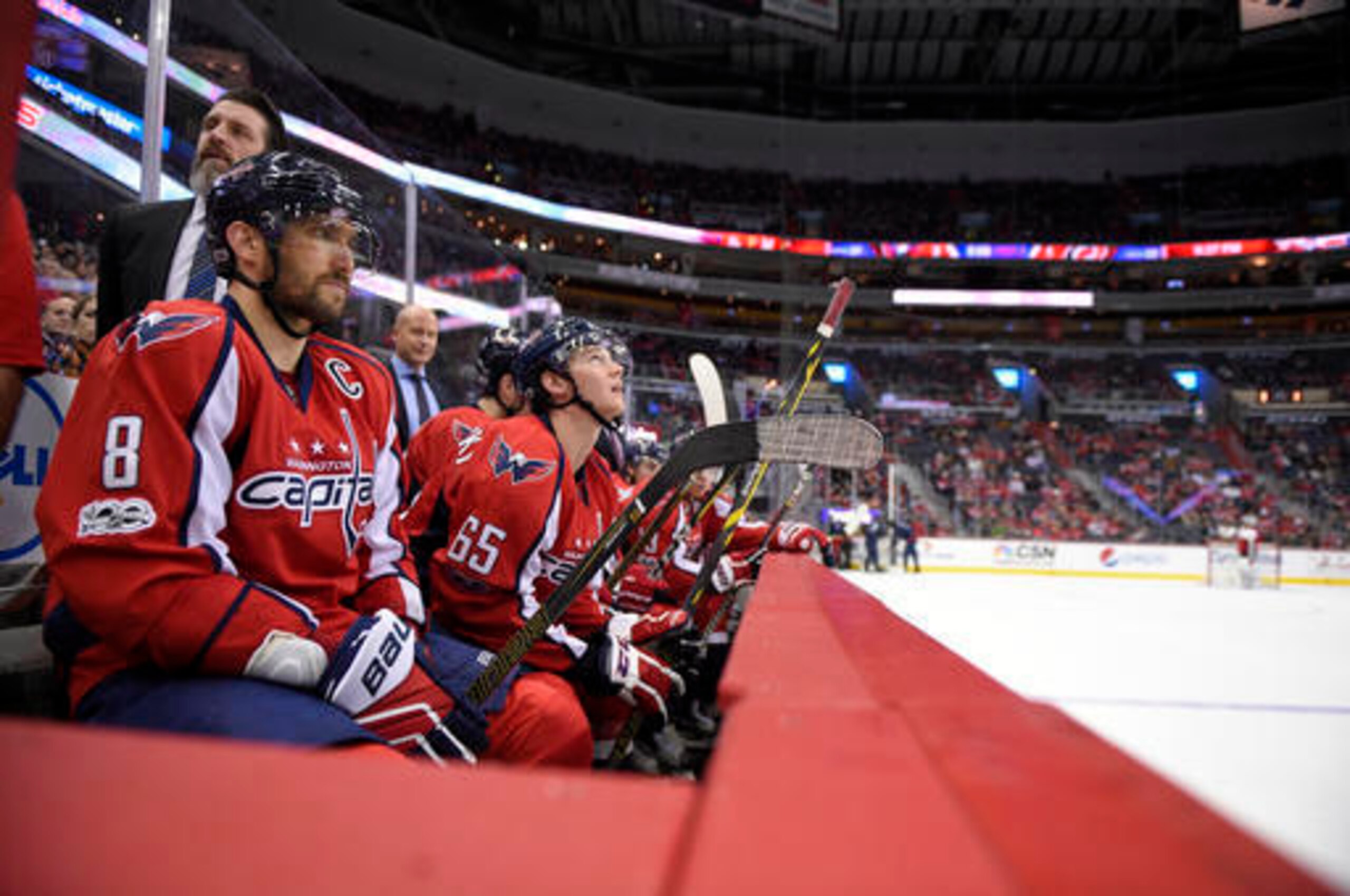
The Capitals entered this season's NHL All-Star break sitting atop the Eastern Conference standings. Their only real performance weaknesses are a power-play percentage that's 13th overall (20.7) and a shots-per-game average (29.8) that's among the middle of the pack. A larger concern, however, is the shadow of previous playoff failure.
Since 2007-08, the Washington Capitals have regularly finished among the NHL's top teams in the standings. In 2010 and 2016, they won the Presidents' Trophy for having the best regular-season record. However, they've never advanced beyond the second round in the playoffs. That record of futility remains a significant mental hurdle this season.
More stress is on the Capitals because this will likely be the last chance for their current core to win a championship. Defenseman Karl Alzner and scoring wingers T.J. Oshie and Justin Williams are eligible for unrestricted free agency and could prove too expensive to re-sign.
Longtime Capitals leaders Alexander Ovechkin, Nicklas Backstrom and Braden Holtby will feel significant pressure to carry this club to a Cup title this season. This could be their last best chance to shrug off the playoff choke label.
Stats (as of Jan. 30, 2017) via NHL.com. Additional info via Hockey-Reference.com.

.jpg?w=2560 "49ers LB Suspended for Headbutt")
.jpg?w=2560 "Buzz: MHJ Hired Agents for Trade")

.jpg?w=2560 "AD Trolls Bears WR on IG 😂")
.jpg?w=2560 "Report: Steelers WR to Miss 'Weeks'")