Power Ranking the Line Combinations in the 2016 Stanley Cup Final
With the Stanley Cup Final set to start Monday, it's a good time to take a look at the forward line combinations used by the Pittsburgh Penguins and San Jose Sharks. We ranked each team's four lines, placing a heavy emphasis on performance in the playoffs.
In each slide, we broke down the line's three players individually and then considered some key performance metrics for the unit during the postseason. Though we consulted Hockey-Reference.com and Stats.HockeyAnalysis.com as part of the process, our key tool was Corsica's line combination generator.
Read on to see which lines have been getting the job done for the Penguins and the Sharks in these playoffs.
8. Dainius Zubrus, Nick Spaling and Tommy Wingels
1 of 8
Left Wing: The Sharks' Dainius Zubrus followed Peter DeBoer over from the New Jersey Devils last year, and while DeBoer has found minutes for him, it's clear the veteran is in his twilight years as an NHLer. The 6'5", 225-pound all-positions forward has survived this long thanks to his smarts and versatility, but his offence has dried up. If injured forward Matt Nieto returns, Zubrus will likely find himself in the press box.
Centre: Nick Spaling, added a week before the trade deadline, has been a regular on the penalty kill for San Jose but has been a disappointment otherwise. He didn't score much in the regular season (two goals and six points in 23 games with the Sharks) and has just a single assist through 18 playoff games. He did play for the Penguins a year ago, however, and that knowledge may come in handy during the Stanley Cup Final.
Right Wing: Tommy Wingels has had a tough season, with his point production (18) falling by 50 percent from a year ago. He does play a physical brand of hockey and leads all San Jose forwards with 58 hits in the postseason.
Key Playoff Stat(s): Despite starting 21 shifts in the offensive zone (to just 11 in the defensive end), this line has been outshot 20-11. The only positive is it has kept the bleeding to a minimum; goals are 1-1 when it has been on the ice in the postseason.
7. Tom Kuhnhackl, Matt Cullen and Eric Fehr
2 of 8
Left Wing: Tom Kuhnhackl was drafted by the Penguins in 2010 and worked his way to Pittsburgh over the course of his pro career. The German rookie is a versatile skater who can play either wing. He kills penalties and has steadily improved his offensive game.
Centre: Matt Cullen enjoyed something of a bounce-back campaign at the age of 39, scoring 16 goals and recording 32 points for the Pens in the regular season. A veteran of nearly 1,300 regular-season games, he plays key minutes on the penalty kill and has been one of Pittsburgh's most reliable faceoff men in the playoffs.
Right Wing: It has been a disappointing season for Eric Fehr, who fell from 19 goals and 33 points a year ago to just eight and 14 this season. He's big (6'4" and 212 pounds), reasonably physical and versatile—capable of playing any forward position and killing penalties.
Key Playoff Stat(s): This line has been outshot 38-26 and outscored 5-2 at even strength. On the other hand, all three players on it have contributed to Pittsburgh's 83.6 percent kill rate when shorthanded.
6. Melker Karlsson, Chris Tierney and Joel Ward
3 of 8
Left Wing: The undrafted Melker Karlsson is in his second season with San Jose. He's good on the forecheck, kills penalties and displays some talent in the offensive zone.
Centre: Despite youth and inexperience, Chris Tierney is already an important two-way presence for the Sharks. He had an off season in the scoring department after years of improvement in that area but has bounced back in the postseason, recording five goals after managing just seven during 2015-16 proper. He's also a regular on the penalty kill.
Right Wing: Joel Ward has bounced around the San Jose lineup, spending time at all three forward positions and on both special teams units. He's big (6'1" and 226 pounds), physical and finds a way to make positive contributions at both ends of the rink.
Key Playoff Stat(s): This line has not been good together. It has been outshot 30-15 and outscored 2-1. All three players have been better as part of other units. We've only seen this unit together for a short period of time, so it's possible (if not probable) that it will perform better in the future. The talent of the individual players on the unit is such that it's hard to rank this line below Pittsburgh's fourth trio.
.jpg?w=2560 "Simon Edvisson Landing Spots")

5. Patrick Marleau, Logan Couture and Joonas Donskoi
4 of 8
Left Wing: It was a bit of an off year for Patrick Marleau, who fell to 48 points, his worst output since the lockout-shortened 2012-13 campaign. The 36-year-old is also playing a reduced role in San Jose, with his playoff average of 13:06 of action per night at even strength ranking 13th on the team. Nevertheless, he does have 12 points in the postseason (fifth on the team) and brings size, speed and skill to the forward corps.
Centre: Logan Couture is San Jose's leading point producer, with 24 in 18 postseason games. In large part, that's due to his work on the power play, as he has a team-leading 11 points with that unit. But it would be wrong to reduce his importance to the man advantage. Couture's 13 even-strength points are tied for the team lead with Joe Pavelski, and he also kills penalties.
Right Wing: The 2016 playoffs have led a lot of people to realize how good rookie winger Joonas Donskoi is. The free-agent signing skates well, can play either side of the ice and has been a quality support player on offence. Of note: He was the playoff MVP in Finland's top league a year ago and has once again improved upon his regular-season totals in the playoffs.
Key Playoff Stat(s): This line has featured Joel Ward in place of Patrick Marleau at times, but it has been better with Marleau. Not only has the unit improved its shot metrics, but it has also outscored the opposition 6-2 at even strength.
4. Conor Sheary, Sidney Crosby and Carl Hagelin
5 of 8
Left Wing: Undrafted Conor Sheary is the rare 5'8", 175-pound forward to get an honest shot at the NHL level. His offensive gifts are undeniable—he put up 36 points in 30 AHL games before being promoted to the majors—but his hold on an NHL roster spot remains precarious. At times, he has been bumped off this line in favour of the more established Chris Kunitz.
Centre: Sidney Crosby is generally acknowledged as the NHL's best player. His on-ice intelligence is second to none, he skates beautifully and he's stronger than his 5'11", 200-pound frame suggests. He's a brilliant offensive player and equally dangerous as a shooter and passer.
Right Wing: Patric Hornqvist has been a consistent offensive producer over the course of his career, but he isn't a pretty player. He's at home in front of the net and is a constant thorn in the side of the opposition; he's been credited with 58 hits in 18 playoff games. He's also diligent on the defensive side of the puck.
Key Playoff Stat(s): Despite strong possession numbers, this line has been outscored 9-7 in 5-on-5 situations over the course of the postseason. Mostly, though, that's the result of the .859 save percentage posted by Pittsburgh's goalies when this trio is on the ice.
3. Chris Kunitz, Evgeni Malkin and Bryan Rust
6 of 8
Left Wing: Chris Kunitz used to be Sidney Crosby's go-to winger, but the former first-team NHL All-Star and Canadian Olympian has produced diminishing returns over the last two seasons. However, the 36-year-old can still contribute. He had a 40-point regular season and is scoring at a healthier clip in the postseason, with 10 points in 18 games. He also leads all Penguins with 66 hits.
Centre: Evgeni Malkin is a formidable talent and would be a first-line centre with pretty much any other team in the league. He's so routinely brilliant that his last four seasons (he scored at better than a point-per-game pace in all of them) are sometimes seen as disappointing. He won the Conn Smythe when Pittsburgh last won the Cup in 2009.
Right Wing: Bryan Rust is far and away the least famous player on this line. The 24-year-old has some offensive ability but has overachieved in the playoffs with five goals (including four in series finales against the Tampa Bay Lightning and New York Rangers) and eight points in 17 games. Somewhat undersized at 5'11" and 192 pounds, Rust's value is as a two-way threat; he's a responsible player who contributes all over the ice.
Key Playoff Stat(s): In just over an hour together at five-on-five in the playoffs, this line has outscored the opposition 7-0. It's not smoke and mirrors, either; the shot totals with this unit on the ice are 44-15 in the Penguins' favour.
2. Carl Hagelin, Nick Bonino and Phil Kessel
7 of 8
Left Wing: Carl Hagelin joined the Penguins at midseason in a trade from the Anaheim Ducks and instantly blossomed. After scoring 12 points in 43 contests with the Ducks, he put up 27 in just 37 games with Pittsburgh, turning what had been his worst NHL season into one in which he set a career high in points. He brings ability at both ends of the ice, as well as elite speed.
Centre: Nick Bonino is a complete player and ended up being the perfect fit for Phil Kessel after previous attempts to match the sniper with one of the Penguins' star centres failed. He's not as fast as his wingers but is comfortable distributing the puck and letting them lug it up the ice. He's been an underrated offensive player for years and has scored at a comparable points/hour clip to players such as Jason Spezza and David Krejci over the past three seasons.
Right Wing: Kessel leads Pittsburgh in both goals and points in the playoffs. He boasts elite speed and is one of the game's best pure shooters. He drives this line offensively, as Hagelin and Bonino both possess enough skill to complement him and enough two-way nous to support him defensively.
Key Playoff Stat(s): Bonino, Hagelin and Kessel rank first, second and third in even-strength scoring for the Pens. They have combined for 32 even-strength points, and Bonino alone (12 points) has produced nearly as much at evens as Sidney Crosby and Evgeni Malkin combined (14 points).
1. Tomas Hertl, Joe Thornton and Joe Pavelski
8 of 8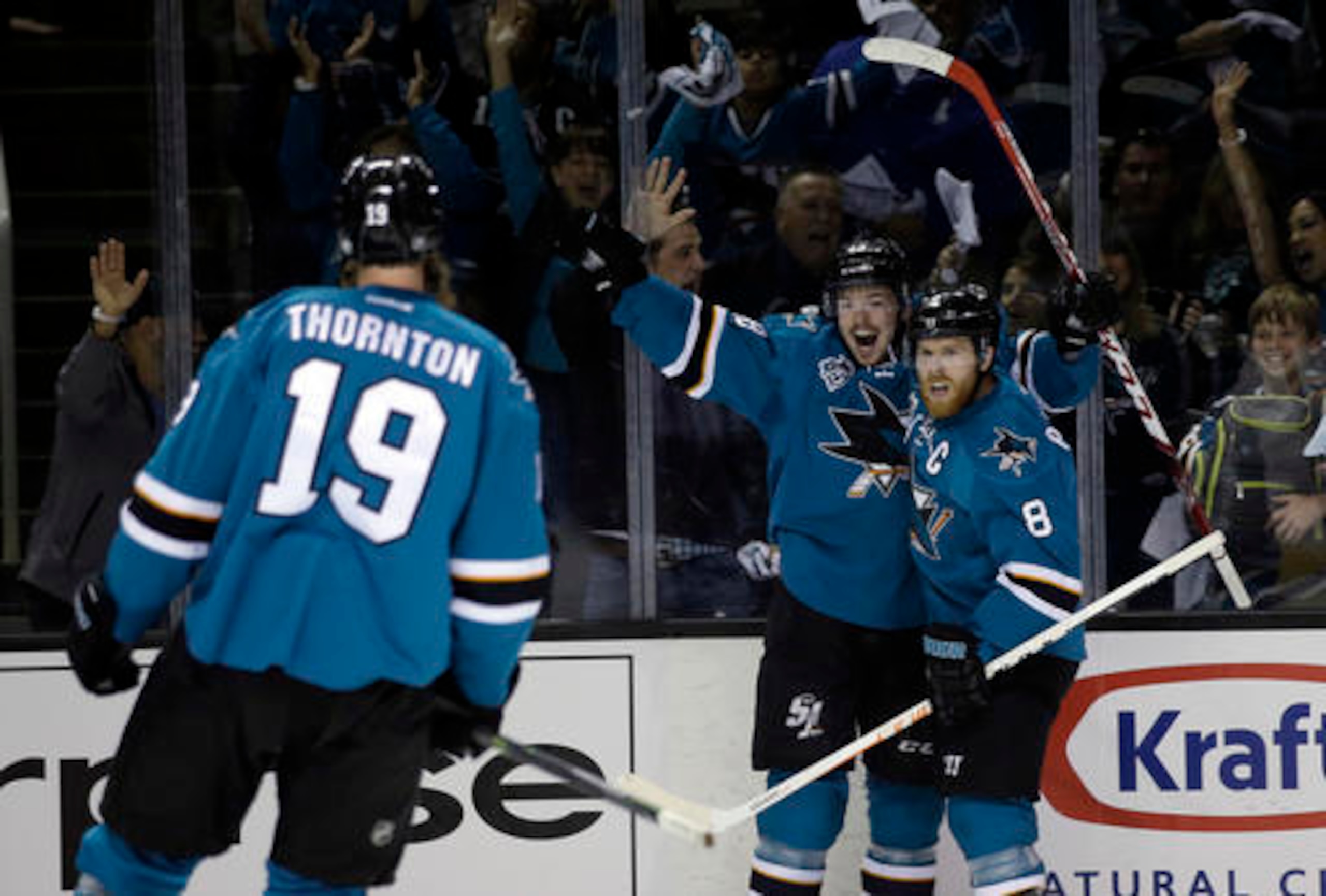
Left Wing: Tomas Hertl's skating has improved since his draft year (2012), but he's never going to be mistaken for a speedster. He does, however, combine size (6'2" and 210 pounds) and strength with good offensive instincts. He scored 21 goals for the Sharks this year with minimal power-play time and finished fourth on the team in even-strength points with 39, behind only linemates Joe Thornton (53) and Joe Pavelski (50) and Brent Burns (45).
Centre: Thornton isn't a full-time centre these days, as he and Pavelski switch roles and trade faceoff responsibilities depending on which side of the ice the draw is on. He's an elite playmaker, and at 6'4" and 220 pounds, he has the reach and strength to be formidable in puck battles. He's also responsible defensively.
Right Wing: Joe Pavelski is good at everything, but what has changed over the last few years is he's been put into positions where his ability to one-time the puck is emphasized. He can play all positions, play in any given situation and, for good measure, is also the playoffs' leading goal scorer (13).
Key Playoff Stat(s): This line has a 54 percent Fenwick rating in the playoffs and has outscored its opponents 12-6.

.jpg?w=2560 "Weather Channel Trolls Texans-Titans 💀")