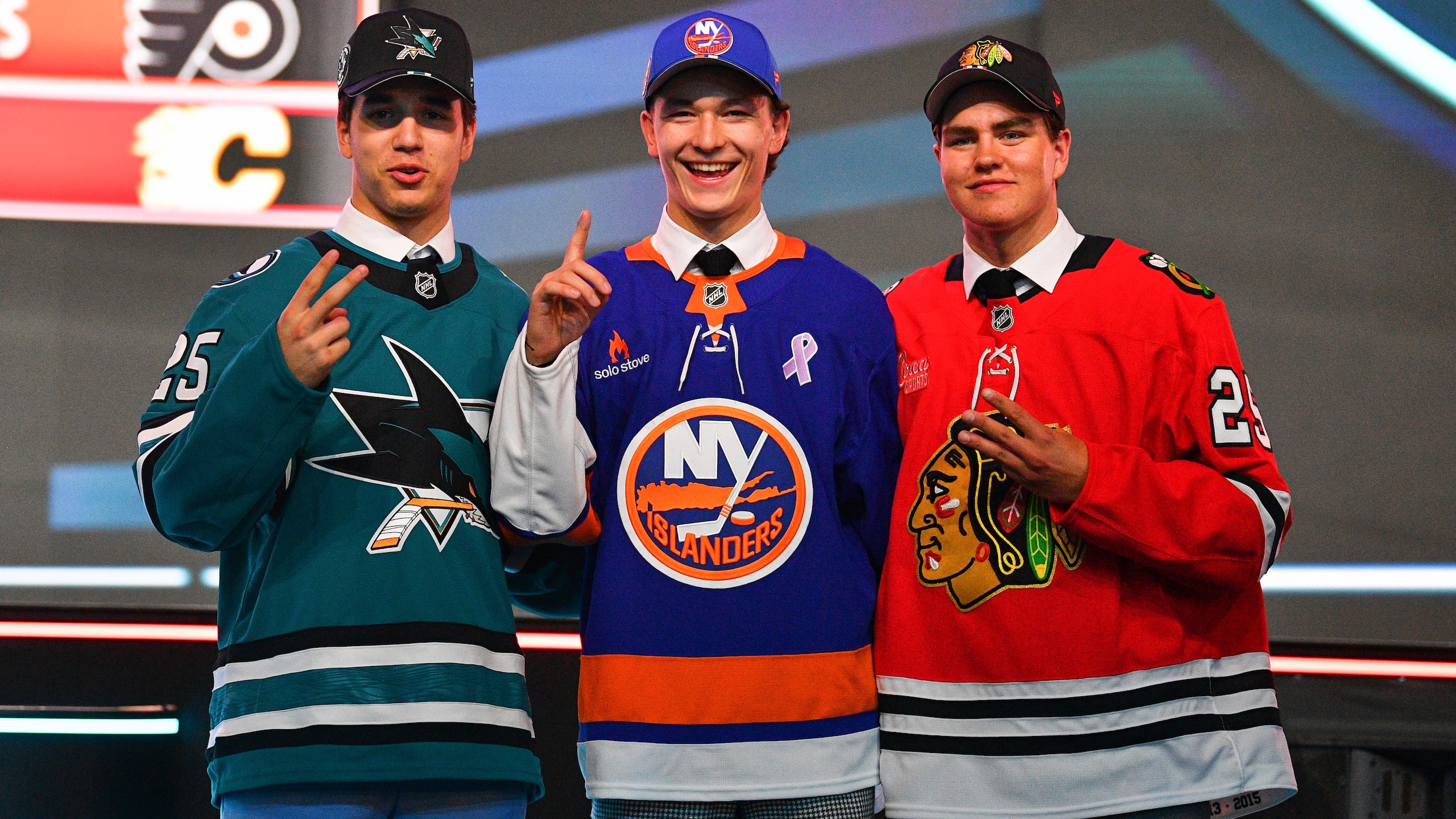


The current NHL collective bargaining agreement (CBA) expires in September 2026. Those words probably send a shiver down the spine of anyone who has been around this sport for longer than a decade.
Miraculously, though, the owners and the NHL Players Association agreed to the framework of the new deal this summer. While the new CBA's Memorandum of Understanding hasn't been released in full to the public, one very interesting change has been outlined by NHL insider Frank Seravalli.
When the new CBA comes into effect, each NHL team will be allowed to assign one 19-year-old prospect to their AHL team each season.
This new policy will affect a maximum of 32 players per year. At first, that doesn't sound like a lot. That changes when you break down its potential impact on the development landscape for NHL prospects.
The road from prospect to the NHL has just changed dramatically.
What Has Changed for CHL Prospects?
1 of 3
Under the current CHL-NHL agreement, prospects who were drafted out of one of the Canadian major-junior leagues — the OHL, WHL, or QMJHL — cannot be assigned to the AHL or ECHL until one of two things happens. They must either turn 20 years old or they must have completed four seasons in the CHL. Players who were drafted from another junior league and then later joined a CHL team are exempt from this rule.
The new CBA won't be in place until the 2026-2027 season, so the first players it will potentially affect are those born in 2007. Vancouver Canucks prospect Braeden Cootes, for example, will turn 19 in February of 2026. He could then conceivably be assigned to the Abbotsford Canucks that fall, should Vancouver's front office decide that the WHL is no longer the best place for his development.
The rule being by age and not by draft year means that once the CBA takes effect, a freshly drafted CHL player who turns 19 the fall immediately after he's drafted could avoid returning to the CHL entirely. Take 2026-eligible top prospect Ryan Roobroeck, for example. As a September 2007 birthday, if Roobroeck signs his ELC immediately and hangs around his NHL team's development camp long enough, they could decide to assign him directly to the AHL rather than return him to the Niagara IceDogs of the OHL. (This is not me arguing for that path for Roobroeck, to be clear; his birthday and top prospect status just make him a great example for this scenario.)
This provides CHL-affiliated prospects with another potential development path—one sorely needed by a select group. This has been the case for a long time; a whole decade ago I was writing articles arguing that this exact development option was needed for Dylan Strome, who was far too good to return to the OHL's Erie Otters but who was not ready for the NHL, and whose development was frankly botched by the Arizona Coyotes as a result. If this path had been available to Strome, he might've gotten his NHL career on track sooner and not spent several years being labeled a bust by many.
We've seen flashes of proof of concept in recent years. Cole Perfetti played for the Manitoba Moose when the pandemic canceled his major-junior season with the OHL's Saginaw Spirit in 2021. Shane Wright was granted an exception to play with the AHL's Coachella Valley Firebirds during the 2023-2024 season because he'd been playing in the OHL since he was 15, he would've had the qualifying seasons if the pandemic hadn't canceled the 20-21 season, and his 20th birthday missed the qualifying cutoff by less than a week.
In both cases, playing at the AHL level was a greater benefit to the player than returning to the OHL, or missing a full season of play (duh) would've been.
How Do the CBA Changes Affect CHL and NHL Teams?
2 of 3
Specific language used by insiders describing the clause is "one player per organization per season".
It would logically follow, then, that teams couldn't assign one 19-year-old temporarily, then call him up or return him to his junior team and assign another 19-year-old to play an AHL stint. But that's not likely to be an issue; it's rare that teams have more than one 19-year-old prospect at a time who really forces the issue of needing a more challenging development path, and who is also playing in the CHL.
This is a huge benefit to NHL teams that want to keep one of their top prospects a little closer to home—easier to observe players and work with them directly when they're in your system, after all, and they're available for callups to boot. CHL teams? Not so much.
It's pretty easy to extrapolate that the one-player limit was at least partly influenced by the CHL itself. Teams aren't going to want to lose top guys, and while each NHL team can only assign one player per year, there's no stated limit on how many players can be taken from each CHL team. For top teams with high-level prospects drafted to various NHL teams, this is a dangerous game.
All of this is a bit of a setback for the CHL, and that's on top of the CHL to NCAA rule change. It would be remiss of me, though, not to note that that setback may soon be mitigated slightly if the draw of NIL money is taken away—it depends on how US President Donald Trump's recent executive order on NIL regulations is interpreted and applied by schools.
How Does An Earlier AHL Arrival Benefit Players?
3 of 3
With this new development path option, top CHL players are no longer at risk of getting into that sticky situation where they're not ready to break into the NHL yet but don't need to return to the CHL.
Those players can now jump into professional hockey a year early, challenging their weaknesses and gaining experience using their strengths consistently at the pro level, rather than being benched on and off in the NHL or going back and dominating their junior leagues, learning nothing and developing bad habits.
An excellent example of a team whose players would greatly benefit from this new path, though they would hate me for saying so, is the OHL's London Knights. The Knights are a team that is always stacked; a perpetual powerhouse. A drawback of that is that while they're busy winning championships consistently at the junior level, their players never really have the opportunity to struggle. And if you don't struggle, you don't improve. NHL teams that see that may decide to throw their best 19-year-old prospect out of the Knights' cold frying pan and into the fire of the AHL.
There are also unintended but related benefits.
Scott Wheeler, prospect writer for The Athletic, says:
"I've had multiple agents tell me this week that many of their guys would make the CHL-to-AHL choice (with the ELC signing bonus) over going to the NCAA. Lots of kids who don't want to go back to school.
One CHL GM pointed out that, depending on the CBA language, kids could potentially get their arb rights a year earlier by going AHL at 19 as well."
Getting arbitration rights a year earlier would be a significant win for these players, on par with or in some cases even more valuable than entering pro hockey a year earlier. That's one of those unintended consequences of this rule change that players and agents are going to love, and NHL teams are going to hate.
The signing bonus benefit for players going from CHL to AHL is another huge benefit, and a big draw over going NCAA. That's especially the case recently, with the possibility of NIL money in jeopardy and the hazy regulations (or lack thereof) around foreign-born players and NIL money. Playing in the AHL doesn't just bring that guaranteed signing bonus; it also comes with a guaranteed salary.
And not going back to school, which most of these guys don't want to do.


.jpg?w=2560)


.jpg?w=2560 "Bears Edge Suspended for PED Violation")

.jpg?w=2560 "Report: Rams Changing Kickers 😬")
.jpg?w=2560 "Buzz: Browns Shopping Jeudy")

.jpg?w=2560 "Jerry Defends Dak Heckler")

.jpg?w=2560 "Breaking News")