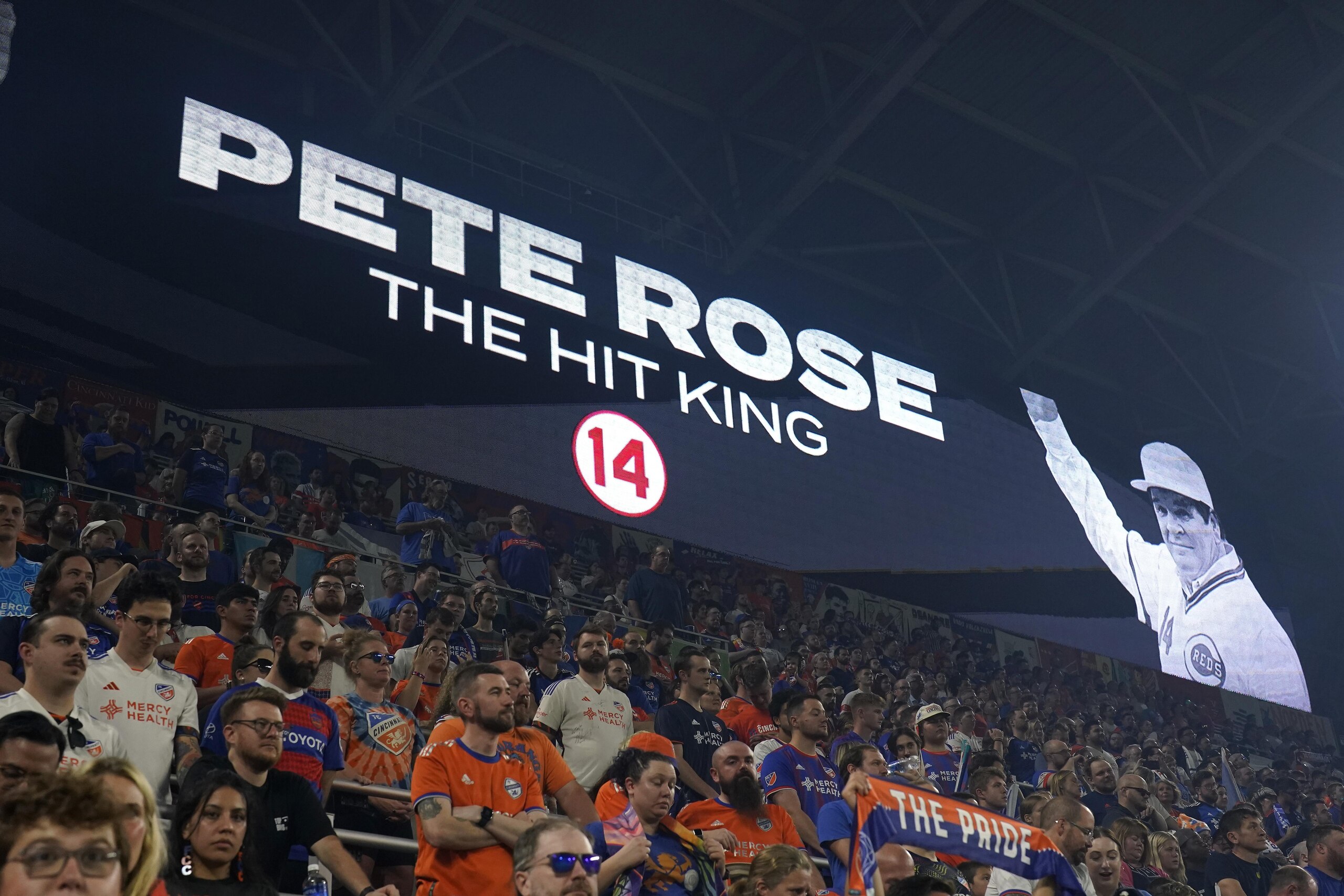

Reinstating Pete Rose Doesn't Solve MLB's Gambling Problem—It Complicates It

Pete Rose is no longer a pariah in the eyes of Major League Baseball, resulting in a whole new chapter to a story that seemed to end for good last September.
But is this a happy ending to the sport's most infamous gambling sage? Is it a sad ending? Or, could it be a beginning to a new saga that MLB will come to regret?
All we know for now is that Rose, who passed away at 83 on September 30, 2024, is no longer on baseball's permanently ineligible list. MLB commissioner Rob Manfred made the announcement on Tuesday, which also holds that "Shoeless" Joe Jackson and other deceased individuals are likewise off the list and, accordingly, now eligible for induction into the Hall of Fame.
TOP NEWS

MLB Commissioner Defends Salary Cap
Miz Sets WS Record Already ⛽
Brewers Get 1st WS Win Since 1982 💪
This is a huge development, yet one that ultimately belongs in the "shocking, but not surprisingly" genre of news stories.
The possibility of Rose being reinstated cropped up here and there after MLB originally banned "The Hit King" for life in 1989. His passing seemed to put an end to that, but then President Donald Trump rallied to Rose's cause in March by issuing him a pardon and not-so-subtly pressuring MLB to effectively do the same. Manfred even met with the president in April to discuss the matter.
'Charlie Hustle' Now Has a Lane to Cooperstown
Now the only question is whether Rose will finally get a plaque in the Hall of Fame, and there may be an answer as soon as December 2027.
That is when the Hall of Fame's 16-member Classic Baseball Era Committee—whose purpose is to consider Cooperstown cases of players whose careers have been over for 15-plus years—will meet next. As Rose is no longer banned and both his playing and managing careers ended in the 1980s, he will be eligible for consideration.
A big piece of baseball history would no longer be missing from the Hall of Fame if Rose were granted entry. Beyond his record-setting 4,256 career hits, his accolades include 17 All-Star selections, an MVP and three World Series titles.
It also can't be glossed over that Rose is the greatest player in MLB's oldest franchise's history, not to mention arguably the most beloved. The timing of Manfred's announcement hardly seems accidental, as the Cincinnati Reds are set to celebrate "Pete Rose Night" at Great American Ball Park on Wednesday.
This Changes Nothing About Why Rose Was Banned
Despite all of this, one thing that was decidedly not changed on Tuesday is Rule 21, Section 21(d)(2), which reads like so in the MLB rule book:
"Any player, umpire, or Club or League official or employee, who shall bet any sum whatsoever upon any baseball game in connection with which the bettor has a duty to perform, shall be declared permanently ineligible."
This is the rule that Rose was found to have broken, specifically by special counsel John Dowd via an extensive report that led to Rose's ouster in 1989. Rose denied the charges, but Dowd's investigation turned up overwhelming evidence that he had bet on baseball, including on Reds games he was managing.
It really was that simple, and it cannot be emphasized strongly enough that the oft-used defense (notably employed by President Trump) that Rose only ever bet on the Reds to win rings hollow.
Rule 21 has no permissive carve-outs for specific types of bets. And even if it is true—and it might not be—that Rose only ever bet on the Reds to win, Daniel J. Wakin of The Athletic made a compelling point last October: "that in itself was a signal to bookies on a game’s likely outcome."
Rose eventually copped to betting on the Reds "every night," yet his post-banishment act never broke free from a general attitude of defiance. So much so that Manfred struck a different tone in 2015, when he denied a petition for reinstatement by Rose on the grounds he had "not presented credible evidence of a reconfigured life either by an honest acceptance by him of his wrongdoing."
This is not to say that Rose never said he was sorry. It's how he ended his 2004 book, My Prison Without Bars, but with a twist.
"So let's leave it like this," he wrote, "I'm sorry it happened, and I'm sorry for all the people, fans and family that it hurt. Let's move on."
Those are not the words of someone who is actually sorry. Those are the words of someone who only knows "sorry" as a word that is supposed to get people off their backs.
It is commendable that Major League Baseball resisted giving in to Rose for as long as it did. But given the circumstances, the league's decision to finally cave is not commendable.
The Dark Implications of Absolution for Rose
There is, of course, no denying that things couldn't be more different now compared to when Rose was banned. Nobody summed it up better than Rod Carew in 2023.
“It has gone too far and it’s hypocritical," the Hall of Famer wrote on X. "How can you keep Pete Rose out and haeve a sportsbook at the Reds stadium?”
There isn't actually a sportsbook at Great American Ball Park anymore, but that is beside the point. Thanks to a 2018 Supreme Court ruling in favor of online sports betting, pretty much anyone, depending on the state, can operate their own personal sportsbook out of their phone.
Sports leagues and online gambling outlets have long since gotten into bed together, and MLB is no exception. And it is only getting fairer to ask who really holds the power in the relationship.
Whereas the gambling element of professional sports used to be underground, now it's out in the open, plastering its name and visage everywhere it can and raking in cash hand over fist. While Rose's reinstatement may not have happened without pressure from the president, it certainly would not have happened if the online gambling industry hadn't so thoroughly conquered the sports world.
In this brave new world, Rule 21 now looks like a case of "do as I say, not as I do" from a certain angle. Yet to take this position is to miss the point of Rule 21.
Sports entertainment is ultimately built upon a foundation of honest competition. Try as they might, a random person placing a wager from the stands can't damage that foundation. An athlete or anyone involved in the competition can, and Rule 21 exists precisely because any crack in the foundation is an existential threat to baseball.
There are enough cracks as it is. Whereas baseball only occasionally had to deal with game-fixing headaches before 2018, it has since found itself playing whack-a-mole with interpreters, umpires and, yes, even players.
The worst-case scenario isn't hard to imagine. Though the average MLB player is much better paid than they were in the days of "Shoeless" Joe and the rest of the Black Sox, not all are and relatively few stick around long enough to earn real wealth. If a has-been or never-will-be was offered a fortune to throw just one game, would he really be able to say no?
If you think it can't happen in MLB, well, that's probably what the NBA thought, too.
Ultimately, just because Rose's reinstatement does not rewrite Rule 21 does not mean that nothing has changed. There is now a sort of permission structure, one that implies that even "permanent" ineligibility isn't necessarily permanent.
And worse, that you don't even need to truly earn forgiveness in order to get it.

.png?w=2560)


.jpg?w=2560 "NFL House in Paris Closes for Protests")
.jpg?w=2560 "Trevon Diggs Cut by Seahawks")
.jpg?w=2560 "Jonathan Taylor Landing Spots")
