

Why Roger Federer's Faith in New Coach Stefan Edberg Will Pay Off
Roger Federer and Stefan Edberg just feels right. There is everything to like about these two champions. They are generations apart, but they are standards who personify grace and imagination on the tennis court.
There's symmetry in the Federer-Edberg tandem, or “Fedberg” (to use a portmanteau that suggests a fast-moving mountain). They are nostalgia and new age, science and art, hoping to harmonize for another Grand Slam run.
Federer is right to put his faith in new coach Edberg.


Edberg Was (Sort of) Federer
Bear with me on this quick detour. I was in college in early March 1995, but found a way to fly to Scottsdale, Arizona. I wanted to watch Jim Courier, who was struggling to find his No. 1 form that had won four Grand Slam titles from 1991-93.
Not coincidentally, Edberg was there. Courier and Edberg were linked. They had battled each other three times in Grand Slam finals and for the No. 1 ranking in 1991-92. Their rivalry had been billed as Edberg’s old school serve-and-volley skills versus Courier’s relentless and brawnier groundstokes. Nowadays, we refer to Courier types as “grinders.”
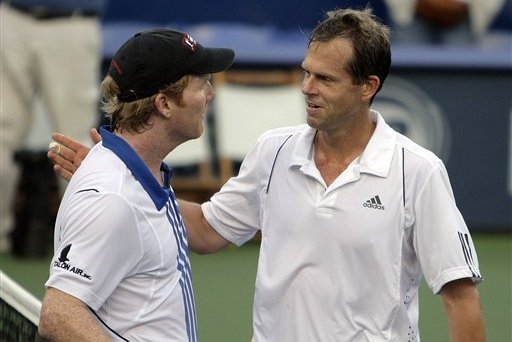
Courier made short work of Mark Woodforde in the quarterfinals that day, but it was Edberg’s tennis display that was unforgettable.
Edberg was 29, but slipping by his usually lofty standards. He had fallen to No. 15 in the rankings. But none of that mattered when he walked out with his tall, athletic stride. Not a hair was out of place, and his regal stoicism was the kind of image the Greeks must have had in mind when they built the Parthenon.
There are few players who radiate with a champion’s aura. Without fanfare, Edberg promptly put on a net display that left poor opponent Brett Steven scampering and pulling up short. His hands, control and precision were astounding. He angled soft and firm. He glided into passing gaps. It was all so effortless, as if the tennis gods had gifted him this talent just for us to enjoy.
And it’s that late-career impression of Edberg that translates into so many of the qualities I see in Federer. Forget about the numbers and records (Federer has nearly tripled Edberg in this regard), but understand that these two champions are the artistic embodiments of their generations.
Fedberg was destined to merge, even if it will only be a brief, radiant eclipse.
Fedberg and their Plan of Attack
Federer needs a fresh start after an injury-plagued and frustrating 2013. More than ever, he knows he cannot duel an entire ATP field from the baseline. There are too many younger opponents who dig in as if it were trench warfare. He needs to find ways to shorten points and dictate on his terms.
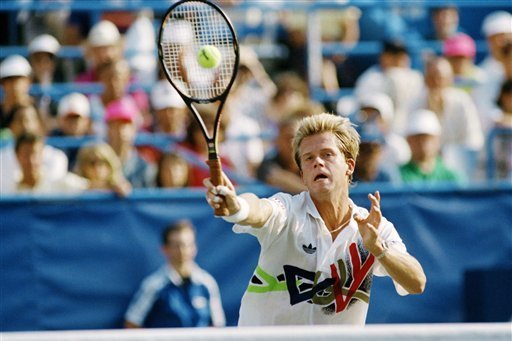
Edberg may understand this more than anyone on the planet. In the early 1990s, he had to fight back younger champions like Courier, Andre Agassi and Pete Sampras. They laced biting topspin and flashed their new breed of tennis power and athleticism.
So Edberg worked more on his forehand, and attacked with his tenacity and quick feet. His movement and imagination were the perfect weapons to break up his more predictable opponents. He even improved his mental toughness and won back-to-back titles at the U.S. Open in 1991-92, a venue that had once been an arena of misery.
Edberg is not looking for a radical change to Federer’s game. He admitted this, as reported by Daniel Germann (translated to English from Neue Zürcher Zeitung), saying “Technically Roger is strong. It's more about how he moves on the court, how he hits the ball. And I think it would also be good if he would vary his game a bit more than he does at the moment.”
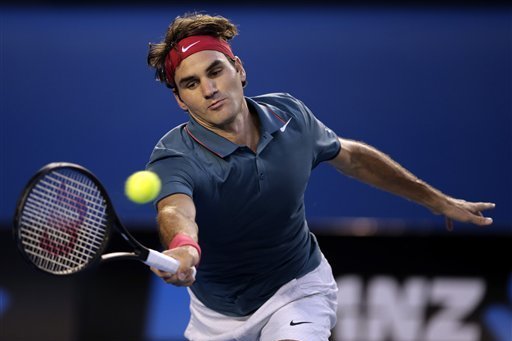
Thus far, Fedberg's early results have been very encouraging. Federer charged into the 2014 Australian Open semifinals, dismantling top opponents Jo-Wilfried Tsonga and Andy Murray with intelligent varieties of approach shots and net finishes. It was a display of the tennis brain as much as skill of execution.
Best of all, he shortened his matches and had plenty of energy for his semifinal match. Even that match was encouraging, except that he was victimized by Rafael Nadal’s near-perfect counter of defensive attacking.
Hard Work and Attention to Details
Federer’s tennis spirit will be energized to keep working on his game. He will continue to make adjustments, refine his talents and look to win. After all, it’s not like he is a complete stranger to playing more serve-and-volley tennis; before his prime dominance he had shown he could play this way, as he explained to Tom Gainey from Tennis X:
"Looking back how I played Sampras in 2001, I was serve and volleying most of the time on first serves. So I definitely played more aggressive when (I) was younger just because I didn’t believe in my ability from the baseline against the likes of Agassi, Ferrer, Nalbandian, you name it.
"
Edberg could only thrive with serve-and-volley tennis. He did not have a huge serve like Boris Becker and Sampras. Instead, he figured out how to serve with precision, mixing in his great kick serve and slices. The objective was to give himself more time to get to the net, and with his fluid footwork and hands to finish off anything that was not returned impeccably. Edberg won by employing his skills to play the percentages.
Team Fedberg is collaborating on just how Federer can set up and finish his own advantages. Federer’s recent Australian attack was about playing the percentages and pressuring his opponents. It was about taking away their comfort zones.
Federer looks trimmer, quicker and full of his old confidence. Tennis looks fun once again.
Right now, Fedberg has over four months to fine-tune its approach for Wimbledon. There's a good chance that Federer’s faith in hard work and sage advice from Edberg will pay off.
.jpg?w=2560)
.jpg?w=2560 "Falcons Saints Football")
.jpg?w=2560 "Viral Rams Coach Vid 🖕")
.jpg?w=2560 "Injury-stricken Seahawks signing veteran RB")


.jpg?w=2560 "2 NFL Officials Suspended")
