2024 NFL Draft: Week 14 Buzz and Teams That Could Look to Trade out of 1st-Round Pick
While the first round of the NFL draft consists of 32 draft picks, not all prospects drafted in the opening frame are considered elite talents. Typically, teams grade somewhere between 15-20 individuals as a legitimate first-round prospects.
Among the Bleacher Report Scouting Department's initial top-100 board for the 2024 class, 18 prospects currently hold a grade equivalent to a true first-round pick.
But not every prospect will be viewed similarly across 32 draft rooms.
"Everybody's board is different, everybody has different rosters and different needs, they're looking for different things," Detroit Lions general manager Brad Holmes told reporters after drafting running back Jahmyr Gibbs with this year's 12th overall selection.
Holmes' point is important to understand that value for each team is not viewed in the same manner. In this particular instance, some organizations prefer to trade down and acquire extra assets to get more bites at the apple without potentially losing anything in quality.
Again looking at the B/R draft board, prospects 19 through 96 carry solid Day 2 grades. That's quite a lot of depth. Multiple general managers toward the back end of the first round could and should seriously entertain the idea of trading back and gaining more assets.
Who are they? We'll take a look at five scenarios while B/R's quartet of scouts—Brandon Thorn, Cory Giddings, Derrik Klassen and Matt Holder—provide extra insight into this week's trending lists regarding performance during college football's championship weekend.
Trending Up
1 of 7
1. CB Mike Sainristil, Michigan
Among the last two draft classes, the Michigan Wolverines placed Daxton Hill and DJ Turner II among the opening two rounds. Both defensive backs fell on the smallish side, but the versatility they brought to a backfield helped override that potential concern.
Mike Sainristil fits the same mold, and he's thrived as a playmaker in the Wolverines defense.
The 5'10", 182-pound corner is an ideal nickel defender because of all the different things he can do. Over the last two seasons, the first-team All-Big Ten performer accumulated 88 total tackles, 10.5 tackles for loss, four sacks, five interceptions, 18 defended passes and two forced fumbles. He has no fear playing through traffic or around bigger bodies.
"Sainristil is a versatile cornerback who plays mostly out of the slot but has shown the abillity to play out wide," Giddings said. "He's a quick-twitch athlete who has excelled in both the pass and run game. He does a good job of breaking on the ball in the air, with ball skills to capitalize. On occasion he has shown to face-guard downfield, which can open him up to penalties.
"His lack of length and size can show up in both the pass and run game, where bigger receivers can shield him.
"When defending the run, he does a great job of reacting to what he sees. He triggers quickly and closes ground, showing good physicality and the willingness to tackle. His versatility will give him exceptional value at the next level."
2. DL Byron Murphy II, Texas
Fellow Texas defensive tackle T'Vondre Sweat may have bragging rights this week after catching a touchdown pass in the Big 12 Championship Game. But Byron Murphy II deserves credit for a top-notch defensive performance in which he continually worked his way up field, destroyed blocking schemes and disrupted the Oklahoma State offense.
"Murphy has been a big riser all year since he's become a full-time starter and really stepped up as a pass-rusher," Holder said. "The latter was on display during the conference championship since he logged a handful of pressures. Murphy displays a nice swim move that should translate well to the next level. He's also hard to move with one-on-one blocks at the point of attack.
"The 6'1", 308-pound underclassman presents enough potential to be a well-rounded player at the next level if he gets more consistent with pad level and leg drive."
3. RB Kimani Vidal, Troy
When a player sets an NCAA record during a conference championship game, his name should probably be mentioned.
In the case of this year's Sun Belt Championship, Troy's Kimani Vidal became the first player in FBS history to run for five touchdowns in a conference championship, according to ESPN Stats & Info. The reigning Sun Belt Offensive Player of the Year contributed 233 rushing yards. He ranks second nationally with 1,582 yards.
"Vidal is not your everyday running back prospect," Klassen said. "At 5'8" and 215 pounds, the two-time first-team All-Sun Belt performer is built like a little human bowling ball. Vidal's sturdy build, paired with some nifty footwork and an explosive lower half, makes for a runner who is difficult to bring down in the open field. Arm tackles and ankle-biting attempts won't cut it.
"Vidal's height and lack of long speed likely limits him from becoming a lead back in the NFL, but he has played himself into being a fun Day 3 selection."
4. WR Jalen McMillan, Washington
It's easy to overlook wide receiver Jalen McMillan in an explosive offense that also features Rome Odunze and Ja'Lynn Polk, both of whom are potential first-round prospects.
But McMillan showed up when his teammates needed him the most, with a game-high 131 receiving yards in the Pac-12 Championship Game.
"Welcome back, Jalen McMillan," Klassen said. "After missing a good chunk of the season with a knee injury, McMillan returned just in time to torch the Oregon Ducks.
"A wiry guy at 6'1" and 192 pounds, McMillan wins with quickness and flexibility. He's a smooth, agile player who weaves through his routes and in between defenders with relative ease. When those traits are coupled with strong hands, the Huskies benefit from an exceptionally reliable player with just enough juice to be a problem with the ball in his hands."
5. CB Quinyon Mitchell, Toledo
No collegiate cornerback showed better ball skills than Toledo's Quinyon Mitchell over the last two seasons. A year ago, he snagged five interceptions and led the nation in passes defended (25). This season, the 6'0", 196-pound defender ranks second with 18 pass breakups.
His ability to make a play on the ball will be highly valued throughout the league.
"The two-time first-team All-MAC performer is a strong player with good physical stature and high upside," Giddings said. "Mitchell is a little raw with his technique, but he has the skills to be a man and zone defender at the next level.
"Obviously, he's a highly instinctive player with very good route recognition and vision, with quick feet to get out of breaks. But he can clean up footwork that leads to too much separation at times.
"Mitchell is not simply a coverage defender, either. He displays good physicality when taking on blocks and tackling."
Trending Down
2 of 7
1. QB Michael Pratt, Tulane
Since throwing for 394 yards during the 2022 American Athletic Championship Game, quarterback Michael Pratt hasn't broken the 300-yard barrier once.
Against top competition during the Cotton Bowl followed by this year's AAC championship contest, the senior completed 54.7 percent of his passes. He was under constant duress against the SMU Mustangs but made two bad passes by underthrowing one deep pass, which wasn't intercepted, and leaving the ball inside on an out-breaking route, which was picked.
"Pratt fell flat in the conference championship against SMU," Klassen said. "The quarterback was under pressure all day (seven sacks), but he rarely had an answer for any of it. He struggled to escape the pocket or beat pressure with quick throws. That's somewhat surprising considering Pratt had been a capable scrambler and creator all season. In fact, Pratt's toughness and adequate athleticism are some of his best traits, alongside a willingness to make tough throws into traffic."
2. NT Nazir Stackhouse, Georgia
Anytime a 320-pound nose tackle is decleated, it's an impressive feat. But a performance is about more than one play. In the case of Georgia's Nazir Stackhouse, the Alabama Crimson Tide delivered a serious message by how they dominated along the interior throughout the entire SEC Championship Game.
Stackhouse failed in his primary job to hold the point of attack, while the Crimson Tide owned the the line of scrimmage.
"Run defense is Stackhouse's calling card," Holder said. "However, he was getting bullied by Alabama's offensive line. While one game doesn't erase his entire body of work, underperforming against the top competition he's faced will weigh on scouts' minds and cause him to slide down draft boards, especially since Stackhouse offers little to nothing as a pass-rusher."
3. OT LaDarius Henderson, Michigan
The Michigan Wolverines consistently feature one of the nation's best offensive lines. In fact, the unit won back-to-back Joe Moore Awards.
However, individuals can be exposed against superior athletes when pulled out of their traditional offense. As an example, left tackle LaDarius Henderson struggled to get quality depth and establish any kind of quality pass set against the Iowa Hawkeyes in the Big Ten Championship Game.
"After transferring from Arizona State prior to the season, Henderson took over at left tackle for the Wolverines and made eight starts after splitting time between left guard (19 starts) and left tackle (10) during his time in the desert," Thorn said. "Henderson has been shaky in pass protection for the Wolverines. Thanks to their run-heavy approach, he's been functional despite inconsistent technique while being serviceable as a run-blocker.
"Henderson is an older prospect (graduate student) with below-average athletic ability who will need to fight for a job inside as an NFL guard where his experience level will give him a shot at sticking as a backup."
4. LB Smael Mondon Jr., Georgia
While Alabama easily handled Georgia's defensive front, weaknesses among the Bulldogs' linebacker corps were also exposed.
Georgia's Smael Mondon Jr. was all over the place with missed keys, poor angles and an inability to take on blockers.
"Heading into this season, Mondon's run defense needed a lot of work, and that's continued to be an issue all year, especially against Alabama," Holder said. "At 6'3" and a listed 225 pounds, the linebacker is pretty wiry. He needs to add some size and strength to take on blocks from offensive linemen and even bigger tight ends.
"As a junior, Mondon does have at least one more year of eligibility, so it wouldn't be surprising to see him head back to school for another season and spend some time in the weight room before heading to the NFL."
5. OT Christian Jones, Texas
In a bit of a quirk courtesy of current eligibility rules, Christian Jones will leave the Texas Longhorns program as a four-year starter after needing two seasons to crack the lineup.
It's easy to see why it took some time for Jones to take over a job because he's a top-heavy blocker who relies more on his physicality and strength than proper technique. He was often seen leaning on Oklahoma State defenders during the Big 12 Championship Game.
"Jones is a 45-plus-game starter with experience at both tackle spots, bringing good size at 6'6" and 321 pounds and plenty of play strength to the line," Thorn said. "Jones does show below-average quickness, agility and ability to protect on an island at tackle, getting manipulated out of position by quality edge-rushers, which leads to quick losses that will be more difficult to hide at the pro level.
"As a result, he will likely move inside where his stiff, powerful hands, strain and physicality give him a shot at becoming a quality backup with spot-starter potential.
"Jones will likely get some reps at guard in Mobile at the Senior Bowl, which would provide an opportunity for him to show how that transition might look."
Indianapolis Colts
3 of 7
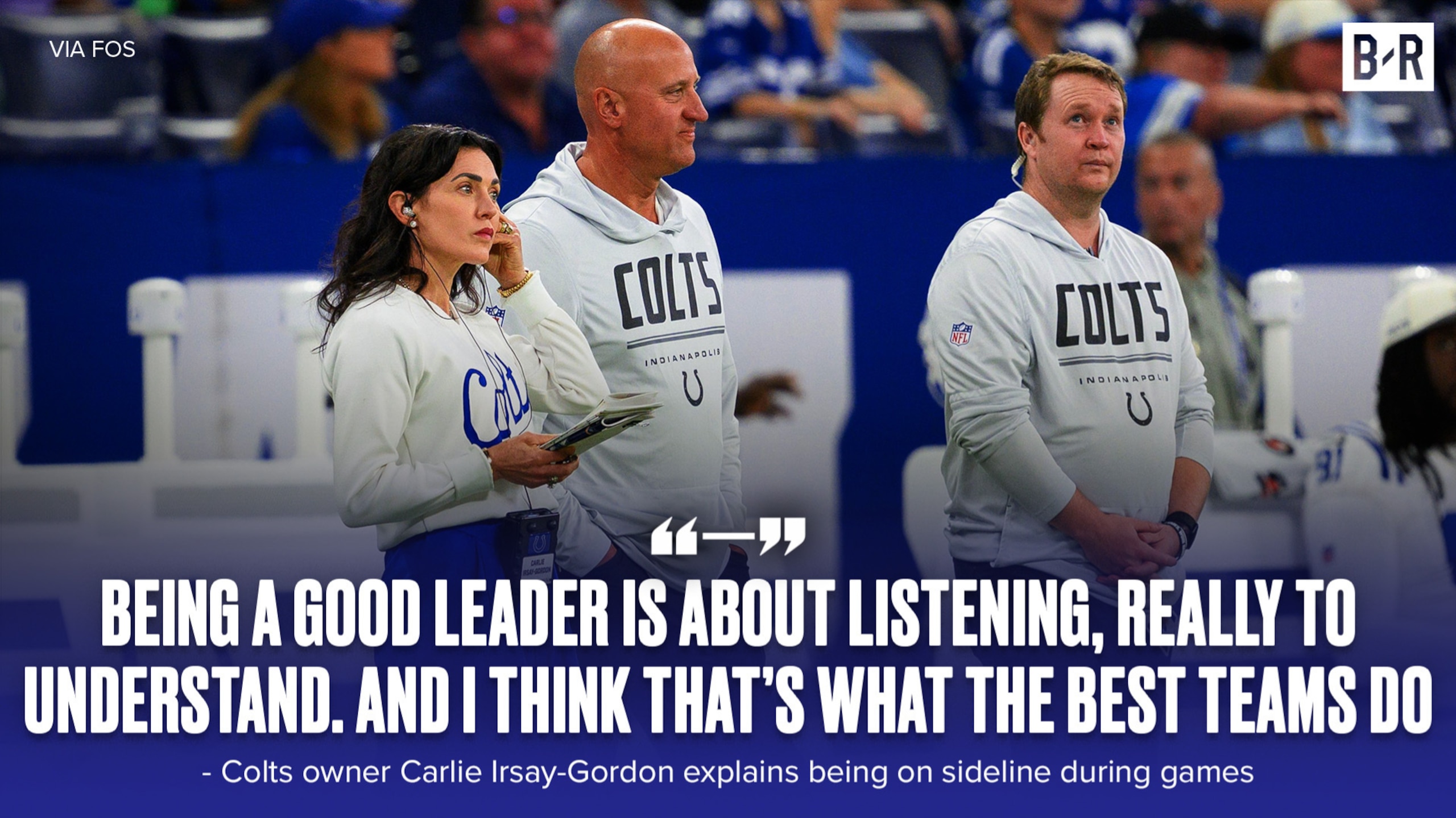
Of the teams that should considering trading out of the first round, the Indianapolis Colts probably weren't the first to come to mind.
But the 7-5 Colts are exceeding expectations. They're currently sitting in a spot to claim a postseason berth. While the roster is far from complete, some of the young players the front office banked on this season are playing well.
Most importantly, general manager Chris Ballard loves to wheel-and-deal. His preference is almost always to trade down.
"The more picks you have, the better chances you get, shots at the board," Ballard told reporters two years ago. "I think we're pretty good at what we do, but there needs to be a little luck involved, and the more picks you have, the more chances of luck are going to show up."
After taking quarterback Anthony Richardson with this year's fourth overall draft pick, Ballard traded down three separate times on Day 2. He's more than willing to move around, add assets and see how the board falls, because the Colts' scouting department is pretty good.
Since Ballard became general manager in 2017, Indianapolis chose the following players during the draft's second day: Shaquille Leonard, Braden Smith, Bobby Okereke, Michael Pittman Jr., Jonathan Taylor, Julian Blackmon, Dayo Odeyingbo, Alec Pierce, Bernhard Raimann, JuJu Brents and Josh Downs.
That's an exemplary track record. Was every pick in that range a hit? Of course not. But the fact Indianapolis hit on so many shows exactly why it's better to trade down and add more picks.
It's especially true for the upcoming draft when the Colts already have their quarterback in place and must build the most complete roster they possibly can throughout Richardson's rookie contract.
Ultimately, how the team proceeds will be dictated by who the front office re-signs since Pittman, nickel Kenny Moore II, safety Julian Blackmon and nose tackle Grover Stewart are pending free agents.
Current Draft Pick: 22nd
Potential Trade-Down Target: Safety/Nickel Malachi Moore, Alabama
.jpg?w=2560 "Browns Jaguars Football")
Dallas Cowboys
4 of 7
A perfect storm of potential issues meet for the Dallas Cowboys to strongly consider trading down once they're on the clock next April.
Financially, they're already in the red for 2024, according to Spotrac.
The Cowboys have found themselves here before. Some organizations like the New Orleans Saints merely rework the numbers into their favor. Cowboys owner Jerry Jones tends to take a different approach by unloading bloated contracts. He did so the last two offseasons by trading wide receiver Amari Cooper and cutting running back Ezekiel Elliott.
Secondly, Jones and Co. must take of some of their own regarding their current contracts.
Left tackle Tyron Smith, center Tyler Biadasz, safety Jayron Kearse, defensive ends Dorance Armstrong and Dante Fowler Jr., cornerbacks Jourdan Lewis and Stephon Gilmore, defensive tackles Johnathan Hankins and Neville Gallimore and running backs Tony Pollard and Rico Dowdle are upcoming free agents. All of them won't re-sign. But Dallas will almost certainly bring a few back into the fold.
Dallas should also look to recoup the fourth- and fifth-rounders it gave up for backup quarterback Trey Lance and the chance to move up in this year's draft.
When speaking with reporters about this season's trade deadline, Jones said: "I have areas of the team that we could, if certain circumstances happen, that you might improve. Your best chance to get it done is when it comes by you and you grab it."
The described mentality applies to the NFL draft, where the Cowboys will likely be in somewhat of a financial bind after re-signing some of their free agents, with a need to add a more talent and a couple of selections.
A trade out of the first round entirely would help the Cowboys address some of those areas.
Current Draft Pick: 27th
Potential Trade-Down Target: DL Kris Jenkins Jr., Michigan
Detroit Lions
5 of 7
After making four first-round selections in the last two draft classes, the Detroit Lions have reached the point where the on-field product matches the offseason investments and the organization can be more flexible with how it builds its roster.
General manager Brad Holmes previously discussed this approach two years ago after drafting Penei Sewell with the seventh overall pick.
"So it goes back to, yeah, you could trade back and have more bats at the plate, and more cost and control, but how much impact are you adding versus being in position, or let's say striking distance, to trade up and get a player where you're not sure if you're going to be in striking distance again?" Holmes said during an interview with The Athletic's Robert Mays (h/t Jeremy Reisman of SB Nation's Pride of Detroit).
To the general manager's own point, the current iteration of the Lions won't be within striking distance of the prospects who will be viewed as instant-impact contributors. So the opposite approach can be taken.
Besides, Holmes and his staff have done an excellent job finding Day 2 talent.
In their first three classes, they chose defensive lineman Alim McNeill, safety Kerby Joseph, tight end Sam LaPorta and defensive back Brian Branch. Those selections don't even include standout wide receiver Amon-Ra St. Brown, whom the team acquired near the top of the 2021 fourth round.
Starting this offseason and extending into the next two, the Lions will look to pay all of those already mentioned, plus defensive end Aidan Hutchinson, since they're currently operating on rookie deals.
As bills come due for a job well done regarding drafting, the next wave of talent must be acquired to maintain a balanced roster. Turnover will occur as well.
Edge-defenders Romeo Okwara, Julian Okwara and Charles Harris, defensive backs Chauncey Gardner-Johnson, Will Harris and Emmanuel Moseley, guard Jonah Jackson and wide receiver Josh Reynolds are soon-to-be free agents. Some injuries are involved with those specific names, but they were all meant to play big parts this season.
Current Draft Pick: 28th
Potential Trade-Down Target: Edge Jack Sawyer, Ohio State
Miami Dolphins
6 of 7
The Miami Dolphins could trade down for salary-cap maintenance while still getting good talent.
The Dolphins are now counted among the AFC's elite. They're competing for a Super Bowl this year. But they haven't gotten much from their rookie class.
De'Von Achane has been fantastic when healthy, as the league's second-leading rookie rusher. Cornerback Cam Smith has played just 18 defensive snaps. Miami's other two draft picks—Elijah Higgins and Ryan Hayes—were both released before the start of the season and picked up by other squads, though Hayes returned to the Dolphins after being waived by the Indianapolis Colts.
Next year's free agents include center Connor Williams, defensive lineman Christian Watkins, linebacker Jerome Baker, wide receiver Cedrick Wilson Jr., nose tackle Raekwon Davis and guards Isaiah Wynn and Robert Hunt.
However, Miami is already well into the red regarding next year's salary-cap projection. Granted, the figure has yet to include any future reworkings of current deals or releases. Plus, salary-cap gurus can always massage the numbers and make them work in a team's favor.
Even so, the Dolphins will need to bring in cheap talent on rookie deals to make up for looming contract extensions, particularly quarterback Tua Tagovailoa and wide receiver Jaylen Waddle.
Over the last three drafts, Miami has selected 15 players. Nearly half of those came in the '21 class. It's an unsustainable approach to team-building.
By moving out of next year's first round, the Dolphins, who are currently down their third- and fourth-round picks in 2024, can add a much-needed influx of bodies to supplement an already talented roster.
It's a necessary change of direction after making multiple high-profile acquisitions (and one that didn't happen but cost them picks). Thus, the long-term health of the franchise remains viable and not entirely reliant on everyone currently found on the roster.
Current Draft Pick: 31st
Potential Trade-Down Target: IOL Christian Mahogany, Boston College
Philadelphia Eagles
7 of 7
Philadelphia Eagles general manager Howie Roseman has officially replaced the New England Patriots' Bill Belichick as the decision-maker that everyone assumes won a trade by default. The former has been that good in building the Eagles roster since returning to the role of general manager in 2019.
Some of the league's other general managers probably feel like they're trading with someone from The Sopranos since it's likely not going to go in their favor. Yet they still do so. It's not going to change.
While the projected aura that Roseman created with his shrewd moves doesn't accurately encapsulate his track record, it's clear that the continued positivity created by his decisions has an effect, to the point where rival executives grew annoyed by the public praise.
In reality, Roseman and his staff have made mistakes, just like Belichick did throughout the Patriots' dynasty. The difference now is that Roseman is doggedly looking to make moves and usually quicker to move away from a player if it didn't work out than other franchises are.
When it comes to the draft, Roseman doesn't stand pat. To fully understand how active the Eagles tend to be, they made seven selections during this year's class. Only one of those weren't moved at one point or another. Three of the previous year's five choices also changed hands.
Roseman remains active. Next year shouldn't be any different, especially looking at the Eagles' current setup.
As one of the squads expected to land somewhere near the back end of the first round, those picks become valuable for teams searching to drastically improve their rosters because those picks include fifth-round rookie options. But Philadelphia is already operating at a Super Bowl standard. The Eagles can move down, add assets and continue to accumulate talent elsewhere.
Keep in mind, Roseman already traded away third-, fourth-, fifth-, sixth- and seventh-round picks for next April's draft. Philadelphia can recoup some ammunition with another early trade.
Current Draft Pick: 32nd
Projected Trade-Down Target: CB Kamari Lassiter, Georgia