NHL: The Top 100 Goaltenders in NHL History
It is an extremely tough exercise to try and compare goaltenders from different eras. Ranking them in order from 1 to 100 is an even tougher task if you ask me, as trying to compare goalies from the 1920's (and earlier) to the goalies of today is nearly impossible to do. After all, how can you fairly compare goalies who played in the era of six teams in the league, playing without masks or helmets, but to an extent lesser skilled players to the goalies of today, that wear as much padding as they do, but have to face more highly skilled players that watch video of other teams to be able to exploit weaknesses? What about the fact the NHL schedule has ranged from 24 to 84 games over the last 90-plus years? Along with labor issues and rule changes, they all have impacted the stat accumulations of different players, which needs to be taken into account.
As I said, it's nearly impossible. How do you value the player who had one or two spectacular seasons versus the goalie that has a long body of work? How do I distinguish between these? With that, here's one man's opinion on who rank as the 100 greatest goaltenders in the history of the National Hockey League. Not only is this a look at all of the goalies in the history of the league, but I also hope some of you look at this list as either a learning experience of NHL history, or in some cases, a trip down memory lane, as I know I definitely enjoyed rehashing some of the experiences I have written about with the assembly of this list, especially the ones I witnessed live during my 25+ years of watching NHL hockey.
WRITER'S NOTE: I tried to eliminate players track records outside of the NHL for this purpose, meaning a player like Vladislav Tretiak was not included. Also, I tried to not let international performances influence my rankings either, meaning Mike Richter did not receive the benefit of his amazing 1996 World Cup performance. These are obviously just two examples, I also think it's inevitable there could be a bias to players I have watched and seen live as opposed to players from the distant past that I have only read about and watched clips. Thanks also to Hockey-reference.com for a place to look up the relevant stats.
I look forward to everyone's opinion on this and welcome any and all friendly debates that might arise from this list.
WANT TO DISCUSS THIS LIST, HOCKEY, THE NHL OR THE DEVILS? FOLLOW ME ON TWITTER @ LEVINAKL
No. 100 Dan Bouchard
1 of 100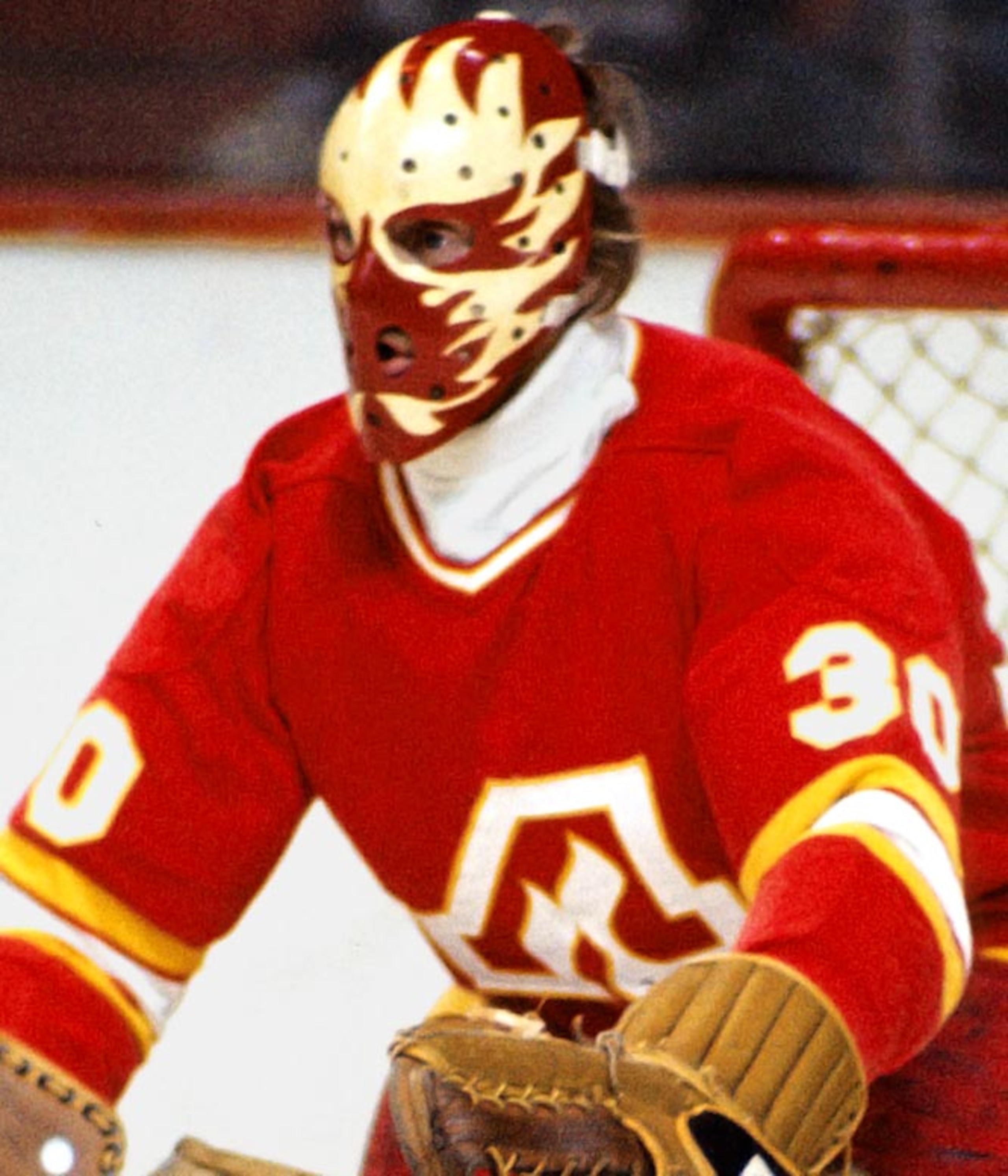
Career statistics: Regular season (NHL): 655 GP, 286-232-113, 3.26 GAA, 27 SO; Playoffs: 43 GP, 13-30, 3.46 GAA, 1 SO
Bouchard was a second round pick of the Boston Bruins in the 1970 NHL Entry Draft. He never played for the Bruins, instead being selected by the Atlanta Flames in the Expansion Draft, where he would play with the franchise for eight-plus seasons. Bouchard shared time with Reggie Lemelin in Atlanta and played more than half of the games most of his time there.
He seemed to perform much better in the regular season than the playoffs as a playoff record of 1-11 in Atlanta haunted Bouchard. He would be traded to Quebec in January of 1981, where he took his game to the next level to an extent. That is, if you track his playoff victories, because it improved to 10-20 over his five seasons with the Nordiques. He would be dealt to Winnipeg for what turned out to be his final season in 1985-86.
Bouchard played in the postseason the final eleven years of his career but had little success in the post season, which hurts Bouchard's ranking on this list. Had his regular season play carried into the post season, he definitely would be higher in the rankings than at number 99.
Best season: Bouchard's best year was 1977-78, when as a member of the Atlanta Flames, he posted a record of 25-12-19 in 58 games, with a 2.75 GAA and 2 shutouts. In the playoffs, the Flames would lose to the Detroit Red Wings in two games.
No. 99 Jeff Hackett
2 of 100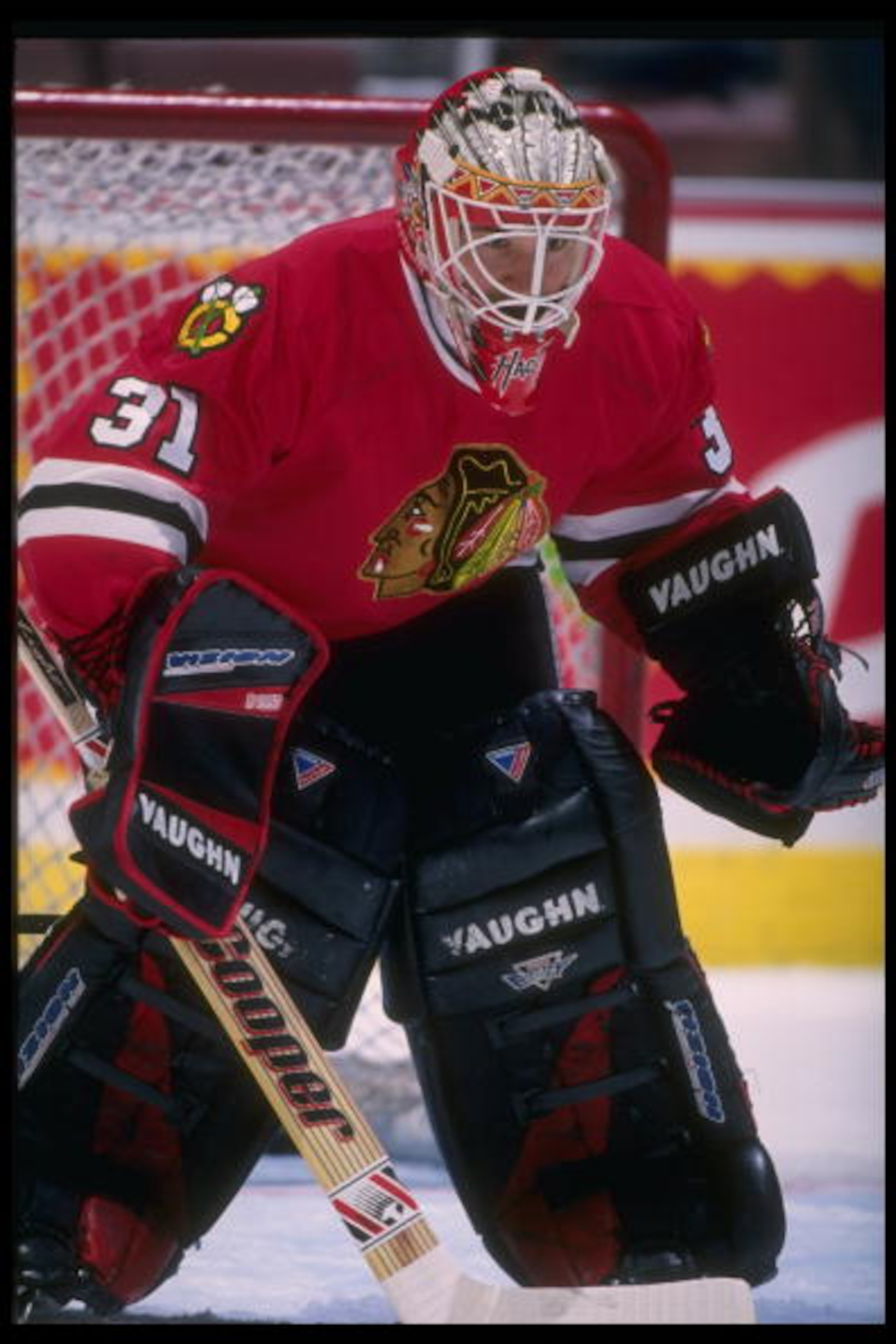
Career statistics: Regular season (NHL): 500 GP, 166-244-56, 2.90 GAA, 26 SO, .902 S % Playoffs: 12 GP, 3-7, 3.54 GAA, .883 S %
Hackett was a goalie who had a few solid seasons but never seemed to have a year where he was able to put it all together. Coming up with the New York Islanders first in 1988-89, Hackett played in 13 games as a 20-year old. He would be taken by the San Jose Sharks in the expansion draft, where he played two seasons, including a disastrous 2-30-1 record in 1992-93, before moving onto Chicago where he probably had the best years of his career.
He also played with the Montreal Canadiens, Boston Bruins and Philadelphia Flyers in a career that saw Hackett play in 500 NHL games. Injuries definitely took a serious toll on his career, as a hand injury in October 2000 saw Hackett limited to just 19 games in 2000-01. He followed that up with a significant shoulder injury suffered in October 2001, which limited him to just 15 games in the 2001-02 season and Hackett's career wasn't nearly the same after that. He retired after the 2003-04 season, when he was limited to just 27 games in that season after suffering from the effects of vertigo.
Jeff Hackett didn't have any significant milestone accomplishments, such as an All-Star game or a Vezina Trophy, but he definitely had a solid run in Chicago that earns him at number 99 on this list.
Best season: 1997-98 was an excellent year for Jeff Hackett individually on the ice. Despite posting a losing record of 21-25-11, Hackett had a 2.20 GAA in 58 GP, with a .917 S % and 8 shutouts. Unfortunately, the team failed to qualify for the playoffs, and Hackett would be dealt to Montreal the following season in a multi-player deal involving Jocelyn Thibault, Dave Manson and Eric Weinrich (plus others). Hackett would fail to have the same success he had in 1997-98 in Montreal, as well as future stops in Boston and Philadelphia.
No. 98 Steve Mason
3 of 100
Career statistics: Regular season (NHL): 173 GP, 77-67-23, 2.77 GAA, 18 SO, .906 S %; Playoffs: 4 GP, 0-4, 4.27 GAA, 1 Calder Trophy (2008-09)
Mason took the league by storm as a rookie and didn't need a whole lot of seasoning in the minor leagues, playing just three games for the Syracuse Crunch before coming up to the NHL. Mason set the bar high with his rookie season and has struggled to get back to that level in his next two seasons. It hasn't helped that the team he plays for has been far from the greatest.
It's tough to figure out where to place Mason on this list, if at all, but off the highlights of his rookie year and ability he has shown since, he makes it in at number 98.
Best season: 2008-09, with a record of 33-20-7, with a 2.29 GAA and 10 Shutouts and a .916 Save %, Mason came in and dominated as an NHL rookie, picking up the Calder Trophy, and helping bring the Columbus Blue Jackets into the playoffs.

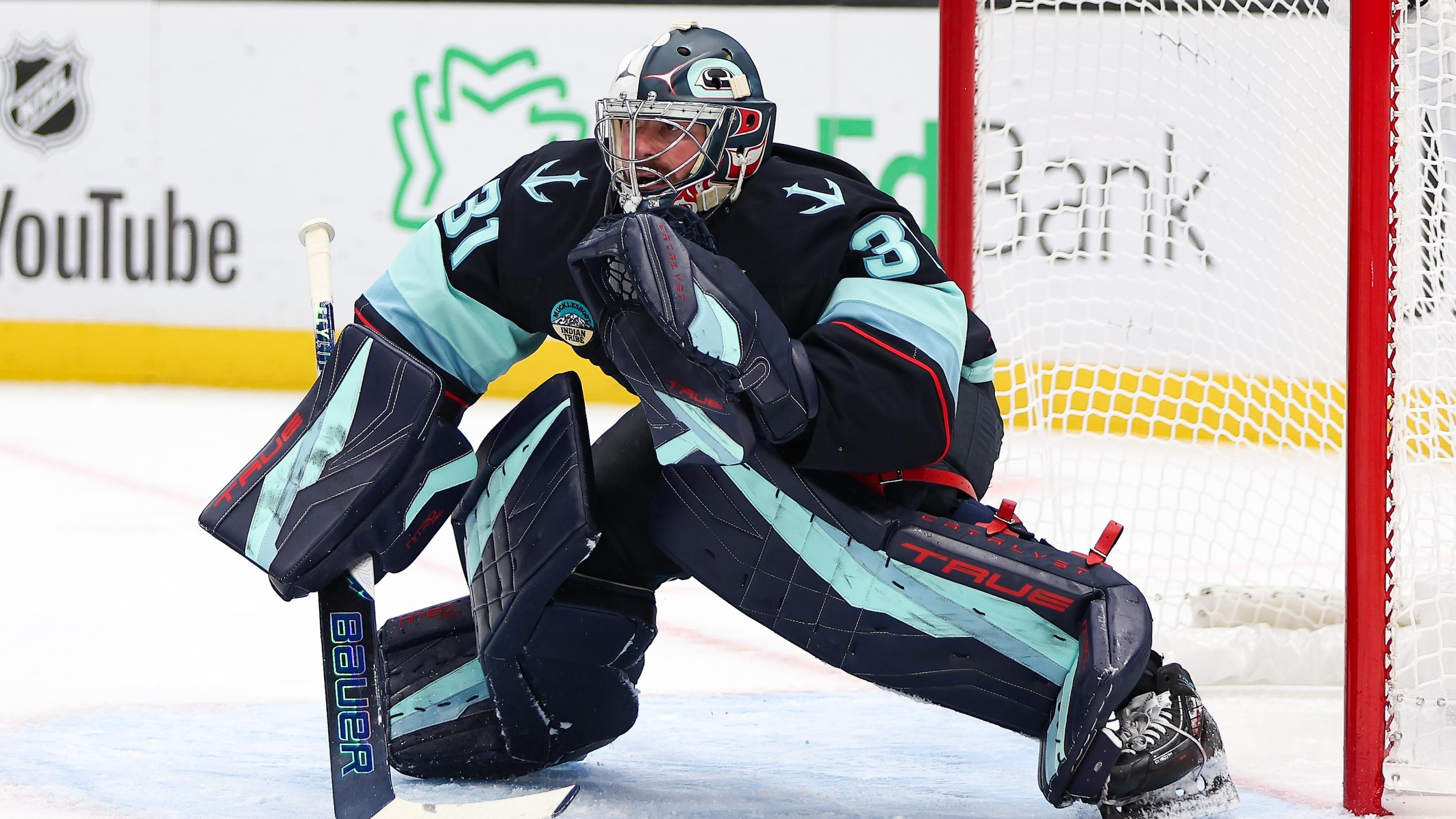

No. 97 Trevor Kidd
4 of 100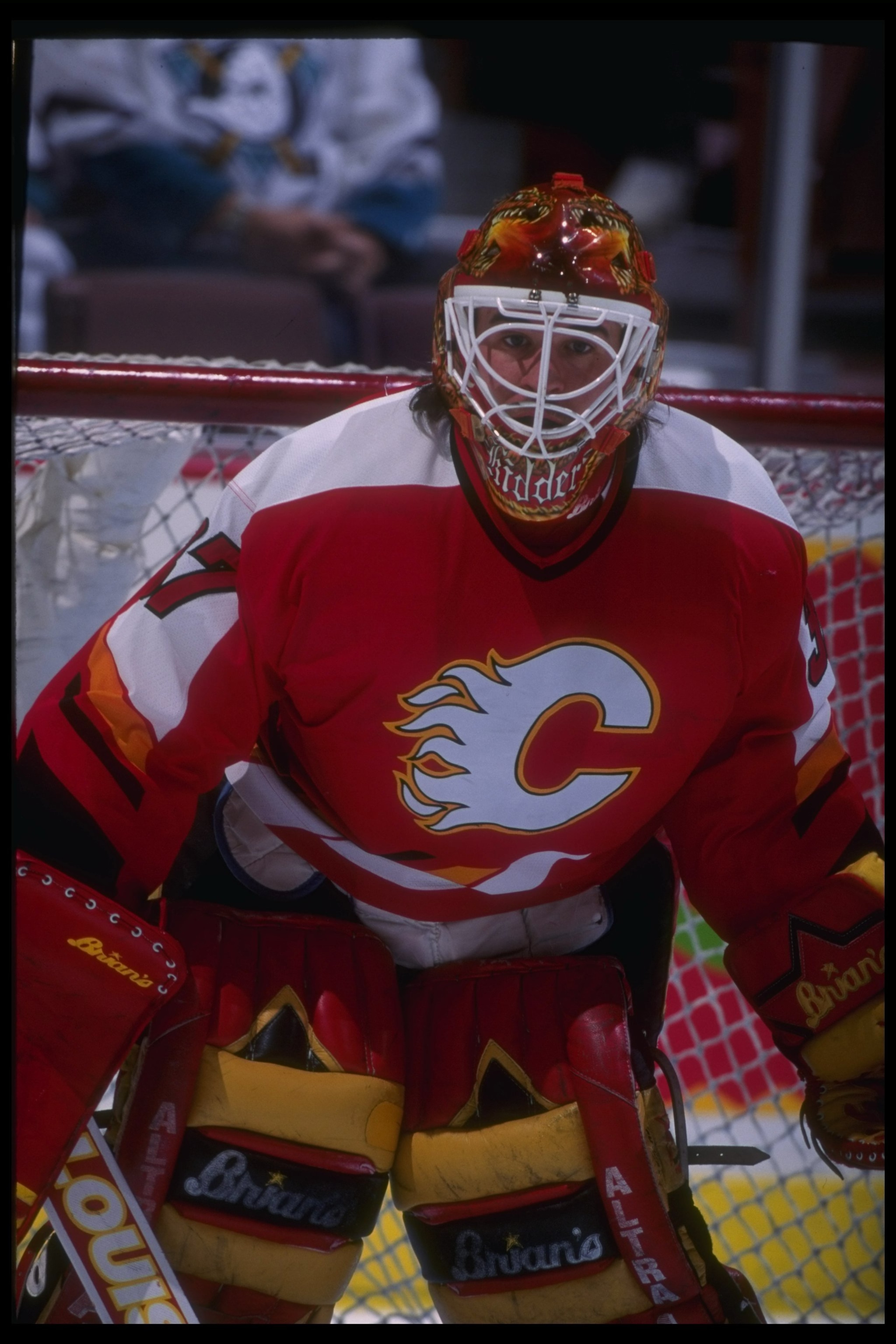
Career statistics: Regular season (NHL): 387 GP, 140-162-52, 2.84 GAA, .901 S %, 19 SO; Playoffs: 10 GP, 3-5, 3.93 GAA, .845 S %
Trevor Kidd was drafted by the Calgary Flames in the first round of the 1990 NHL Entry Draft, who had the misfortune of drafting Kidd over the great Martin Brodeur. Despite that drafting, Kidd had a solid NHL career, although he was unable to convert his successes in the regular seasons into any success in the postseason.
Kidd spent parts of five seasons in Calgary, before being traded to the Carolina Hurricanes in a four player deal that involved both Gary Roberts and Jean-Sebastien Giguere. His stay with the Hurricanes would last just two years, before Kidd moved on to the Florida Panthers via the Atlanta Thrashers. After being selected by the Thrashers in the Expansion Draft, he was traded the same day to Florida in a four-player deal that gave Atlanta some extra depth.
He would spend three seasons in Florida, mostly as a backup to both Mike Vernon and Roberto Luongo before signing on as a backup to Curtis Joseph in Toronto for two seasons (2002-03 & 2003-04) to finish out his career. While Kidd had spurts where he stood out, he never seemed to have that one full season where he was able to put it all together and because of it, he's relegated to number 97 on this list.
Best season: Kidd's best performance came in the 1997-98 season, when he shared time in net with Sean Burke, and played in 47 games for the Carolina Hurricanes, posting a 21-21-3 record, with an outstanding 2.17 GAA and a .922 save percentage, with three shutouts. Unfortunately, the Hurricanes finished in last place that season and finished nine points out of a playoff spot.
No. 96 Guy Hebert
5 of 100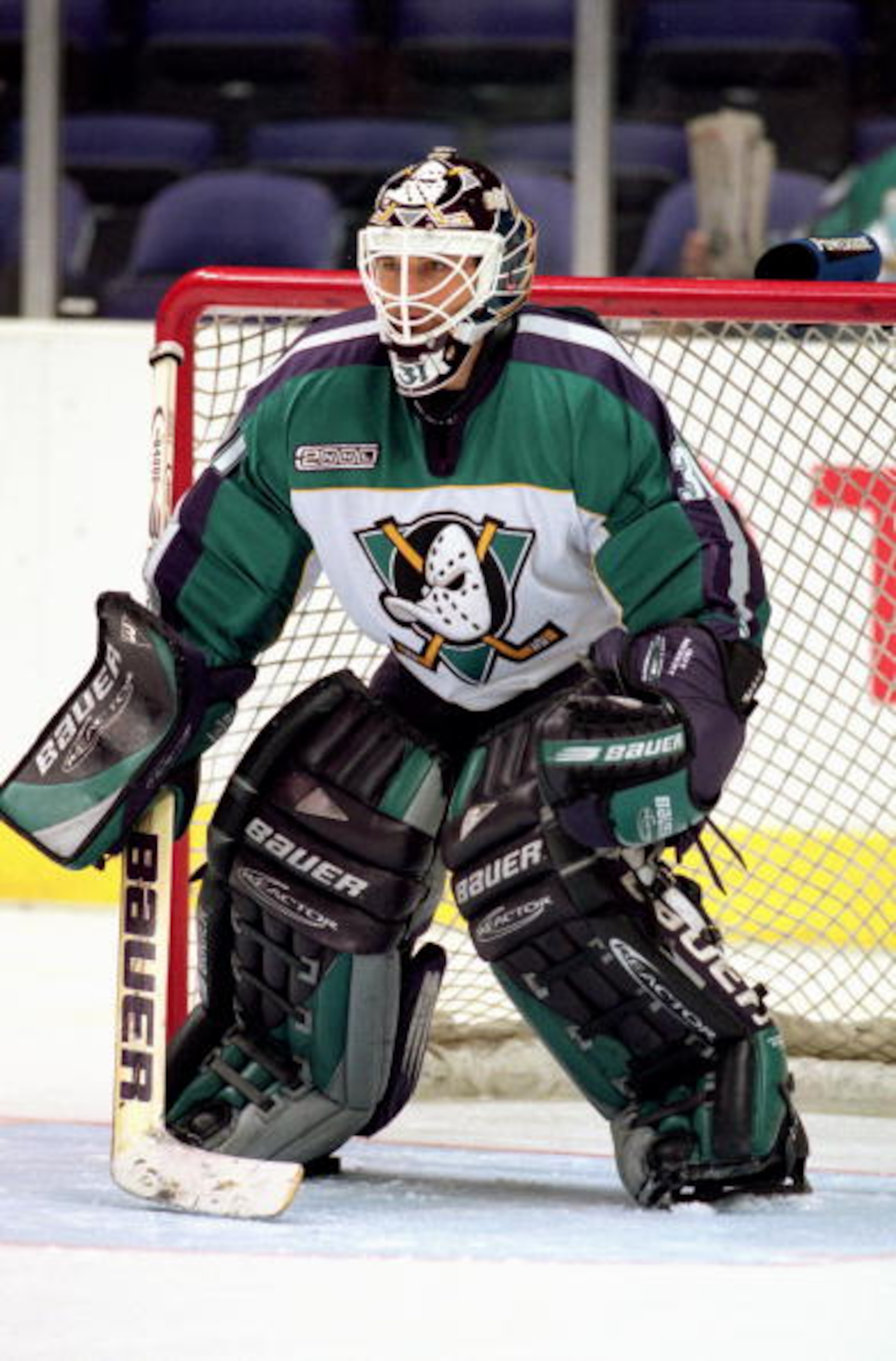
Career statistics: Regular season (NHL): 491 GP, 191-222-56, 2.81 GAA, .909 S %, 28 SO; Playoffs: 14 GP, 4-7, 2.66 GAA, .913 S %, All-Star (1997)
Guy Hebert was drafted by the St. Louis Blues in the eighth round of the 1987 NHL Draft. An alumnus of Hamilton College, Hebert worked his way through the IHL for the Peoria Riverman before making it to the Blues in the 1991-92 season, where he played his first 13 NHL games, posting a 5-5-1 record with a solid 2.93 GAA and .908 save percentage. He would play in 24 more games the following season, before being selected by the Mighty Ducks of Anaheim in the Expansion Draft in the ensuing off-season.
Hebert played the next seven plus seasons for the Ducks, where he always seemed to have a real nice save percentage, a pretty good goals against and would sprinkle in a few shutouts. His biggest problem was usually the team around him, as the Ducks struggled at the outset of the franchise, only making the playoffs twice during Hebert's tenure (1996-97 & 1998-99). A short history/profile of Hebert and his career can be found here. Hebert is another goalie that gets overlooked a bit historically mostly because of the teams he played for and his goaltending talents don't always get appreciated enough and he's good enough for the number 96 spot on my list.
Best season: Guy Hebert played in 69 games for the Mighty Ducks of Anaheim in 1998-99, posting a 31-29-9 record with a 2.42 GAA, and posting a .922 S % and a career-high six shutouts. He led the league in saves that year, but did not perform well in the playoffs, as his team fell in four straight to the Detroit Red Wings in the first round.
No. 95 Manny Fernandez
6 of 100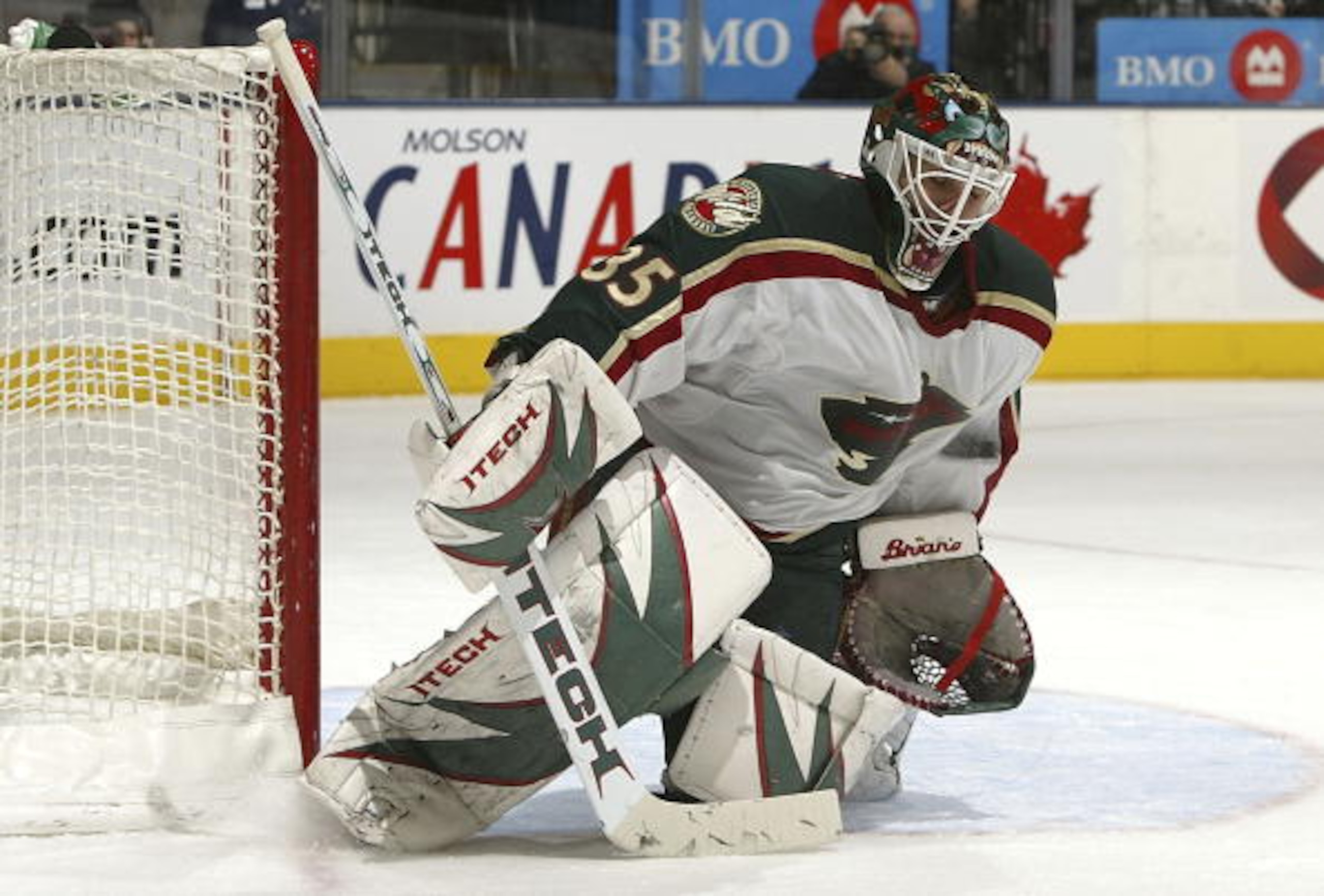
Career statistics: Regular season (NHL): 325 GP, 143-123-35, 2.50 GAA, .912 S%, 15 SO; Playoffs: 11 GP, 3-4, 2.00 GAA, .927 S %, Jennings Trophy (2006-07, 2008-09)
Manny Fernandez was originally drafted by the Quebec Nordiques in the third round of the 1992 NHL Entry Draft. After a long stint in the juniors and the AHL, Fernandez made his NHL debut during the 1994-95 season, playing in one game for the Dallas Stars, who had acquired his rights from Quebec in a February 1994 trade. He would play in just nine games over the first five years of his NHL career, spending most of his time in the IHL.
Fernandez would become the primary backup for the Dallas Stars in their 1999-2000 season, sharing time with Ed Belfour. That off-season, he would be dealt to the Minnesota Wild, where Fernandez would receive significantly more playing time. He played six seasons with the Wild, teaming with Dwayne Roloson and later Nicklas Backstrom. He would be traded to the Boston Bruins in the summer of 2007 where he would back up Tim Thomas in the last two seasons of his career.
Fernandez didn't always get the most opportunity, but his career numbers place him at number 95 in my top 100 list.
Best season: Fernandez's best year in the NHL was 2005-06, when he put up a 30-18-7 record in 58 games, posting a 2.29 GAA, a .919 save percentage and one shutout. The Wild unfortunately would finish eleven points out of a playoff spot.
No. 94 Rick DiPietro
7 of 100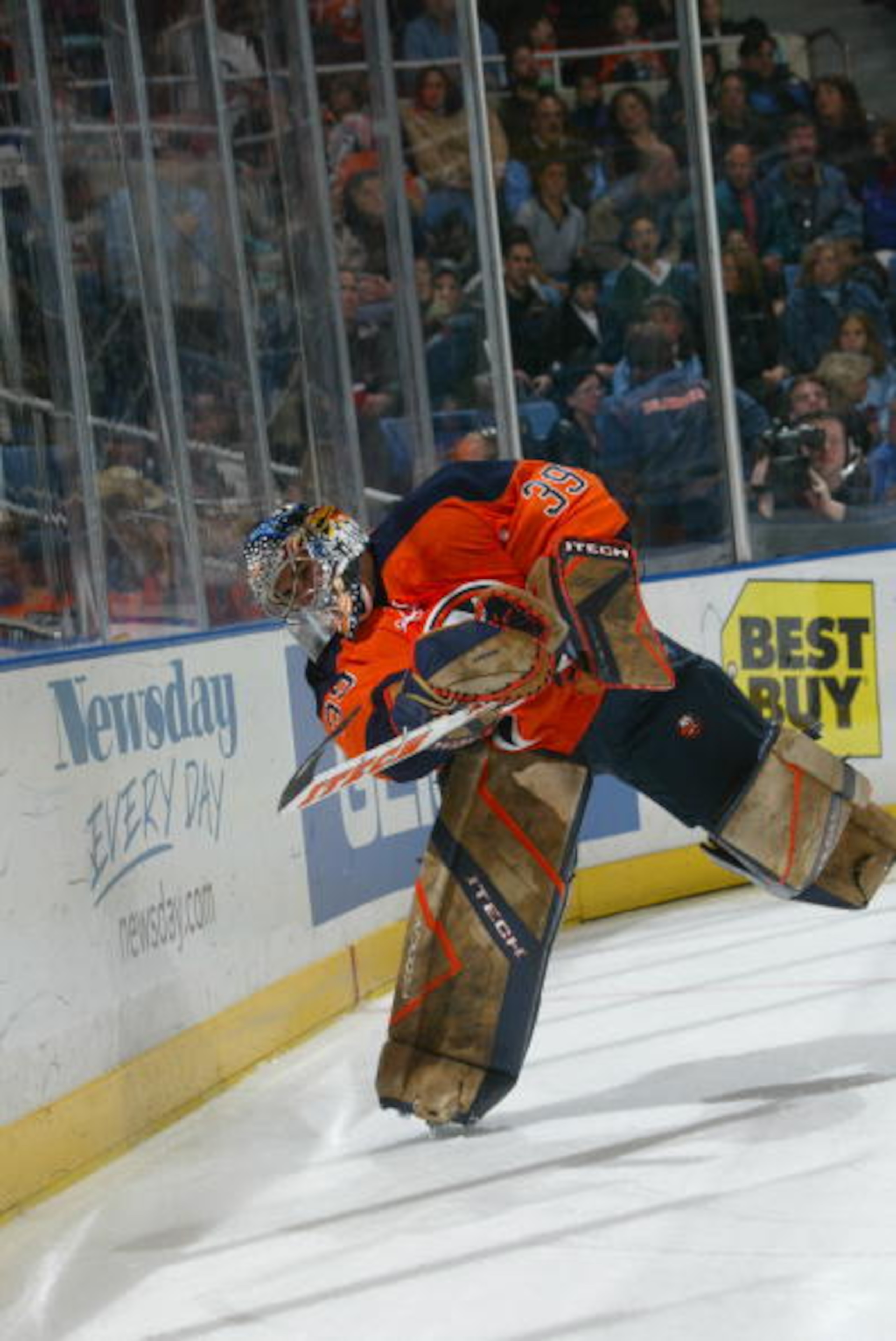
Career statistics: Regular season (NHL): 307 GP, 127-131-33, 2.84 GAA, .903 S %, 16 SO; Playoffs: 10 GP, 2-7, 2.60 GAA, .904 S %, All-Star (2008)
Rick DiPietro has been in the spotlight since he starred at Boston University in 1999-2000, and was the first goaltender to be selected number one overall in an NHL Entry Draft, when the New York Islanders selected him. He came in as a heralded prospect who was not only great between the pipes, but was supposed to be a great puckhandler in the mold of Martin Brodeur or Ron Hextall outside the net.
Although he would first appear with the Islanders during the 2000-01 season at age 19, it was not until 2003-04 that DiPietro would take the full-time job, playing in 50 games. After the lockout, he signed a historic 15-year $80 million contract after the lockout and while the $4.5 million salary per year looked pretty good, the contract has become more a mockery around the league than anything else.
After three somewhat successful campaigns (including his All-Star appearance) in the first three years of the deal, injuries have derailed DiPietro's career, to the point, he's only been able to play in just 39 games over the last three seasons. It's really a shame too, because DiPietro at his best is a great goaltender. It's also a shame his long-term contract and rash of injuries have become a bigger story than his ability and talent but DiPietro's goaltending talent and puckhandling abilities are still good enough to earn DiPietro the number 94 spot on this list, especially when you factor in the lack of talent some of his Islanders teams have had over the years.
Best season: DiPietro's best season as an Islander thus far was the 2006-07 season, when he posted a 32-19-9 record in 62 games, while posting a 2.58 GAA, .919 save percentage and five shutouts. The Islanders would go on to lose in the first round of the playoffs that season to the Buffalo Sabres in just five games.
No. 93 Jaroslav Halak
8 of 100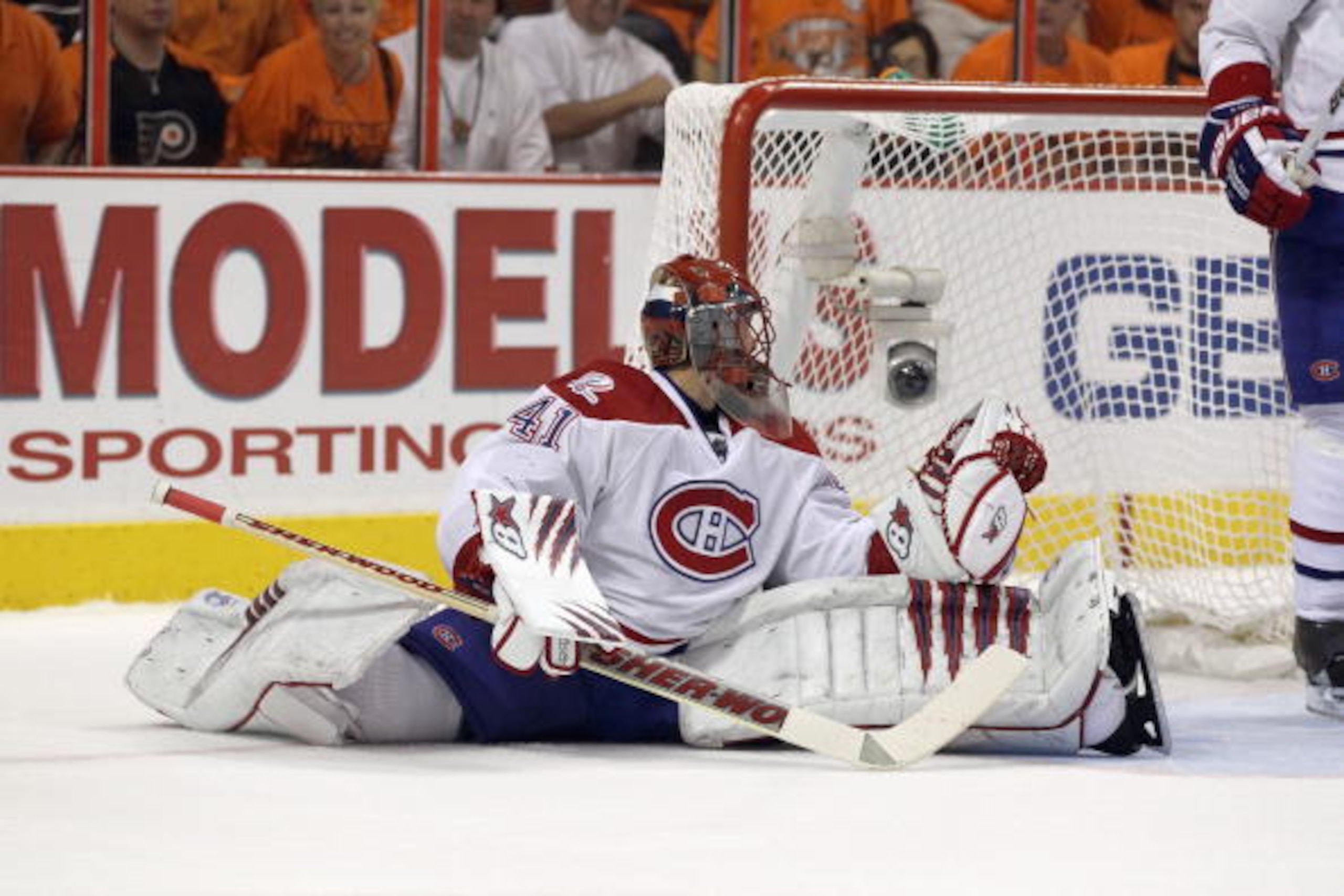
Career statistics: Regular season (NHL): 158 GP, 83-55-14, 2.57 GAA, .916 S %, 16 SO; Playoffs: 21 GP, 9-10, 2.49 GAA, .923 S %
Jaroslav Halak was a ninth round draft of the Montreal Canadiens in the 2003 NHL Entry Draft and overcame the long shot odds of making it to the NHL, by working his way through the Slovokian junior leagues and then the AHL. His NHL debut would come in 2006-07, when he played in 16 games for the Canadiens. He would bounce back and forth between the NHL and AHL for another season, before becoming more of a regular at the NHL level and sharing time with Carey Price in the 2008-09 season.
Halak's playing time would increase each season before culminating in a wild 2010 playoff ride with the Canadiens, creating a bit of a goaltender controversy for Montreal. They decided to stick with Carey Price for the long-term, and sent Halak to the St. Louis Blues, in a deal for two prospects. Halak played quite well in his first year with the Blues, posting a 27-21-7 record with a 2.48 GAA and a .910 save percentage with a career-high seven shutouts.
It's tough to determine where to rank Halak because he still has so much of his career left to play. Based on his production thus far and the outlook for his talent, I place him at number 93 for now, but I would fully expect Halak to move up this list in the years ahead.
Best season: Halak's breakout season was the 2009-10 campaign, where he put up a 26-13-5 record in 45 regular season games, with a 2.40 GAA, a .924 save percentage and five shutouts, all while sharing the load with Carey Price. It was in the playoffs where Halak really had a coming out party, as he helped lead the Habs to the Eastern Conference Finals by going 9-9 in 18 games with an impressive .923 save percentage and a 2.55 GAA. A loss to the Philadelphia Flyers in five games ended the dreams of another Stanley Cup title to Montreal.
No. 92 Bob Sauve
9 of 100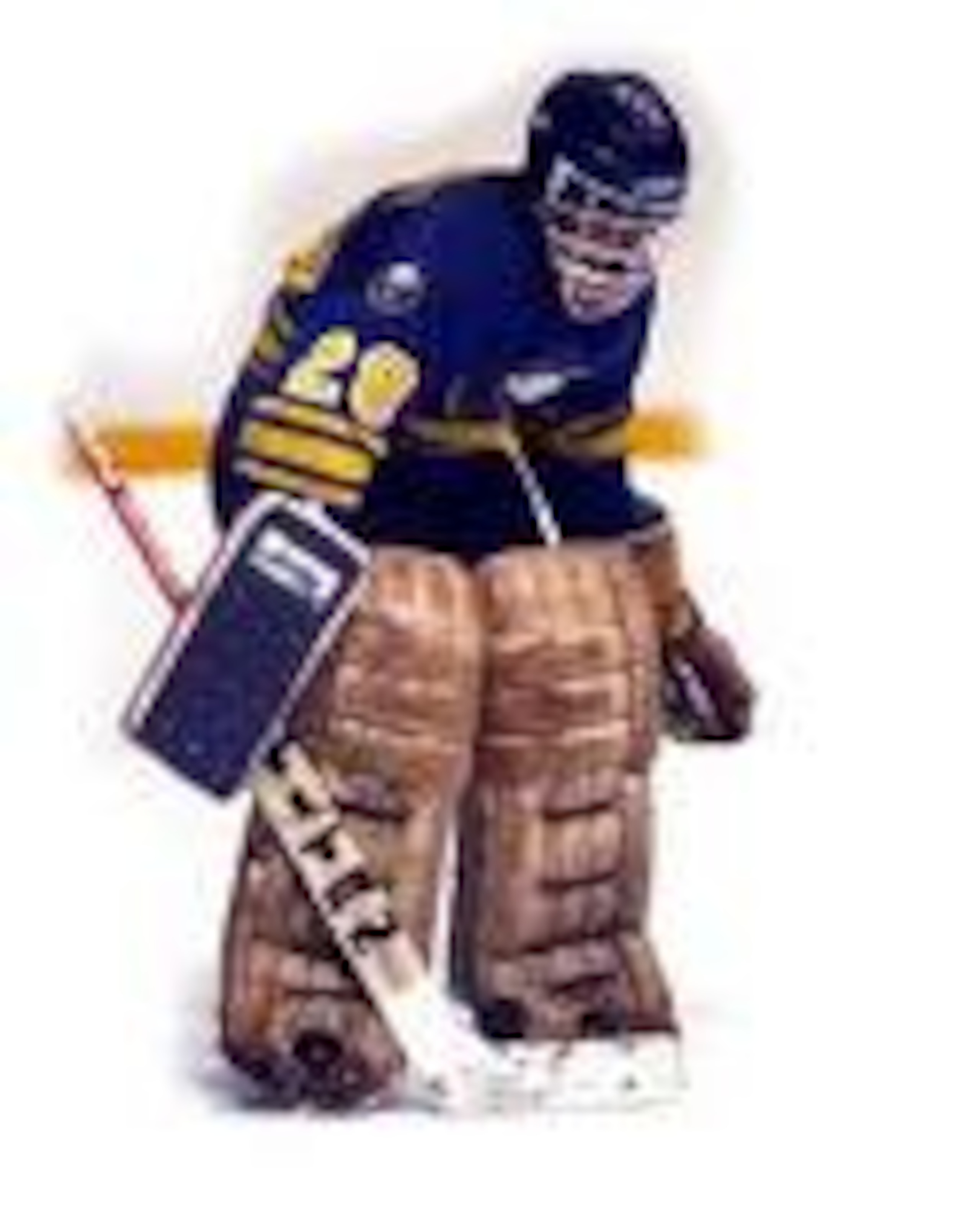
Career statistics: Regular season (NHL): 420 GP, 182-154-54, 3.48 GAA, 8 SO; Playoffs: 34 GP, 15-16, 3.08 GAA, 4 SO, Vezina Trophy (1979-80)
Bob Sauve was drafted by the Buffalo Sabres in the first round of the 1975 NHL Draft, where he ended up teaming up with fellow draft pick Don Edwards for parts of six seasons after arriving in the NHL for four games in the 1976-77 season. Sauve would play more of a supporting role most of his career, but did lead the league in GAA in 1979-80.
He was dealt away to the Detroit Red Wings in December 1981 where he played 41 games for a team that did not do much of anything in front of him. That off-season, he returned to Buffalo as a free agent and he played 54 games the following season, his most in one season for a single team, and was probably the only time in his nine-year Sabres career that he was the predominant starting goalie.
The following season brought the likes of high school phenom Tom Barrasso, so Sauve was relegated to tutoring the youngster while sharing the workload. The remaining six years of his career saw Sauve play the backup role for the Sabres, Chicago Blackhawks and New Jersey Devils, where he played a good supporting role. His second season with Barrasso (1984-85) saw Sauve share earn a part of the Jennings Trophy, for fewest goals allowed. Sauve was forced to retire after the 1988-89 season when injuries, mostly his back, began to take their toll, but his career was still good enough to warrant the number 92 spot in my list. Sauve has become a somewhat prominent player agent after his retirement.
(NOTE: As a Devils fan, it's hard to forget the night of March 25, 1988 when he dueled the Sabres to a 2-2 tie against his "student" Tom Barrasso. I will always remember the big save he made on Ken Priestlay's breakaway which helped preserve the Devils' 11-1-1 finish to earn their first playoff berth).
Best season: Sauve's best season was the 1979-80 season in which he shared the Vezina Trophy with Don Edwards (NOTE: The Vezina Trophy was awarded to the goalie(s) that had the team with the fewest goals against in those days, similar to the Jennings Trophy of the current day) for the Buffalo Sabres, and posted a 20-8-4 record in 32 games played and led the NHL with a 2.36 goals against, and 4 shutouts. He also followed it up with a league leading 2.04 GAA and 2 shutouts in the playoffs that year, helping the Sabres reach the league semifinals before falling to the eventual Stanley Cup Champion New York Islanders in six games.
No. 91 Kelly Hrudey
10 of 100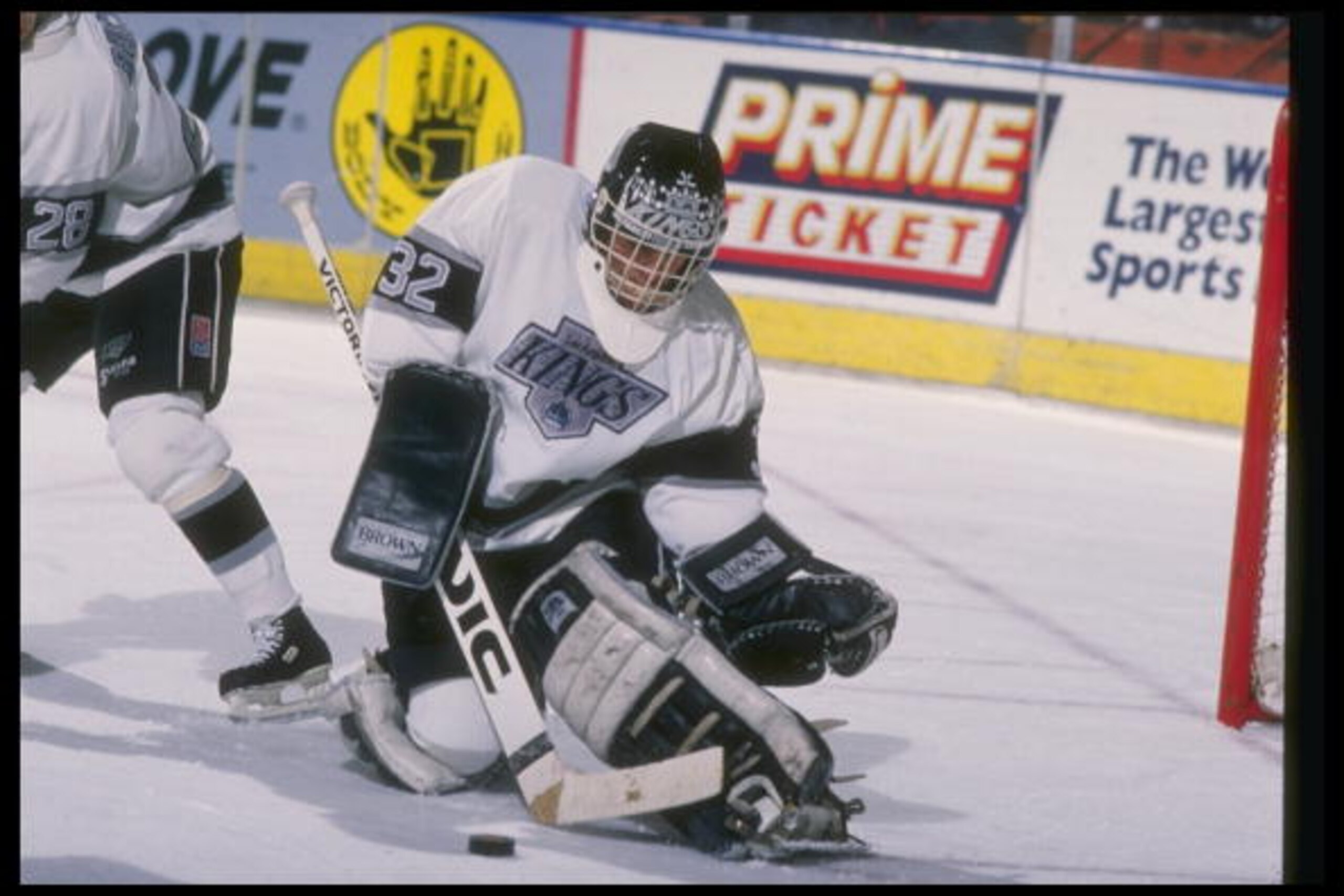
Career statistics: Regular season (NHL): 677 GP, 271-265-88, 3.43 GAA, .893 S%, 17 SO; Playoffs: 85 GP, 36-46, 3.29 GAA, .891 S%
Kelly Hrudey was a second round pick of the New York Islanders in the 1980 NHL Entry Draft. He made his debut with the Islanders in the 1983-84 season, when he went 7-2 in 12 games for the Islanders. He would play almost six seasons on Long Island before being dealt to the Los Angeles Kings in February 1989. His most famous moment as an Islander was Easter Sunday (April 18, 1987) when the Islanders outlasted the Washington Capitals to win in four overtimes by a 3-2 score.
Hrudey played seven-plus seasons in Los Angeles where he helped the Kings to five straight playoff appearances, highlighted by a trip to the Stanley Cup Finals in 1993, before losing to the Montreal Canadiens in five games. After his time with the Kings, he moved up the West Coast to spend the last two years of his career in San Jose.
After his career, the well-spoken Hrudey has made a nice career working for Hockey Night in Canada as a broadcaster. His on-ice play, especially in pressure situations, puts him at number 91 on my list.
Best season: 1990-91 was the best single season of Kelly Hrudey's career, when he put up a 26-13-6 record in 47 games, while having a 2.90 GAA, a .900 save percentage and a career-high 3 shutouts. He followed it up with a 6-6 record in 12 playoff games, posting a .903 save percentage and 2.78 GAA.
No. 90 Don Edwards
11 of 100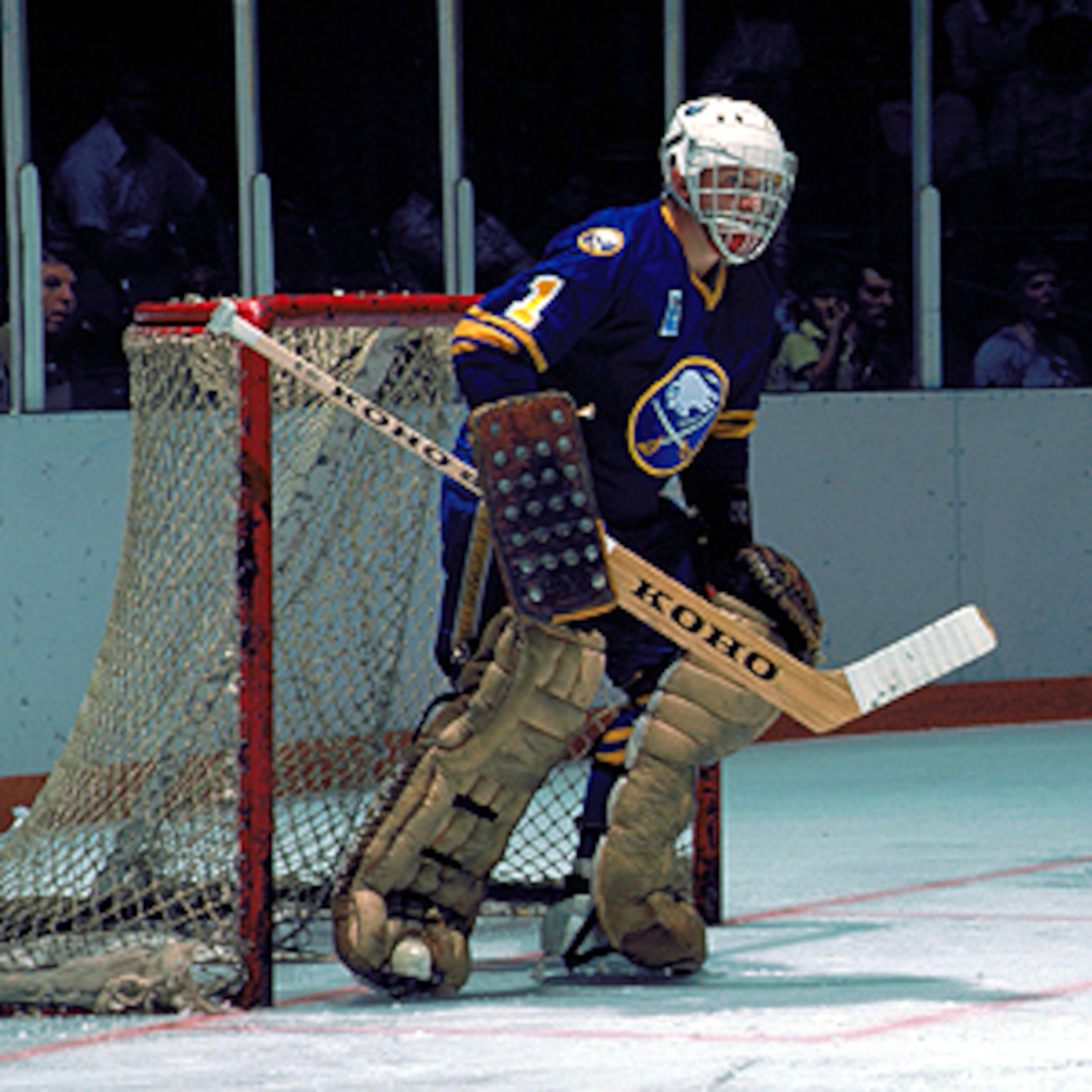
Career statistics: Regular season (NHL): 459 GP, 208-155-74, 3.32 GAA, 16 SO; Playoffs: 42 GP, 16-21, 3.44 GAA, Vezina Trophy (1979-80), All-Star (1980, 1982)
Don Edwards was drafted in the fifth round by the Buffalo Sabres in the 1975 NHL Entry Draft. Like fellow draft class member Bob Sauve, Edwards was brought in to help fill a void at the goaltending position. He played six seasons for the Sabres, most of which were teamed with Sauve. Edwards definitely got more of the playing time for most of those seasons and along with Sauve, shared the 1979-80 Vezina Trophy for fewest goals allowed (NOTE: Trophy was not for best goaltender in those days as it is today).
He would be dealt in the summer of 1982 to the Calgary Flames in a trade that also saw six draft picks exchanged. Edwards failed to have the same success with the Flames that he had in Buffalo, as he never posted a goals against below 4.02 in his time with the Flames as he began to lose playing time to Reggie Lemelin. He would be dealt in the spring of 1985 to the Toronto Maple Leafs where he played his final season.
Edwards had two plus really good seasons for the Sabres, but was unable to sustain that level for the remainder of his career. Was he flash in the pan or a victim of teams around him? I leave that to others to decide, but for the purposes of this list, he comes in at number 90.
Best season: Edwards played his best season in 1977-78 at the age of 22, when he went 38-16-17 in a league-high 72 games, with a 2.64 GAA and five shutouts. His 38 wins were a league-high as well. The Sabres would go on to win in the first round best-of-three over the New York Rangers, but fell in the league Quarterfinals to the Philadelphia Flyers in five games.
No. 89 Ron Tugnutt
12 of 100
Career statistics: Regular season (NHL): 537 GP, 186-239-62, 3.05 GAA, .895 S%, 26 SO; Playoffs: 25 GP, 9-13, 2.27 GAA, All-Star (1999)
Better known as the "Tug Boat," or "Tugger," Ron Tugnutt had an NHL career that spanned 17 years and eight different NHL teams. He started with the Quebec Nordiques, acquired as a 4th round draft pick in 1986. He would play parts of five seasons in Quebec, but struggled for the most part, never posting a save percentage over .892 in his time as a Nordique. His career highlight in Quebec was easily the night of March 21, 1991, when he made 70 saves against Boston in a 3-3 tie.
He was traded to Edmonton in March 1992 where he lasted a season plus. Taken by Anaheim in the Expansion Draft, Tugnutt did not last long in a Ducks uniform, before being dealt to Montreal in February 1994. He did not play all that much as a Canadien, and left as a free agent, where he signed with Washington. He did not play a game with the Capitals, spending the year at the AHL level, helping to lead the Portland Pirates to a Calder Cup and catching the eye of the Ottawa Senators who signed him as a free agent.
He would have his best three seasons as a Senator, first sharing time with Damian Rhodes, before taking over the job. Dealt to Pittsburgh in the stretch run of 2000, Tugnutt would win his first playoff series in net, including another spectacular 70-save performance in a five overtime loss to the Philadelphia Flyers on May 4, 2000.
Tugnutt would sign a free agent deal with the expansion Columbus Blue Jackets, where he would play two seasons helping to tutor Marc Denis. He was traded to Dallas in June 2002, where he served as Marty Turco's backup for the final two seasons of his career. The win-loss stats may not show Tugnutt to be deserving of this list, but his individual performances mostly on sub par teams didn't necessarily reflect his talent as a goaltender, which came clear in performances like his 70-save games, and why the Tug Boat definitely earns his keep to be in the top 100 at spot number 89.
Best year: Tugnutt's best year was probably the 1998-99 season, when he played in 43 games for the Ottawa Senators, leading the league with a 1.79 GAA. He also posted a .925 save percentage and 3 shutouts.
No. 88 Glenn Resch
13 of 100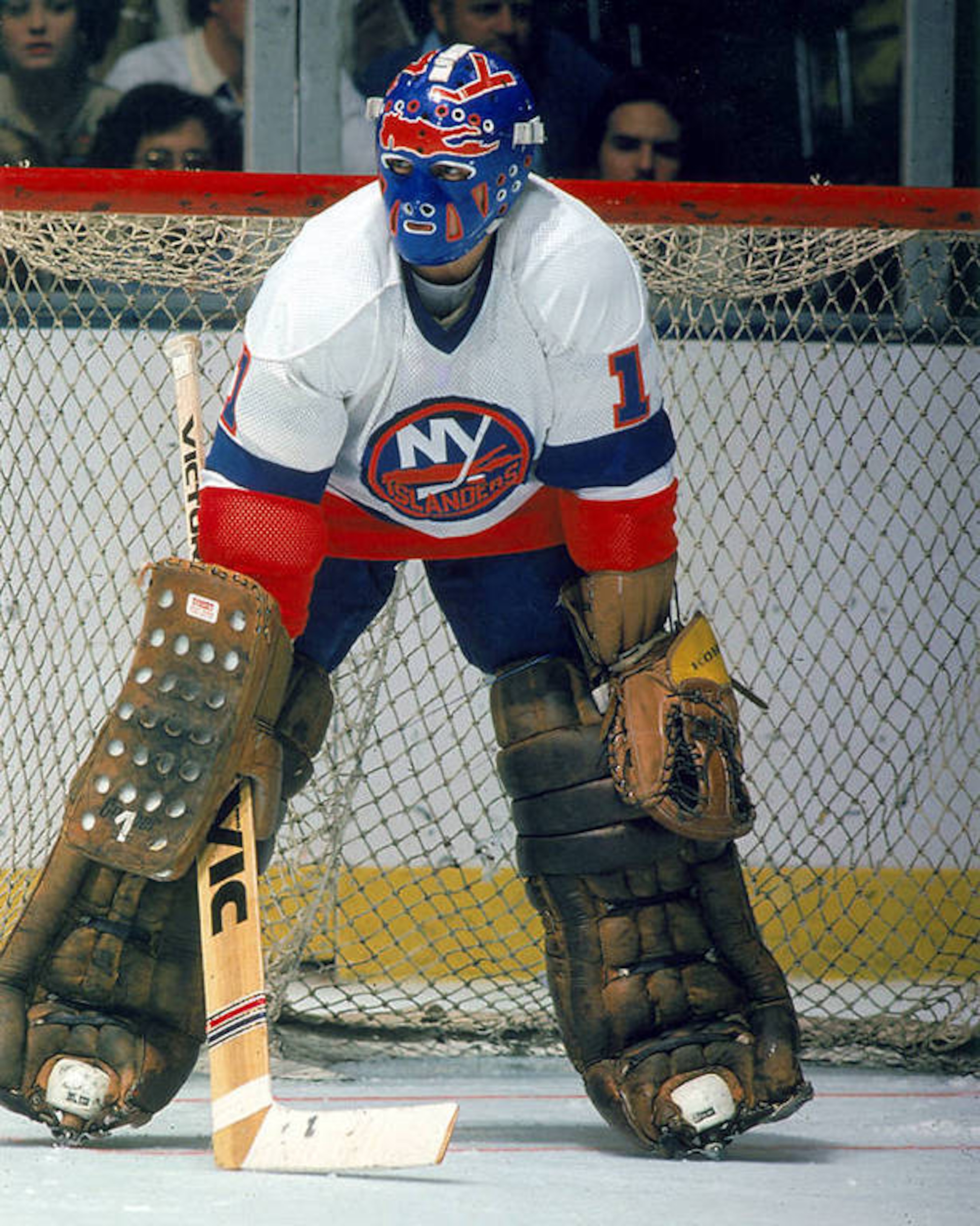
Career statistics: Regular season (NHL): 571 GP, 231-224-82, 3.27 GAA, 26 SO; Playoffs: 41 GP, 17-17, 2.50 GAA, 2 SO, All-Star (1976, 1977, 1984), Masterston Trophy (1981-82), Stanley Cup (1980)
Glenn "Chico" Resch is a popular goalie who played in 571 career NHL games with the New York Islanders, Colorado Rockies/New Jersey Devils and Philadelphia Flyers. He came up with the Islanders to play in two games during the 1973-74 season, going 1-1 with a 3.00 GAA. He never would play more than 46 games in a season with the Islanders, but was still able to make two All-Star Games.
Resch is known for how nice of a guy he always is, and that definitely was tested a bit when he was dealt away from the New York Islanders as they were on the cusp of their dynasty in March 1981, to the Colorado Rockies, potentially costing Resch three Stanley Cup rings. However, Resch did became a bit of a cult figure for the Rockies and Devils, being the best player on some down right awful teams and currently is the color commentator for the TV feed of New Jersey Devils games.
Resch was traded to the Philadelphia Flyers in March 1986 where he finished his career backing up Ron Hextall. Chico had a ton of ability but was overshadowed by Billy Smith with the Islanders, played on horrible teams with Colorado/New Jersey and was pretty much at the end of his career when he came to Philadelphia. His career definitely had the chance to be more than it did, but he'll have to settle for number 88 on this list.
Best season: Chico's best year statistically was in 1975-76, when he posted a 23-11-8 record in 44 games, with a 2.07 GAA and 7 shutouts. He followed it up with a 3-3 record in seven playoff games splitting the time with Billy Smith as the Islanders fell in the semi-finals to the eventual champion Montreal Canadiens.
No. 87 Martin Biron
14 of 100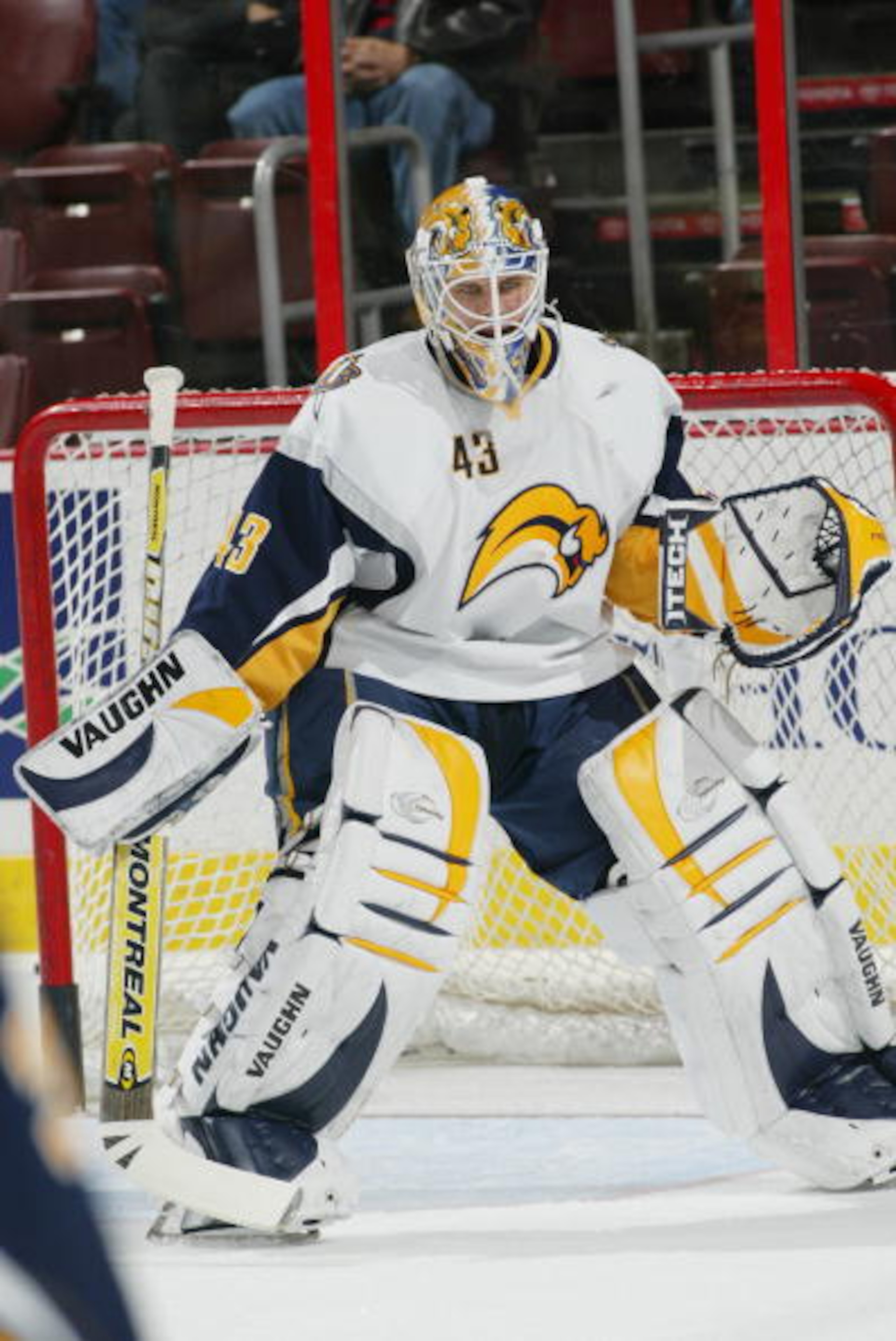
Career statistics: Regular season (NHL): 479 GP, 216-182-49, 2.61 GAA, .911 S %, 26 SO; Playoffs: 23 GP, 11-12, 2.87 GAA, .908 S %,
Martin Biron was drafted in the first round (16th overall) by the Buffalo Sabres in the 1995 NHL Entry draft and played three games in the NHL as an 18-year old. He became a regular during the 1999-00 season, when he played in 41 games, going 19-18-2 with a 2.42 GAA and .909 save percentage with five shutouts. Biron never seemed to get a chance to be "the guy" in Buffalo, even despite putting up solid numbers throughout his eight-plus seasons.
Biron was traded to the Philadelphia Flyers for a second round pick in February 2007, which was supposed to give Biron a chance to be the full-time number one guy with the Flyers, a spot that has been a consistent revolving door in recent years. He played well in the two-plus seasons with the Flyers, but seemed to not get it done enough in the post-season, which ended too early for the Flyers.
After his stint in Philadelphia, Biron signed with the New York Islanders, but got caught up in a numbers game with Dwayne Roloson and Rick DiPietro, which limited Biron to just 29 games. He signed with the New York Rangers this season to back up Henrik Lundqvist, and played extremely well in his 17 games before a broken collarbone ended his season prematurely. It is interesting to think of how much better Biron's career might have been had he gotten more of an opportunity, but you also have to think about whether there is a legitimate reason as to why Biron didn't get the full-time opportunity, which puts him at number 87 on my list.
Best season: Martin Biron had a breakout season with the Buffalo Sabres in 2001-02, taking over for the traded Dominik Hasek, and putting up a record of 31-28-10 in 72 games, with a 2.22 GAA and posting a .915 save percentage with four shutouts. Unfortunately, despite a .500 record, the Sabres finished fifth in the Northeast Division and did not earn a playoff berth.
No. 86 Reggie Lemelin
15 of 100
Career statistics: Regular season (NHL): 507 GP, 236-162-63, 3.46 GAA, 12 SO; Playoffs: 59 GP, 23-25, 3.58 GAA, 2 SO, All-Star (1989)
Rejean (or "Reggie") Lemelin was an NHL goalie who played 507 career games in the league and played for the Atlanta/Calgary Flames and Boston Bruins over his 15 year career. Originally drafted as a Philadelphia Flyer in the 7th round of the 1974 NHL Draft, Lemelin didn't make it to the NHL until being signed by the Atlanta Flames as a free agent in the summer of 1978. Lemelin would play in 18 games for the Flames that year, posting a respectable 3.32 GAA and 8-8-1 record in 18 games.
Lemelin wouldn't reach the 40-game plateau until well after the franchise relocated to Calgary, when Lemelin played 51 games in the 1983-84 season. After the 1986-87 season, Lemelin signed as a free agent with the Boston Bruins, where he probably is most widely known for his body of work.
Lemelin formed a solid goalie tandem with Andy Moog in Boston in the late 1980's, but it is the deep playoff run of 1987-88 that Lemelin was at his best. He dominated the playoffs, including this amazing save on Pat Verbeek in the Eastern Conference Finals against the New Jersey Devils. Lemelin had a pretty solid seven or eight year run for the Flames and Bruins and goes down as the 86th best goaltender in NHL history.
Best season: Lemelin's best year was 1987-88 when he helped lead the Boston Bruins to the Stanley Cup Finals. He posted a 24-17-6 record in the regular season with a 2.93 GAA and a .889 save percentage with 3 shutouts. It is in the postseason where he got real hot, posting a league-best 2.63 GAA in 17 games, with an 11-6 record and 1 shutout.
No. 85 Kirk McLean
16 of 100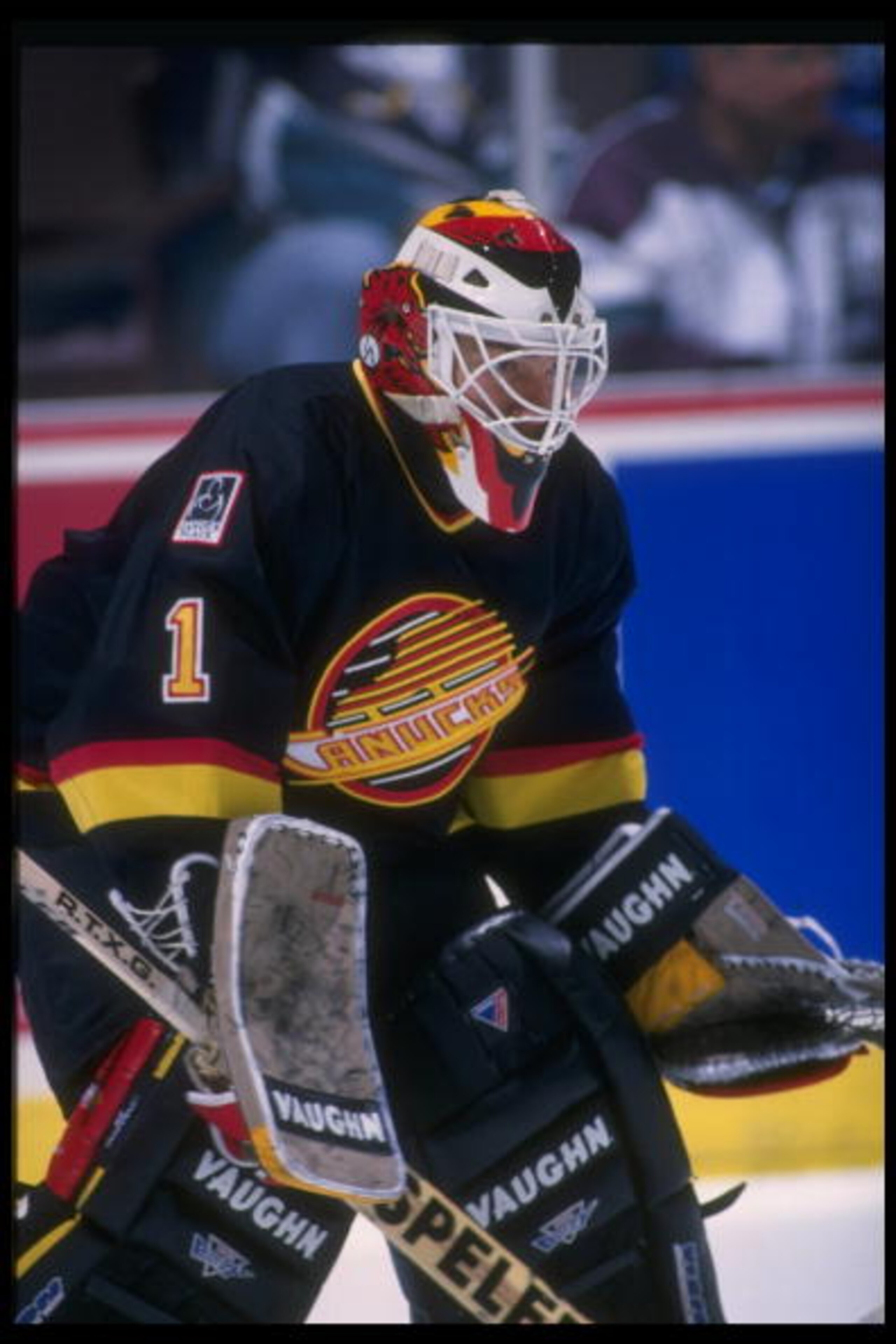
Career statistics: Regular season (NHL): 612 GP, 245-262-72, 3.26 GAA, .887 S %, 22 SO; Playoffs: 68 GP, 34-34, 2.84 GAA, .907 S %, 6 SO, All-Star (1990, 1992)
In the mid-to-late 1980's and early 1990's, the New Jersey Devils stockpiled a lot of young goaltenders. One such goalie was Kirk McLean, who the Devils drafted in the sixth round of the 1984 NHL Entry Draft. McLean would see just six games over two seasons as a Devil, but was traded to the Vancouver Canucks in a six-player/draft choice deal on September 15, 1987 that saw Greg Adams, McLean and a 2nd round choice sent to Vancouver, with Patrik Sundstrom and 2nd & 4th round choices sent to New Jersey.
McLean would jump right into the mix in net for the Canucks, playing in 41 games during the 1987-88 season, posting a 11-27-3 record, with a 3.71 GAA and .875 save percentage during his rookie year. He would improve greatly for the Canucks, where he played over ten seasons for the franchise. The team highlight was the 1994 playoff run, where the Canucks made it to within one win of a Stanley Cup Championship, falling to the New York Rangers. During the first round of those 1994 playoffs, here was a great save McLean made against Calgary during overtime of Game 7. Had it not been for that save, the magical run would not have had a chance.
McLean would be dealt from the Canucks to the Carolina Hurricanes with Martin Gelinas for Sean Burke, Geoff Sanderson and Enrico Ciccone on January 3, 1998. Just two months later, he was dealt to Florida for Ray Sheppard. In Florida, he played mostly a backup role, to both John Vanbiesbrouck and Sean Burke over the two seasons. In the summer of 1999, he signed with the New York Rangers where he spent his last two years as a backup to Mike Richter. McLean had a very solid career and ranks 34th all-time on the list of games played for an NHL goalie, and comes in at number 85 on my all-time list of goalies.
Best season: McLean's best individual year was the 1991-92 season when McLean posted a 38-17-9 record in 65 games played with a 2.74 GAA, .901 save percentage and five shutouts. The 38 wins were a league-high. In the playoffs that year, he posted a 6-7 record in 13 games, with a 2.52 GAA, .909 save percentage and a league-high 2 shutouts.
No. 84 Darren Puppa
17 of 100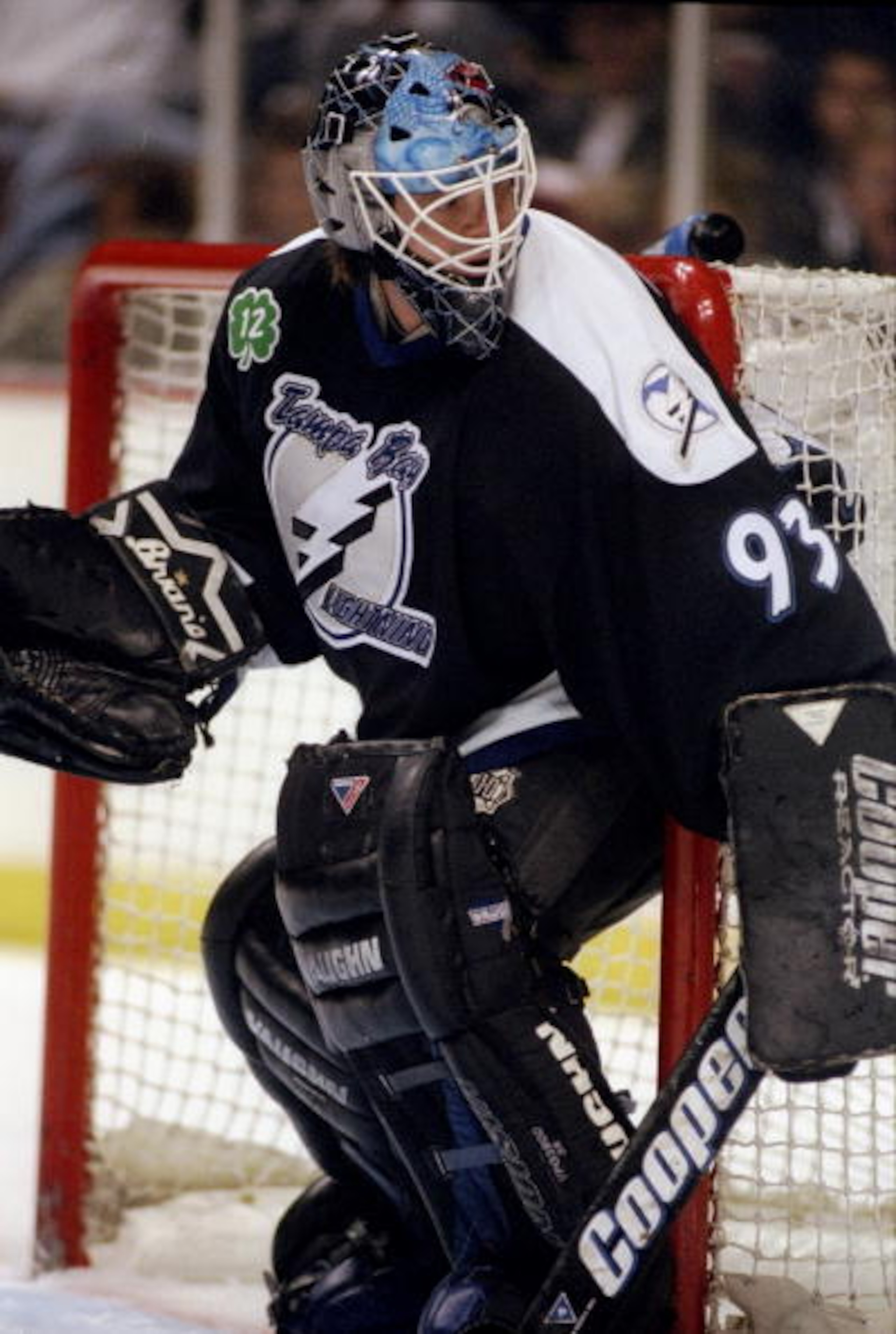
Career statistics: Regular season (NHL): 429 GP, 179-161-54, 3.03 GAA, .897 S %, 19 SO; Playoffs: 16 GP, 4-9, 3.89 AA, .872 S %, All-Star (1990)
Darren Puppa was drafted by the Buffalo Sabres as a fourth round draft pick in the 1983 NHL Entry Draft. He played two seasons at RPI before playing in both the AHL and NHL with the Buffalo franchise. His NHL career started in 1985-86, when he would play in seven games for the Sabres. He would play mostly in the AHL his first two seasons, before breaking through to share time with Clint Malarchuk the next four seasons.
He was traded to the Toronto Maple Leafs along with Dave Andreychuk and a first round pick in return for Grant Fuhr and a fifth round pick. He played in just eight games for the Maple Leafs, backing up Felix Potvin before being exposed in the Expansion Draft and taken by the Florida Panthers. Puppa would remain a Panther for one day, before he was taken by the Tampa Bay Lightning in Phase II of the Expansion Draft.
It is with the Tampa Bay Lightning that Puppa is best remembered as he played in the first seven seasons of the franchise. In the initial year of the team, he played in 63 games, and posted a respectable 22-33-6 record with a 2.71 GAA and .899 save percentage, while accumulating four shutouts. He would play three very solid years for Tampa Bay, before injuries curtailed his success a bit. Puppa always was a fan favorite in Tampa, and is another guy who is stronger than his numbers might indicate, and he's good enough for number 84 in this top 100.
Best season: Puppa's best season was in 1995-96, when he helped lead the Tampa Bay Lightning to their first playoff berth in franchise history. He went 29-16-9 in 57 games while posting a 2.46 GAA, a .918 save percentage and a career-high five shutouts. He followed that up with a 1-3 postseason, with a 4.86 GAA and a disappointing .837 save percentage.
No. 83 Jon Casey
18 of 100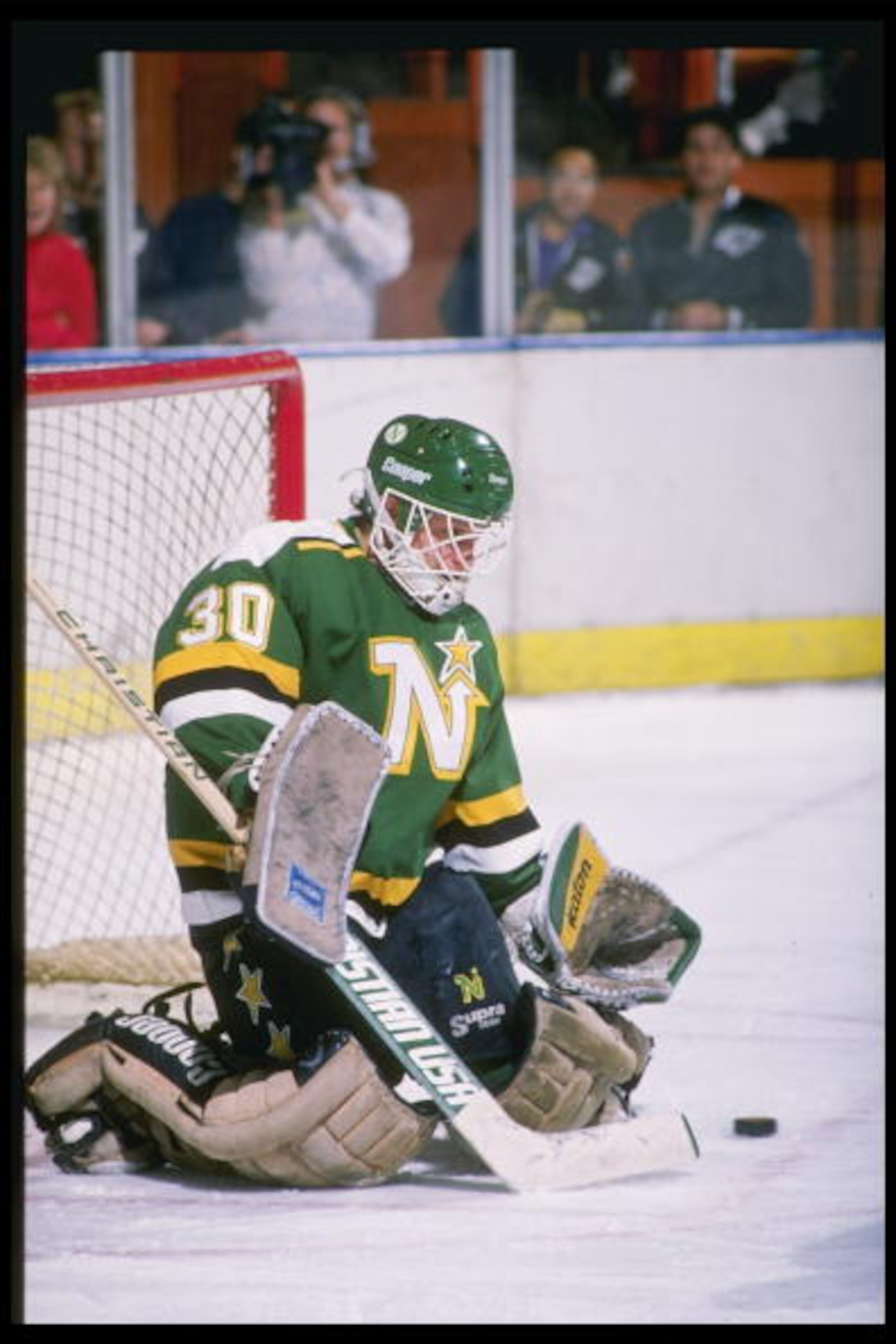
Career statistics: Regular season (NHL): 425 GP, 170-157-55, 3.21 GAA, .888 S %,16 SO; Playoffs: 66 GP, 32-31, 3.08 GAA, .895 S %, All-Star (1993)
Jon Casey was signed out of the University of North Dakota by the Minnesota North Stars after a successful four year run with the Fighting Sioux from 1980-84. He would appear in two games right out of college, giving up six goals in just 84 minutes of action. He would not become an NHL regular until the 1988-89 season, when he played in 55 games for Minnesota, and had a very respectable .900 save percentage and a GAA of 3.06, while posting his first career shutout.
It began a five-year run of 52+ starts for the North Stars for Casey, highlighted by a 1991 Stanley Cup playoff run that brought Casey and his teammates to the Stanley Cup Finals, before they fell to the mighty Pittsburgh Penguins, led by Mario Lemieux in six games. Casey was the backbone for the North Stars during that run, going 14-7 in the 23 games the North Stars played during those playoffs. Casey would play two more years for Minnesota, before being dealt to Boston in a deal for Andy Moog in the summer of 1993.
Casey had a great one year in Boston, posting 30 wins in 57 games, but was allowed to become a free agent, where he signed with the St. Louis Blues, a team where Casey played the final three seasons of his NHL career. Casey was a goalie who had a really good six year run and during that run was considered one of the better goalies in the league, and for that run, he claims number 83 on this list.
Best season: Casey's best year is a tough one to pick out, as he had a pretty good six year run or so that was pretty consistent. I have selected the 1989-90 season, where Casey put up a league-high 31 wins in 61 games played. He also had a GAA of 3.22 and a save percentage of .896, while pitching three shutouts. In the playoffs, he posted a 3-4 record as the North Stars fell to the Chicago Blackhawks in the first round.
No. 82 Jocelyn Thibault
19 of 100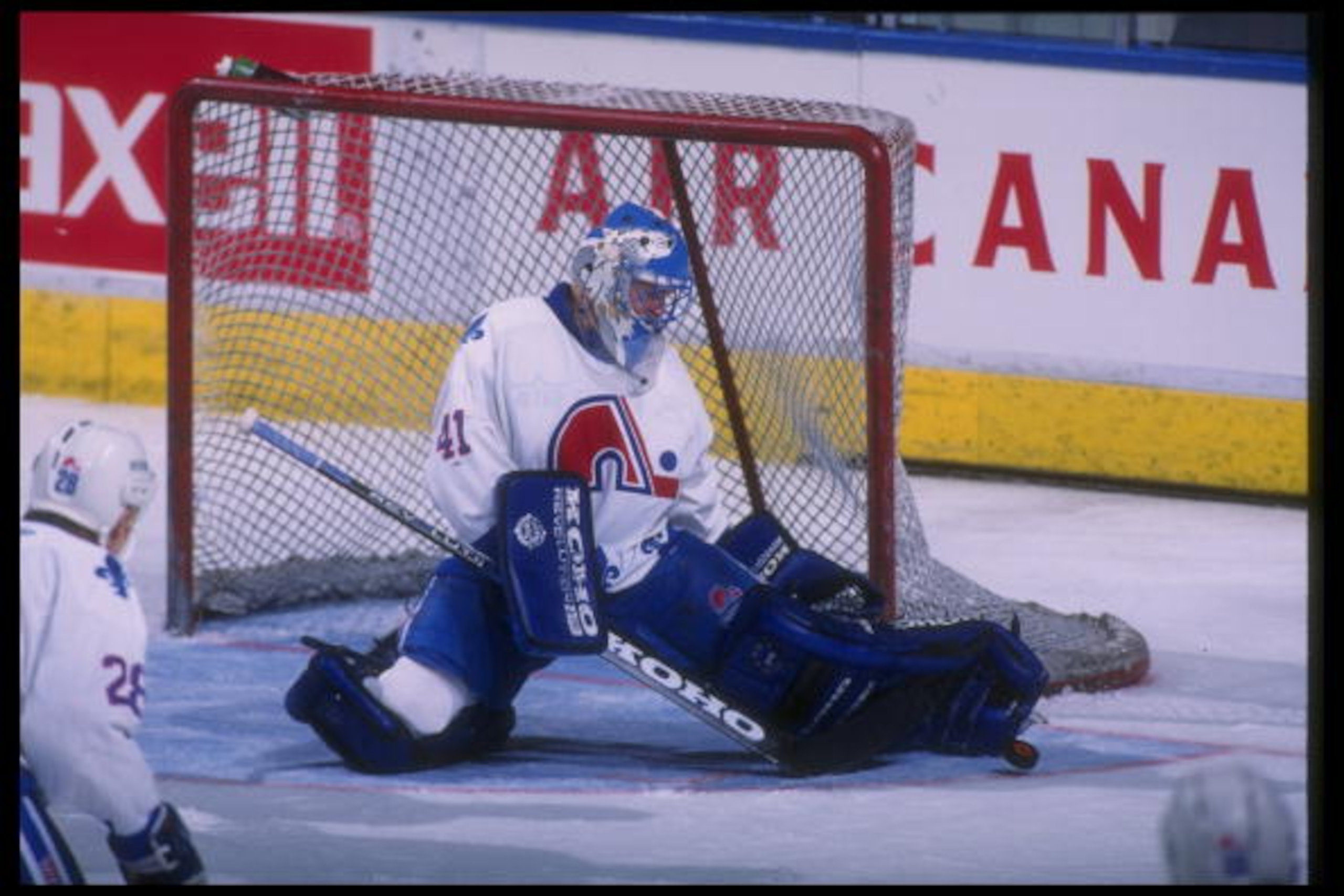
Career statistics: Regular season (NHL): 586 GP, 238-238-75, 2.75 GAA, .904 S %, 39 SO; Playoffs: 18 GP, 4-11, 3.54 GAA, .891 S %, All-Star (2003)
Jocelyn Thibault was selected by the Quebec Nordiques as the 10th overall pick in the 1993 NHL Entry Draft. He would debut with Quebec later that season, playing 29 games and posting a 8-13-3 record, with a 3.31 GAA and .892 save percentage as a 19-year old. He would bounce back and forth between the juniors, minors and Nordiques for the next season and a half, before being dealt to the Montreal Canadiens in the Patrick Roy trade in December 1995.
He definitely had some growing pains in Montreal having to try and replace the legend that was Patrick Roy, but it probably wasn't fair to put those expectations on the French-Canadian Montreal native. He lasted about three years with the Habs before being traded to the Chicago Blackhawks. Thibault played some really good hockey in Chicago in the five-plus seasons he played with the Blackhawks.
Thibault had a four year run where he started at least 60 games and at least 25 wins each year, and a goals against average of 2.81 or below. Unfortunately, Thibault was unable to match the success he had in the regular season with any strong statistics in the post-season as Thibault only played in the post-season once in a Blackhawk uniform. Thibault would play with the Pittsburgh Penguins and Buffalo Sabres to finish his career.
It's a wonder if Thibault could've been better had he not had to endure being a homegrown product playing in Montreal, which had to be tough to be a part of. All in all, Thibault had a solid career and ranks at number 82 in my top 100 list.
Best season: Thibault's best season was in the 2002-03 campaign with the Chicago Blackhawks, when he posted a 26-28-7 record in 62 games played with a .915 save percentage and 2.37 GAA with a career-high eight shutouts. It was Thibault's only All-Star appearance, but it was in a season the 'Hawks failed to qualify for the playoffs.
No. 81 Jim Carey
20 of 100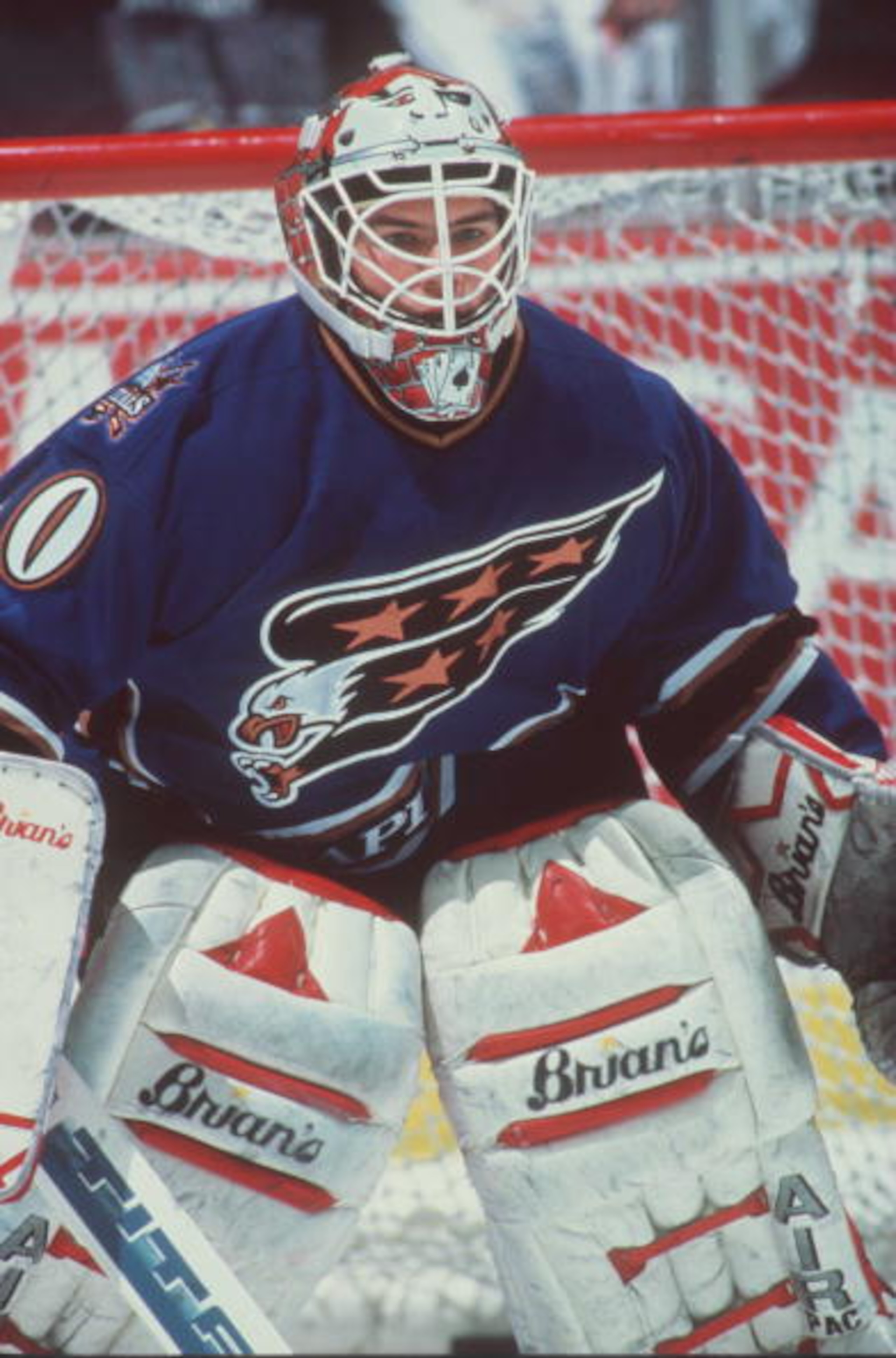
Career statistics: Regular season (NHL): 172 GP, 79-65-16, 2.58 GAA, .898 S %, 16 SO; Playoffs: 10 GP, 2-5, 4.62 GAA, .816 S %, 1 Vezina Trophy (1995-96)
Jim Carey is a goalie who certainly fits more into the "one year wonder" category than he does for a full body of work on this list. If you were ranking single season performances, Carey would be in a different conversation. He was drafted by the Washington Capitals in the second round of the 1992 NHL Entry Draft. He chose to go to the University of Wisconsin for two years before joining the professional ranks in 1994-95, starting first in the AHL and than with the Capitals for 28 games, going 18-6-3 with a 2.13 GAA and four shutouts. Not a bad way to begin an NHL career to say the least.
The following season was even better, as Carey put up possibly the best statistical year for the Capitals in their history, taking home the Vezina Trophy. He became the biggest craze in Washington, as fans fell in love with the player who shared the same name as the actor who played Ace Ventura: Pet Detective. In his third season, it did not go nearly as well for Carey with the Capitals. Although his GAA was certainly a respectable 2.75 GAA, he had a record below .500 (17-18-3), bu the Caps decided to make a splash, dealing Jim Carey to the Boston Bruins in a blockbuster trade deadline day deal involving big names like Adam Oates, Bill Ranford, Rick Tocchet, Jason Allison and Anson Carter.
When Carey was sent to the Bruins, his hometown team, it seemed the goalie that had won the Vezina Trophy was left behind in Washington. He struggled through a season plus in Beantown, losing the goalie job to Byron Dafoe, and being demoted to the minor leagues. He was cut by Boston on March 1, 1999 and immediately picked up by St. Louis, where he would play just four games before being demoted again and essentially retired at age 24.
It definitely is one of the more bizarre stories about a goalie who rose quickly, but fell from stardom just as quickly and didn't stick around to try and work himself back, he just walked away. He has since succeeded in the financial world. His little bit of success ranks him at number 81 in my top 100.
Best season: Carey won the Vezina Trophy in the 1995-96 season, playing for the Washington Capitals, putting up a 35-24-9 record with a 2.26 GAA and .906 save percentage with nine shutouts. He got routed in the playoffs that year, going 0-1 in three games and a horrendous 6.19 GAA with a .744 save percentage.
No. 80 Manny Legace
21 of 100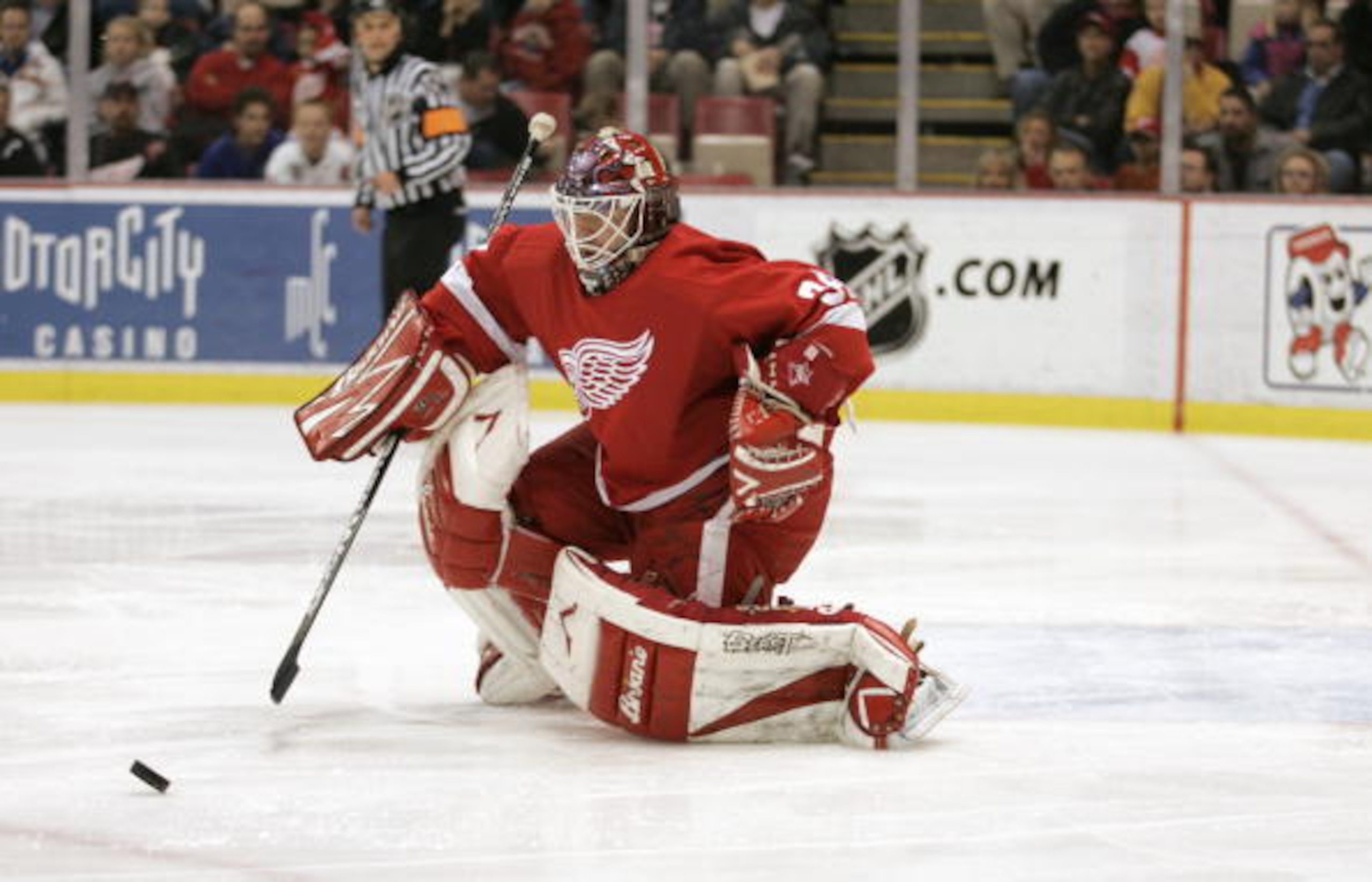
Career statistics: Regular season (NHL): 365 GP, 187-99-41, 2.41 GAA, .912 S %, 24 SO; Playoffs: 11 GP, 4-6, 2.54 GAA, All-Star (2008), Stanley Cup (2002)
Manny Legace is a goalie who has had impressive statistics most of his career but was never counted on too often which makes you wonder if he was a victim of a numbers game, or if his numbers were a product of the teams and styles that surrounded him. Legace played for great teams in Detroit, spending most of his six seasons as a backup to the likes of Chris Osgood, Dominik Hasek and Curtis Joseph.
Legace was first drafted by the Hartford Whalers in the eighth round of the 1993 NHL Entry Draft. He would not make it to the NHL with Hartford/Carolina, and would be dealt to Los Angeles in the summer of 1998. He would only play 17 games as a King, putting up an unimpressive 2-9-2 record, but a very respectable 2.60 GAA with a .911 save percentage. He would sign with the Detroit Red Wings as a free agent the following off-season, where he would end up going back and forth between Vancouver and Detroit on waivers, in the span of just under two weeks. He would play in the Russian league during the lockout, but returned to the NHL for a final season in Detroit, before signing with the St. Louis Blues as a free agent in the summer of 2006.
He probably received more of an opportunity to be "the guy" in St. Louis than he did at any of his other career stops, and he took advantage of the chance, all be it on teams that were sub-par, at least in the standings. Legace spent three seasons with the Blues, playing 45 and 66 games in his first two seasons, with GAA of 2.59 and 2.41, showing that Legace's success was not a fluke in Detroit. He did struggle as a 35-year old in 2008-09 and was limited to just 29 games his final year in St. Louis. One more year in the NHL with Carolina wrapped up Legace's career.
A talented yet untested (at least at times) goalie, Legace has better numbers than one would think, but his resume is a little incomplete, in that he didn't get enough opportunity to be the number one goalie in pressure spots, especially the postseason, where he only suited up in eleven games for his career. Add it all up and Legace falls at number 80 on my list.
Best season: Legace's career year was probably the 2003-04 season with the Detroit Red Wings as he shared the load with both Dominik Hasek and Curtis Joseph, but played 41 games in the regular season, going 23-10-5 with an amazing 2.12 GAA and .920 save percentage while adding three shutouts. He would go 2-2 in four playoff games as the Detroit Red Wings fell in the second round to the Calgary Flames in six games.
No. 79 Arturs Irbe
22 of 100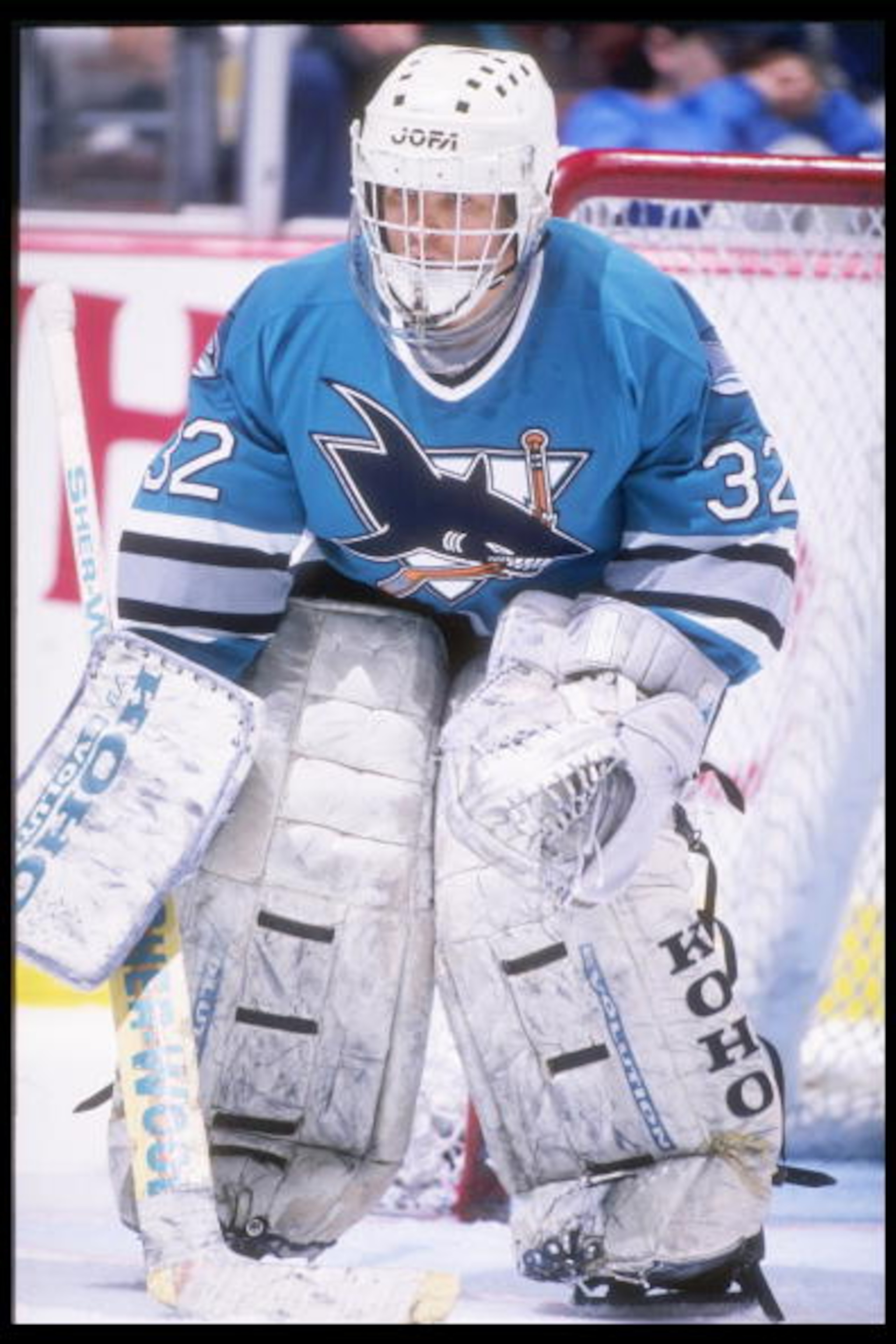
Career statistics: Regular season (NHL): 568 GP, 218-236-79, 2.83 GAA, .899 S %, 33 SO; Playoffs: 51 GP, 23-27, 2.86 GAA, .902 S %, All-Star (1994, 1999)
Arturs Irbe came over from Latvia to join the expansion San Jose Sharks after being selected from Minnesota in the Dispersal Draft. After spending time in the IHL with the Kansas City Blades, Irbe joined the Sharks to play in his first 13 NHL games in the Sharks' inaugurual season. For Irbe, it began five years in San Jose that turned into a bit of a roller coaster ride. The highlight without a doubt was the 1994 playoffs, when the Sharks knocked off the top-seeded Detroit Red Wings in the Sharks' first playoff series, and followed it up by taking the Toronto Maple Leafs to a seventh game before falling in round two.
After five seasons in San Jose, Irbe would sign a free agent deal with the Dallas Stars, where he spent one season and followed it up with a single season in Vancouver. It was not until the season after that which Irbe seemed to find a new home, when he signed as a free agent in Carolina. He played parts of six seasons with the Hurricanes, where he became a fan favorite and was a big workorse, working 62 plus games in three of those seasons.
Arturs Irbe was a workhorse throughout his career when given the opportunity, and played for his native country Latvia when also given the chance. I think historically Irbe tends to get overlooked at times but I think a fair place for him on my list is at number 79.
Best season: Irbe had three really good stand out seasons that were tough to distinguish between, but I am going to go with the 2000-01 season in which Irbe played in a league-high 77 games, while posting a record of 37-29-9 with a 2.45 GAA and .908 save percentage, while matching his career-high with six shutouts. The Hurricanes would lose in the first round of the playoffs to the New Jersey Devils in six games, with Irbe receiving the decision in all six games.
No. 78 Normie Smith
23 of 100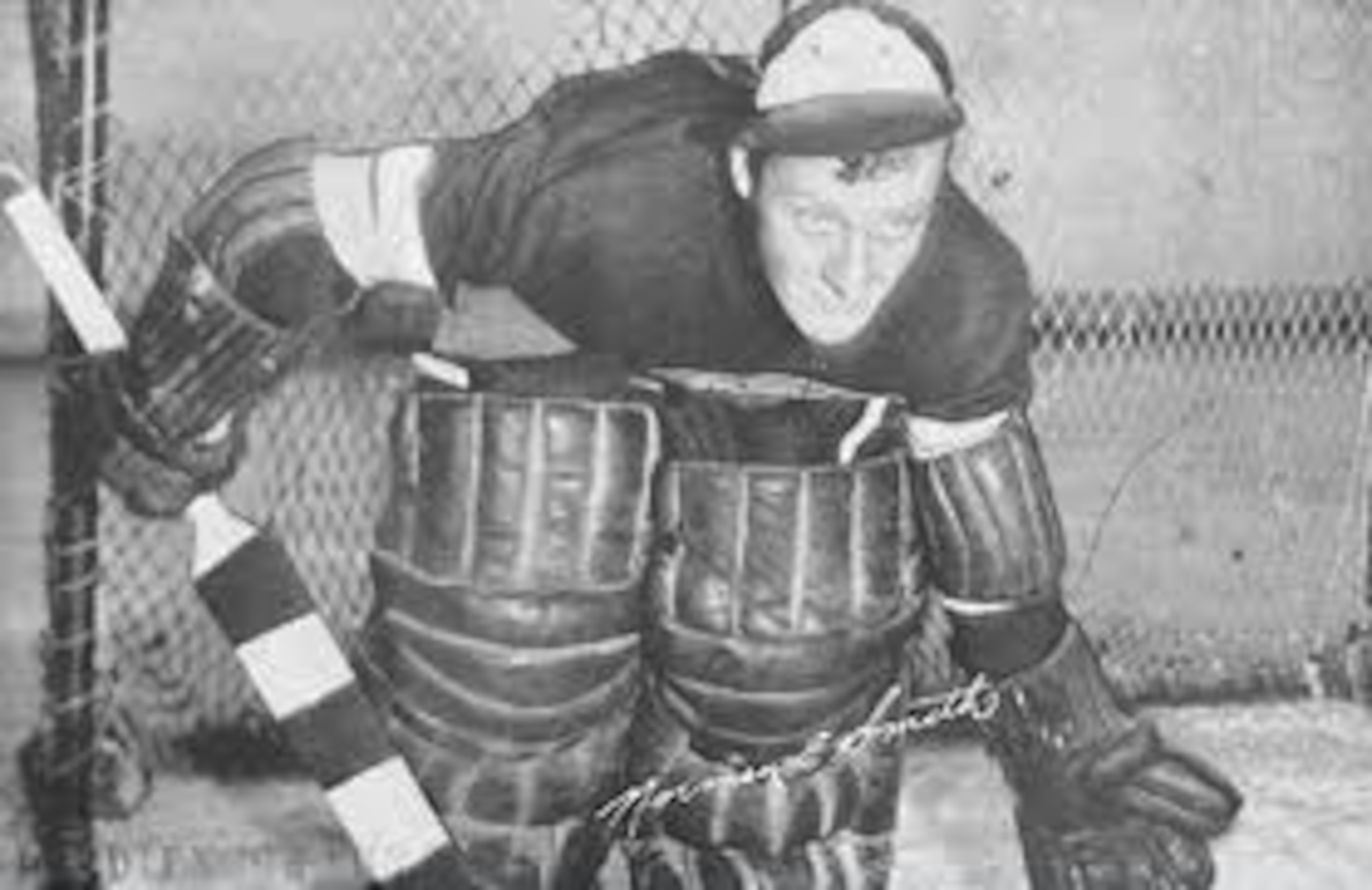
Career statistics: Regular season (NHL): 199 GP, 81-83-35, 2.33 GAA, 17 SO; Playoffs: 12 GP, 9-2, 1.32 GAA, 3 SO, Vezina Trophy (1936-37), All-Star (1936-37), Stanley Cup (1936, 1937)
Normie Smith started his NHL career with the Montreal Maroons in 1931-32, playing in 20 games before the great Howie Morenz collided with Smith and knocked him out for the season with an injury. It would take two seasons regrouping in the minors before he would return to the NHL, when he reemerged with the Detroit Red Wings, where he would play for four full seasons.
Smith was the winning goalie in the longest shutout in NHL history, when on March 24, 1936, the Red Wings defeated the Montreal Maroons at the Montreal Forum 1-0, on a goal by Mud Bruneteau scored at 16:30 of the sixth overtime period. For Smith, it was part of a consecutive streak of 248 minutes and 32 seconds of scoreless hockey Smith had in net against the Maroons over the course of three games.
Smith did not have a long career, but he had a pretty successful run, including back-to-back Stanley Cup titles, not to mention the longest shutout in NHL history. Add it all up, and it puts Smith at number 78 in my top 100.
Best season: Normie Smith had a four year run with the Detroit Red Wings that hasn't been matched by many, but his best season was 1935-36 when Smith played every minute of all 48 games, and put up a record of 24-16-8 with a 2.04 GAA and six shutouts. He followed it up with a 6-1 record with a 1.34 GAA and two shutouts in the playoffs and led the Red Wings to the first of two straight Stanley Cup titles.
No. 77 Johnny Mowers
24 of 100
Career statistics: Regular season (NHL): 152 GP, 65-61-26, 2.56 GAA, 15 SO; Playoffs: 32 GP, 19-13, 2.55 GAA, 2 SO, Vezina Trophy (1942-43)
Johnny Mowers only played four seasons in the National Hockey League, but three factors played into his short tenure--only six jobs being available, World War II and Mowers missing time, and a back injury all forced Mowers to miss time at one point.
After five seasons in lower leagues, Mowers made his debut with the Detroit Red Wings and immediately stood out, putting up a stunning 2.01 GAA while posting a record of 21-16-11. A sweep at the hands of the Boston Bruins in the Stanley Cup Finals would deny Mowers and the Red Wings a title. Mowers and the Wings came even closer the next year, losing in seven games in the finals to the Toronto Maple Leafs in the famous series where Toronto overcame a 3-0 deficit to win in seven games.
Mowers would get his revenge the next season, leading Detroit to a Stanley Cup title, sweeping the Boston Bruins in the finals. Mowers would play just seven more NHL games in his career, missing time for World War II and then losing time to the great Harry Lumley upon his return. Mowers' run was very short, but it still was impressive enough to earn number 77 on the list.
Best season: Mowers best season was the 1942-43 Vezina Trophy winning season when he put up a 25-14-11 record in 50 games, with a league-best 2.47 GAA and a career high six shutouts. It was in the post season where Mowers took the Red Wings to a Stanley Cup title, with an 8-2 record in ten games, posting a 1.94 GAA and a league-best two shutouts.
No. 76 Niklas Backstrom
25 of 100
Career statistics: Regular season (NHL): 281 GP, 141-91-35, 2.42 GAA, .917 S %, 22 SO; Playoffs: 11 GP, 3-8, 2.55 GAA, .911 S %, Jennings Trophy (2006-07), All-Star (2009)
Niklas Backstrom came over from Finland at the age of 28, signing as a free agent with the Minnesota Wild. In his first season, he shared the goaltending duties with Manny Fernandez, but led the NHL in both save percentage (.929) and goals against (1.97). He's played five years now for Minnesota and his .917 career save percentage ranks fifth all-time in NHL history. His goals against average also ranks 20th best (2.42).
Unfortunately, Backstrom has had little postseason success thus far, with just two appearances, and both a first round loss. Despite the fact Backstrom hasn't had the best teams around him, he needs to win a few playoff series to move up this list.
As such, he comes in at number 76 on my list of top 100 goaltenders, but there definitely is room for Backstrom to move upward. Here's a look at Backstrom's top moments in his career.
Best season: Nicklas Backstrom's best year was 2008-09 when he went 37-24-8 in 71 games under Jacques Lemaire, with a .923 save percentage, 2.33 GAA and a career-best eight shutouts. Unfortunately, the Wild missed the playoffs by two points behind the eighth seeded Anaheim Ducks.
No. 75 Gerry McNeil
26 of 100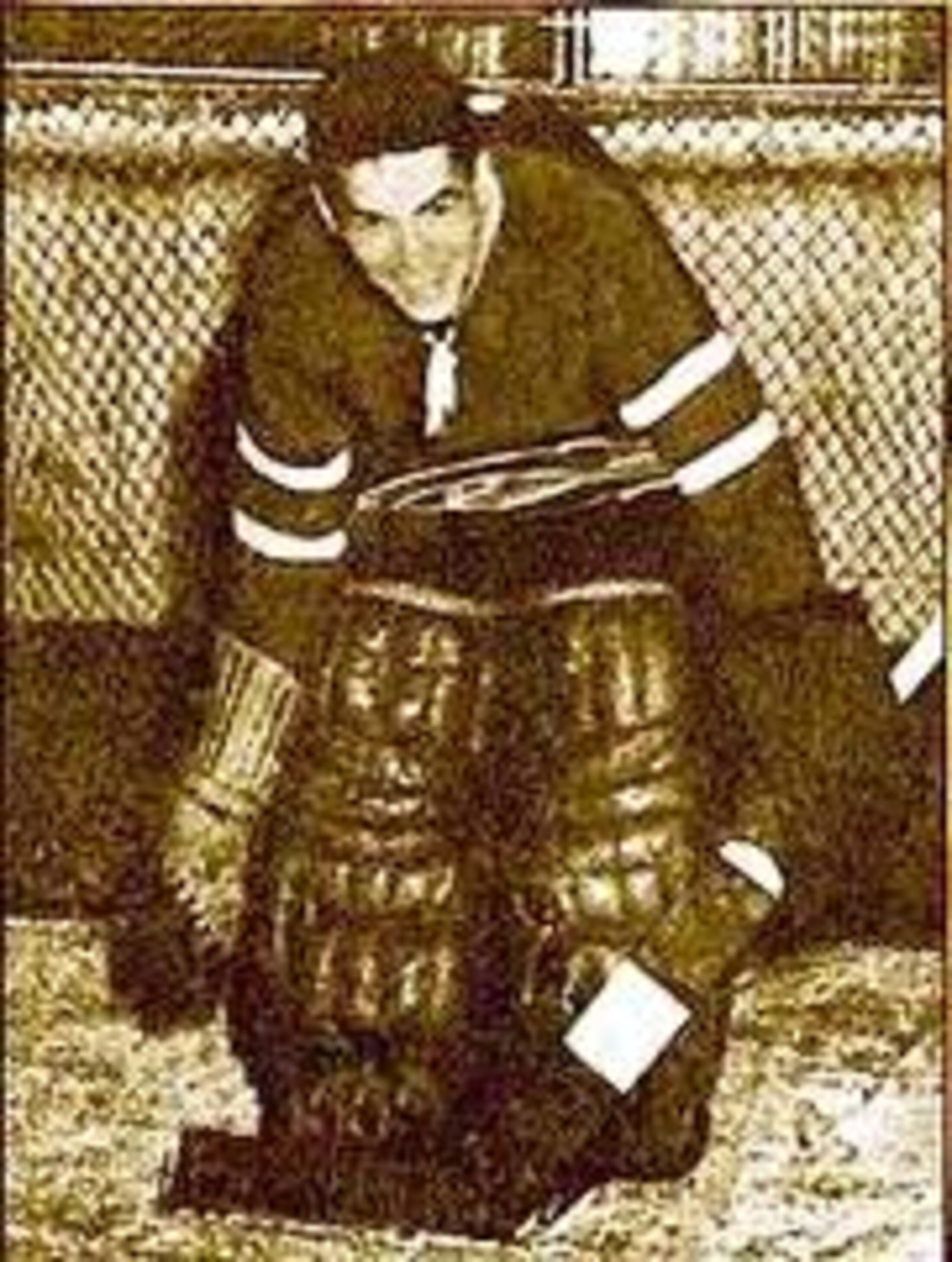
Career statistics: Regular season (NHL): 276 GP, 119-105-52, 2.36 GAA, 28 SO; Playoffs: 35 GP, 17-18, 1.98 GAA, All-Star (1951, 1952, 1953), Stanley Cup (1953)
Gerry McNeil didn't have a long NHL career, but he definitely was involved with some historic moments in his short seven year career. After playing in eight games over two seasons, he took over for retired great Bill Durnan in 1950-51 and played every second of each game that year, helping to lead the Canadiens to the Stanley Cup Finals, before losing to Toronto on Bill Barilko's famous winning goal to end the series.
The following year, McNeil would lead Montreal once again to the finals, before losing once again. In his third season as a starter (all as an All-Star), McNeil finally won the ultimate prize, as Montreal won the Stanley Cup. In his fourth season, his playing time began to be cut, as Jacques Plante emerged as the new starting guy in Montreal.
McNeil would only play nine more NHL games three years later and was relegated to the minors afterward. It was a short run for McNeil, but a pretty successful one, with three straight trips to the Finals. It was enough to warrant spot number 75 on my list.
Best season: McNeil had an amazing 1952-53, but despite putting up a 25-23-18 record in 66 games with a 2.12 GAA and a career-best ten shutouts. He would follow it up in the playoffs, sharing the load with a young Jacques Plante, who combined to lead the Montreal Canadiens to a Stanley Cup title, besting the Boston Bruins in five games. McNeil posted a 5-3 record in eight playoff games, with a 1.98 GAA and two shutouts.
No. 74 Patrick Lalime
27 of 100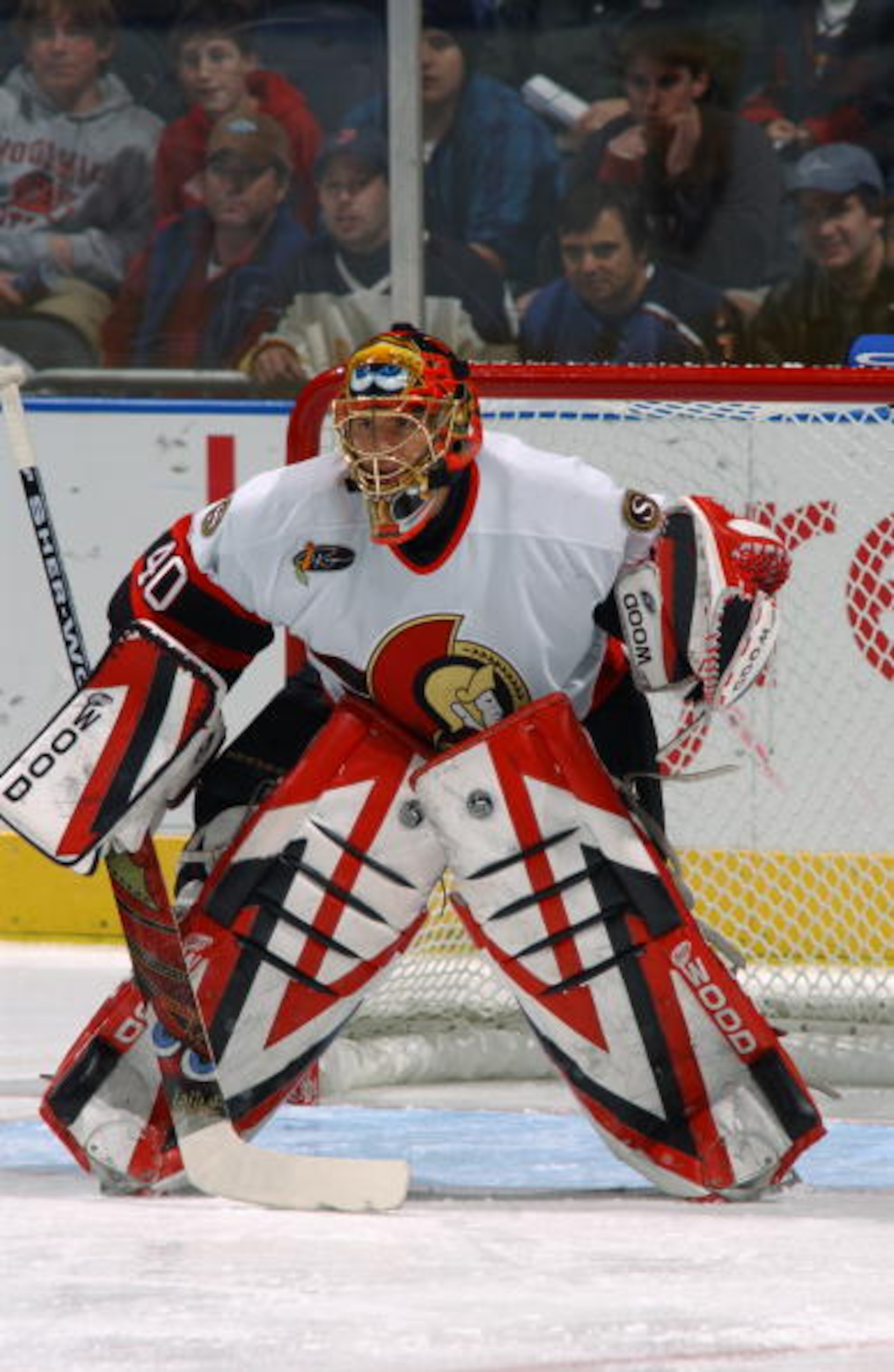
Career statistics: Regular season (NHL): 444 GP, 200-174-48, 2.58 GAA, .905 S %, 35 SO; Playoffs: 41 GP, 21-20, 1.77 GAA, .926 S %, 5 SO, All-Star (2003)
Patrick Lalime is another who had a very strong stint with one team, but was hard pressed to match that success elsewhere and has fallen into the role of a quality backup in recent years. Lalime was originally drafted by the Pittsburgh Penguins in the sixth round of the 1993 NHL Entry Draft. He would come in and play his first 39 NHL games at the age of 22 during the 1996-97 season for the Penguins, where he didn't really get a chance to distinguish himself, playing a backup role to veteran Ken Wregget.
Lalime would be a victim of a numbers game in Pittsburgh, spending the next two seasons in the minors, before being dealt to Ottawa in the summer of 1999. Lalime got the opportunity to be a starter in Ottawa, and he took full advantage, playing in at least 57 games in four of the five seasons he was a Senator. Lalime had impressive numbers in his tenure as a Sen, but never was able to go over the hump and take the Senators to the Stanley Cup, coming up short in a Game 7 of the Eastern Conference Finals in 2003, losing to the New Jersey Devils.
After the lockout, the Senators went in a different direction, trading Lalime to the St. Louis Blues, where Lalime struggled to come close to the success he experienced in Ottawa. Lalime a would sign as a free agent in Chicago where he spent two seasons as a backup, and has followed it up the last three seasons with a run as the backup to Ryan Miller in Buffalo, where he has put up good, but not great numbers, but has been reliable enough to be a strong backup.
Lalime's run in Ottawa projected over a full career would likely have had Lalime in the top 20, but since it was only really a four-year run, Lalime will have to settle for number 75, but it does make you wonder of what might have been.
Best season: Lalime's best season was the 2002-03 campaign, where Lalime starred in 67 games, putting up a 39-20-7 record with a 2.16 GAA and a .911 save percentage, while adding eight shutouts. Lalime would carry his success into the playoffs, putting up a 11-7 record with a 1.82 GAA and a .924 save percentage, adding one shutout. The Stanley Cup Finals quest would fall one game short as the New Jersey Devils defeated the Senators 2-1 in a Game Seven remembered by Jeff Friesen's late goal for the Devils.
No. 73 Gilles Villemure
28 of 100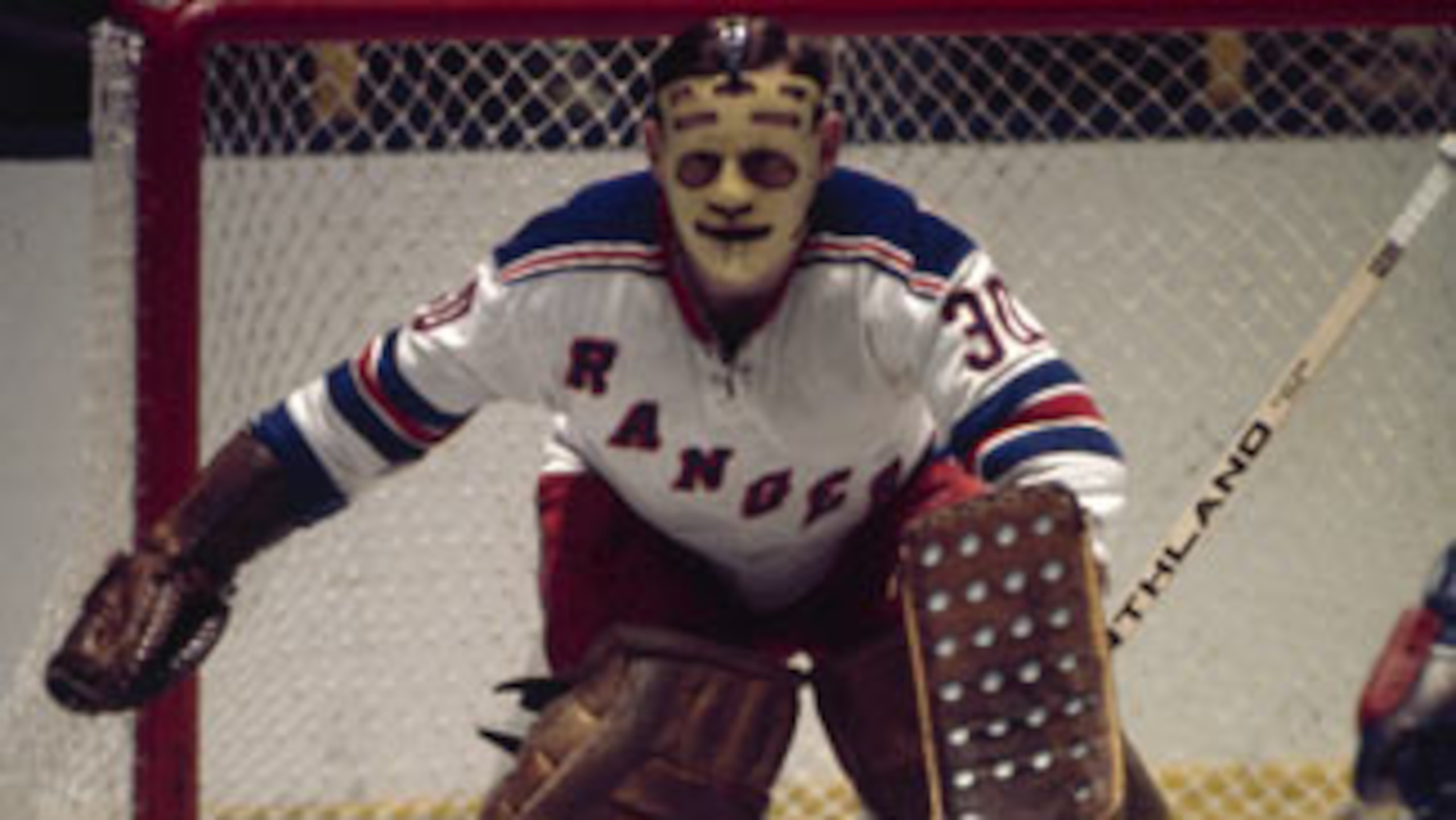
Career statistics: Regular season (NHL): 205 GP, 100-64-29, 2.81 GAA, 13 SO; Playoffs: 14 GP, 5-5, 2.93 GAA, All-Star (1971, 1972, 1973)
Gilles Villemure made his NHL debut with the New York Rangers when he played five games in the 1963-64 season at the age of 23. He didn't really get a true chance to display his talents until the Rangers decided to put a goaltending tandem in place and gave Villemure a chance to share the load with starter Ed Giacomin.
He spent five seasons playing 20-plus games with the Rangers and putting up some solid numbers, especially in his first three seasons, including sharing the Vezina Trophy with Giacomin in 1970-71. In 1975, Villemure was dealt to the Chicago Blackhawks, where Villemure once again was stuck as a backup, this time to the great Tony Esposito.
As a result, it is tough to guage Villemure's talents as he had a hard time gaining an opportunity in a league where there were only six spots open (Teams did not carry backups regularly in those days like they do today). Injuries and opportunity took away from Villemure the opportunity to be even better on this list and as such keep Villemure limited to number 73 on the list.
Best season: Villemure's best season statistically was the 1971-72 campaign, where he put up a 24-7-4 record in 37 games, while posting an impressive 2.09 GAA and three shutouts. He followed it up with a 4-2 record in six playoff games as he teamed with Ed Giacomin to help bring the Rangers to the Stanley Cup Finals before losing to the Boston Bruins.
No. 72 Tommy Salo
29 of 100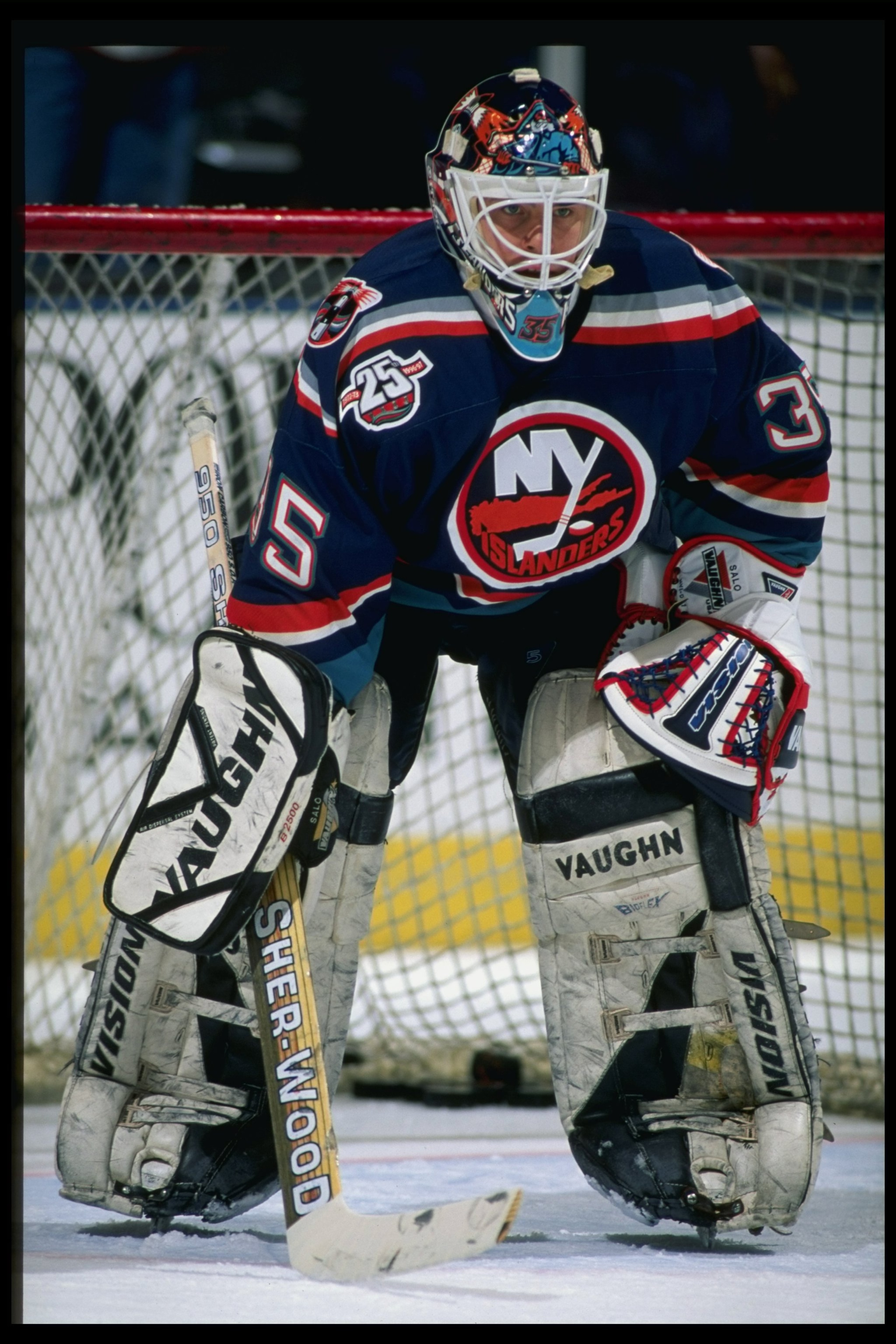
Career statistics: Regular season (NHL): 526 GP, 210-225-73, 2.55 GAA, .905 S %, 37 SO; Playoffs: 22 GP, 5-16, 2.54 GAA, .909 S %, All-Star (2000, 2002)
Tommy Salo was a Swedish goaltender that had a more big game success on the international level than he did in the NHL post-season. He was originally drafted by the New York Islanders in the fifth round of the 1993 NHL Entry Draft. After some success at the IHL level, Salo debuted for the Islanders with six games in the 1995 season. He would breakthrough as a starter during the 1996-97 season when he played in 58 games for the Islanders, beginning a three year streak of 50+ for them.
A midseason deal to Edmonton in March 1999 sent Salo to the Oilers. He would play parts of six seasons for the Oilers, and while he had a lot of regular season success, Salo was never able to duplicate that success in the postseason. Salo lost four straight times in the first round for Edmonton and wasn't able to shake the label of not being able to withstand the postseason, despite the gold medal he won for Sweden in the 1994 Olympics and other successes at the International level.
I feel Salo was a little underrated because of his postseason play, but it is a legitimate concern if you are ranking him on his NHL resume. As such, he comes in at number 72 on this list.
Best season: Salo's best year was the 2001-02 season, when he had a 30-28-10 record in 69 games for the Edmonton Oilers, adding a 2.22 GAA, .913 save percentage and six shutouts. The Oilers finished just two points out of a playoff spot that year, despite a record ten games over .500.
No. 71 Charlie Hodge
30 of 100
Career statistics: Regular season (NHL): 358 GP, 150-125-61, 2.70 GAA, 24 SO; Playoffs: 16 GP, 7-8, 2.39 GAA, 2 SO, Vezina Trophy (1963-64, 1965-66), All-Star (1964, 1965, 1967), Stanley Cup (1965)
Charlie Hodge didn't get an early start in the NHL, like many other guys, he was forced to the sidelines a bit to wait for a spot to open up, filling in for Jacques Plante for 59 different games over a stretch of games from the 1955-56 season through 1960-61. In 1963-64, a space finally opened up for Hodge after an injury to Gump Worsley and Hodge took advantage and played in 62 games that season and winning the Vezina Trophy.
Hodge's critics figured his 1963-64 season was a fluke, but Hodge would show otherwise, providing great support and teamwork with Gump Worsley, including helping the Canadiens to win the Stanley Cup in 1964-65 and sharing the Vezina Trophy in 1965-66. Things came apart a bit the next season as the great phenom Rogie Vachon came up for Montreal and Hodge went to the Oakland Seals in the 1967 Expansion Draft. Switching from one of the better defenses to an expansion team took a little toll on Hodge's stats, but he still put up a solid first year with the Seals.
He would see his playing time diminish the next two seasons as the younger Gary Smith was given the playing time. Hodge had a spectacular short run with Montreal, which was good enough to place number 71 in my top 100.
Best season: Hodge had his best season when he had the biggest opportunity of his career, posting a 33-18-11 record in 62 games with a 2.26 GAA and league-high eight shutouts. Unfortunately, the Canadiens lost in the semi-finals to the Toronto Maple Leafs, bowing out in seven games, despite Hodge only giving up 16 goals in the seven games, including one shutout.
No. 70 Jonas Hiller
31 of 100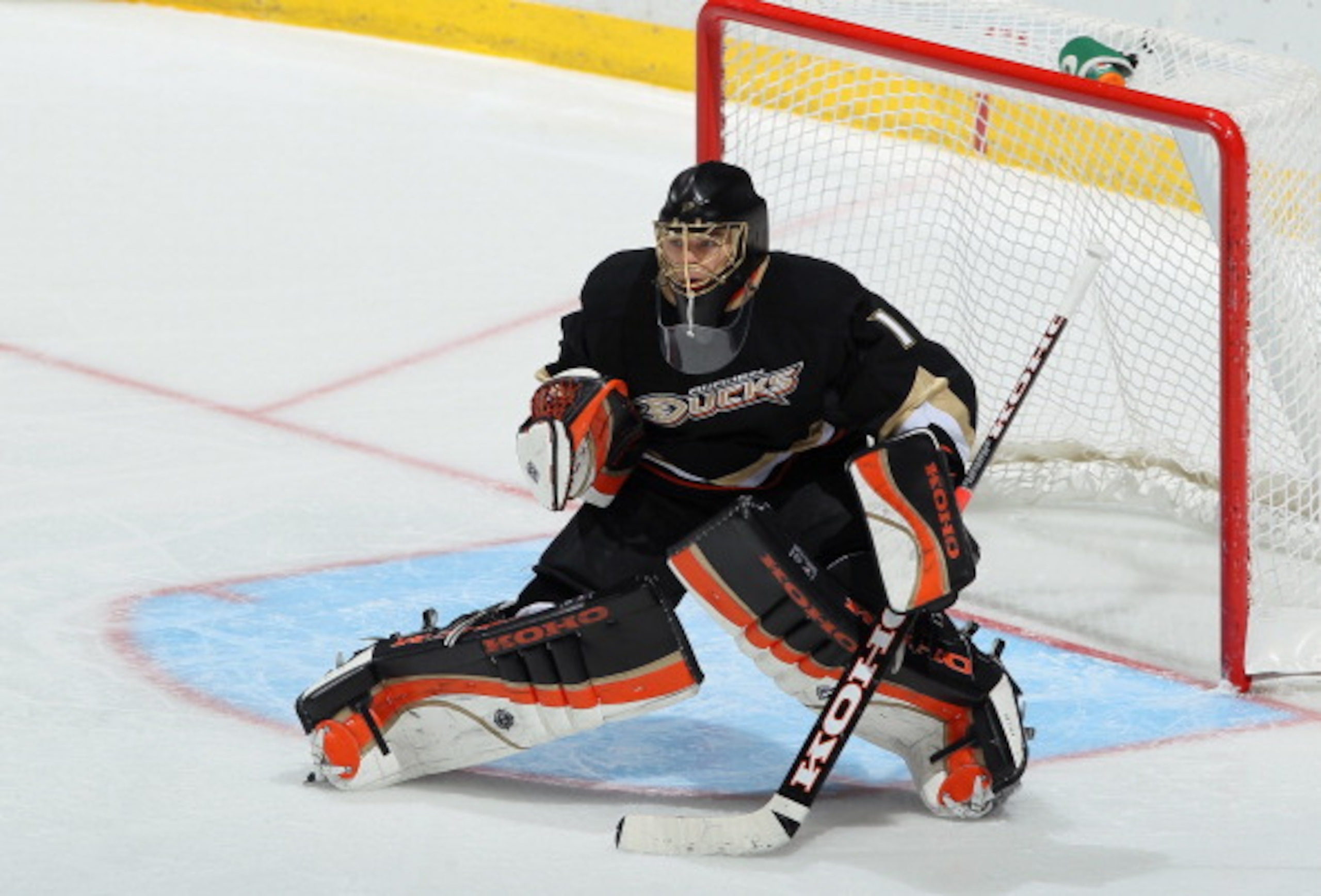
Career statistics: Regular season (NHL): 177 GP, 89-61-9, 2.51 GAA, .921 S %, 11 SO; Playoffs: 13 GP, 7-6, 2.23 GAA, .943 S %, 2 SO, All-Star (2011)
In May 2007, the Anaheim Ducks signed Jonas Hiller as a free agent. He would share time in the AHL and NHL and shared time with Ilya Bryzgalov and Jean-Sebastien Giguere. Hiller would get more and more of the playing time and in 2008-09 he would take over the number one job. By the end of the playoff run, Hiller would be entrenched as the number one guy, helping the Ducks make it to the second round of the post-season, before falling to the Detroit Red Wings in seven games, with Hiller putting up an amazing performance along the way.
A tribute to Hiller can be found here, including some of his time playing with Switzerland. With a contract extension in place, it seems like Hiller is in place to work his way up the list and he's looking like he could be moving up the list in years ahead. For now, he's at number 70.
Best season: Hiller played in 49 games this past season, putting up a 26-16-3 record, while putting up a 2.56 GAA and .924 save percentage with five shutouts. Despite being limited to just 49 games because of suffering from a bout with vertigo, and was unable to play in the first round loss to the Nashville Predators. On the positive side of things, Hiller did play in his first All-Star game.
No. 69 Roman Cechmanek
32 of 100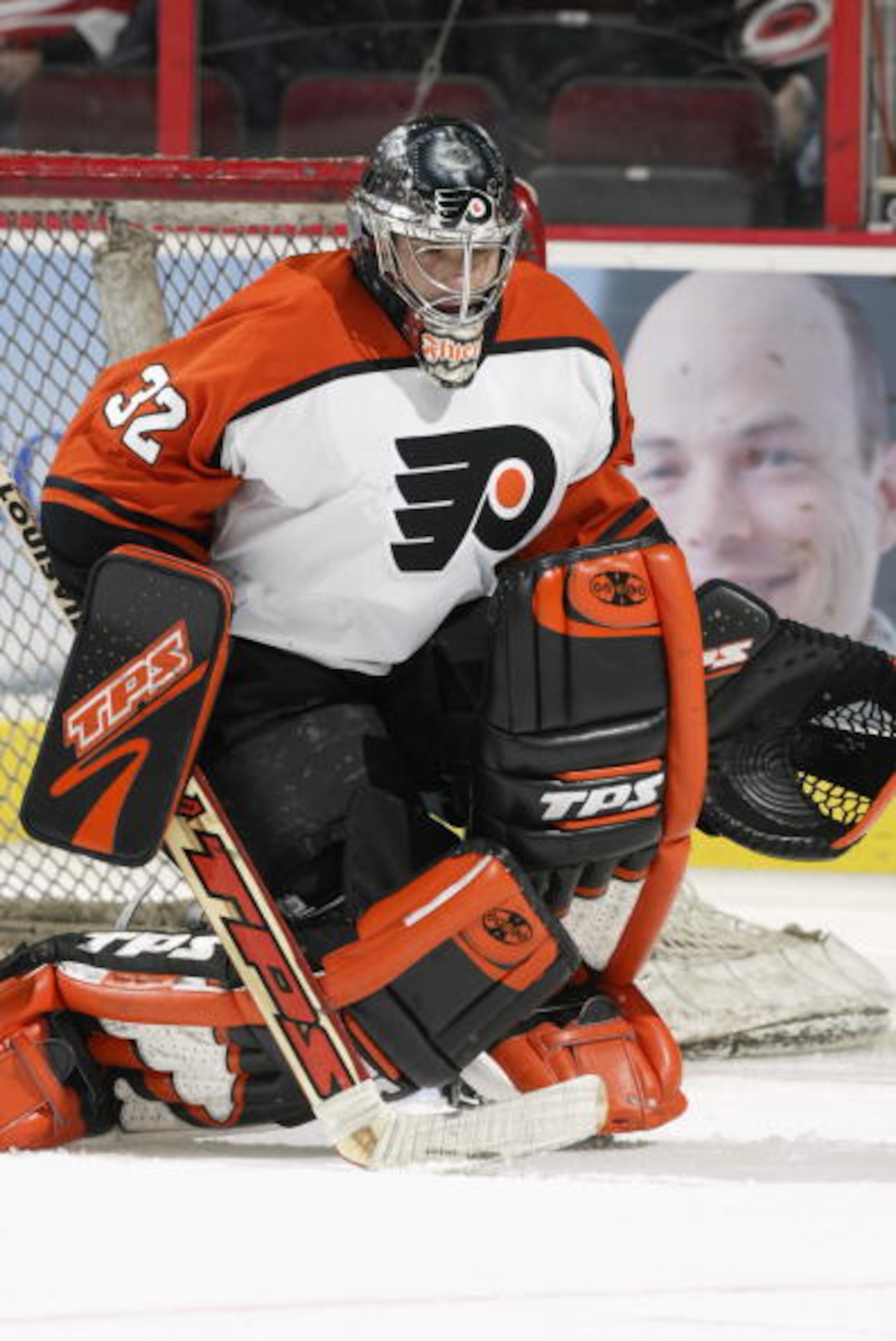
Career statistics: Regular season (NHL): 212 GP, 110-64-28, 2.08 GAA, .919 S %, 25 SO; Playoffs: 23 GP, 9-14, 2.33 GAA, .909 S %, Jennings Trophy (2002-03), All-Star (2001)
Roman Cechmanek was drafted by the Philadelphia Flyers as a 29-year old in the sixth round of the 2000 NHL draft. He immediately thrust himself into the starting role with the Flyers, playing 59 games as a rookie and posting a record of 35-15-6, with a ridiculous 2.01 GAA and .921 save percentage, with ten shutouts. He was not eligible for the Calder Trophy due to age limits but it would be ranked as one of the better first years of all-time.
However, as often been the case with the goaltenders of recent years in Philadelphia, Cechmanek was not able to succeed in the post season like he did in during the regular season. His second year was even better than his first in the regular season, but once again, a first round loss awaited him and the Flyers in the playoffs that year.
In his third year, the regular season was even better, but despite a win of one playoff round, Cechmanek was still labeled the scapegoat. In fact, by the end of his third season, Cechmanek was basically run out of Philadelphia by the fans and team. He was shipped off to Los Angeles for a draft pick that off-season, where he had a quieter, yet solid season, before returning to Czech during the lockout. His productive regular seasons earn him the number 69 spot in my list.
Best season: Cechmanek had three amazing regular seasons with the Flyers, but his best was 2002-03, when he had a record of 33-15-10 in 58 games with a 1.83 GAA, .925 save percentage and six shutouts. The Flyers would go on to beat the Toronto Maple Leafs in seven games, but fell to the Ottawa Senators in the second round in six games.
No. 68 Carey Price
33 of 100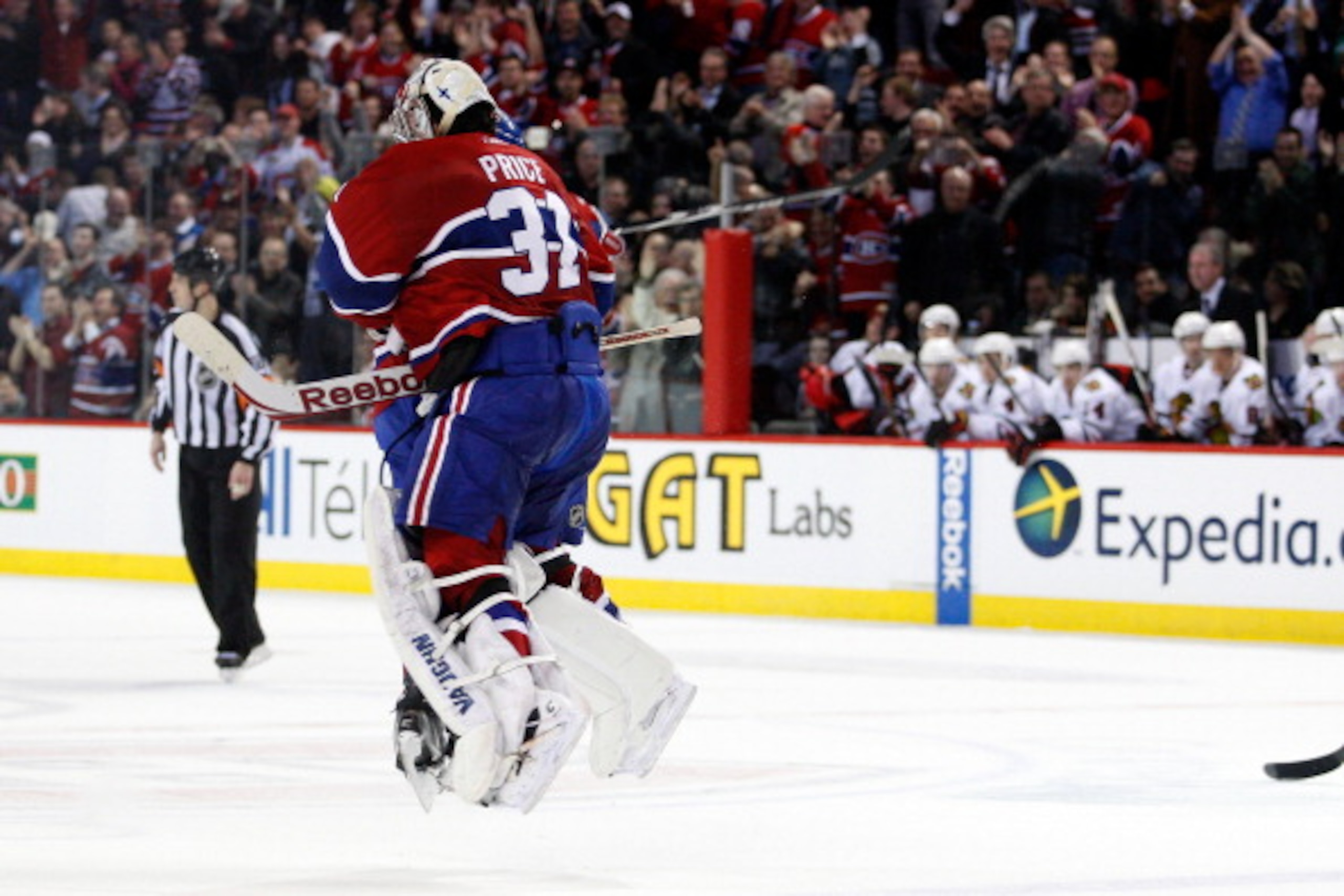
Career statistics: Regular season (NHL): 206 GP, 98-76-24, 2.60 GAA, .916 S %, 12 SO; Playoffs: 26 GP, 8-14, 2.84 GAA, .907 S %, All-Star (2009, 2011)
Carey Price was the fifth overall draft choice of the Montreal Canadiens, coming out of the Western Hockey League and has been under the microscope for certain in his four seasons thus far with the Canadiens. Always being forced to live up to the legends of the past, a goalie in Montreal always is forced to deal with extra scrutiny, because it's as famous a position as center field with the New York Yankees, or quarterback of the Dallas Cowboys, it all just comes with the territory. Despite it all, Carey Price has become a legitimate star in goal, at least for sure in the regular season.
A two-time All-Star, the acrobatic Price has put together a nice portfolio of acrobatic saves and highlights for everyone to enjoy. His first three seasons, Price was asked to share the load with Jaroslav Halak, where there were some ups and downs along the way. After Halak helped take the Canadiens to the Eastern Conference Finals, it seemed like Price may be shipped out of town. Ultimately, Montreal decided that Carey Price was their man and sent Halak away in a trade to St. Louis.
Price made the decision look good this past season, playing in 72 games and posting 38 wins to help lead Montreal to the playoffs. However, a first round loss to the rival Boston Bruins definitely took a lot of luster off his otherwise All-Star season. Price will need to step it up in the playoffs soon if he will remain a beloved goaltender in the tough market of Montreal. For now, he comes in at number 68, but the sky is truly the limit for the 23-year old (who turns 24 in August).
Best season: Price's best season was this current season, as he posted a 38-28-6 record in 73 games, with a 2.35 GAA and .923 save percentage, while pitching a career-high eight shutouts. Price played well in the post-season, but didn't get the job done well enough, as the Canadiens fell to the Boston Bruins in seven games in round one. His 2.11 GAA and .934 save percentage, with one shutout, are impressive, but it always comes down to wins and losses more than anything in the playoffs.
No. 67 Roman Turek
34 of 100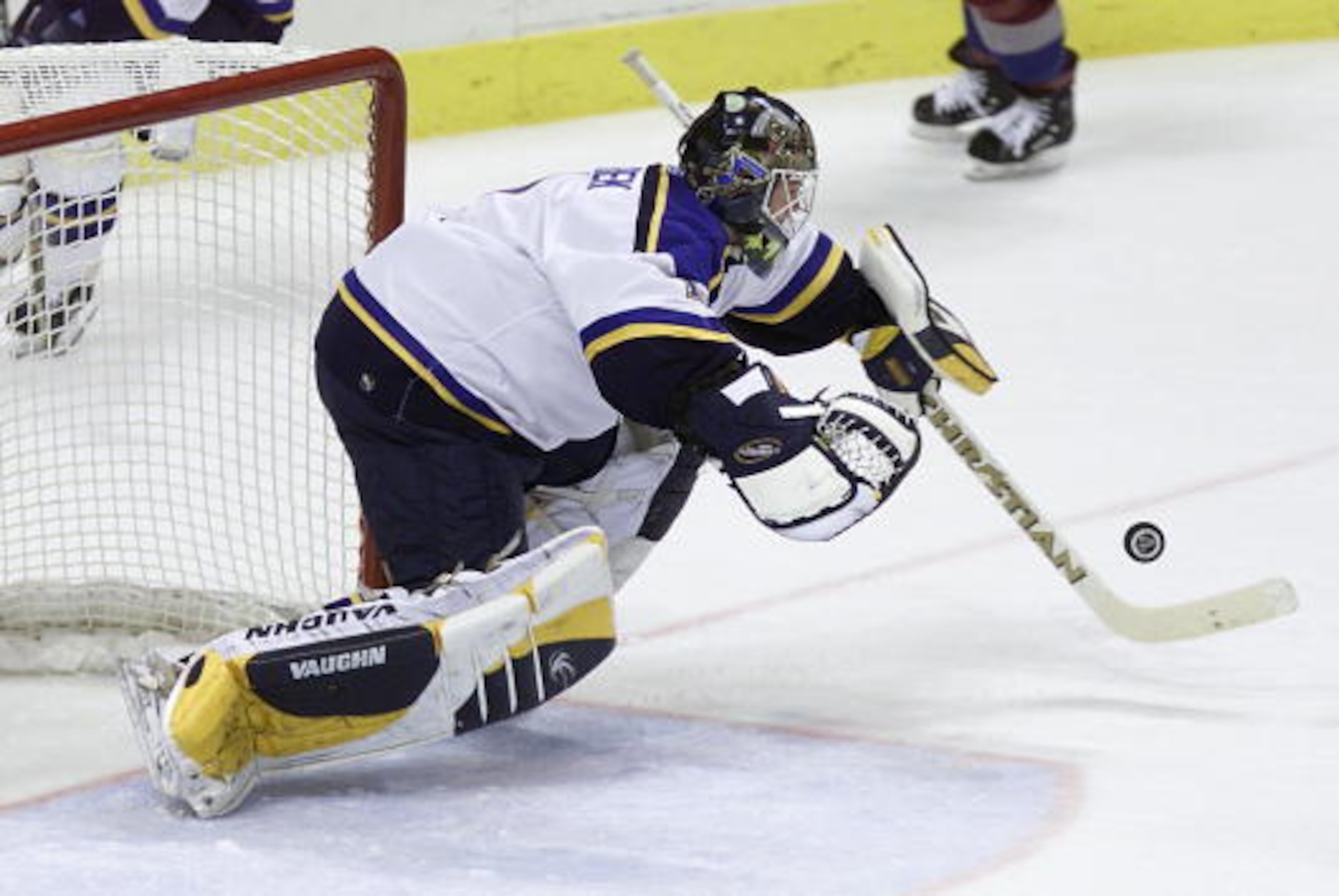
Career statistics: Regular season (NHL): 328 GP, 159-115-43, 2.31 GAA, .907 S %, 27 SO; Playoffs: 22 GP, 12-9, 2.24 GAA, .908 S %, All-Star (2000), Jennings Trophy (1998-99, 1999-2000)
Roman Turek was a draft choice of the Minnesota North Stars, taken in the sixth round of the 1990 NHL Entry Draft. He did not come over to North America until the 1996-97, choosing to stay in his native Czech Republic. He would get his first taste of the NHL that season, playing in six games for the Dallas Stars, and going 3-1 with a 2.05 GAA and a .930 save percentage.
Turek would play three seasons in Dallas, but would have a tough time being stuck behind Ed Belfour and didn't get a chance to be a full-time starter until he was traded to the St. Louis Blues in June 1999 when the Stars received a second round pick. Turek would play two really good years with the Blues, making his first and only All-Star game appearance in 2000. He would be dealt in June 2001 to the Calgary Flames, where Turek was brought in to take the helm and run with it.
Turek's career in Calgary produced solid numbers, but statistically was a drop off from his time in St. Louis. After two nice years, a knee injury limited Turek to only 18 games in the 2003-04 season and opened a spot for Mikka Kiprusoff to take over the job. After the lockout, Turek returned to Czech to play in the leagues there. His numbers in the regular season were outstanding, but his lack of postseason success limits Turek to number 67 in my top 100.
Best season: Turek's best season was with the St. Louis Blues during the 1999-2000 season, when he had a 42-15-9 record in 67 games, along with an amazing 1.95 GAA, .912 save percentage and a league-high seven shutouts. Unfortunately, the Blues came up short in the first round of the playoffs that season, falling to the San Jose Sharks in seven games.
No. 66 Pekka Rinne
35 of 100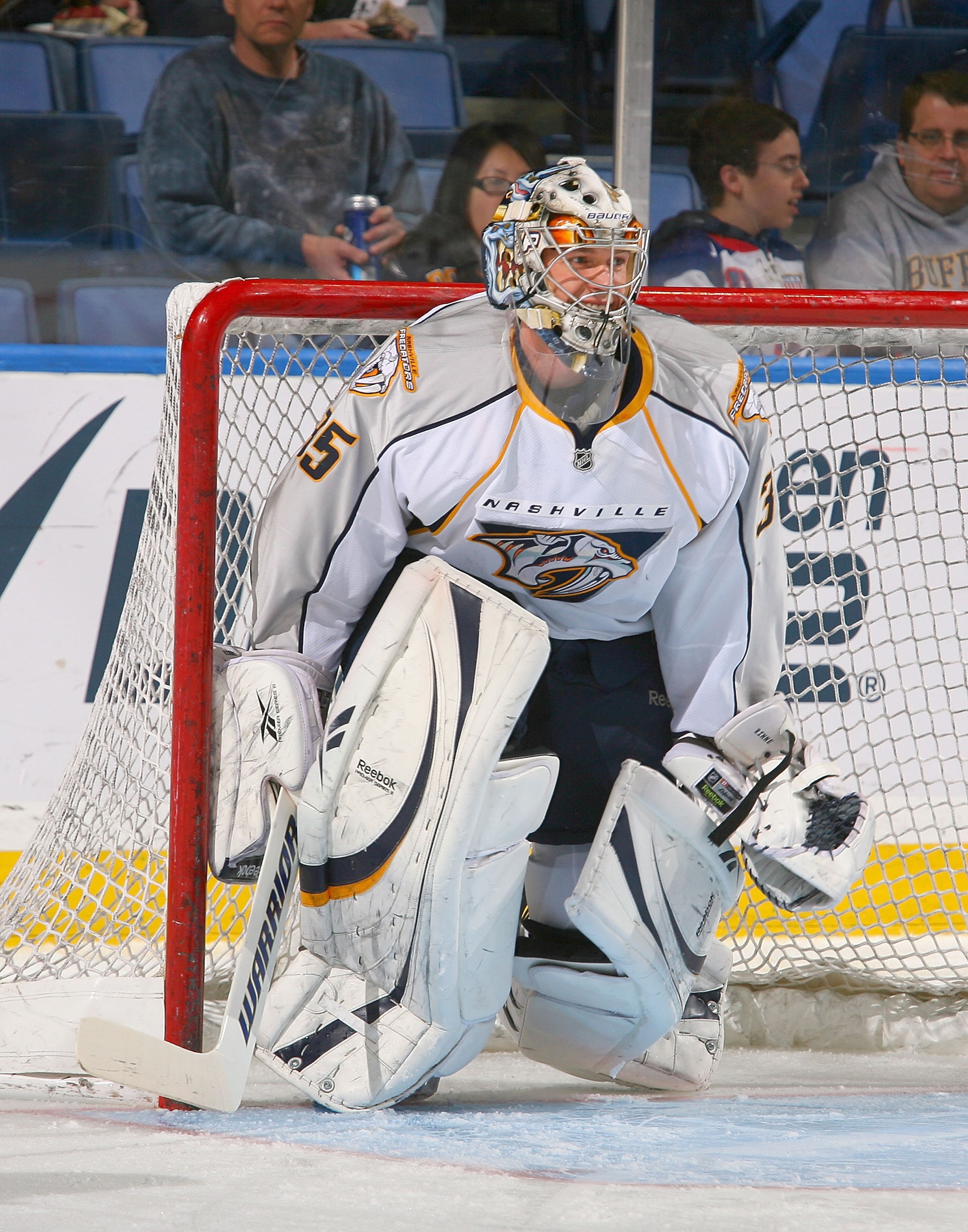
Career statistics: Regular season (NHL): 177 GP, 95-54-18, 2.33 GAA, .920 S %, 20 SO; Playoffs: 10 GP, 4-6, 3.09 GAA, .892 S %,
It gets very difficult to rank the current players that have yet to finish off their careers and especially so for the younger guys who haven't put together much of an NHL resume as of yet. Such is the case with Pekka Rinne, who still at age 28, could easily have a number of years left, which should influence whether he is ranked correctly or not.
Rinne was drafted by the Nashville Predators in the eighth round of the 2004 NHL Entry Draft. He came over to North America during the 2005-06 season, where he would get a two game cup of coffee with the Predators. A 29-minute stint is all Rinne got a taste of over the following two seasons, but he had a breakthrough year in 2008-09 when he played 52 games for Nashville, as Rinne took control of the number one job in net for the Preds.
Rinne is a bit of an unorthodox goalie, at least in terms of style with his 6-5 frame. I'm not sure his height played much of a role with this incredible save, but Rinne has continued to improve each year as the starter, to the point he was nominated this past year as a Vezina Trophy finalist. The immediate future seems very bright in Nashville, at least in net, as Pekka Rinne looks to be a fixture for years to come. For now, he has to settle for the number 66 spot in my top 100.
Best season: This past season was a borderline historic one for Pekka Rinne, as he posted an incredible 2.12 GAA and a .930 save percentage in his 64 games played, with a record of 33-22-9 and six shutouts. Rinne just needs to add playoff success to his resume to really shoot up this list but theVancouver Canucks stood in their way, denying the Predators a trip to the Conference Finals in six games.
No. 65 Ilya Bryzgalov
36 of 100
Career statistics: Regular season (NHL): 326 GP, 156-116-35, 2.53 GAA, .916 S %, 23 SO; Playoffs: 27 GP, 12-13, 2.55 GAA, .917 S %, 3 SO, Stanley Cup (2007)
Ilya Bryzgalov was drafted by the Anaheim Ducks in the second round of the 2000 NHL Draft. He would play one game in each of two seasons at age 21 and 23 for the Ducks, but it was not until after the missed season from the lockout that Bryzgalov got a chance to establish himself at the NHL level, playing in 31 games for the Ducks during the 2005-06 season.
Bryzgalov would play just 27 games the following season, as he was having a hard time earning enough playing time, stuck behind Stanley Cup winning goaltender Jean-Sebastien Giguere in 2006-07. In 2007-08, he played just nine games for the Ducks, before being waived by Anaheim. Jonas Hiller had taken the number two spot away from Bryzgalov, and he ended up being claimed by the Phoenix Coyotes, where Bryzgalov not only got the chance to be the guy, he seized the moment and has risen to one of the top goaltenders in the league.
Bryzgalov continues to get better and has been one of the better goalies in the league the last three seasons. Coming up on age 31, it's interesting to think of what the future might hold for him, but for now, he comes in at number 65 in my top 100. If saves like this are any indication, then we have a lot left to enjoy, that's for sure.
Best season: Bryzgalov was a Vezina Trophy finalist in the 2009-10 season, when he posted a 42-20-6 record with a 2.29 GAA, .920 save percentage and eight shutouts. Despite the great efforts of Bryzgalov, the Coyotes would still finish twelve points out of a playoff spot, behind the Anaheim Ducks.
No. 64 Roger Crozier
37 of 100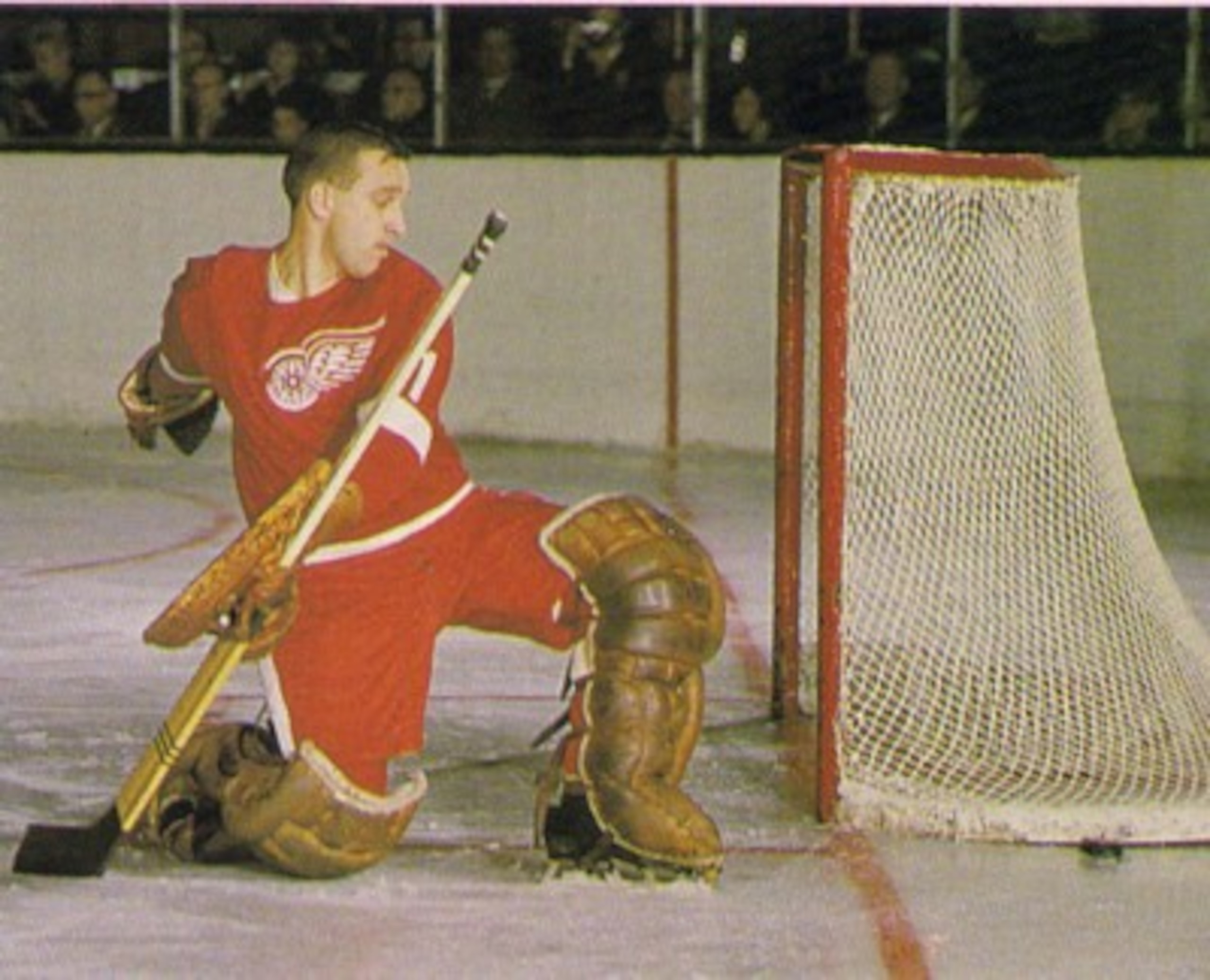
Career statistics: Regular season (NHL): 518 GP, 206-197-70, 3.04 GAA, 30 SO; Playoffs: 32 GP, 14-16, 2.75 GAA, Calder Trophy (1964-65), Conn Smythe Trophy (1965-66), All-Star (1964-65)
Roger Crozier came to the Detroit Red Wings in a trade from the Chicago Blackhawks and started out his NHL career with 15 games in 1963-64. The next year, he played all 70 and took home the Calder Trophy. In his third season, Crozier won his first playoff series, but the Red Wings fell in the Stanley Cup Finals to the Montreal Canadiens. Crozier was best remembered, however, for his nerves and his injuries, which definitely took their toll on him over the years.
He retired at age 25 because of his nerves and had a change of heart a few months later, after being dealt to the Buffalo Sabres, where he would play for seven years. Despite some success with the Sabres, Crozier was never able to match his rookie output, mostly due to the damge injuries and his frayed nerves did over the years. Crozier was hospitalized over 30 times due to ulcers and other ailments that were directly related to his various sicknesses.
Sadly, Crozier died on January 11, 1996 after a battle against cancer. He had an impressive NHL career, but its easy to wonder how much better it might have been had Crozier been able to maintain good health. Based on his actual performances alone, he comes in at number 64 on this list.
Best season: Crozier had a marvelous rookie year in 1964-65, leading the league in wins, games played and shutouts, going 40-22-7 in 70 games, while posting a 2.42 GAA and seven shutouts. He picked up the Calder Trophy for his regular season exploits, but the postseason did not go that well as the Red Wings lost in the first round to the mighty Chicago Blackhawks.
No. 63 Sean Burke
38 of 100Career statistics: Regular season (NHL): 820 GP, 324-341-110, 2.96 GAA, .902 S %, 38 SO; Playoffs: 38 GP, 12-23, 3.32 GAA, .888 S %, All-Star (1989, 2001, 2002)
Sean Burke was drafted in the second round by the New Jersey Devils in the 1985 NHL Draft. After playing two seasons with the Canadian National Team, including the 1988 Olympics, he joined the Devils down the stretch and helped catapult them into not only their first playoff berth, but a run all the way to the seventh game of the Eastern Conference Finals before falling to the Boston Bruins. Burke played in 17 games in that playoff, but only would play 21 more playoff games in the remaining 17 seasons of his career.
The ultimate journeyman, Burke played for eight teams (one of them twice, with two stints in Philadelphia) and also played in the 1988 & 1992 Olympics (thanks to a contract holdout in 1992). Burke struggled at least initially after his holdout as it appears he may have been trying to justify the holdout and/or try to regain the early success he had in his career with the initial year playoff success. After five-plus seasons with Hartford (and relocating to Carolina), he would spend the 1997-98 season with three franchises (Carolina, Vancouver & Philadelphia) thanks to being traded twice, both times in deals involving other goalies (Kirk McLean & Garth Snow).
The next stop for Burke was with the Florida Panthers where he signed as a free agent. He would spend one-year plus before being sent packing to Phoenix in a trade in November 1999. His career would have a bit of a resurgence in Phoenix, where he spent parts of five seasons, including two All-Star appearances. A second trade to Philadelphia would follow in February 2004, followed by a free agent signing in Tampa Bay. He would play one season with the Lightning but would end up being waived and claimed by the Los Angeles Kings, where he would play 23 games in his final season. Burke had a lengthy career, but other than his stint in Phoenix was never able to recapture the amazing success he had in his initial season, so it's tough to gauge where Burke places on the list, but he slots in at number 63.
Burke accumulated some nice totals in his career, ranking 12th all-time in games played, 19th in wins, and sixth in losses, saves and shots against. All in all an impressive run by the man from Windsor, Ontario.
Best season: While Burke began his NHL career with a legendary 13-game run with the New Jersey Devils, it clearly is his 2001-02 season with the Phoenix Coyotes that stands above the other years in his career. His 33-21-6 record with a .920 save percentage and a 2.29 GAA sent Burke to an All-Star appearance. The Coyotes were unable to parlay that year into playoff success however, as they fell in five games to the San Jose Sharks in the first round of the postseason.
No. 62 Bill Ranford
39 of 100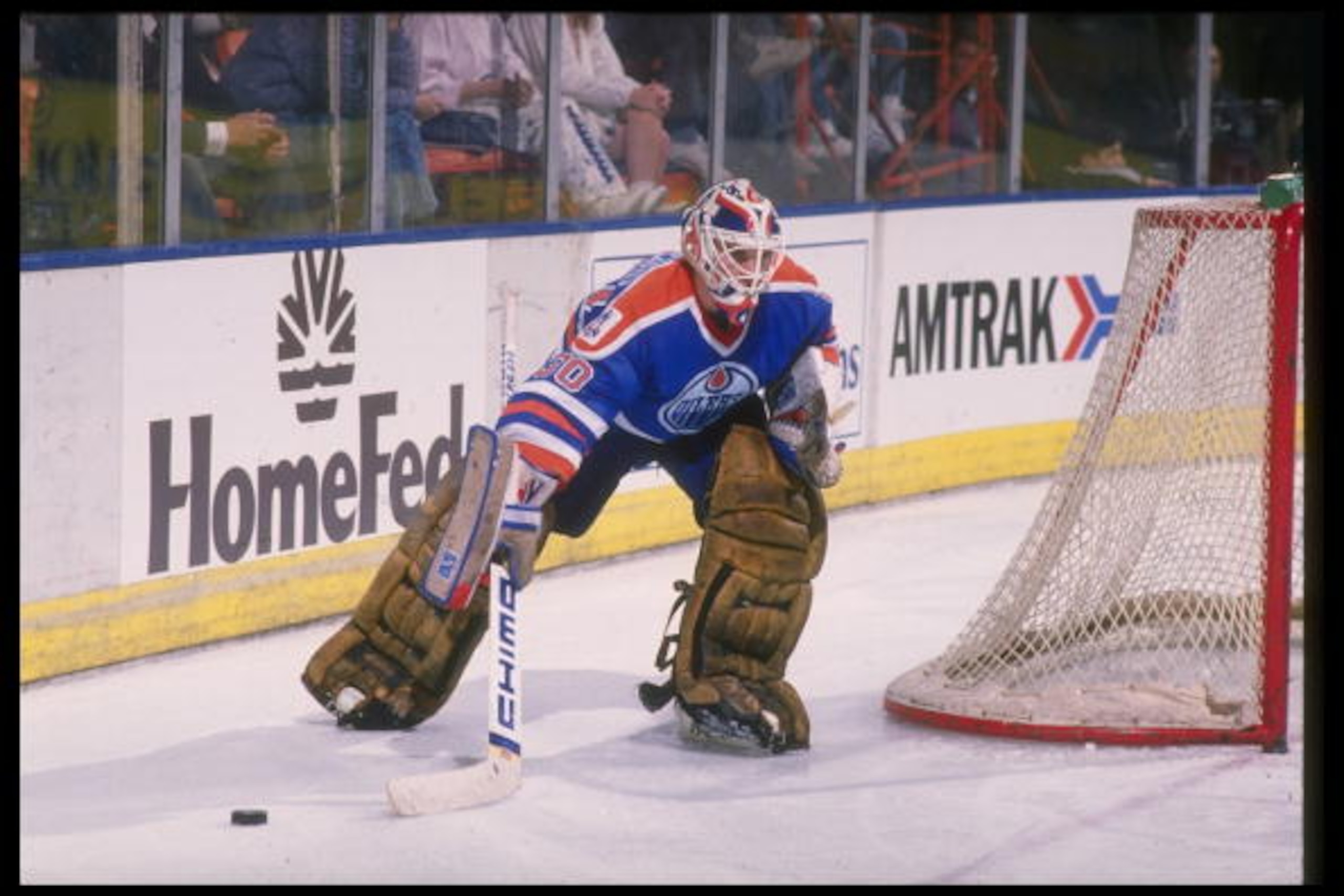
Career statistics: Regular season (NHL): 647 GP, 240-279-76, 3.41 GAA, .888 S %, 15 SO; Playoffs: 53 GP, 28-25, 3.07 GAA, .897 S %, Conn Smythe Trophy (1989-90), All-Star (1991), Stanley Cup (1990)
Bill Ranford was a third round draft choice of the Boston Bruins in the 1985 NHL Entry Draft. He played a handful of games for the Bruins before being dealt to the Edmonton Oilers in a deal that brought Andy Moog back to the Bruins. He would begin his career as an Oiler as a backup to Grant Fuhr, but took over the starting job in the 1989-90 season and dominated the 1990 playoffs, to the point he not only won a Stanley Cup, but also took home the Conn Smythe Trophy.
Ranford would play eight-plus seasons in Edmonton, but was not able to recapture the magic of that 1989-90 season, although he did play better than his statistics might indicate. After all, remember he was playing for a team in Edmonton that didn't exactly play the neutral zone trap. He spent two seasons in Boston before being dealt to Washington in a six-player blockbuster deal in March 1997.
He wouldn't play that much in Washington for his two seasons, before moving on to stints with Tampa Bay and Detroit. He returned to another stint in Edmonton where he finished his career with his last 16 games in 1999-2000. Ranford was a better goaltender than his statistics might show and his Conn Smythe Trophy adds enough to his resume to place him at number 62 on my list.
Best season: Ranford's best season was in 1995-96 when he played for both Edmonton and Boston. His combined numbers were a record of 34-30-9 in 77 games, with a 3.29 GAA and an .885 save percentage with two shutouts. He would be 1-3 in four playoff games, bowing to the Florida Panthers in the first round in five games.
No. 61 Mike Liut
40 of 100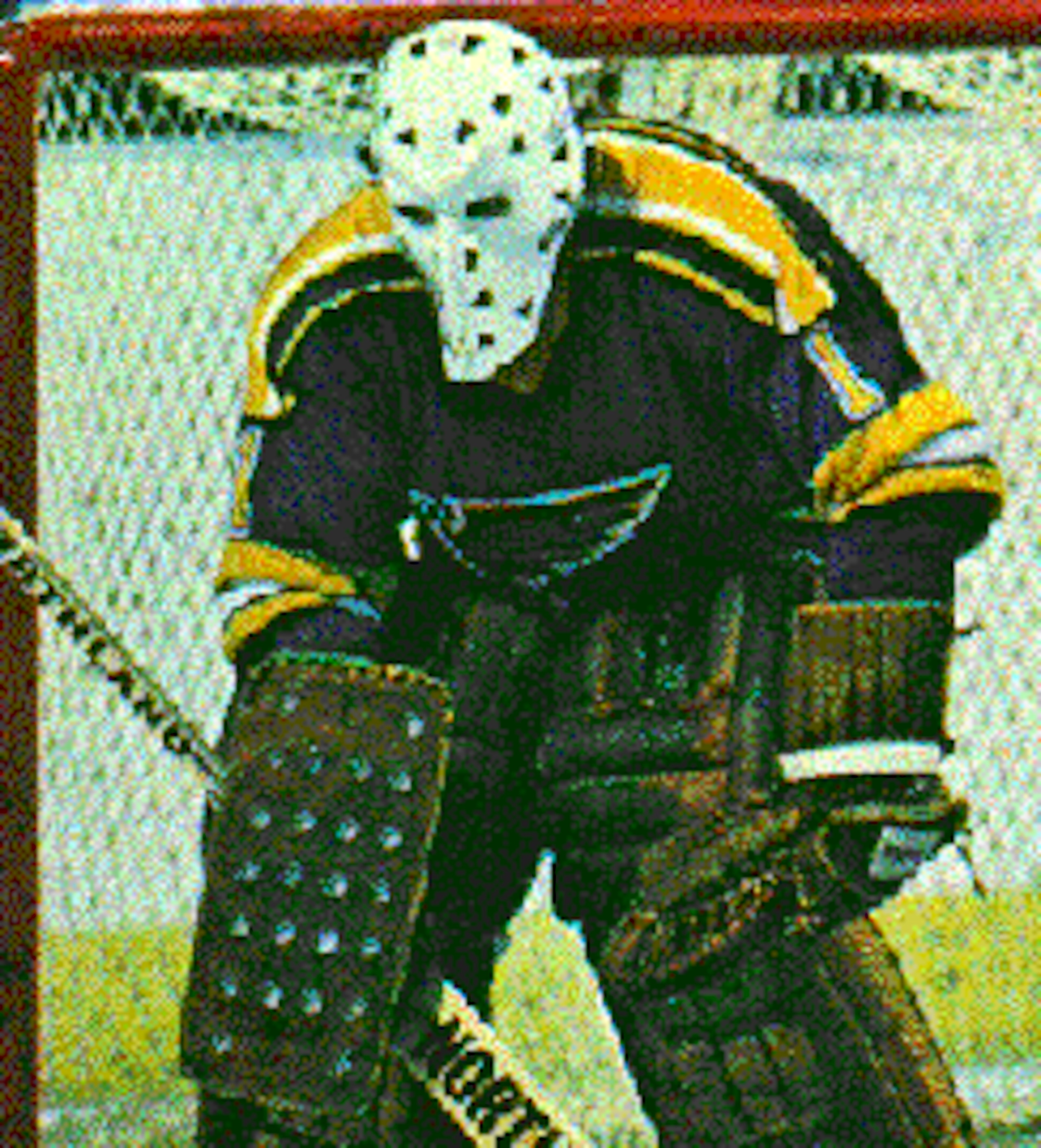
Career statistics: Regular season (NHL): 664 GP, 294-271-74, 3.49 GAA, 25 SO; Playoffs: 67 GP, 29-32, 3.38 GAA, 2 SO, Ted Lindsay Award (1980-81), Lester B. Pearson Award (1980-81), All-Star (1981)
Mike Liut was drafted in the fourth round and 56th overall by the St. Louis Blues in the 1976 NHL Entry Draft after success and learning his craft at Bowling Green University. However, Liut's professional career began in the WHA with the Cincinnati Stingers, where he played for two seasons. When the leagues merged, Liut was again property of the Blues. His first two seasons with St. Louis would rival anyone's first couple of seasons, as Liut posted 65 victories.
Liut's career seemed to take a sudden turn after a dismal 8-1 shellacking at the hands of the Russians in the 1981 Canada Cup. While Liut had a lengthy career, it seemed the game took a toll on Liut and maybe he just lost the edge that had given him such success over the first two seasons. Whatever it was that did it, Liut was no longer the same goaltender. While he would last three and a half more seasons in St. Louis, there was a drastic reduction in his production. He was eventually traded to the Hartford Whalers on February 25, 1981 in a four-player deal.
Liut would have an up and down six year tenure with Hartford, leading the NHL in goals against with a in 1989-90 playing for both Hartford and the Washington Capitals, who acquired him on March 6, 1990. At this point of his career, Liut would struggle greatly with his back and wasn't able to handle the same workload, and his performance suffered some. Liut comes in and earns number 61 in my top 100 for his success.
Best season: It isn't hard to pick out Liut's best year as his 1980-81 season was a historic one, as Liut just barely missed out on a rare Hart Trophy for a goaltender, missing out by a slim margin to Wayne Gretzky. Liut posted a 33-14-13 record with a 3.34 GAA and one shutout as the Blues won the Smythe Division. The Blues would lose in the quarterfinals in six games to the New York Rangers. Liut would go 5-6 in 11 playoff games, with a 4.38 GAA.
No. 60 Pete Peeters
41 of 100
Career statistics: Regular season (NHL): GP, 246-155-51, 3.08 GAA, 21 SO; Playoffs: 71 GP, 35-35, 3.31 GAA, 1 Vezina Trophy (1982-83), All-Star (1980, 1981, 1983, 1984)
Pete Peeters was originally drafted in the eighth round of the 1977 NHL Entry Draft by the Philadelphia Flyers and after a year-plus in the AHL, he made his NHL debut with the Flyers, playing five games in the 1978-79 season, where he posted a 1-2-1 record with a 3.43 GAA. The following year, along with Phil Myre, formed a goalie tandem that helped lead the Flyers to the Stanley Cup finals, where they lost to the New York Islanders in six games. He had a very impressive 22-0-5 stretch to begin that season, a start of legendary proportions.
He continued to share time in Philadelphia for the next two years, before being traded to the Boston Bruins for Brad McCrimmion on June 9, 1982, a deal that would help both teams. Peeters would play three-plus seasons in Boston, playing at least 50 games in each of the three full seasons he played in Boston. His first year he won the Vezina Trophy, but was unable to match the production the next two years and he was dealt to the Washington Capitals for Pat Riggin in November 1985.
Peeters would play four seasons with the Capitals, but never got an opportunity to play a majority of the games, sharing time with the likes of Bob Mason, Clint Malarchuk and Don Beaupre at different times. One personal memory I have of Peeters is the night of April 24, 1988 when a scary incident took place with Peeters being literally knocked out by a shot off the stick of John MacLean of the New Jersey Devils (I was at the game).
After the 1988-89 season Peeters would return to the Philadelphia Flyers as a free agent, and spend his final two NHL seasons, backing up Ron Hextall. Peeters probably peaked in his first year with the Bruins, but still had a solid NHL career and his resume puts him at number 60 in my top 100.
Best season: Peeters had a few very good seasons, but it was his Vezina Trophy winning season of 1982-83 that stands above the rest, as his 40-11-9 record in 62 games and a league-leading 2.36 GAA and eight shutouts were impressive. Peeters followed it up with a 9-8 record in 17 playoff games with a 3.57 GAA and one shutout as the Bruins fell to the New York Islanders in the Conference Finals in six games.
No. 59 Marty Turco
42 of 100Career statistics: Regular season (NHL): 538 GP, 273-165-66, 2.35 GAA, .910 S%, 41 SO; Playoffs: 47 GP, 21-26, 2.17 GAA, .914 S %, 4 SO, All-Star (2003, 2004, 2007)
Marty Turco is the quintessential goaltender who had a hard time matching his amazing regular season play with comparable success in the postseason. He had many highlights in his career, but always seemed to miss out on the one major highlight that would knock Turco in the next level of goaltending pantheon.
Turco thrived his first four seasons with the Dallas Stars and coaches Ken Hitchcock and Dave Tippett. He would play nine seasons overall with Dallas, before leaving as a free agent and joining the Chicago Blackhawks. Turco's career took a rapid downturn after his early success, and other than a strong 2007-08 season, some may label his career a bit of a disappointment.
Overall, it's hard to overlook Turco's incredible numbers, including his .910 save percentage, which is good for the 20th best of all-time and his 2.35 GAA is the 14th best. I think his career is good enough for number 59 in the top 100 ranking.
Best season: Turco was simply amazing in 2002-03, when he posted a league best 1.72 GAA and .932 save percentage along with a record of 31-10-10 and seven shutouts in 55 games. The Stars would be upset by the Mighty Ducks of Anaheim in six games in Round Two. Turco was 6-6 in 12 games, while posting a 1.88 GAA and .919 save percentage.
No. 58 Pelle Lindbergh
43 of 100
Career statistics: Regular season (NHL): 157 GP, 87-49-15, 3.30 GAA, 7 SO; Playoffs: 23 GP, 12-10, 3.11 GAA, 3 SO, 1 Vezina Trophy (1984-85), All-Star (1983, 1985)
Pelle Lindbergh's hockey career is a bit of a tragic tale, as a car accident on November 16, 1985 took away not only a promising career, but also his life. Lindbergh was originally drafted in the second round of the 1979 NHL Entry Draft and 35th overall by the Philadelphia Flyers. He would come over to play in the United States for the first time in the 1980-81 season when he played for the Maine Mariners in the AHL and first tasted NHL hockey with eight games in the 1981-82 season.
He would share the goaltending load with Bob Froese in his first two full seasons before his breakthrough year in 1984-85. It leaves you wondering how great Lindbergh's career might have been had it not been for the unfortunate accident. It definitely makes Lindbergh one of the tougher guys to rank on this list, and while it may be unfair, I've placed him at number 58, since he really doesn't have a large enough of a sample in my opinion to warrant being much higher. It's probably a pretty fair statement to say had he not passed away, he likely would be significantly higher on this list, but unfortunately, we can only use the body of work he was able to put together and not speculate on what might have been.
Best season: Unfortunately, not a tough one at all here, as Pelle Lindbergh's Vezina Trophy season of 1984-85 easily stands alone in Lindbergh's short career, as he put up a record of 40-17-7 in 65 games, with a 3.02 GAA, two shutouts and a .899 save percentage. Lindbergh led the league in games played, shots against, saves, minutes played and wins. In the playoffs, he really starred, putting up a 12-6 record in 18 games with a 2.50 GAA, 3 shutouts and a .914 save percentage as the Flyers made it to the Stanley Cup Finals before falling to the Edmonton Oilers in five games.
No. 57 Chuck Rayner
44 of 100
Career statistics: Regular season (NHL): 424 GP, 138-208-77, 3.05 GAA, 25 SO; Playoffs: 18 GP, 9-9, 2.43 GAA, 1 SO, Hart Trophy (1949-50), All-Star (1949, 1950, 1951, 1952)
Chuck Rayner started his professional career in the American Hockey League, earning his first taste of the National Hockey League in a 12-game tryout with the New York Americans in 1940-41. He played 36 games with the Americans the following season before joining the Royal Canadian Navy during World War II, not returning to the NHL until the 1945-46 season, and with the New York Rangers, the team he would play with his final eight seasons.
Rayner was known for wandering out of his crease with the puck after making saves and was forced to sometimes scramble to get back in his net after sometimes taking the puck all the way close to the opposing goal. I wonder if his roaming had to do with the level of talent around him, as Rayner wasn't always playing for the best teams. He helped bring the Rangers to within a game of the Stanley Cup title in the 1950 playoffs.
Rayner had a good run with the New York Rangers and despite not winning a Stanley Cup, his four straight All-Star awards and Hart Trophy are good enough to place Rayner at number 57 in my top 100.
Best season: Rayner won the Hart Trophy in 1949-50 with the New York Rangers, despite a losing record of 28-30-11 and a 2.62 GAA with six shutouts. The Rangers would lose in Game Seven of the Stanley Cup Finals to the Detroit Red Wings
No. 56 John Ross Roach
45 of 100
Career statistics: Regular season (NHL): 492 GP, 219-204-68, 2.46 GAA, 58 SO; Playoffs: 29 GP, 12-14, 1.89 GAA, 7 SO, All-Star (1932-33)
Going to some serious "old-time hockey" with the selection/mention of Roach here, who played for the Toronto St. Patricks, Toronto Maple Leafs, New York Rangers and Detroit Red Wings in his 14-season career. In his rookie year, he helped the St. Patricks to a Stanley Cup championship, with a playoff shutout.
Roach had an impressive career, but it is very tough to get a good idea or understanding of whether it was his goaltending or if the game was just that different back in the roaring 20's and 30's. Clearly the path to the Stanley Cup was different then as it was decided by Total Goals in favor of the St. Patricks in 1921-22, but since the league was only made of four teams then, I guess it's fair to say things were a little different on all fronts.
It was very tough to figure out where to put hm on this list, but I feel like number 56 is the place for Roach to be.
Best season: Although as I pointed out, it was a different game back then, Roach's 1928-29 season stands out statistically as a season of legendary proportions. He posted a 21-13-10 record in 44 games, while having a microscopic 1.41 GAA and 13 shutouts. Just to give some perspective, his goals against was only good enough for fifth that year. As for the Rangers, they lost in the Stanley Cup Finals that year, losing 2-0 to the Boston Bruins.
No. 55 Antti Niemi
46 of 100
Career statistics: Regular season (NHL): 102 GP, 62-26-11, 2.36 GAA, .911 S %, 13 SO; Playoffs: 27 GP, 18-8, 2.87 GAA, 2 SO
Annti Niemi was an undrafted goalie who signed as a free agent with the Chicago Blackhawks at age 24 and played predominantly in the AHL in his first season in the league. In 2009-10, Niemi slowly took the job away from Cristobal Huet and had the number one job heading into the post-season, which is where Niemi really took off and became a borderline star.
Niemi has a very small NHL resume thus far, but he's given no reason to think he isn't a star thus far. Here's one recap of his spectacular 2009-10 season from YouTube, showing many of his highlights. After his Stanley Cup performance the Blackhawks took Niemi to arbitration and walked away from the decision, making Niemi a free agent. To be fair, it was mostly because of Salary Cap concerns that the Blackhawks allowed Niemi to become a free agent, it was in no way a reflection on his talents.
He signed with the San Jose Sharks and had a really good 2010-11 regular season, earning a four-year extension which should leave Niemi in Northen California for the next few seasons. It also earns him the number 55 spot in my top 100.
Best season: Niemi's best statistical season was this current year with the San Jose Sharks, which was his first full-time starting gig in the NHL. He posted a 35-18-6 record in 60 games, with a 2.38 GAA and a sparkling .920 save percentage, adding six shutouts. His playoff performance has not equaled his regular season this year, but he stepped up his game in round two, and has the Sharks facing the Vancouver Canucks for the right to represent the Western Conference in the Stanley Cup Finals.
No. 54 Andy Moog
47 of 100
Career statistics: Regular season (NHL): 713 GP, 372-209-88, 3.13 GAA, 28 SO; Playoffs: 132 GP, 68-57, 3.04 GAA, 4 SO, Jennings Trophy (1989-90), All-Star (1985, 1986, 1991, 1997)
Andy Moog is an interesting lesson in NHL history in his own right, as he is 22nd on the all-time list of games played for a goaltender. It started as a seventh round draft pick of the Edmonton Oilers in the 1980 NHL Entry Draft. He would ease into carrying the load as the starting goalie, sharing duties with Grant Fuhr. It would remain that way for most of Moog's career as he never played more than 55 games in a season once (1991-92), sharing time with Fuhr in Edmonton, Rejean Lemelin in Boston, Darcy Wakaluk and Arturs Irbe in Dallas and Jocelyn Thibault in Montreal.
A three-time Stanley Cup champion, Moog rode the coattails of Fuhr for most of those, only appearing in eleven postseason games in those three playoff years. However, Moog did want more of a share in the playoffs and dictated it by joining the Canadian National Team in 1987-88, holding out from Edmonton and forcing a trade to the Boston Bruins on a May 24, 1988, a deal that saw both Bill Ranford and Geoff Courtnall and a draft pick sent back to Edmonton. Moog would play six-plus seasons in Boston, helping them get deep in the playoffs, but never the title they craved so much.
Moog would be dealt to the Dallas Stars on June 20, 1993, in a deal that sent Jon Casey to Boston. He would play four seasons with the Stars, but while he had regular season success with Dallas, he was unable to do much in the playoffs. He would play his final season in 1997-98 with the Montreal Canadiens, before retiring after the season. Moog is more of an accumulator of stats more so than a star goalie, but to last 18 seasons, you have to give Moog credit and I give him enough credit to earn spot number 54 in the countdown.
Best season: Moog had what I would classify as his best year at the age of 36, playing for the Dallas Stars in 1996-97, and putting up a record of 28-13-5 in 48 games, with a 2.15 GAA, .913 save percentage and three shutouts. His Stars would lose in the first round of the playoffs that year to the seventh seeded Edmonton Oilers and essentially ending Moog's tenure in Dallas.
No. 53 Tomas Vokoun
48 of 100
Career statistics: Regular season (NHL): 632 GP, 262-267-76, 2.56 GAA, .917 S%, 44 SO; Playoffs: 11 GP, 3-8, 2.47 GAA, .922 S%, All-Star (2004, 2008)
Tomas Vokoun was originally a ninth round draft choice by the Montreal Canadiens in the1994 NHL Entry draft. After playing just one game in Montreal during the 1996-97 season, Vokoun was selected by the Nashville Predators on June 26,1998 after putting up good numbers in the IHL and AHL. Vokoun would share time with Mike Dunham for four-plus seasons before taking sole possesion of the number one job during the 2002-03 season. Vokoun was part of teams in Nasvhille that weren't too great, but he has more often than not played well enough to usually keep his team in games.
After three seasons as the full-time guy, Vokoun lost playing time to Chris Mason and was traded to the Florida Panthers on June 22, 2007, where he has played the last four seasons. Vokoun has always been the kind of goaltender who didn't get the exposure I think he deserved and has often been overlooked, mostly because of the teams he has played on. Had he been on a Detroit, New Jersey or Pittsburgh, he would be considered one of the stars of the league in my opinion.
Vokoun once again will be a free agent this offseason and it will be interesting to see which team will end up signing him, if I was his agent, I would try to match him up with a better team, if possible, even if it meant only taking a one-year contract. I think it would be a great career move for Vokoun, which would allow him an opportunity to hopefully play in the post-season for a third time.. His career save percentage of .917 ranks 6th all-time, and I've seen him play too many great games over the years to rank him any lower than number 53 on my top 100.
Best season: Vokoun carried a subpar Florida Panthers team practically on his back in the 2008-09 season, posting a 26-23-6 record in 59 games with a .926 save percentage (2nd in league), 2.49 GAA and six shutouts. Unfortunately, the Panthers missed out on a playoff spot by losing a tiebreaker to the Montreal Canadiens and Vokoun was once again denied a chance to play in the playoffs, a recurring theme throughout his career.
No. 52 Felix Potvin
49 of 100
Career statistics: Regular season (NHL): 635 GP, 266-260-85, 2.76 GAA, .905 S %, 32 SO; Playoffs: 72 GP, 35-37, 2.64 GAA, .910 S %, All-Star (1994, 1996)
Felix "The Cat" Potvin was a second round draft pick of the Toronto Maple Leafs in the 1990 NHL Entry Draft that produced a bunch of NHL goaltending talent. He became a regular with the Leafs during the 1992-93 season when he played in 48 games, making the All-Rookie Team. Toronto would make the conference finals before losing in a Game 7 to the Los Angeles Kings. Potvin would be the regular goalie for Toronto the next five seasons, but unable to match the playoff success of his first season, eventually losing the confidence of the Maple Leafs, and was dealt to the New York Islanders in January 1999, essentially in return for Bryan Berard.
Potvin would last less than a calendar year with the Islanders, before being dealt in December to the Vancouver Canucks for a package that included Kevin Weekes, Dave Scatchard and Bill Muckalt going back to the Islanders. His time in Vancouver did not last long, as he was dealt away after 69 games over two seasons, this time to the Los Angeles Kings on February 15, 2001. The Cat would have a bit of a resurgence with the Kings, putting up nice numbers in the two-plus seasons he donned the silver and black.
Felix Potvin was a solid goaltender who earned his nickname both with his first name (Felix) and his quick cat-like reflexes he displayed. A look at his career can be found here, courtesy of YouTube. I have fond memories of his goaltending in the 1990's into the 2000's, but more so for his time with the Maple Leafs and Kings is what stands out. For his play, I've ranked Potvin at number 52 on my list.
Best season: Felix Potvin is another example of a goalie who came in and took the league by storm, with initial success he was unable to repeat. That isn't in any way to say his career wasn't successful, it's just saying his best year was his first one, as in 1992-93 Potvin had a year to remember, posting a 25-15-7 record in 48 games, with a .910 save percentage, league-leading 2.50 GAA and two shutouts. In what was a very memorable post season, especially in Toronto, Felix would post a 11-10 record in three straight series to go seven games (obviously winning two of them), before losing in a memorable Game 7 to the Los Angeles Kings. He also had a 2.84 GAA, one shutout and a .903 save percentage in those 21 playoff games.
No. 51 Marc-Andre Fleury
50 of 100
Career statistics: Regular season (NHL): 367 GP, 184-126-37, 2.74 GAA, .908 S %, 19 SO; Playoffs: 69 GP, 41-28, 2.52 GAA, .910 S %, 5 SO, All-Star (2011)
Marc-Andre Fleury was the number one overall pick of the Pittsburgh Penguins in the superstar filled 2003 NHL Draft, becoming only the second goaltender to have that honor in league history. After his initial training camp, the Penguins opted to keep Fleury on the active roster and he played in 22 games as a rookie before being returned to his junior team.
After the lockout, Fleury joined the Penguins for good, having played a majority of the games over the course of the last six seasons, establishing himself as one of the better goaltenders in the league. His biggest highlights include a Stanley Cup title in 2008-09 and being named an All-Star for the first time in 2011. He's shown his athleticism on saves like this one against Mike Green, or the wild save to finish the Stanley Cup title in 2009.
Marc Andre-Fleury had a few bumps in the road to stardom, but was able to overcome any obstacles that stood in his way to become one of the best goalies in the league today, and has a very bright future ahead of him. Still just age 26, I wonder how much higher Fleury will move up this list than his current position of number 51 in my top 100.
Best year: Fleury's best season was this past season, as his Penguins relied more on defense and goaltending in the absence of superstars Sidney Crosby and Evgeni Malkin. Fleury went 36-20-5 in 65 games with a 2.32 GAA, .918 save percentage and three shutouts. Unfortunately for Fleury and his Penguins, they lost in seven games to the Tampa Bay Lightning with Fleury putting up a 3-4 record with a 2.52 GAA, .899 save percentage and one shutout.
No. 50 Evgeni Nabokov
51 of 100Career stats: 563 GP, 293-178-66, 2.39 GAA, .912 S %, 50 SO, 80 GP, 40-38, 2.29 GAA, .913 S %, 7 SO; Calder Trophy (2000-01), All-Star (2001, 2008)
Evgeni Nabokov was drafted in the ninth round of the 1994 NHL Entry Draft by the San Jose Sharks, 219th overall. Nabokov would stay in his native Russia a few seasons before heading to North America and working his way through the IHL and AHL before ascending to the NHL for 11 games during the 1999-2000 season.
It would begin a streak of nine seasons where he would play a majority of the games for the Sharks, including the last three of 41 plus wins each year. He's always shown good athletic skill and movement in net, as well as a great glove hand. Nabokov has accumulated some really good career statistics, to the point he is 18th on the all-time goals against average list and 14th in save percentage. There is no question that Nabokov has had a great NHL career, but there is one big blemish on his resume and that is the lack of a Stanley Cup.
Nabokov left the NHL after the 2009-10 season, signing a big money deal with the KHL. Unfortunately for him, things didn't work out as hoped and he bailed midyear to try and join the Detroit Red Wings. However, thanks to the "Reijo Ruotsalainen rule" Nabokov had to clear waivers first. When the New York Islanders claimed him, Nabokov refused to report and was suspended. His rights still belong to the Islanders, so it remains to be seen what will happen this off-season and whether or not Nabokov will return to the NHL.
Overall, Nabokov has led his team on two occasions to the conference finals, but only went 2-8 in his ten games at that level. Is it fair to blame him solely? Of course not, the team must share blame, but ultimately, it is Stanley Cup titles, Hart Trophies and Vezina Trophies that have a major impact in my rankings and with Nabokov 0 for 3 in that category, his great regular season numbers and success only translate to number 50 in my top 100.
Best season: Nabokov's best season was the 2003-04 campaign when he had a 31-19-8 record in 59 games, with a 2.20 GAA, .921 save percentage and career best nine shutouts. He would follow it up with an impressive playoff run as well, going 10-7 in 17 games, with an eye-opening 1.71 GAA and .935 save percentage, while adding three shutouts. The team would lose in the conference finals to the Calgary Flames in six games, falling short once again of the Stanley Cup Finals.
No. 49 Al Rollins
52 of 100
Career statistics: Regular season (NHL): 430 GP, 141-205-83, 2.78 GAA, 28 SO; Playoffs: 13 GP, 6-7, 2.38 GAA, Hart Trophy (1953-54), Vezina Trophy (1950-51), All-Star (1954)
Al Rollins was brought in by GM Conn Smythe of Toronto to allegedly push Turk Broda and provide depth. After some injuries, Rollins was left as the sole backup to Broda and became the apprentice to Broda. He played in just two games that initial season for the Maple Leafs, but helped share a lot of the load in his second season, playing in 40 games in his second year.
Rollins would play all 70 games the following season before being dealt to the Chicago Blackhawks in a four-for-one trade, which gave him the opportunity to play full time. In his second season, Rollins would play so well on such a bad team that he was rewarded with the Hart Trophy, despite an awful record of 12-47-7 in 66 games, with a 3.23 GAA and five shutouts.
Al Rollins is an overlooked goalie historically, but he did enough to warrant a legitimate spot in my top 100, and spot 49 seems to be the right spot for him and his career.
Best season: Rollins' best season was when he took over for Turk Broda and won the Vezina Trophy with an unbelievable record of 27-5-8 with a 1.77 GAA and five shutouts. He followed it in the postseason by helping the Maple Leafs win the Stanley Cup on Bill Barilko's famous Cup-winning goal. Rollins went 3-1 in the post-season with a 1.71 GAA, sharing the load with Turk Broda.
No. 48 Olaf Kolzig
53 of 100
Career statistics: Regular season (NHL): 719 GP, 303-297-87, 2.71 GAA, .906 S %, 35 SO; Playoffs: 45 GP, 20-24, 2.14 GAA, .927 S %. Vezina Trophy (1999-2000), All-Star (1998, 2000)
Olie the Goalie was a first round draft pick of the Washington Capitals, in a draft where the Capitals were desperate for goaltending, after the departures of both Pete Peeters and Clint Malarchuk. Olaf Kolzig was selected in the first round and Byron Dafoe in the second, giving some instant depth the Capitals organization. Although Kolzig would play two games for the Caps in his first year (1989-90), he wouldn't be a regular in the NHL until the 1997-98, playing in 71 games over parts of six seasons.
Kolzig became one of the faces of the franchise for the Washington Capitals in the late 1990's and early to mid 2000's, staring in at least 54 games over a ten year stretch ending in 2007-08. Along the way, he led the Capitals to a trip to the Stanley Cup Finals in 1997-98, and picked up a Vezina Trophy to boot, all while posting five 30-plus win seasons and essentially being one of the classiest guys both on and off the ice.
A tribute to his career can be found here, courtesy of Youtube. Kolzig may fall more into the accumulator category for some, but that would overlook the great success he had in his first few years as a starter for Washington. A late career move to Tampa Bay and subsequent trade to Toronto (where he never appeared) took away his only having played for one franchise, but it doesn't hurt his all-time ranking, which I have picked for number 48.
Best season: Kolzig had an exceptional year for the Washington Capitals in 1999-2000, putting up a 41-20-11 record in 73 games, with a 2.24 GAA and a .917 save percentage while picking up his Vezina Trophy in the process. Kolzig led the league in minutes played, shots against and saves that season. Unfortunately, the post season did not fare as well as Kolzig and the Caps fell in the first round to the Pittsburgh Penguins in five games, with Kolzig only posting a 3.38 GAA and .845 save percentage to go with his disappointing 1-4 record.
No. 47 Dave Kerr
54 of 100
Career statistics: Regular season (NHL): 427 GP, 203-148-75, 2.15 GAA, 51 SO; Playoffs: 40 GP, 18-19, 1.74 GAA, 8 SO, Vezina Trophy (1939-40), All-Star (1937-38, 1939-40)
David Kerr came to the NHL at the age of 20 with the Montreal Maroons in the 1930-31 season, playing in 29 games for the Maroons, and posting a 2.37 GAA and one shutout. Other than a one game appearance on loan with the New York Americans (to cover for the injured Roy Worters), Kerr did not appear in the 1931-32 season. He would spend one more year sharing time with Flat Walsh, before taking over the full-time job and playing all 48 games in the 1933-34 season.
After additional time in the minors the following season, he was sold to the New York Rangers to replace the injured Andy Aitkenhead, and Kerr would spend his final seven years playing with the Rangers, and putting together a resume that includes the 6th best career goals against average (2.15) in the history of the league. After his initial season with the Rangers, Kerr would play in all but one of a possible 288 games in his last six seasons with the club, posting three years with a goals against average of sub 2.00.
Kerr was the goalie of the famous 1940 New York Rangers Stanley Cup Championship team, the last Stanley Cup-winning team the Rangers would see for 54 years, and Kerr was absolutely incredible during that championship season. His career records and highlights place him at number 47 on my top 100 list.
Best season: Kerr's 1939-40 season with the New York Rangers was quite a memorable one, as he played in all 48 games, posting a 27-11-10 record, yielding just 77 goals and a league-best 1.54 GAA with a league-leading eight shutouts. In the post-season, Kerr would go 8-4 in 12 games, with a sparkling 1.56 GAA and three shutouts, leading the Rangers to a Stanley Cup title, besting the Toronto Maple Leafs in six games.
No. 46 Dwayne Roloson
55 of 100
Career statistics: Regular season (NHL): 566 GP, 214-241-79, 2.65 GAA, .910 S %, 28 SO; Playoffs: 38 GP, 20-14, 2.48 GAA, .920 S %, 1 SO, All-Star (2004)
Dwayne Roloson did not enter the NHL through conventional means, signing as a free agent with the Calgary Flames in the summer of 1994 after a four-year career at the University of Massachusetts-Lowell. After two-plus seasons in the AHL, he would make his NHL debut in the 1996-97 season by playing in 31 games. He would play two seasons in Calgary, before moving on to the Buffalo Sabres, where he played two seasons, backing up Dominik Hasek.
He would spend another season in the minors before joining the Minnesota Wild as a free agent in the summer of 2001. It was under the tutelage of Jacques Lemaire and teaming with fellow goalie Manny Fernandez that the journeyman's career would take off. Roloson would play for the Wild for three-plus and would help bring the Wild to the Western Conference Finals in his first major playoff time.
Roloson would be dealt to Edmonton in March 2006, where he would help lead the Oilers all the way to a Game Seven of the Stanley Cup Finals before falling to the Carolina Hurricanes, including an amazing save here on Jonathan Cheechoo during the second round of the playoffs. He would spend three more seasons with the Oilers, with no playoff action, before signing with the New York Islanders as a free agent. He spent one-plus year with the Islanders, before being dealt to the Tampa Bay Lightning on January 2, 2011. Roloson has put up solid numbers with the Lightning and has taken the helm as the number one guy with Tampa and continues to impress during the current 2011 playoff run.
Dwayne Roloson has survived more than anything, at least at first, to last as long in the NHL as he has and despite a late start to his success, has accumulated some good statistics. At age 41, it is a wonder how long Roloson will be able to maintain a high level of play, but his resume is good enough to earn him spot number 46 on my list. I wonder how many teams kick themselves over the fact they haven't utilized all Roloson had to offer over the years.
Best season: Roloson's best season was in 2003-04, when while sharing the load with Manny Fernandez he went 19-18-11 in 48 games, while leading the league with a .933 save percentage and posting a 1.88 GAA and five shutouts. The Wild did not qualify for the post-season that year, finishing eight points out of a playoff spot.
No. 45 Henrik Lundqvist
56 of 100
Career statistics: Regular season (NHL): 406 GP, 213-137-49, 2.32 GAA, .918 S %, 35 SO; Playoffs: 35 GP, 15-20, 2.60 GAA, .909 S %, All-Star (2009, 2011)
Henrik Lundqvist was a seventh round draft choice of the New York Rangers in the 2000 NHL Entry Draft, who developed his game in the Swedish leagues before coming to North America and taking the number one goaltending job with the Rangers in 2005-06, by starting 53 games and making the All-Rookie team. From there, his workload has rivaled just about anyone, averaging 70.6 games the last five seasons, with many incredible saves along the way.
While nicknamed "The King" by Rangers faithful, Henrik has not always been able to live up to his nickname, specifically in the post-season, where he has only won two series in five playoff years. Now, it's certainly unfair to lay all the blame at Lundqvist's feet, but the numbers show that Lundqvist hasn't been the same player in the postseason. At age 29 and in his prime, there is plenty of time left for Lundqvist to earn the moniker of King, but he certainly isn't there yet.
A short biography of Lundqvist can be found here, courtesy of MSG. Lundqvist has had six straight 30-wins to begin his NHL career, with no goals against average higher than 2.43 in a season. His career mark of 2.32 is currently the 13th best goals against average in league history and his .918 save percentage over his career is 4th best. He's also averaged nearly six shutouts a season in his career. If you look at these numbers, it puts Lundqvist at number 45 in my top 100. You can also speculate as to how much higher he will be if he is able to make a few deep runs in the playoffs and/or win a Stanley Cup.
Best season: Lundqvist's 2010-11 season was his best yet in his NHL career, posting a 36-27-5 record with a 2.28 GAA, .923 save percentage and a league-best 11 shutouts. After an injury to backup goaltender Martin Biron, Lundqvist played the final 18 games with a novice backup the Rangers did not want to use. Lundqvist and the Rangers were unable to win their first round playoff series, losing to the Washington Capitals in five games.
No. 44 Roberto Luongo
57 of 100
Career statistics: Regular season (NHL): 672 GP, 308-269-75, 2.53 GAA, .919 S %, 55 SO; Playoffs: 44 GP, 23-19, 2.41 GAA, .919 S %, 3 SO, All-Star (2004, 2007, 2009)
Roberto Luongo was originally drafted by the New York Islanders fourth overall in the 1997 NHL draft. He played in just 22 games for the franchise, before being dealt to the Florida Panthers along with Olli Jokinen for Mark Parrish and Oleg Kvasha on June 24, 2000. Luongo played in 317 games over five seasons with the Panthers, posting a 108-154-41 record with a very good 2.68 GAA and very impressive .920 save percentage, while posting 26 shutouts. He also would play in his first All-Star game, earning the nod in 2004. Unfortunately, the talent around him was certainly not the best, and he never tasted the post-season in a Panthers uniform, only coming within seven points of a playoff spot in his final season in Florida. He would be dealt along with Lukas Krajicek and Florida's 6th round choice (Sergei Shirokov) in 2006 Entry Draft for Todd Bertuzzi, Bryan Allen and Alex Auld.
Luongo would complete the transition from a very good goalie in Florida to one of the best in the league during his time in Vancouver. His athletic ability has allowed him to build up a long list of spectacular saves over his career. For Luongo, the one knock on his resume has been his playoff performance thus far, where he has yet to put together that one defining playoff year where he leads his team deep into the postseason and possibly raises Lord Stanley at season's end. The 2011 playoffs have had their share of moments thus far for Luongo, as saves like this one on Patrik Kane or a breakaway stop on Mike Fisher have helped the Canucks in their attempt to reach the Western Conference Finals.
Luongo is a goalie that doesn't always get the credit he always deserves, but he should be able to silence most of the critics with a few more wins in the current playoffs. His days pre-Vancouver are overlooked a bit in my opinion, but his 2010 Gold Medal earned in Vancouver have helped Luongo gain more notoriety and recognition as a big game goalie. If Luongo adds a Stanley Cup to his resume, it likely would move him higher than his current standing at number 44.
Best season: Luongo's best season at least statistically was the 2003-04 season, when despite playing for a Florida Panthers team that finished 16 points out of a playoff spot, put up an unbelievable .931 save percentage, facing well over 34 shots per game in his 72 appearances. He put up a 25-33-14 record, with a 2.43 GAA and seven shutouts in a season he didn't get much help from his teammates. It was amazing his stats were still able to be as impressive as they were with all the pressure he faced.
No. 43 Ryan Miller
58 of 100
Career statistics: Regular season (NHL): 399 GP, 221-126-42, 2.57 GAA, .915 S%, 22 SO; Playoffs: 47 GP, 25-22, 2.46 GAA, .917 S %, Vezina Trophy (2009-10), All-Star (2007)
Ryan Miller was a fifth round draft choice and 138th overall by the Buffalo Sabres in the 1999 NHL Entry Draft. An alumnus of Michigan State University, Ryan is one of ten members of his family to have played hockey as a Spartan. After graduating from there in 2002, Miller would play parts of three seasons in the AHL before becoming an NHL regular in the 2005-06 season, playing in 48 games for the Sabres, and taking the number one job away from Martin Biron and Miller hasn't looked back since.
Miller has played in at least 59 games each of the last five seasons for the Sabres, and has shown no signs of slowing down. Coming up on age 31, Miller is coming off his best few seasons and is easily in the mix as one of the top goalies in the NHL today. Best known for his play for Team USA during the 2010 Olympics, Miller has been worthy of the notoriety for his play in Buffalo, he just didn't have the same spotlight on him that the Olympics offered.
Ryan Miller is a stud goalie with a great catching glove hand and excellent mobility and net coverage, just needs a Stanley Cup title on his resume to become one of the truly elite goaltenders. For now, he's stuck in a group of current goalies who would move up if they added a Stanley Cup to their resume, and Miller earns spot number 43 in my top 100 for now.
Best season: Miller's best was during the 2009-10 season when he posted a 41-18-8 record in 69 games, with a 2.22 GAA and .929 save percentage, while matching a career-best with five shutouts, helping to lead the Buffalo Sabres to a division title. The Sabres would lose in the first round to the rival Bruins in six games. For his exceptional regular season, Miller did take home his first Vezina Trophy
No. 42 Jose Theodore
59 of 100
Career statistics: Regular season (NHL): 580 GP, 260-232-55, 2.69 GAA, .909 S %, 30 SO; Playoffs: 51 GP, 19-28, 2.82 GAA, .911 S %, 1 SO, Hart Trophy (2001-02), Vezina Trophy (2001-02), Masterston Trophy (2009-10), All-Star (2002, 2004)
Jose Theodore was a second round draft pick of the Montreal Canadiens in the second round of the 1994 NHL Entry Draft, a draft that also included other top goalies like Tim Thomas, Evgeni Nabokov and Tomas Vokoun. None of the four were drafted in the first round, those picks were Jamie Storr (LA Kings - 7th), Eric Fichaud (Toronto - 16th) and Dan Cloutier (N.Y. Rangers - 30th). It just is another reminder how hard it is to scout 18-year old hockey players, it definitely is an inexact science.
As for Theodore, he made his NHL debut on February 21, 1996 at the tender age of 19, playing just nine minutes in a game against the Hartford Whalers. After four seasons of bouncing around and playing part time with the Canadiens, he would break through during the 2000-01 season to play in 59 games for Montreal, beginning four straight seasons with 57 plus games and having Theodore breakout as one of the top goalies in the league over that stretch to the point that Theodore was the biggest story of the 2001-02 season, almost singlehandedly carrying the Canadiens to the playoffs, winning a lot of individual hardware in the process.
In 2005-06, Theodore's game would take a rapid turn for the worse and would be dealt that March to the Colorado Avalanche for David Aebischer in March of that season. His game began to come back slowly over the course of his two-plus seasons with the Avalanche with a solid 2007-08 season, but was never able to duplicate the success he had in Montreal, nor was he able to put together a good playoff run. He became a free agent after that season, signing with the Washington Capitals to a two year deal and try to shore up the goaltending position for the Caps. Unfortunately in both seasons, Theodore was relegated to backup status by season's end, although he also had to overcome personal tragedy along the way, earning the Masterston Trophy in 2009-10.
This past season, Theodore was a backup in Minnesota for the Wild, playing well in his 32 games, but not At age 34 (35 by Opening Night 2011), it seems Theodore's future is as a backup. His prime years and highlights are enough to warrant number 42 on my top 100 list.
Best season: A lot of players, its tough to pick one year in particular that stands out. That is not the case with Theodore, who absolutely took the NHL by storm in 2001-02, winning both the Hart and Vezina Trophies with the Montreal Canadiens, posting a 30-24-10 record in 67 games, while adding a 2.11 GAA and league-leading .931 save percentage and adding seven shutouts. The Canadiens would make it to the second round before losing in six games to the Carolina Hurricanes.
No. 41 Roy Worters
60 of 100
Career statistics: Regular season (NHL): 484 GP, 171-229-83, 2.27 GAA, 67 SO; Playoffs: 11 GP, 3-8, 2.09 GAA, 3 SO, Hart Trophy (1928-29), Vezina Trophy (1930-31), All-Star (1931-32, 1933-34)
Known as "Shrimp" for his small 5'3" size, Roy Worters didn't usually come up short in net and played pretty large most of the time. He made his entry into the NHL with the expansion Pittsburgh Pirates, playing in 35 games his first season. He would play every game for the Pirates the following two seasons and despite the expansion team around him, Worters usually kept them very competitive. He would be traded after a contract dispute to the New York Americans for Joe Miller and $20,000 on November 1, 1928.
He would spend the next nine seasons with the New York Americans and despite some incredible numbers, it didn't really translate to much success as Worters only made the postseason twice in the nine years with the Americans, and only once made it out of the first round in any of the four seasons he did make it to the postseason, making it to the semifinals in 1935-36 before losing to the Toronto Maple Leafs in the semifinals.
Worters never really played for any strong team, usually having to do most of his work himself, and his gaudy numbers he produced were impressive enough to be elected into the Hockey Hall of Fame in 1969, despite a career losing record. When you put it all together and add it all up, while its interesting to think about what might have been had Worters been on a powerhouse team, you simply can't do that, and since I haven't seen too much footage of his career, I can only go by what I read, and with what I have learned, I place Worters at number 41 in my top 100.
Best season: Worters put up an amazing 1.15 GAA (which surprisingly was only good for third in the league!) in 1928-29, along with a 16-12-10 record and 13 shutouts. He did not win a game in two games with a 0.40 GAA and one shutout, losing by total goals to the New York Rangers in the quarterfinal. Worters became the first goaltender to receive the Hart Trophy, as he helped turn around a team that had finished in last place the season before.
No. 40 Ron Hextall
61 of 100
Career statistics: Regular season (NHL): 608 GP, 296-214-69, 2.97 GAA, .895 S %, 23 SO; Playoffs: 93 GP, 47-43, 3.04 GAA, .897 S%, 2 SO, Conn Smythe Trophy (1986-87), Vezina Trophy (1986-87), All-Star (1988)
Ron Hextall was a memorable NHL goaltender to say the least. Whether you want to look at his first NHL goal, or his well-documented temper (all-time record for goalies of 113 PIM during the 1988-89 season, and two other seasons with 104 PIM), or just his outright goaltending ability, there is a lot to take in. You probably may not want to overlook Hextall's second goal either, that was pretty memorable too.
Hextall was acquired by the Philadelphia Flyers in the sixth round of the 1982 NHL Entry Draft, and worked his way up through the ranks of the WHL, IHL and AHL before getting his big break with the Flyers as the starting goalie for the 1986-87 season. It would rank as one of the best rookie years a goaltender has had, as he helped bring the Flyers to within one game of a Stanley Cup title, and took home the Conn Smythe and Vezina Trophies as a rookie. Hextall missed out on the Calder Trophy to Luc Robatille of the Los Angeles Kings.
Hextall's Philadelphia career would continue with two more 30-plus win seasons, but his 1989-90 season was hamstrung by a 12-game suspension from this incident with Chris Chelios. Injuries also limited him to just eight games that season. After two more disappointing seasons, Hextall would be part of the massive trade to acquire Eric Lindros in the summer of 1992, being shipped to Quebec. After one okay season with the Nordiques, Hextall was shipped to the New York Islanders, where he again would last just one season, before being shipped back to the Flyers for a draft choice, before the 1995 lockout.
It seemed Hextall thrived in the tough Philadelphia market, but as the years went by, the propensity for Hextall to give up a soft goal increased quite a bit. As a Devils fan, its hard to forget the way Claude Lemieux victimized him in the 1995 Playoffs. But, what can't be forgotten is the way Hextall took puck handling to new heights for the goaltender position, acting like a third defenseman most of the time. He definitely helped to revolutionize the position (that is, before ironically Bobby Clarke helped to create the trapezoid, but I digress) and brought a ton of excitement to fans alike. He comes in at number 40 in my rankings, mostly off the strength of his first tenure in Philadelphia and the way he helped revolutionize his position.
Best season: Hextall's best season was his first, when he took home all that hardware (Conn Smythe & Vezina Trophies) from posting a 37-21-6 record in a league-high 66 games, also leading the league in wins, saves, shots against and save percentage (.902), while adding one shutout and a 3.00 GAA. It was in the 26 playoff games that followed where Hextall will always be remembered, posting a 15-11 record with a 2.77 GAA, two shutouts and a .908 save percentage, helping to bring the Flyers within one game of knocking off the great Edmonton Oilers, who won the Stanley Cup as part of their great dynasty run in 1986-87.
No. 39 John Vanbiesbrouck
62 of 100
Career stats: 882 GP, 374-346-119, 2.98 GAA, 40 SO, 71 GP, 28-38, 2.68 GAA, .915 S %, 5 SO; Vezina Trophy (1985-86), All-Star (1994, 1996, 1997)
John "Beezer" Vanbiesbrouck was drafted by the New York Rangers in the fourth round of the 1981 NHL Entry Draft, 72nd overall. After cups of coffee in 1981-82 (1 game) and 1983-84 (3 games), Beezer would become an NHL regular during the 1984-85 season, playing in 42 games. The following season would see Vanbiesbrouck win a league-high 31 games en route to his one and only Vezina Trophy.
Vanbiesbrouck had a lengthy and highlight-filled career, playing with the Rangers, Florida Panthers, Philadelphia Flyers, New York Islanders and New Jersey Devils. It spanned the high-scoring 1980's all the way through the tight-checking and low offense-filled late 1990's and early 2000's. Vanbiesbrouck wasn't always the flashiest guy, but he always remained solid in the net and usually gave his teams a solid if not spectular effort in net, giving his team the chance to win, something he did 374 times, good for 13th all-time on the NHL wins list.
The best stretch of Vanbiesbrouck's career was his five year stretch with the Florida Panthers, when he played at a level as good as anyone in the game, making the All-Star game in three of those seasons. It is this stretch of years, and specifically the magical 1996 playoff run that brought Vanbiesbrouck and the Panthers to the Stanley Cup Finals, before losing to the Colorado Avalanche, that earn him the number 39 spot in my top 100.
Best season: Vanbiesbrouck's best season was the 1993-94 year when he was under siege in net, facing 1912 shots against in just 57 games, an average of 33.5 per game. He responded with a 21-25-11 record with a 2.53 GAA and career best .924 save percentage and also one shutout. The Panthers would fail to qualify for the postseason in their first year of existence, but it had nothing to do with Vanbiesbrouck's All-Star performance.
No. 38 Tim Thomas
63 of 100
Career statistics: Regular season (NHL): 319 GP, 161-102-44, 2.50 GAA, .922 S %, 26 SO; Playoffs: 29 GP, 18-11, 2.11 GAA, .931 S %, Vezina Trophy (2008-09), Jennings Trophy (2008-09), All-Star (2008, 2009, 2011)
Originally a ninth round draft pick of the Quebec Nordiques in the 1994 NHL Entry Draft, Tim Thomas has not taken what would be thought as a short or normal path to stardom. Thomas is an old school "read and react" type of goaltender you don't see all that often, and doing whatever is needed on occasion to stop the puck in today's NHL, which has seen its goalies evolve more and more into the butterfly style made so famous in recent years. Despite being one of the few to maintain the older style of play, Thomas continues to thrive.
Thomas started his NHL career with the Boston Bruins in the 2002-03 season after many travels that took him through Finland, Sweden and both the AHL and IHL. It seemed Boston didn't want to have Thomas as their number one goalie, because Thomas played in just four games that year and didn't play again for the Bruins until the 2005-06 season at the age 31 when he began to take over the number one goalie spot from Andrew Raycroft. The Bruins brought in Manny Fernandez to take over the goaltending job, but an injury opened up the spot for Thomas who took it and didn't let go of it.
Sure, there was a bit of a hiccup last season when Tuukka Rask played a good amount of games, but Thomas came back this year and absolutely dominated, with a save percentage so high it made other goalies jealous. Thomas hasn't always looked incredibly smooth in net, but his numbers speak for themselves and place Thomas number 38 in my top 100. It's a shame Thomas didn't get his chance in the NHL before the age of 31, but he's certainly making up for lost time in a big way.
Best season: Thomas recaptured the Bruins number one job from Tuukka Rask and took the NHL by storm once again, possibly en route to a second Vezina Trophy. Thomas posted a 35-11-9 record in 57 games with a league-best 2.00 GAA and .938 save percentage, while adding a career-best nine shutouts. Thomas and the Bruins sit in the Eastern Conference Finals with just the Tampa Bay Lightning standing in their way to the Stanley Cup Finals.
No. 37 Mike Richter
64 of 100
Career stats: 666 GP, 301-258-73, 2.89 GAA, .904 S%, 24 SO Playoffs: 76 GP, 41-33, 2.68 GAA, .909 S%, 9 SO, All-Star (1992, 1994, 2000)
Mike Richter was a goalie who was able to rise to the occasion when needed. He didn't always generate the best statistics each year, but when the game was on the line, he was a guy you were very comfortable with having in net for you, whether it was the 1994 Stanley Cup Playoffs, the 1996 World Cup, or other big games too. Sure, there was the one exception, when he let up a weak goal to Ron Francis in the 1992 Stanley Cup Playoffs, but no one is perfect.
As a Devils fan, I can truly say Mike Richter was an excellent goaltender who I certainly didn't root for, but respected his ability. Perhaps the one save people remember most from Richter was his penalty shot save on Pavel Bure in Game 4 of the 1994 Stanley Cup finals. My best memories of Richter were for his 1996 World Cup play, since I was able to root for him then, but that performance wasn't used in my calculation.
Richter came up with the Rangers after being a second round pick in the 1985 NHL Entry Draft and made his NHL debut in a 4-3 loss to the Penguins in game four of the first round of the playoffs, as the Rangers were swept by Pittsburgh. The following season, Richter would share the goaltending duties with John Vanbiesbrouck, a combo that would be one of the best, if not the best tandem in the league for the next four seasons until Vanbiesbrouck was sent to Florida before the 1993-94 season.
Given the full opportunity and responsibility, Richter's career would take off and he would become a fixture at Madison Square Garden for the next nine-plus seasons until concussions forced him to miss most of the 2002-03 season after a severe head injury suffered on November 7, 2002. Richter made the right decision to retire than risk of permanent damage. Richter's excellence on the ice was good enough to make number 37 on my top 100 list.
Best season: Richter's best season was his Stanley Cup winning season of 1993-94, when he first took complete control of the number one goaltending spot for the Rangers and had the team around him to get it done, and done superbly. Richter went 42-12-6 with a 2.57 GAA, .910 save percentage and five shutouts. In the playoffs, he helped create memories to last a lifetime, as Richter helped lead the Rangers to their first Stanley Cup season in 54 years. Richter went 16-7 with a 2.03 GAA with a .921 save percentage
No. 36 Nikolai Khabibulin
65 of 100
Career statistics: Regular season (NHL): 743 GP, 316-308-88, 2.72 GAA, .907 S%, 43 SO; Playoffs: 72 GP, 39-31, 2.40 GAA, .917 S%, 6 SO, All-Star (1998, 1999, 2002, 2003), Stanley Cup (2004)
Nikolai Khabibulin began his career with the Winnipeg Jets during the lockout-shortened 1994-95 season, sharing time with Tim Cheveldae. The following season began with the same duo in net, but by season's end, Khabibulin, despite a knee injury, emerged as the true starting goalie and was the number one guy when the team relocated to Phoenix and was known as the Coyotes.
In Phoenix, the "Bulin Wall" would become a star, putting up three straight seasons of 30 or more wins, before a contract dispute relegated Khabibulin to the IHL for almost two seasons and essentially forcing a trade to Tampa Bay. With the Lightning, Khabibulin fit in well with the group of up and comers around him, culminating with a Stanley Cup in 2003-04. After a second lockout forced Khabibulin to Russia for a year, he came back to the NHL and signed a big free agent contract with the Chicago Blackhawks.
Khabibulin took a minor set after joining the Blackhawks, but still had four productive seasons to most goalies, just not at the superior level he had shown in Phoenix and Tampa Bay. Injuries definitely contributed to the downturn, and Khabibulin showed little signs of the goaltender he was in Tampa Bay, until a late resurgence in the spring of 2009, when Khabibulin showed signs of life, and re-established himself as the number one guy for the Blackhawks in their playoff run, helping the Blackhawks reach the Conference Finals before being bounced by Detroit. It was his only playoff appearances for Khabibulin since 2004.
As a free agent after the 2008-09 season, Khabibulin signed with the Edmonton Oilers, where he's played the last two seasons and has had some personal problems and injuries to deal with, as well as on-ice struggles, which are likely a product of his getting older, as well as a young and inexperienced team playing around him, but still able to show flashes of his old self at times.. The Bulin Wall was a spectacular goaltender with Phoenix and Tampa Bay, earning four All-Star appearances and a Stanley Cup title, earning Nikolai the number 36 spot in my top 100.
Best season: Khabibulin posted a 32-23-7 record in 63 games with the Phoenix Coyotes in 1998-99 and posted a 2.13 GAA and .923 save percentage, along with eight shutouts, all career-best numbers. Unfortunately the 'Yotes would fall to the St. Louis Blues in the first round in seven games.
No. 35 Chris Osgood
66 of 100
Career: 744 GP, 401-216-95, 2.49, .905 S%, 50 SO Playoffs: 129 GP, 74-49, 2.09 GAA, .916 S%, 15 SO, Jennings Trophy (1995-96, 2007-08), All-Star (1996, 2008), Stanley Cup (1997, 1998, 2008)
Chris Osgood is a goalie that often is under appreciated, that is, until you start to look at his numbers and realize what kind of body of work he has put together. He may never have been in the argument as the best guy in the league at any point, but he was usually on the periphery at worst.
Osgood was a 3rd round draft choice of the Detroit Red Wings in the 1991 NHL Entry Draft and worked his way up through the Western Hockey League into the American Hockey League before making his NHL debut with the Wings during the 1993-94 season, which saw Osgood play in 41 games, taking over the number one job from Bob Essensa. Osgood doesn't have great size, but always had the great side-to-side quickness and reflexes to make up for his small frame and a great glove hand certainly hasn't hurt. His stick handling prowess led to his one career goal scored in a game versus Hartford.
The one thing that always seem to work against Osgood is for whatever reason, the Red Wings always tried to find a better option but usually would end up relying on Osgood at some point over the course of the eight seasons in his first stint with Detroit. Whether it was Mike Vernon, Manny Legace, Bill Ranford or Dominik Hasek, there was always someone brought in to seemingly take over the job from Osgood. In the 2001 Waiver Draft, Osgood was left exposed by the Red Wings, after the acquisition of Dominik Hasek and was taken by the New York Islanders, where he would have a solid year-plus before being traded to the St. Louis Blues in March 2003. Osgood would have three straight first round playoff losses after leaving Detroit. Post-Lockout, he returned to the Red Wings, signing as a free agent where he has played the last six years and being the primary goaltender for a second Stanley Cup title in 2008 and losing in the finals in 2009.
Chris Osgood for whatever reason wasn't always appreciated for everything he brought to his team, but his career stats are up there with anyone, placing 10th on the all-time wins list (401), and in the top 50 in most other categories. Add it all up, and while it might be surprising to some, Osgood comes in at number 35 in my top 100. He always was able to respond when it seemed people or teams lost faith in him, and the fact the Red Wings brought him back for a second stint speaks volumes to me. My guess is Osgood will be riding off into the sunset after being a backup in 2010-11, but Osgood finishes his career as a borderline Hall of Famer, although he probably will come up short of the needed votes.
Best season: Osgood's best year was 1995-96 when he had a just plain ridiculous 39-6-5 record in 50 games with a 2.17 GAA and a .911 save percentage with five shutouts. He followed it up in the post season with an 8-7 record with a 2.12 GAA, .898 save percentage and two shutouts, as the Red Wings made it to the conference finals before falling to the Colorado Avalanche in six games, in what was one of the hardest fought series in playoff history, setting off the legendary Avs-Wings "war of the late 1990s."
No. 34 Rogie Vachon
67 of 100
Career statistics: Regular season (NHL): 795 GP, 355-291-127, 2.99 GAA, 51 SO; Playoffs: 48 GP, 23-23, 2.77 GAA, 2 SO, Vezina Trophy (1967-68), All-Star (1973, 1975, 1978), Stanley Cup (1968, 1969)
Rogie Vachon came up with the Montreal Canadiens during the 1966-67 season and was set to mostly backup Gump Worsley when needed or called upon. However, Worsley would end up playing nine of the ten playoff games that year for Montreal, and played well, despite the team losing in the Finals to the Toronto Maple Leafs. The following season, Vachon shared the Vezina Trophy with Worsley and the tandem helped bring back-to-back Stanley Cups for the Canadiens in 1968 and 1969. Worsely "retired" a year later after suffering a nervous breakdown and Vachon inherited the number one spot and lasted two plus seasons with the job, before being shipped to the Los Angeles Kings on November 4, 1971, after a request was made by Vachon to be traded.
Vachon would become the face of the franchise for the Kings in his seven seasons with the team, playing in 398 of his 795 career games with Los Angeles. In 1974-75, Vachon put together a start for the ages, with a 1.41 goals against average in the first 17 games, helping launch a season where the Kings would have a franchise record 105 points, and saw Vachon lose out by just a few votes for the Hart Trophy. Despite regular season successes, Vachon was never able to duplicate the postseason success he had in his time with Montreal. He would leave the Kings via free agency and play two seasons for the Detroit Red Wings, before finishing his career by playing his last two seasons with Boston Bruins.
Vachon was a beloved figure in Los Angeles and his #30 was the first jersey retired in team history on Rogie Vachon Night on February 14, 1985. He was one of the stars of the league who helped draw attention to the sport, especially on the West Coast, as he drew fans to the game in California long before Wayne Gretzky arrived and took things to the next level and beyond. Vachon also was widely known for his MVP performance in the 1976 Canada Cup and while that doesn't impact his rating here, it does remind us of what Vachon was capable of on the big stage, and why he deserves number 34 in my top 100.
Best season: Vachon had an impressive 1974-75 season with the Los Angeles Kings, posting a 27-14-13 record with a career-best 2.24 GAA and six shutouts. Unfortunately, the Kings would lose to the Toronto Maple Leafs in the Preliminary Round two games to one, with Vachon going 1-2 with a 2.11 GAA, yielding seven goals in the three games.
No. 33 Miikka Kiprusoff
68 of 100
Career statistics: Regular season (NHL): 529 GP, 276-177-58, 2.46 GAA, .913 S %, 40 SO; Playoffs: 56 GP, 25-28, 2.32 GAA, .921 S%, Vezina Trophy (2005-06), Jennings Trophy (2005-06), All-Star (2007)
Miikka Kiprusoff was a fifth round draft choice of the San Jose Sharks in the 1995 NHL Entry Draft. He would remain in Europe until coming over to North America joining Kentucky of the AHL in 1999-2000, where he played very well, but was stuck behind Evgeni Nabokov who had the number one job with San Jose. He did make his NHL debut with the Sharks during the 2000-01 season, appearing in 5 games for San Jose. Eventually, Kiprusoff would be dealt to the Calgary Flames for a second round pick in November 2003, and finally received his chance to get the number one job.
Kiprusoff would share the job with Jamie McLennan and Roman Turek his first season in Calgary, but had the number one job in the postseason, helping to guide the Flames to the Stanley Cup Finals. Although Kiprusoff has been a huge workhorse and made his share of amazing saves the last six seasons, playing in 71-plus games each of those years, he has not been able to help bring the Flames deep into the post-season since 2004. In fact, Calgary has not been able to make it out of the first round in any of those seasons.
Miikka Kiprusoff has played superb hockey for the Calgary Flames, winning a Vezina Trophy and making a Stanley Cup Final. He is definitely a little overlooked as his games on the West Coast of Calgary often get missed by the East Coasters who usually miss Kiprusoff's games and don't realize just how good he has been and continues to be. If you put it all together, it puts Kiprusoff at number 33 in my top 100 and still has a good chance to move up if he continues his outstanding production.
Best season: Kiprusoff would lead the NHL in goals against average (2.07) for the second straight season and had a league-best ten shutouts in the 2005-06 season, while posting a 42-20-11 record in 74 games for the Calgary Flames. Unfortunately, the regular season success did not carry over to the postseason, where the Flames bowed out to the Mighty Ducks of Anaheim in seven games in round one, despite Kiprusoff's 2.24 GAA and .921 save percentage.
No. 32 Cam Ward
69 of 100
Career statistics: Regular season (NHL): 176 GP, 80-54-20, 3.21 GAA, 5 SO; Playoffs: 4 GP, 0-3, 3.75 GAA, Stanley Cup (2006)
Career statistics: Regular season (NHL): 346 GP, 175-126-33, 2.74 GAA, .909 S %, 16 SO; Playoffs: 41 GP, 23-18, 2.38 GAA, .917 S%, 4 SO, Conn Smythe Trophy (2005-2006), All-Star (2011), Stanley Cup (2006)
Cam Ward has been an exceptional goaltender since he took the NHL by storm his first year, replacing Martin Gerber in net during the first round and then leading the Carolina Hurricanes to the 2006 Stanley Cup, taking home the Conn Smythe Trophy along the way. Maybe I'm a little skewed by his play against my favorite team (the Devils), but I've seen Ward make too many great saves and have too many great games to not warrant a pretty high spot in my top 100. His play has all too often far exceeded the statistics on a page and he's risen to the occasion when needed most.
Ward was originally a first round pick of the Carolina Hurricanes in the 2002 NHL Draft, coming off a Stanley Cup Finals appearance. After two more years at the junior level, and one-plus seasons at the AHL level, Ward came to the Hurricanes, and the team nor Ward haven't looked back. With six years in the fold and still at age 27, I look forward to watching the rest of his career to see how much more he can continue to shine.
I think Ward gets overlooked by many around the league because he doesn't play in the biggest market, nor do the Hurricanes necessarily have the deepest roster, but make no mistake about it, if the Hurricanes are going to have success, it's going to be mostly because of the outstanding goaltending they receive almost every game from Cam Ward, my 32nd best goalie of all-time in my top 100. I expect this to be a controversial choice to some, but I've seen too many incredible performances from Ward over the last few years to have him any lower.
Best season: Playing in a league high 74 games, Ward had a sensational 2010-11 season, posting a 37-26-10 record, with a ridiculous .923 save percentage. He also had a 2.56 GAA and four shutouts, while typically being under siege from opponents, facing over 32 shots per game and rarely getting a day off. The Hurricanes finished just short of a playoff spot, but it certainly wasn't because of the efforts of Ward, who made it to his first All-Star Game, and will go down in history as the first drafted player in the All-Star draft, selected by Team Staal.
No. 31 Ed Giacomin
70 of 100
Career statistics: Regular season (NHL): 609 GP, 289-209-96, 2.82 GAA, 54 SO; Playoffs: 65 GP, 29-35, 2.81 GAA, 1 SP, Vezina Trophy (1970-71), All-Star (1967, 1968, 1969, 1970, 1971, 1973)
Ed "Eddie" Giacomin came up with the New York Rangers after being acquired from Providence of the American Hockey League on May 18, 1965. Giacomin would play the next ten seasons with the Rangers and was and still is, one of the most beloved Rangers in their history, playing in 538 games for the franchise and posting 264 wins and 49 shutouts.
A great example of how much the fans loved Giacomin is the night of November 2, 1975, when Giacomin returned to Madison Square Garden as a Detroit Red Wing, his first game n New York after being waived by the Rangers just two nights earlier (and claimed by Detroit). The home crowd turned on the home team Rangers and started with chants of "ED-DIE, ED-DIE," in a Red Wings 6-4 victory. The night still to this day is considered one of the highlights in the famed history of Madison Square Garden.
Giacomin played a scrambling style in net and would wonder around when the situation called for securing loose pucks. He played on a lot of subpar Rangers teams, but still was recognized for six All-Star game appearances and at number 31 in my top 100. I can't hold the lack of a Stanley Cup against him too much, having played for some awful Rangers teams over the years.
Best season: Giacomin's best season was the 1970-71 season where he went 27-10-7 with a career-best 2.16 GAA and a league-high eight shutouts. Giacomin would be an All-Star for the fourth straight (of five) season and took home his only Vezina Trophy. In the post-season, the Rangers would lose in the second round to the Chicago Blackhawks in seven games, with Giacomin posting a 7-5 record and 2.21 GAA in the 12 games he played.
No. 30 Curtis Joseph
71 of 100
Career stats: 943 GP, 454-352-96, 2.79 GAA, .906 S %, 51 SO, Playoffs: 133 GP, 63-66, 2.42 GAA, .917 S%, 16 SO; King Clancy Memorial Trophy (1999-2000), All-Star (1994, 2000)
Curtis "CuJo" Joseph began his career with the St. Louis Blues, signing as a free agent in June 1989. He would immediately jump in that season to play 15 games with the Blues during the 1989-90 season. Who knew then that the undrafted free agent would eventually become a top goaltender in the league and have great success over a 19-season (20 years) career, especially when his team needed him most? Not too bad for a guy who almost quit goaltending at the amateur level because of a lack of interest by colleges, etc.
While Joseph's stature and place grew in St. Louis as the Blues' goaltender, it didn't always appear that way, as the Blues had offered Curtis Joseph as part of a compensation package, along with Rod Brind'amour and draft picks as compensation to the New Jersey Devils for the restricted free agent signing of Brendan Shanahan. Imagine how NHL history of the 1990's and early 2000's might have changed had the arbitrator sided with the Blues and their offer? How many careers and teams might've been impacted and to what extent? Perhaps I can dig into that issue more in a future piece.
Anyhow, Joseph did stay in St. Louis, making his first All-Star appearance in 1994. However, just over a year later, with the Blues looking to cut costs in the summer of 1995, they traded the very popular goaltender to Edmonton in with Mike Grier for two first round picks. The deal was not well received by the fans of the Blues, as Joseph's big game and playoff production had almost instantly made him a hit with the loyal Blues fans.
It was with the Oilers where his "big game" label and ability to essentially steal a playoff series began to surface, notably during a first round upset of the Dallas Stars in 1997, where Joseph basically carried his Oilers teammates on his back and knocked off the heavily favored top seed. He would have a very nice three-year run with Edmonton, before signing as a free agent with the Toronto Maple Leafs on July 15, 1998, allowing another player to leave the Oilers mostly because of money.
It is with his hometown Toronto Maple Leafs that Joseph took his game to his highest level and is best remembered for playing his best hockey, helping the Maple Leafs with regular season success and winning some playoff series, but unfortunately always falling short of any trips to a Stanley Cup Final. However, I don't think too many fans, if any at all, blame Joseph for the team coming up short of the ultimate goal, as Joseph always came up big and often seemed under siege from opponents. Curtis Joseph had a more successful career than a simple look at his statistics might indicate. And that's not to say his stats aren't good either, as he ranks third all-time in NHL in saves made, fourth in wins (454) and 31st all-time in save percentage at .906. Add it all up and I think number 30 is the right place for Joseph in my top 100, although after watching his career, part of me is conflicted, thinking he deserves to be higher.
Best season: 2000-01 was the best year in Joseph's career as he put up a 33-27-8 record in 68 games with a 2.39 GAA and .915 save percentage and adding six shutouts. The Maple Leafs would sweep the Ottawa Senators in round one, but lost out to the New Jersey Devils in a hard-fought seven-game series that I personally will always remember as a great series by both teams, but think the better team did prevail. Certainly, it was Joseph who was the biggest reason the game went seven games as another reminder of how Joseph elevated his game when it was needed most.
No. 29 Harry Lumley
72 of 100
Career statistics: Regular season (NHL): 803 GP, 330-329-142, 2.75 GAA, 71 SO; Playoffs: 76 GP, 29-47, 2.49 GAA, 7 SO, Vezina Trophy (1953-54), All-Star (1951, 1954, 1955), Stanley Cup (1950)
Harry Lumley was a 16-year NHL veteran who played for five of the Original Six teams, only not having played for the Montreal Canadiens during his career. Lumley's career started at the tender age of 17, when he appeared on two games for the Detroit Red Wings. His New York Rangers career would last just 20 minutes, when he was loaned to New York by the Red Wings to cover for an injury to Ken McAuley on December 23, 1943.
Lumley's NHL career would take off for the first time in 1944, when he came back up from the minors with Detroit and took the starting job away from the incumbent. Lumley helped bring the Red Wings to within a game of a Stanley Cup, before bowing to Toronto in a hard fought seven-game series, a team that would be the nemesis of the Red Wings during Lumley's time with the Wings. Detroit, led by Lumley, would win the Stanley Cup in 1950 despite an injury to star Gordie Howe, who saw Lumley excel with a 1.86 GAA and 3 shutouts during that Cup run.
Lumley's reward for winning the Cup was being dealt by GM Jack Adams to the Chicago Blackhawks in July 1950, to open up the starting role for a kid named Terry Sawchuk. While Lumley still provided quality goaltending, the team around him was awful. Lumley would be acquired by the Toronto Maple Leafs about two years later and his career had a resurgence, adding a Vezina Trophy in 1953-54, a year that Lumley had 13 shutouts. He would finish his career with the Boston Bruins where he played parts of two seasons.
Harry Lumley was elected to the Hockey Hall of Fame in 1980 and is fondly remembered to this day by both fans of the Red Wings and Maple Leafs. Known as "Apple Cheeks" for his complexion, his 71 shutouts are 11th on the all-time list and made three All-Star Games and ranks at number 29 on my top 100.
Best season: Lumley had a sparkling league-best 1.86 GAA and 13 shutouts, with a 32-24-13 record in 69 games, giving Lumley a Vezina Trophy and All-Star appearance. Unfortunately, the Maple Leafs fell to the Red Wings in five games in the postseason as Lumley went 1-4 with a 2.80 GAA.
No. 28 Tom Barrasso
73 of 100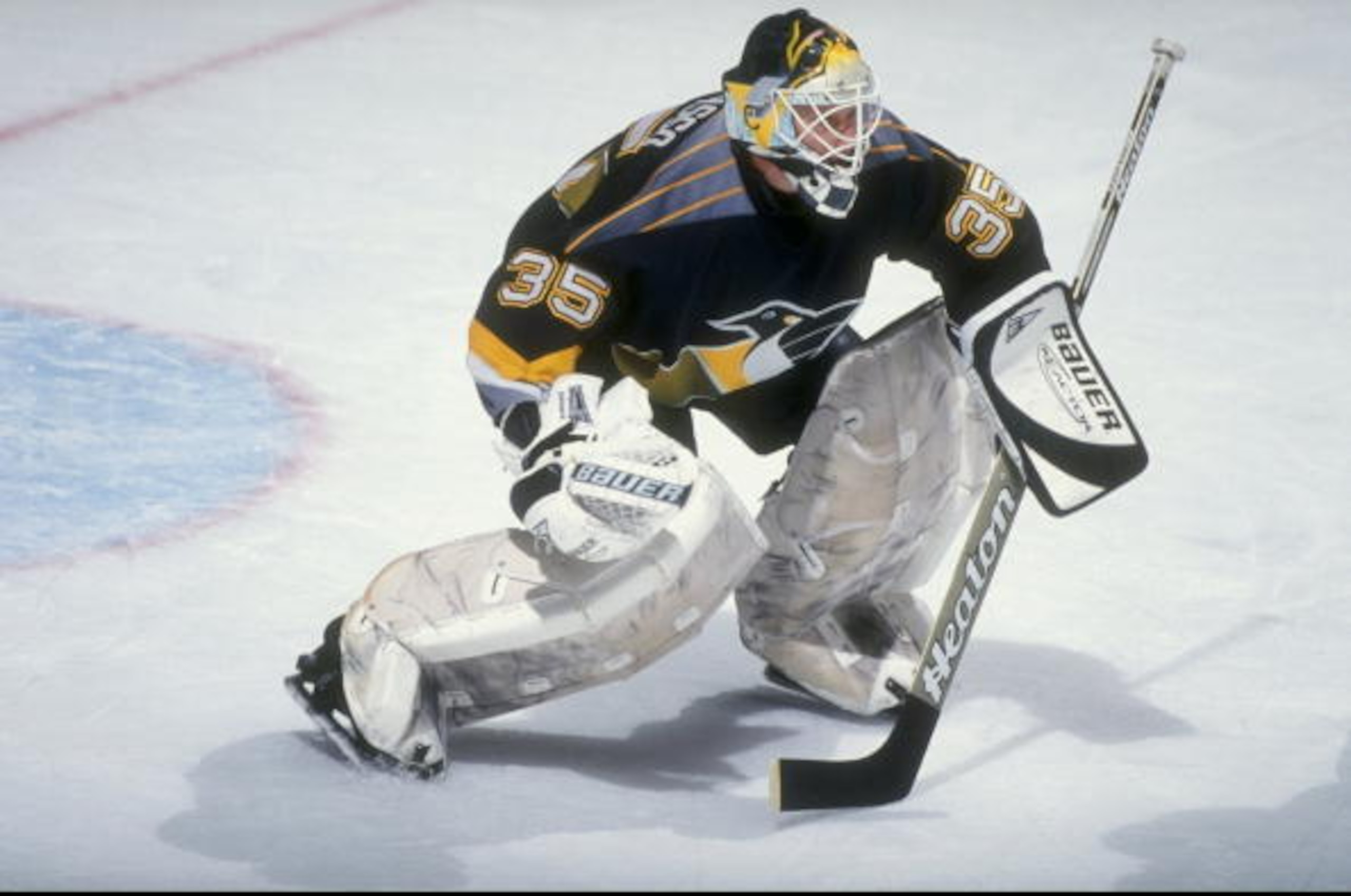
Career statistics: Regular season (NHL): 777 GP, 369-277-86, 3.24 GAA, .892 S %, 38 SO; Playoffs: 119 GP, 61-54, 3.01 GAA, .902 S %, Calder Trophy (1983-84), Vezina Trophy (1983-84), Jennings Trophy (1984-85), All-Star (1985), Stanley Cup (1991, 1992)
Tom Barrasso was a high school sensation in Massachusetts, who was the talk of the draft as a rare goalie at the top of the draft and was drafted 5th overall by the Buffalo Sabres in the 1983 NHL Entry Draft and immediately thrust himself into a primary role with the Sabres, playing in 42 games and capturing the Calder and Vezina Trophies in 1984-85. He followed that up by leading the league in GAA and shutouts year 2 while winning (and sharing with Bob Sauve) the Jennings Trophy. Outside of adding the big silver chalice in the postseason, there wasn't much more Barrasso could've possibly done in the regular season his first two seasons.
Barrasso had some setbacks his next three-plus seasons with Buffalo and it eventually led to his being dealt to the Pittsburgh Penguins on November 12, 1988. Barrasso instantly upgraded the goalie position for Pittsburgh, and was a major piece of two championship teams in 1991 and 1992, shedding any possible misconceptions of Barrasso not being a clutch goalie. He would struggle some with his play and injuries in the mid 90's before a bit of a resurgence in the late 90's, before being dealt to Ottawa in March 2000. He would bounce around between Toronto, Carolina and St. Louis and play 44 games over his last two seasons.
Tom Barrasso started off his career as a teenage phenom and came up large for his teams when he was needed most, winning the Stanley Cup twice. Since he played on a few teams that were so offensively focused, his stats were a bit skewed, but when he was on his game, Barrasso was right there in the mix with just about anyone. He fits in at number 28 in my top 100 and a case could be made that he deserves to be even higher.
Best season: Since it took place in the mid-80's in the high offensive era, I'd have to say Barrasso's best season was the 1984-85 season, when he posted a 25-18-10 record in 54 games, with a league-best 2.66 GAA and five shutouts. He also posted an .887 save percentage, which ranked sixth in the league and also picked up the Jennings Trophy. His playoff record was 2-3 with a 4.40 GAA and .854 saver percentage as the Sabres lost in the first round to the Quebec Nordiques. All in all, not a bad year for a 19-year old.
No. 27 Mike Vernon
74 of 100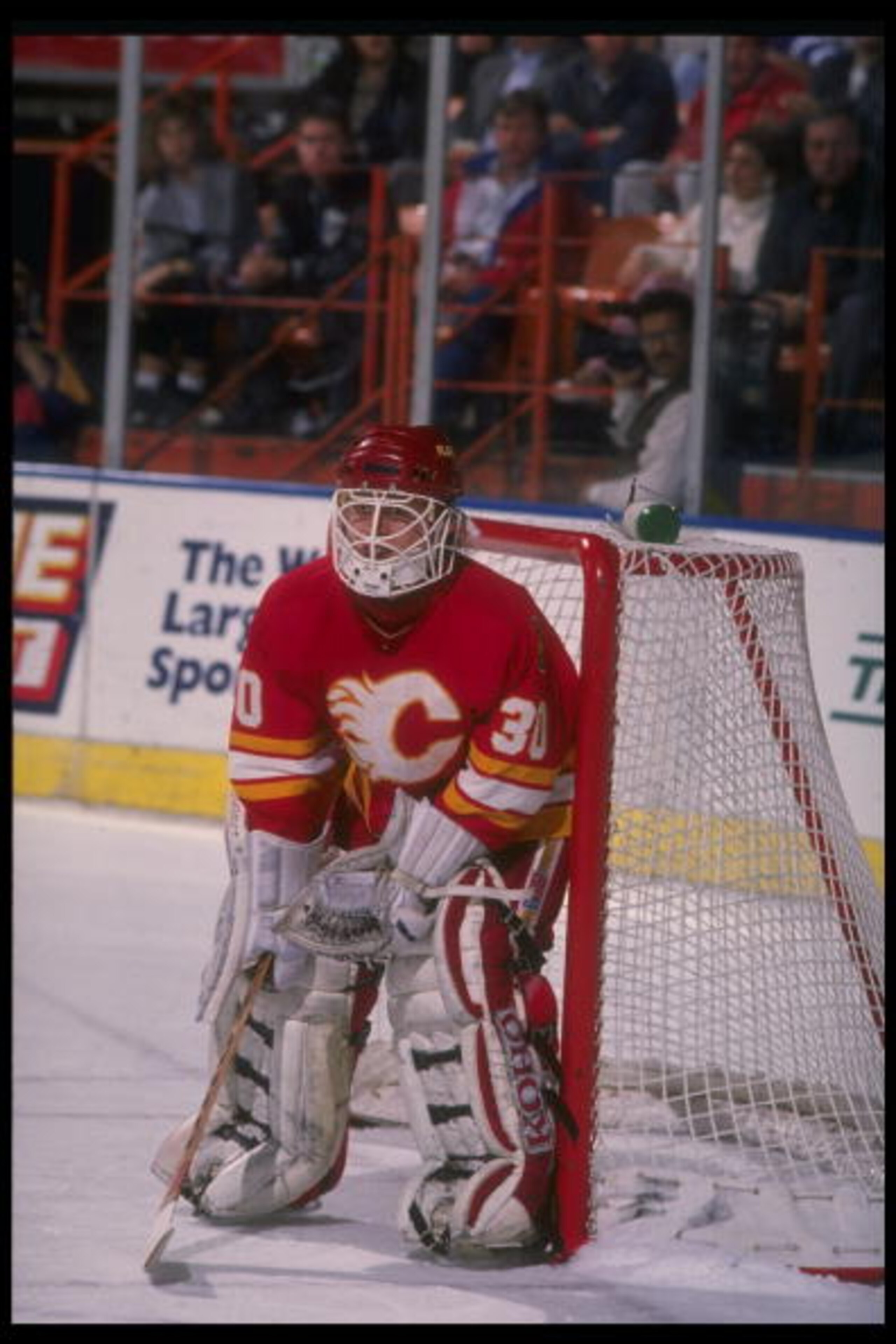
Career statistics: Regular season (NHL): 781 GP, 385-273-92, 2.98 GAA, 27 SO; Playoffs: 138 GP, 77-56, 2.68 GAA, .896 S %, 6 SO, Conn Smythe Trophy (1996-97), Jennings Trophy (1995-96), All-Star (1988, 1989, 1990, 1991, 1993), Stanley Cup (1989, 1997)
Mike Vernon was a 2nd round draft choice of the Calgary Flames and 56th overall in the 1981 NHL Entry Draft. He would make his Flames NHL debut with a couple of games in both the 1982-83 and 1983-84 seasons, but had his first major contributions in helping the Flames make the 1986 Stanley Cup Finals before losing to the Montreal Canadiens. Vernon actually played more games in the playoffs (21) than he did in the regular season (18) during the 1985-86 season, which certainly doesn't happen often. He would win his first Stanley Cup three years later, gaining revenge on the Canadiens.
Vernon was generally a small guy in terms of size, but he certainly didn't play small, coming up very big in his play, showing off his agility and goaltending ability, winning two Stanley Cups and 73 playoff games in 123 chances with both the Flames and Detroit Red Wings. The Wings acquired Vernon from Calgary for the late Steve Chiasson on June 29, 1994. Vernon would play three seasons with the Red Wings posting 53 wins in 95 games. He made the finals twice, losing to the New Jersey Devils in 1995 and then winning it all with Detroit in 1997, all while "fighting" off the Western Conference opponent Colorado Avalanche.
Vernon would be dealt to the San Jose Sharks after winning the Cup and had two and a half solid years with the Sharks before moving on to the Florida Panthers for a half season, before returning to the Calgary Flames for two seasons to finish his career. Mike Vernon had an amazing career and remains the franchise leader in just about every career goaltending stat you can think of for the Atlanta/Calgary Flames franchise, as well as having his number 30 to the rafters with the Flames. Add it all up and it places Vernon at number 27 on my top 100 list.
Best season: Mike Vernon's best year was 1988-89 with the Calgary Flames, when he posted a league-best 37 wins in 52 starts, with a 2.65 GAA and .897 save percentage. In the post-season, Vernon went 16-5 in 22 games, with a 2.26 GAA, .905 save percentage and a league-high three shutouts, all while leading the Flames to a Stanley Cup title, defeating the Montreal Canadiens in six games.
No. 26 Jean-Sebastien Giguere
75 of 100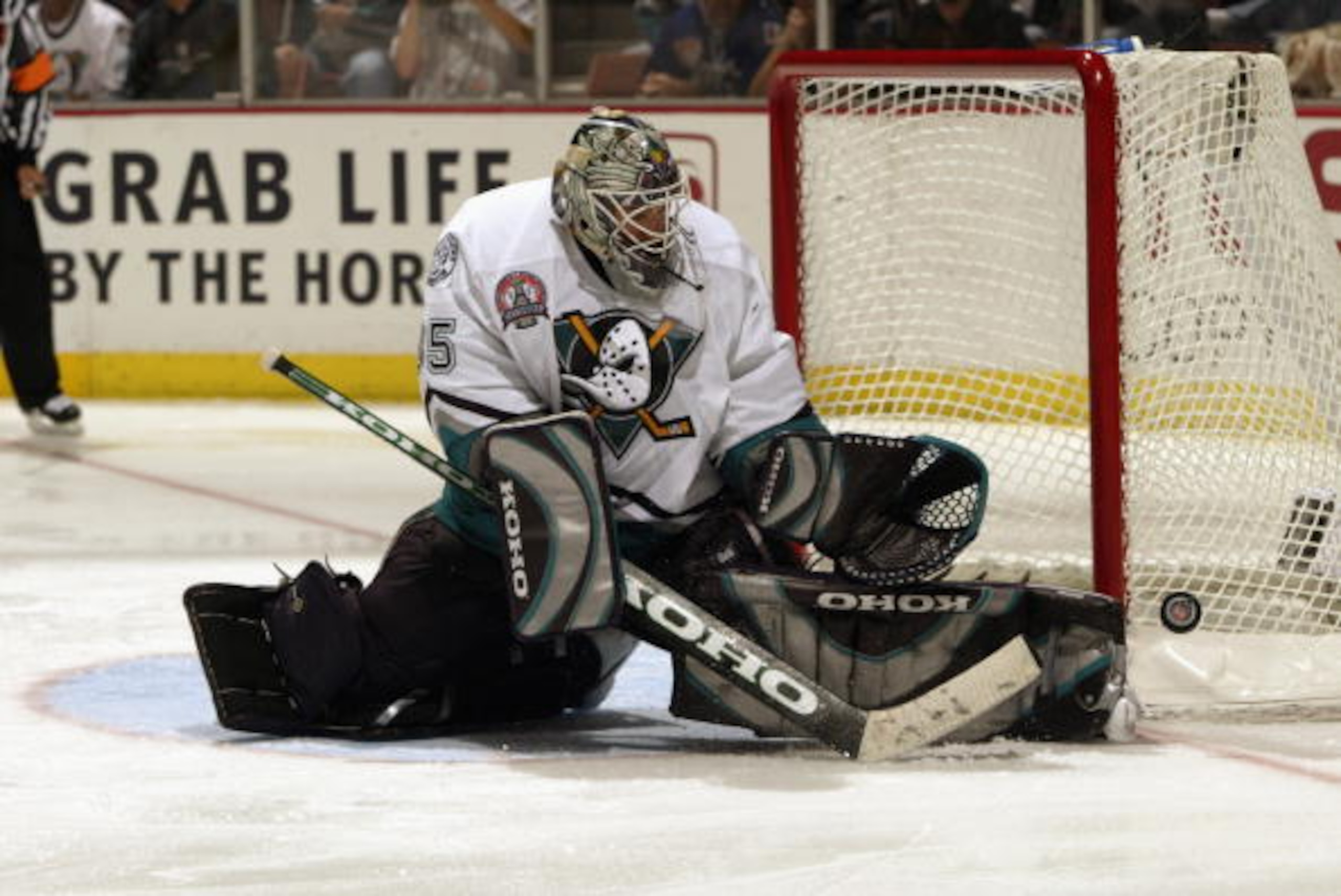
Career statistics: Regular season (NHL): 525 GP, 231-195-67, 2.53 GAA, .913 S%, 34 SO; Playoffs: 52 GP, 33-17, 2.08 GAA, .925 S %, Conn Smythe Trophy (2002-03), All-Star (2009), Stanley Cup (2007)
Jean-Sebastien "Jiggy" Giguere was somewhat of a late bloomer, originally a first round pick of the Hartford Whalers, but not growing into his stardom until he was part of his third franchise. His NHL career started with eight games of limited action towards the end of the 1996-97 season. He was first dealt away from Carolina (after relocating from Hartford) to Calgary with Andrew Cassels for Gary Roberts and Trevor Kidd on August 25, 1997. Giguere would be frustrated greatly during his time with the Flames, being yo-yoed between the parent club and the minor leagues and never getting a chance to show what he can do and losing confidence while being stuck behind the likes of Fred Brathwaite and Ken Wregget.
While Giguere was expected to stay on the fast track and take over the number one job in Calgary, it certainly did not happen that way, and he played in just 22 games over two seasons, before being dealt to the Anaheim Mighty Ducks for a second round draft pick on June 10, 2000, to avoid losing him in the upcoming expansion draft. GM Terry Murray had allegedly targeted Giguere for some time and it also reunited Jiggy with his goaltending coach he first had as a teenager, Francois Allaire, who was the goaltending coach with Anaheim. Being reunited with Allaire immediately helped Giguere's confidence and he took advantage of the opportunity, playing in a career-high 34 games in 2000-01, setting the stage for the path his career would take in Anaheim.
Giguere would play 53-plus games the next six seasons with Anaheim including his legendary 2003 playoffs, earning him a Conn Smythe Trophy, despite losing in the Stanley Cup Finals to the New Jersey Devils in seven games. He would redeem the loss four years later when the Ducks won the 2006-07 title. Giguere was capable of dominating and rose to the occasion more often than not when given the opportunity. His performance in those 2003 playoffs, specifically in his performance against the Detroit Red Wings that year showed what Jiggy was capable of and earn him spot number 26 in my top 100. Giguere would be dealt to the Toronto Maple Leafs on January 31, 2010 and was injury riddled a lot of that time and will be a free agent this off-season, so where the next chapter of J.S. Giguere is written is anyone's guess at this point.
Best season: Giguere's best year was his 2002-03 year, when he went 34-22-6 in 65 games with a .920 save percentage and a 2.30 GAA. His legendary playoff performance that year helped spark the "getting jiggy with it" movement. His playoff stats were a 15-6 record with a 1.62 GAA and .945 save percentage and five shutouts, earning Giguere the Conn Smythe Trophy.
No. 25 Lorne Chabot
76 of 100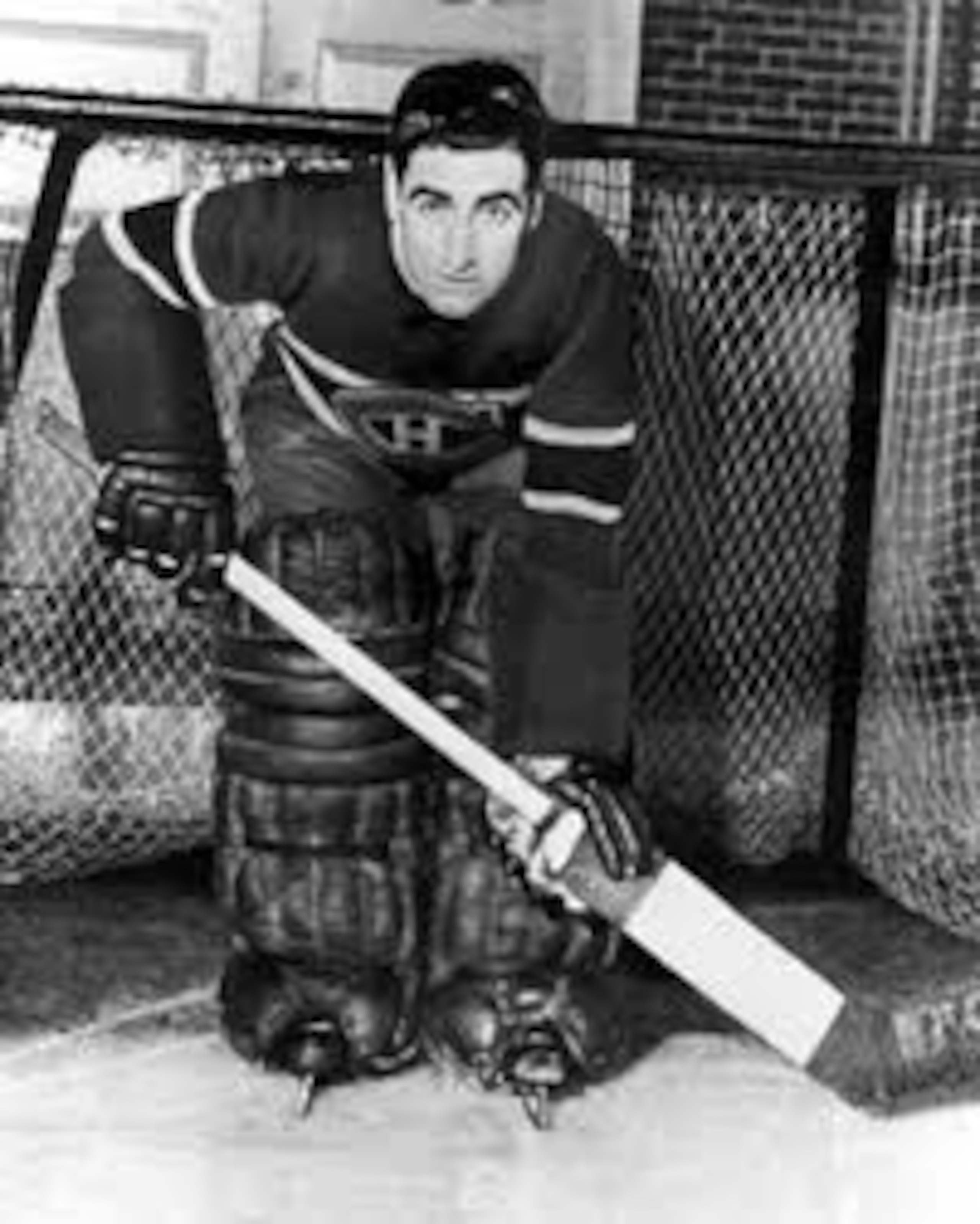
Career stats: 412 GP, 201-147-62, 2.03 GAA, 71 SO, Playoffs: 37 GP, 13-23, 1.54 GAA, 5 SO; Vezina Trophy (1934-35), All-Star (1934-35), Stanley Cup (1928, 1932)
Lorne Chabot was signed by the New York Rangers as a free agent on September 2, 1926. His NHL career would get off to a great start, posting a shutout in his debut, on November 27, 1926 against the Montreal Canadiens. He would take over the starting job for the Rangers, playing in all 44 games the following season, helping the Rangers to the Stanley Cup Finals.
It was in the 1928 Finals one of the more interesting stories in the history of the NHL took place, when Rangers GM Lester Patrick was forced into action to replace Chabot after an injury and helped turn the tide of the series, giving the New York Rangers their first Stanley Cup. That off-season, Chabot was traded to Toronto for John Ross Roach and cash.
Chabot would have a nice five-year run with the Maple Leafs, picking up his second Stanley Cup title in 1932. His next stop was Montreal, having been traded for the great George Hainsworth on October 1, 1933. He would be dealt to Chicago about a year later and would bounce around with the Montreal Maroons and New York Americans to finish his career.
Chabot was a bigger sized goalie for his era, utilizing his 6'1" frame but mostly relying on his quick reflexes to stop opponents. He also had the distinction of playing in the two longest games in league history. It puzzles me that Chabot with all of his statistics has been overlooked for election into the Hockey Hall of Fame. You would think with his 2.03 goals against average being the fourth best of all-time, he might have already gotten enough votes to get in, but then again, it wasn't exactly the high scoring 1980's Chabot played in, so it's tough to gauge whether or not that worked against him or not.
With all the things he did, although doing it sometimes overlooked or under-appreciated to an extent, I place Chabot at number 25 in my top 100. Sadly, Chabot passed away at the age of 46 from complications involving arthritis that likely came to some degree from injuries suffered in his playing days.
Best season: Chabot's one year with the Chicago Blackhawks in 1934-35 produced a record of 26-17-5 in 48 games, with a league best 1.80 GAA, and also adding eight shutouts. They would lose by total goals to the Montreal Maroons in the league quarterfinals, despite the fact Chabot yielded just one goal in the two games.
No. 24 Gump Worsley
77 of 100
Career stats: 861 GP, 335-352-150, 2.88 GAA, 43 SO Playoffs: 70 GP, 40-26, 2.78 GAA, 5 SO, Calder Trophy (1952-53), Vezina Trophy (1965-66, 1967-68), All-Star (1961, 1962, 1965, 1972), Stanley Cup (1965, 1966, 1968, 1969)
Gump Worsley had a career that had two distinctly different phases to it. After growing up in poverty during the Great Depression, Worsley joined the New York Rangers at the age of 23 and began a lengthy NHL career that spanned 21 seasons, the first ten of which were with the Rangers. During that time, Worsley never won a playoff series, but always seemed to be facing 30-plus shots a night and playing incredible in net, but had little results to show for his efforts and earned the label of a "loveable loser." In June 1963, Worsley was traded to his hometown Montreal Canadiens team in a seven-player deal that sent the legendary Jacques Plante to the Rangers.
The second phase of his career came to be with the Canadiens and it was a career of being a great winner for Worsley. In a five year span from 1964-65 to 1968-69, Worsley led the Habs to four Stanley Cups, posting a sub-2 GAA in each of those playoffs. In 1969, Worsley would develop such a fear of flying that it curtailed his career after a nervous breakdown in 1969 and seemingly ending his NHL career. The expansion Minnesota North Stars took a chance on Worsley, adding him in 1970, where Worsley led the Stars to three first-round playoff exits.
While Worsley doesn't necessarily have the most impressive stat line, he is still considered one of the all-time greats and earned an induction into the Hockey Hall of Fame in 1980. One can only wonder what type of career statline Worsley would have ended up with had he played on a team like the Canadiens for his entire career. For his actual career, he'll have to settle for number 24 in my top 100.
Best season: Worsley's best season came in 1967-68, when he posted a 19-9-8 record in 40 games with a career-best 1.98 GAA with six shutouts. He would follow it up with an 11-0 playoff, helping the Montreal Canadiens to another Stanley Cup title, one of four Worsley would take part in.
No. 23 Frank Brimsek
78 of 100
Career statistics: Regular season (NHL): 514 GP, 252-182-80, 2.70 GAA, 40 SO; Playoffs: 68 GP, 32-36, 2.54 GAA, 2 SO, Calder Trophy (1938-39), Vezina Trophy (1938-39, 1941-42), All-Star (1947, 1948), Stanley Cup (1939, 1941)
Frank Brimsek was signed by the Boston Bruins after a successful run had taken him through stops in Minnesota, Pittsburgh and Providence, before the Bruins signed Brimsek. Brimsek had the task of following the legendary Tiny Thompson, but he didn't buckle under any of that pressure as Brimsek starred as a rookie, posting 33 wins, ten shutouts and a 1.56 GAA, in addition to two streaks of at least 200 minutes of scoreless hockey, helping to earn himself a Calder Trophy.
Brimsek would go 8-4 in the postseason to help the Bruins add a Stanley Cup. Two years later, he carried the Bruins to a second title in three years, even with some of their more prominent Bruins skaters battling in World War II and obviously not available. Soon after, Brimsek would miss a couple years serving his country in World War II, but came back and returned to his All-Star form. There definitely was a downgrade in the talent on the Bruins' roster and Brimsek's abilities could only do so much to keep the Bruins in games and led to first round exits for the Bruins. In September 1949, Brimsek was sold to the Chicago Blackhawks where he would play in his final season at the age of 34.
Brimsek was elected to the Hockey Hall of Fame in 1966 and had the unique ability of being a player that was able to throw off his opponents by playing a laid back style. As opposing players would break in, Brimsek was known for laying back calmly against his net and would bait them into feeling overconfident, only to have Brimsek turn them back. He comes in at number 23 in my top 100 based on his amazing career.
Best season: Brimsek took the league by storm in his initial season, posting a ridiculous 33-9-1 record in 43 games during his rookie 1938-39 season, putting up a league best 1.56 GAA with ten shutouts. He followed it up with an even better postseason, with a 1.25 GAA in 12 games, going 8-4 and adding one shutout, while leading the Boston Bruins to a Stanley Cup title, defeating the Toronto Maple Leafs in five games. He earned the nickname "Mister Zero" for an amazing streak he started his career with, including two 200-plus minute streaks of scoreless play against within his first seven games, including six shutouts.
No. 22 Gerry Cheevers
79 of 100
Career statistics: Regular season (NHL): 418 GP, 230-102-74, 2.89 GAA, 26 SO; Playoffs: 88 GP, 53-34, 2.69 GAA, 8 SO, All-Star (1969)
Gerry Cheevers was a goalie who helped lay the groundwork for goalies behind him to carry on his work, whether it was showing fire an emotion a la Ron Hextall or Billy Smith, or being able to act like a third defenseman a la Hextall or Martin Brodeur. Cheevers played the game with a certain flair that always seemed to entertain crowds with his sense of humor as well and he was a fan favorite in Boston.
Similar to some other goalies, Cheevers was at his best when it counted the most. His career started first with the Toronto Maple Leafs, playing just two games in the 1961-62 season. He wouldn't emerge in the NHL again until 1965-66 after being selected by the Boston Bruins in the Intra-League Draft. Cheevers would team up with both Eddie Johnston and Bernie Parent in his rookie year. Cheevers would go on to play in six more seasons with the Bruins before defecting to the WHA and bigger money with the Cleveland Crusaders, where Cheevers would spend three quality seasons, before forcing his own release during his fourth year, allowing him to return to the Bruins.
Cheevers would return to play five more years with the Bruins, but was unable to get them another title, getting them as far as the Stanley Cup Finals in 1976-77, only to get swept by the rival Montreal Canadiens. Cheevers was known as a guy who didn't like to practice, and didn't really care about his numbers per se, but when the game was on the line, he was a guy you wanted between the pipes. For his clutch abilities and pioneering, he ranks at number 22 in my top 100.
Best season: Cheevers' had an amazing record of 27-5-8 in the 1971-72 season, with a 2.50 GAA and two shutouts in 41 games for the Bruins. Keep in mind, the team went 54-13-11 on their way to a Stanley Cup, led by the great Bobby Orr who was an incredible +86 for the season. In the postseason, Cheevers played in eight games, going 6-2 with a 2.61 GAA and two shutouts, sharing the load with Eddie Johnston to bring the Bruins their second Stanley Cup title in three seasons.
No. 21 Clint Benedict
80 of 100
Career statistics: Regular season (NHL): 362 GP, 190-143-28, 2.32 GAA, 57 SO; Playoffs: 28 GP, 11-17, 1.86 GAA, 9 SO, Stanley Cup (1921, 1923, 1926)
Clint Benedict was an original member of the NHL, playing with the original Ottawa Senators franchise in the inaugural 1917-18 season and would be in net for Ottawa for seven seasons total. In that first season, Benedict had one of the only two shutouts league wide (Georges Vezina had the other) and helped overhaul the goalie rules, helping to ensure goalies could drop down off their skates, something that wasn't always allowed in the previous NHA. Dropping to his knees on the ice so often helped earn him the nickname "Praying Benny."
In his seven years with the Senators, Benedict led the league in wins six times and goals against average five times. He was part of the first NHL "dynasty" as the Senators won three Stanley Cups in the first five years of the league, with Benedict becoming one of the first stars in net. In 1924, he was sold along with Punch Broadbent to the Montreal Maroons, where he was part of goalie history, becoming the first goalie to wear a facemask, coming after a shot from the legendary Howie Morenz hit Benedict in the cheek and nose. Benedict would shed the mask after two games, saying the mask obscured his vision on low shots.
It certainly was a different game whi hateen Clint Benedict played in a very different era from the game we know today, so it's all but impossible to compare him to the modern day goalies, but based on the impact Benedict had on the league and the impressive statistics he posted, I rank him at number 21 in my top 100. Benedict was voted into the Hockey Hall of Fame in 1965 and also passed away at the age of 84 back in November 1976.
Best season: Benedict had his best season in 1926-27, when he lead the league with a 1.42 GAA and posted a record of 20-19-4 in 43 games, with 13 shutouts for the Montreal Maroons. The Maroons would lose in the quarterfinals to the Montreal Canadiens despite the fact Benedict yielded just two goals in the two playoff games.
No. 20 Alec Connell
81 of 100
Career statistics: Regular season (NHL): 417 GP, 193-156-67, 1.91 GAA, 81 SO; Playoffs: 21 GP, 8-5-8, 1.19 GAA, 4 SO
The all-time leader in career goals against average, Alec Connell played in the NHL for 12 seasons, but surprisingly, he only led the league in GAA once during those twelve seasons, which gives you some idea about the era he played in and how little offense was scored league-wide during that time.
He was born in Ottawa and would play his first seven seasons as an Ottawa Senator, helping them win the Stanley Cup in 1926-27. During the 1927-28 season, Connell posted six consecutive shutouts, leading to an amazing streak of 446 minutes and nine seconds of consecutive play without yielding a goal against, a record that still stands today. Connell would retire in 1933, but would end up returning with the Montreal Maroons, where he would play two seasons and help the Maroons win a Stanley Cup in 1934-35.
Connell was elected into the Hockey Hall of Fame in 1958, and with his amazing goaltending statistics, shakes out at number 20 on the all-time top 100 list of goaltenders. You'd think with his statistics he might rank higher, but you have to take into consideration the era he played in, which did not have the offensive talent in place like they do today.
Best season: In 36 games for the Ottawa Senators in 1925-26, Connell put up an amazing 24-8-4 record and yielded just 42 goals for a 1.12 GAA, while posting an eye opening 15 shutouts. He would go 0-1-1 in the postseason, but yielded just two goals, as the Senators fell to the Montreal Maroons.
No. 19 Charlie Gardiner
82 of 100
Career statistics: Regular season (NHL): 316 GP, 112-152-52, 2.02 GAA, 42 SO; Playoffs: 21 GP, 12-6, 1.43 GAA, 5 SO, Vezina Trophy (1931-32, 1933-34), All-Star (1930-31, 1931-32, 1932-33, 1933-34), Stanley Cup (1934)
Chuck Gardiner was a rare European import into the NHL of the 1920's and 1930's, coming from Scotland to Canada when he was seven years old. He grew up in Winnipeg and eventually made his way to the Chicago Blackhawks, where he played for seven seasons. His first two seasons did not go well in the win/loss column, as Gardiner's record was 13-51-10. However, his GAA were 2.85 and 1.83 for the two seasons, so it's not as if he played badly during that time.
Gardiner would be at the forefront of a great improvement by the Blackhawks as they worked their way from being a bottom feeder towards making the playoffs and beyond. In his last six seasons, he played in every game for the Blackhawks and saved the best for his last season, as he helped lead Chicago to a Stanley Cup championship in 1933-34, a season that tragically would be Gardiner's last in his career. He died tragically from a brain hemorrhage, just a few weeks after leading the Blackhawks to their first ever Stanley Cup.
Charlie Gardiner was one of the better goaltenders of his day, and his career 2.02 GAA ranks third on the all-time list. It's really tough to figure out where he fits amongst his contermporaries of other eras, but I place Gardiner at number 19 in my top 100.
Best season: Gardiner's best season was his final one, when he went 20-17-11 in 48 games in his final season. He also had a 1.63 GAA and ten shutouts. He followed it up in the postseason with a 6-1-1 record with a 1.33 GAA and two shutouts in helping lead the Blackhawks to a Stanley Cup title. Tragically, Gardiner would pass away from a brain hemorrhage just a few weeks later on June 13, 1934.
No. 18 Ed Belfour
83 of 100
Career statistics: Regular season (NHL): 963 GP, 484-320-125, 2.50 GAA, .906 S %, 76 SO, Playoffs: 161 GP, 88-68, 2.17 GAA, .920 S %, 14 SO, Calder Trophy (1990-91), Vezina Trophy (1990-91, 1992-93), Jennings Trophy (1990-91, 1992-93, 1994-95, 1998-99), All-Star (1992, 1993, 1996, 1998, 1999), Stanley Cup (1999)
Eddie "The Eagle" Belfour was a bit of a late bloomer, starring at the University of North Dakota at age 21, before signing with the Chicago Blackhawks as an undrafted free agent in September 1987. Three years later, he came into the NHL full-time and made an immediate and memorable impact on the Chicago Blackhawks, winning both the Vezina, Calder and Jennings Trophies in his rookie year. Looking to show it was no fluke, Belfour came back with a great second year in 1991-92, helping the Blackhawks reach the Stanley Cup Finals before losing to the Pittsburgh Penguins. Belfour always had the flair for the dramatic save, when needed.
Belfour was known for his fiery temper and emotion, clashing at different times with Blackhawks Head Coach Mike Keenan but rarely let it impact his on-ice play. However, in 1997 when the two sides did not appear close to be signing a contract extension, Belfour was sent packing in a trade to the San Jose Sharks for Chris Terreri, Ulf Dahlen and Michal Sykora. He would finish the year with San Jose but bolt for Dallas that off-season as a free agent. Belfour would have three consecutive deep playoff runs in his first three seasons, losing in the Conference Finals to Detroit in 1998, winning the Stanley Cup in 1999 over Buffalo and losing to New Jersey in the 2000 Finals.
Belfour would spend one more season in Dallas before moving on to the Toronto Maple Leafs for three seasons. He would have two real nice regular seasons before the lockout but was unable to duplicate it in the post-season. Post lockout, Belfour had a bit of a dropoff in his final season with Toronto, as well as his last NHL season with Florida, but it's pretty understandable for a player age 40.
The Eagle was a goalie who was known for his aggressiveness and knack for making the big save and accumulated impressive numbers over the course of his career, including ranking third all-time in wins (484), fourth in games played (963), ninth in shutouts (76) and 26th all-time in GAA (2.50). In my overall top 100, Belfour comes in at number 18.
Best season: Belfour's best season came in his first full season (1990-91), when he put up a 43-19-7 record in 74 games for the Chicago Blackhawks, while adding a .910 save percentage, 2.47 GAA and four shutouts. The wins, games played, GAA and save percentage were all league-bests as Belfour picked up the Vezina, Jennings and Calder Trophies. In the post-season, the Blackhawks were unable to make it out of the first round, falling to the Minnesota North Stars in six games.
No. 17 Tiny Thompson
84 of 100
Career statistics: Regular season (NHL): 553 GP, 284-194-75, 2.08 GAA, 81 SO; Playoffs: 44 GP, 20-24, 1.88 GAA, Vezina Trophy (1929-30, 1932-33, 1935-36, 1937-38), All-Star (1930-31, 1934-35, 1935-36, 1937-38), Stanley Cup (1929)
Cecil "Tiny" Thompson was one of the first West Coast born players to make it to the NHL, coming via the AHA, when he was sold from the Minneapolis Millers to the Boston Bruins of the NHL. Thompson joined the Bruins and immediately took the league by storm, putting up an impressive ten-plus seasons with the Bruins, including a Stanley Cup in his first season (1928-29). Thompson would also be durable, missing just one game during his time in Boston.
He also became the first NHL goaltender to be credited with an assist, when he picked one up during the 1935-36 season, on a goal scored by Babe Siebert. Thompson was one of the first goalies to specialize in using his glove to catch and freeze the puck after making a save and was one of the founding fathers of being a stickhandling goaltender, setting the stage for players like Ron Hextall and Martin Brodeur to come behind him.
His offensive competition may not have been up to par with today's standards, but Tiny Thompson set many trends as a goaltender and won four Vezina Trophies and made the All-Star game four times. He also has the fifth best goals against average of all time at 2.08. Add it all up, plus his Hall of Fame induction in 1959, and Thompson earns the number 17 spot on the all-time list.
Best season: Thompson came in and had an amazing first year in the NHL, posting a record of 26-13-5 in 44 games, with a staggering 1.15 GAA, while adding 12 shutouts. He followed it up with a 5-0 record in the postseason, yielding just three goals (with three shutouts) as the Bruins went on to take the Stanley Cup Championship.
No. 16 Georges Vezina
85 of 100
Career statistics: Regular season (NHL): 190 GP, 103-81-5, 3.28 GAA, 13 SO; Playoffs: 13 GP, 10-3, 2.69 GAA, 2 SO, Stanley Cup (1919, 1924, 1925)
Georges Vezina was a man of NHL firsts. He played in the league's first season, 1917-18, playing in all 21 games (1 was forfeited) for the Canadiens that first season, posting the first shutout in NHL history on February 18, 1918, in a 9-0 victory against Toronto. Vezina also was the first goalie to lead the league in goals against average, posting a 3.93 GAA that first season (NOTE: Remember, there were many anti-goalie rules in place at the beginning, when goalies were restricted from dropping off their skates which gave the offense a great advantage in the first few years of the league). Vezina would also be the first goalie to pick up an assist, doing it on December 28, 1918. Vezina was the original "stand-up" goalie and was the benchmark for many who followed in his footsteps.
Vezina would play 189 straight games over his eight full seasons before getting tuberculosis and literally collapsing on the ice in the first game of the 1925-26 season, essentially ending his career as Vezina would die from the disease on March 27, 1926 at the age of 39. Over his career in both the NHA and NHL, Vezina didn't miss a game, playing in 367 straight games (including playoffs).
He would have the Vezina Trophy named in his honor, when the owners of the Montreal Canadiens donated a trophy to the NHL in honor of the late Vezina before the 1926-27 season. Ironically, the trophy was awarded to Vezina's replacement George Hainsworth. It's hard to gauge Georges Vezina's game against those of other eras, but I place Vezina at number 16 in my top 100.
Best season: Vezina's best season was probably his last full season, when he went 17-11-2 in 30 games (his biggest career workload), posting a league-best 1.81 GAA with a career-best five shutouts. The Canadiens would go on to win their second straight Stanley Cup, with Vezina yielding just two goals in two games for the second straight post-season.
No. 15 Billy Smith
86 of 100
Career stats: 680 GP, 305-233-105, 3.17 GAA, 22 SO, Playoffs: 132 GP, 88-36, 2.73 SO, 5 SO, Conn Smythe Trophy (1982-83), Vezina Trophy (1981-82), Jennings Trophy (1982-83), All-Star (1978)
Billy Smith was originally drafted by the Los Angeles Kings in the 5th round of the 1970 NHL Draft, but Smith would play just five games as a King, before being selected by the New York Islanders in the 1972 Expansion Draft.
Smith would be part of a fierce goaltending tandem/competition with Glenn "Chico" Resch, and Smith never played more than 58 games in a regular season. However, it was in the playoffs where Smith truly had the number one job and earned every minute of it with his clutch goaltending. The two things Smith will be remembered for most are his clutch playoff performances and his intense protection of his goalie crease. Opposing skaters who wandered into the goal crease were "rewarded" with Smith's mastery of his goalie stick, whether into the legs or back of an opponent. He would drop the gloves too if it came to it, and earned the nickname "Battlin'" Billy Smith.
Billy Smith didn't necessarily put up the statistics to merit a selection as high as I have him (at number 15), but his stats were hurt by two major factors, playing in the high scoring 1980's and also being limited by Al Arbour in his games played during the regular season. Both of those factors definitely hurt Smith's career statistics, and especially the second one is probably a big reason Smith surprisingly only made one All-Star appearance.
Ask around and it will be tough to find a goalie who could perform in the playoffs the way Smith did. You can't win four straight Stanley Cup titles like Smith did by accident, not to mention, picking up the playoff MVP award in 1982-83. Mike Bossy, Denis Potvin and Bryan Trottier may have gotten more of the headlines, but make no mistake, Billy Smith was as important as anyone to making that dynasty happen. Billy Smith was also the first NHL goaltender credited with scoring a goal, thanks to an errant pass by Rob Ramage of the Colorado Rockies on November 28, 1979.
Best season: Smith's best season was likely his 1981-82 campaign, when despite playing in only 46 games, Smith would post an amazing 32-9-4 record and his 2.97 GAA would be third best in the league. (His 32 wins led the league). In the postseason, Smith would lead the Islanders to their third straight Stanley Cup title, with a 15-3 record in 18 games, with a 2.52 GAA and adding one shutout.
No. 14 Tony Esposito
87 of 100
Career statistics: Regular season (NHL): 886 GP, 423-306-151, 2.92 GAA, 76 SO; Playoffs: 99 GP, 45-53, 3.07 GAA, 6 SO, Calder Trophy (1969-70), Vezina Trophy (1969-70, 1971-72, 1973-74), All-Star (1970, 1971, 1972, 1973, 1974, 1980)
When you try to compile a top 100 of goalies over different eras, you come across certain guys that are harder to slot in than others. One of those guys is Tony Esposito, who was such a dynamic goaltender, who played during a high scoring era and for some bad teams, making it hard to fairly compare him with goalies who played in the "clutch and grab" era or goalies that played for star studded teams that may not have been necessarily as good as their statistics alone might indicate.
Esposito was first signed by the Montreal Canadiens as a free agent in the fall of 1967 and appeared in 13 games for the Canadiens during the 1968-69 season. Although he did not appear in a playoff game, the team did go on to win the Stanley Cup that season. That summer, the Chicago Blackhawks claimed Esposito from Montreal in the Intra-League Draft and immediately became the number one goalie in the Windy City. His first year, he set the bar incredibly high, winning both the Vezina and Calder Trophies and putting up impressive numbers.
The following season would bring Esposito and the Blackhawks to Game Seven of the Stanley Cup Finals but came up short of a title at the hands of the Montreal Canadiens. Two years later, the Blackhawks once again would come up short in the Stanley Cup Finals, once again falling to the Habs, this time in six games. Esposito would play 15 seasons with Chicago until the age of 40 and goes down as one of the legends not only just in Blackhawks history, but the NHL as well, and earns spot number 14 in my top 100.
Best season: Esposito's first year with the Blackhawks was one for the ages, as he put up a 38-17-8 record in 63 games with a 2.17 GAA and league-best 15 shutouts. Esposito took home the Calder and Vezina Trophies, as well as having his first All-Star Game appearance. The Blackhawks would sweep the Detroit Red Wings in the quarter-finals, but were swept by the Boston Bruins in the semi-finals. Espo was 4-4 in his first taste of the playoffs, with a 3.38 GAA.
No. 13 Grant Fuhr
88 of 100
Career statistics: Regular season (NHL): 868 GP, 403-295-114, 3.38 GAA, 25 SO; Playoffs: 150 GP, 92-50, 2.92 GAA, 6 SO, Vezina Trophy (1987-88), Jennings Trophy (1993-94), All-Star (1982, 1984, 1985, 1986, 1988, 1989), Stanley Cup (1984, 1985, 1987, 1988, 1990)
Grant Fuhr was an Alberta native selected by the hometown Edmonton Oilers in the first round of the 1981 NHL Entry Draft and helped guard the net for one of the greatest dynasties of our time on a team that tended to focus so much on their offensive firepower that their goalie would often be left out to do it all himself, which Grant Fuhr was able to do more often than not. Wayne Gretzky has often called Fuhr the greatest goalie in NHL history, but he's probably a little biased, having spent so many years as Fuhr's teammate.
Fuhr had a distinguished career, starting as an 19-year old with the Oilers, and playing his first ten seasons in Edmonton. Fuhr didn't put up the greatest numbers, but was recognized by others for his great contributions, making six All-Star games, winning a Vezina Trophy and finishing second for the Hart Trophy in those ten seasons, along with countless impressive saves along the way. Fuhr would win five Stanley Cups with the Oilers, although he didn't appear in a playoff game in 1990, due to injury, and was able to rise to the occasion when it was needed most, backed up by his 92-50 record in playoff games, with a 2.92 GAA.
The Oilers would deal Fuhr to the Maple Leafs in a huge seven-player deal in September 1991. He would last just a year and a half or so in Toronto before being dealt to Buffalo in February 1993 in another star filled trade. After teaming with Dominik Hasek to win the Jennings Trophy in 1993-94 with the Sabres, Fuhr was reunited with former teammate Wayne Gretzky on the Los Angeles Kings on Valentine's Day 1995. Fuhr would just play 14 games with the Kings and it appeared his career was near the end. However, Fuhr signed as a free agent with the St. Louis Blues and had an amazing first season with St. Louis, playing in 79 of 82 games his first year, but injured his knee in the playoffs, which killed their playoff chances. He would play 73 games the following season but would struggle to get the Blues very deep in the playoffs as he struggled with opponents and injuries in the final years of his career.
Fuhr would return to his roots in Alberta by being traded from St. Louis to the Calgary Flames, where he played in the final 23 games of his career, including his 400th career win. His number 31 was retired by the Edmonton Oilers and Fuhr was also elected to the Hockey Hall of Fame in 2003, his first year of eligibility. Despite some off-ice issues in his career, there is no doubting Fuhr's production on the ice, and his legendary ability places him at number 13 in my top 100.
Best season: Fuhr's best season was the 1987-88 season with the Edmonton Oilers when he posted a 40-24-9 record in 75 games, while posting a 3.43 GAA and .881 save percentage, with four shutouts. The games played, wins and shutouts would all be a league-best, as was Fuhr's 2,066 saves that year, all earning him the Vezina Trophy and first team All-Star recognition. In the playoffs, Fuhr went an insane 16-2 with a 2.90 GAA and .883 save percentage as the Oilers won their fourth Stanley Cup in five seasons.
No. 12 George Hainsworth
89 of 100
Career statistics: Regular season (NHL): 465 GP, 246-145-74, 1.93 GAA, 94 SO; Playoffs: 52 GP, 22-30, 1.93 GAA, 8 SO, Vezina Trophy (1926-27, 1927-28, 1928-29), Stanley Cup (1930, 1931)
George Hainsworth took over for the legendary Georges Vezina and actually improved upon the bar that Vezina set before him. Hainsworth played seven seasons with the Montreal Canadiens and had an amazing 49 shutouts in his first three seasons, which if those were the only years he played, he still would rank 26th overall in shutouts in league history. He would amass 45 shutouts over the remaining eight seasons in his career.
Hainsworth was known for his laid-back style and he would continuously frustrate his opponents with his ability to stop the puck. After a strong amateur career, Hainsworth signed with the Montreal Canadiens in August 1926. It would certainly be a move that worked out well for both parties. Hainsworth would show his greatest value in the postseason, and helped lead the Habs to back-to-back Stanley Cup titles in 1930 and 1931. He served as captain for the Canadiens during the 1932-33 season, before being dealt to the Toronto Maple Leafs on October 1, 1933, for Lorne Chabot. The two would become the first two players to play for both historic franchises.
He would play three successful seasons with the Maple Leafs, but couldn't bring home a Stanley Cup, losing in the finals each of his last two seasons, at ages 39 and 40. His career goals against average of 1.93 ranks second best in NHL history and his 94 shutouts rank third. Despite the fact he played in an era with a ton less offense than the game of today, Hainsworth played so well that he gets ranked number 12 in my top 100.
Best season: Not hard to figure out Hainsworth's best season, as his NHL-best 22 shutouts in 1928-29 with the Montreal Canadiens while posting a record of 22-7-15 in 44 games, meaning he had a shutout in half the games he played that year! He also had a 0.92 GAA, yielding just 43 goals on the season. Unfortunately, the post season wasn't that kind to Hainsworth and the Habs as they lost in three straight games to the Boston Bruins in the semi-finals. The rules in the NHL changed after that season regarding forward passes, making the game significantly more offensive and near impossible for anyone to duplicate the numbers Hainsworth was able to produce in his first three seasons.
No. 11 Bernie Parent
90 of 100
Career statistics: Regular season (NHL): 608 GP, 271-198-121, 2.55 GAA, 54 SO; Playoffs: 71 GP, 38-33, 2.43 GAA, 6 SO, Vezina Trophy (1973-74, 1974-75), Conn Smythe Trophy (1973-74, 1974-75), All-Star (1969, 1970, 1974, 1975, 1977), Stanley Cup (1974, 1975)
Bernie Parent was a goaltender who had a late start to his stardom, but then also had it taken away quickly because of a freak injury. He started his NHL career with the Boston Bruins before being taken by the Philadelphia Flyers from the Boston Bruins in the 1967 Expansion Draft. He had a really good first year for the Flyers, helping them to a playoff berth in their first season. He would play three-plus seasons with the Flyers before being dealt to the Toronto Maple Leafs in February 1971 in a five-player/pick deal.
Parent was able to team up with his idol Jacques Plante with the Maple Leafs, but did not stay long in Toronto, instead bolting fro the WHA, where he would last only one season before leaving over a pay dispute. He did orchestrate his return to Philadelphia, who re-acquired him in a May 1973 trade. Upon his return to the Flyers, Plante's career took off, helping them to two straight Stanley Cup titles in 1973-74 and 1974-75.
Injuries took away the opportunity for Parent to lead the Flyers to a possible third straight title, but the night of February 17, 1979 ended Parent's career, when an errant stick gave Parent an eye injury he never recovered from. One can only wonder what might have been had Parent been able to stay injury-free, but a minimum, it would've gotten him into my top 10. He'll have to settle for his career highlights, his number being retired by Philadelphia, his 1984 induction into the Hockey Hall of Fame and being ranked number 11 on my list.
Best season: Parent had an incredible 1973-74 campaign, when he put up a then NHL-record 47 wins, with 13 losses and 12 ties in 73 games with a league-leading 1.89 GAA and 12 shutouts, essentially winning the goalie "Triple Crown" and taking home both the Conn Smythe and Vezina Trophies after helping to lead the Philadelphia Flyers to a Stanley Cup. In the postseason, Parent had a 12-5 record with a 2.02 GAA and two shutouts. It would be the first of two consecutive titles for Parent and the Flyers.
No. 10 Johnny Bower
91 of 100
Career statistics: Regular season (NHL): 552 GP, 250-195-90, 2.51 GAA, 37 SO; Playoffs: 74 GP, 54-34, 2.47 GAA, 5 SO, Vezina Trophy (1960-61, 1964-65), All-Star (1961, 1962, 1963, 1964), Stanley Cup (1962, 1963, 1964, 1967)
Johnny Bower had a difficult time entering the NHL, mostly due to the fact there were only six starting goalie spots and teams didn't carry a backup goalie. Many others would have given up by the time Bower got his chance, but Johnny Bower wasn't to be denied, overcoming an arthritic hand condition that would often cause Bower's hand to lock in a claw position and endure through 13 seasons in the minors before finally getting a shot with the New York Rangers in 1953-54. Before the 1958-59 season, Punch Imlach gave Bower the opportunity he was waiting for, making him the starting goalie for the Toronto Maple Leafs.
Bower took advantage of his opportunity, as he started 475 games in net for the Leafs between 1959 and 1970, at the ages of 34 to 45. Over that time, Bower won four Stanley Cups, including three in a row from 1961 to 1963, won two Vezina Trophies and back-to-back-to-back goals against average titles from 1963-64 to 1965-66 and also was a part of four All-Star Games. He was known for both his grace and fearlessness on the ice, but was best known for the poke check, when he would come flying at the skates of an attacking forward to knock the puck away with his stick and eliminate a scoring opportunity. Bower was basically the first goalie to use the poke check as a regular part of his game.
Bower had a large impact on the league and was able to play all the way into his mid 40's and is revered by Maple Leafs faithful for the incredible run he had for the Maple Leafs. It's hard not to wonder what Bower's career totals might have looked at had he been an NHL regular before the age of 34. Even with the late start, I place Bower at number 10 in my top 100.
Best season: Bower had an incredible 1963-64 season, posting a 24-16-11 record in 51 games, with a league-best 2.11 GAA and adding five shutouts. The Maple Leafs would win their third straight Stanley Cup title, winning two straight seven game series over the Canadiens and Red Wings to take the title.
No. 9 Bill Durnan
92 of 100
Career statistics: Regular season (NHL): 383 GP, 208-112-62, 2.36 GAA, 34 SO; Playoffs: 45 GP, 27-18, 2.07 GAA, 2 SO, Vezina Trophy (1943-44, 1944-45, 1945-46, 1946-47, 1948-49, 1949-50), All-Star (1947, 1948, 1949), Stanley Cup (1944, 1946)
Bill Durnan didn't have a long career with the Montreal Canadiens, playing in just seven seasons at the NHL level, but he definitely made his mark, winning six Vezina Trophies (for the best goals against average each year), three All-Star appearances and two Stanley Cups during that time. He was also known as "Dr. Strangeglove," for having the ability to play with either hand holding his stick or being the catching hand, and is the only known ambidextrous goalie to play in the NHL.
Durnan was first a member of the Toronto Maple Leafs organization, before an injury made the Maple Leafs believe he didn't have a future in the NHL. The Canadiens were more than happy to bring Durnan aboard and were the obvious beneficiaries to Durnan's talents. It took until the age of 28 for him to get his first taste of NHL hockey and Durnan certainly grabbed the chance by the horns, winning four straight Vezina Trophies to begin his career, the first goalie to win four straight Vezina Trophies. Turk Broda snapped the streak in 1947-48, but Durnan came back to win two more before calling it quits after the 1949-50 season, a year that saw Durnan set a shutout record (at the time) of over 309 minutes, that lasted until 2004 (broken by Brian Boucher).
Durnan has been quoted by NHL.com as the "greatest nearly forgotten player in the history of the NHL." He was inducted into the Hockey Hall of Fame in 1964 and was also team captain of the Montreal Canadiens, a practice that was banned by the NHL after the 1947-48 season because Durnan left the crease too often and was accused of providing his team with too many uncalled timeouts, a rule that was known to many as the "Durnan Rule." Despite his career being overlooked, his six Vezina Trophies in seven seasons is unmatched by anyone, and because of it, he earns number 9 in my top 100.
Best season: Durnan had a sensational rookie season for the Montreal Canadiens, posting a 38-5-7 record in 50 games, with a league-best 2.18 GAA and adding two shutouts. The Habs would go 8-1 in the playoffs, with Durnan posting a league-best 1.53 GAA and adding one shutout, as the Canadiens defeated the Toronto Maple Leafs in five games and followed it up with a four game sweep of the Toronto Maple Leafs to win the Stanley Cup.
No. 8 Turk Broda
93 of 100
Career statistics: Regular season (NHL): 629 GP, 302-224-101, 2.53 GAA, 62 SO; Playoffs: 101 GP, 60-39, 1.98 GAA, 13 SO, Vezina Trophy (1940-41, 1947-48), All-Star (1947, 1948, 1949, 1950), Stanley Cup (1942, 1947, 1948, 1949, 1951)
"Mr. Maple Leaf" Walter "Turk" Broda wasn't the most athletic looking player and at times, was asked to lose a few pounds off his bulging frame. One famous incident took place between Broda and the legendary Conn Smythe, who at one point replaced Broda until his weight was lowered to a number Smythe was comfortable with and it had a big impact on Broda's career. His lack of true skating ability as a kid is what led to Broda being a goalie. However, just because he wasn't a complete athlete, doesn't change the fact that Borda was the best money goalie of his era, and possibly of all-time.
Despite his excellent regular season numbers in net, it was definitely the post-season where Broda shined most, with a playoff record of 60-39 and a sub 2 goals against average (1.98) and adding 13 shutouts. His most famous playoff performance was probably in the 1942 Stanley Cup Finals, when he helped lead the Toronto Maple Leafs from a 3-0 deficit to come back and take the series in seven games against the Detroit Red Wings. It's the only time until this day that a comeback like that has taken place in the Finals (although it's been done twice by the New York Islanders and Philadelphia Flyers in other rounds since).
After a spectacular 13-plus (1 game in 1951-52) year career with the Toronto Maple Leafs, Broda was voted to the Hockey Hall of Fame in 1967. I think Broda's exceptional career is overlooked to an extent and an argument could be made that Broda should be higher than the number 8 I have him at. He is one player I didn't know all that much about before this article and am glad I read up on him and his great career. Turk Broda Night was at Maple Leaf Gardens on December 22, 1951, where Broda was recognized for his spectacular career by the team and fans.
Best season: Broda had many special years to choose from, but the one that stands out to me was his 1947-48 season when he posted a 32-15-13 record in 60 games, with a league-best 2.38 goals against average, while adding five shutouts. The Maple Leafs would win their second of three straight Stanley Cups that season, with Broda going 8-1 in 9 games, with a dazzling 2.15 GAA and one shutout.
No. 7 Glenn Hall
94 of 100
Career statistics: Regular season (NHL): 906 GP, 407-326-163, 2.49 GAA, 84 SO; Playoffs: 115 GP, 49-65, 2.78 GAA, 6 SO, Calder Trophy (1955-56), Conn Smythe Trophy (1967-68), Vezina Trophy (1962-63, 1966-67, 1968-69), All-Star (1955, 1956, 1957, 1958, 1960, 1961, 1962, 1963, 1964, 1965, 1967, 1968, 1969), Stanley Cup (1961)
Glenn Hall had a lot of impressive numbers in his sixteen-plus year NHL career. The most famous is his amazing iron-man streak of 502 complete games he played in with the Detroit Red Wings and Chicago Blackhawks between the years of 1955 to 1962. Let's not forget the fact that Hall posted this streak while not even wearing a mask over his face! Hall played in an impressive 13 All-Star games and is 8th on the all-time wins list and 4th on the all-time shutouts list.
Hall is also known as the father of the butterfly style of goaltending, something that is often forgotten, as a lot of people think Patrick Roy invented the style and is used in at least some capacity by just about every goalie in the professional ranks these days.
Hall also was a Stanley Cup winner in the midst of his streak, leading the Blackhawks to the title in 1961. He started and ended his career playing with the best, learning under Terry Sawchuk in Detroit and sharing the load with Jacques Plante at the end of his career while in St. Louis. Can you imagine the type of goaltending knowledge these guys must have been able to share amongst themselves?
Hall did it all, earning the nickname "Mr. Goalie," and being voted into the Hockey Hall of Fame in 1975. It all adds up to spot number 7 in my top 100.
Best season: Hall's best season was 1955-56, the year his great consecutive streak started, when he played in all 70 games for the Detroit Red Wings, posting a record of 30-24-16, with a 2.10 GAA and a league-best 12 shutouts. Hall went 5-5 in the postseason as the Wings fell in the finals to the Montreal Canadiens in five games.
No. 6 Dominik Hasek
95 of 100
Career stats: 735 GP, 389-223-95, 2.20 GAA, .922 S%, 81 SO Playoffs: 119 GP, 65-49, 2.02 GAA, .925 S %, 14 SO, Hart Trophy (1996-97, 1997-98), Vezina Trophy (1993-94, 1994-95, 1996-97, 1997-98, 1998-99, 2000-01), Jennings Trophy (1993-94, 2000-01, 2007-08), Ted Lindsay Trophy (1996-97, 1997-98), All-Star (1996, 1997, 1998, 1999, 2001, 2002), Stanley Cup (2002, 2008)
"The Dominator" was as nontraditional a goalie as you might find, as Hasek would twist and turn his body in whatever way he could to stop pucks, using even his posterior, back or any other body part to stop the puck when needed. Hasek, who still is playing in the KHL at age 46, got a late start to his stardom, starting as a 10th round pick of the Chicago Blackhawks in the 1983 NHL Entry Draft. He would stay in his native Czech until 1990, coming to North America, playing for Indianapolis of the IHL. His NHL debut would come later that season, with five games for the Blackhawks.
He would play just 20 games for Chicago the next year, before being traded to the Buffalo Sabres on August 7, 1992 for Stephane Beauregard and a 4th round draft pick. Needless to say, not too shabby a deal for the Sabres, despite sharing time with both Grant Fuhr and Darren Puppa in 1992-93, limiting Hasek to just 28 games.
The following season, Hasek would play 58 games, beginning a streak of six straight years of leading the NHL in save percentage, all but one of those years at .930 or better. His career mark of .922 is the best in league history, his 81 shutouts are 6th, and his 389 wins put him 11th all-time. The Dominator would carry the Sabres often times on his back, but was only able to do so much in the post-season as a Sabre. That did change some, but not until he was traded to Detroit on July 1, 2001, where he dazzled in the post season, going 16-7 with six shutouts, a 1.86 GAA and .920 save percentage, helping the Red Wings win the Stanley Cup. He would retire that off-season, but would return for four more seasons, with the Ottawa Senators and Detroit Red Wings, before retiring for good from the NHL after the 2007-08 season.
Hasek truly is in the mix of the argument for the best of all-time, but his post season struggles in Buffalo, and his late arrival to the NHL slot him in at number 6 on my all-time list. I've included a top 10 list of his biggest moments, but this list alone doesn't come close to covering all of Dominik Hasek's incredible plays.
Best year: Hasek had many seasons that were off the charts, but his 1998-99 season stands out to me for his ridiculous .937 save percentage, 1.87 GAA and 9 shutouts with a 30-18-14 record in 64 games. He picked up his fifth Vezina Trophy and helped lead the Sabres to a controversial ending in the Stanley Cup Finals, losing to the Dallas Stars in six games. Hasek had insane numbers during the post season, with a record of 13-6 in 19 games, with an eye opening .939 save percentage, 1.77 GAA and two more shutouts, and easily could've been selected the Conn Smythe winner that year.
:
No. 5 Ken Dryden
96 of 100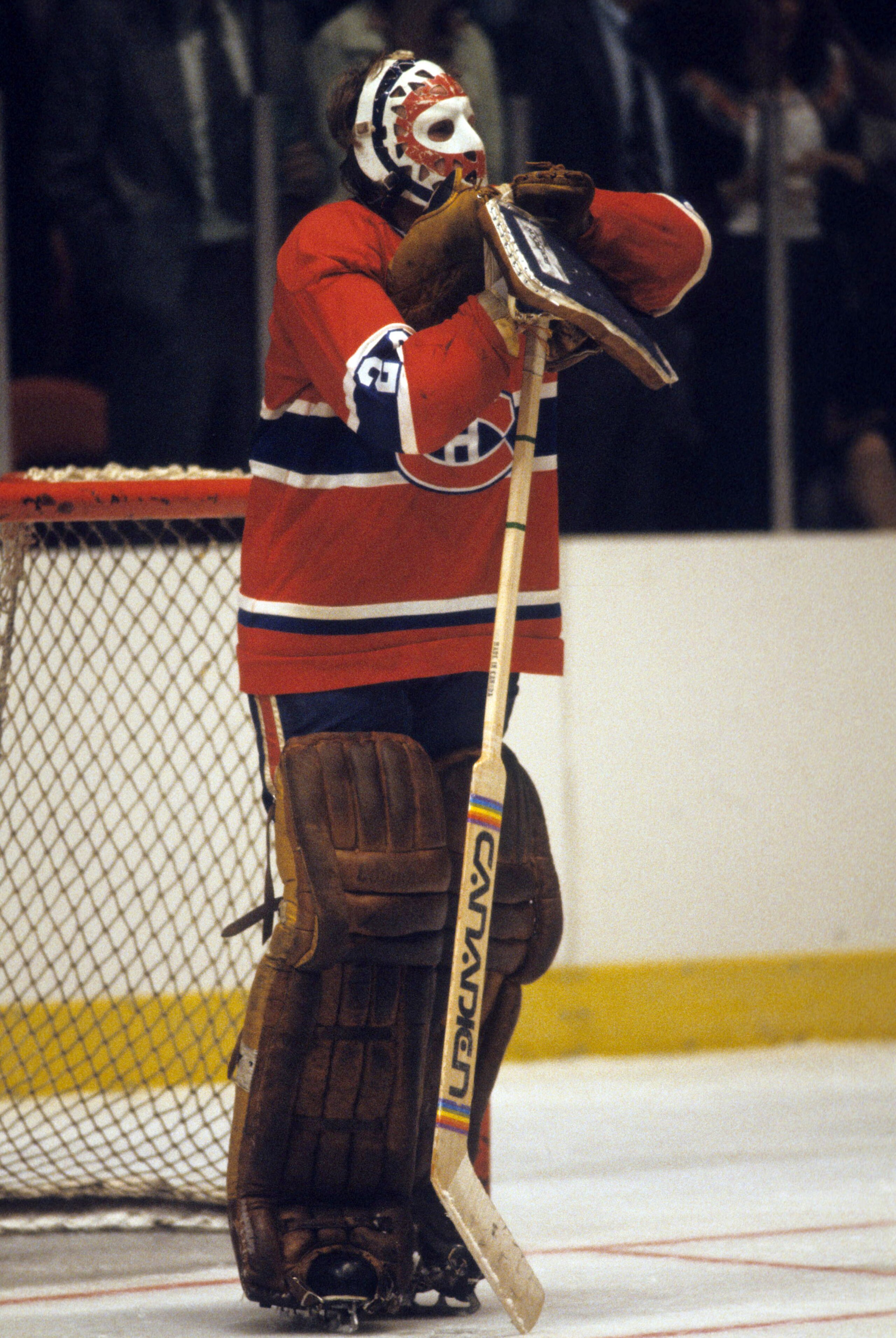
Career statistics: Regular season (NHL): 397 GP, 258-57-74, 2.24 GAA, 46 SO; Playoffs: 112 GP, 80-32, 2.40 GAA, 10 SO, Conn Smythe Trophy (1970-71), Calder Trophy (1971-72), Vezina Trophy (1972-73, 1975-76, 1976-77, 1977-78, 1978-79), All-Star (1972, 1975, 1976, 1977, 1978), Stanley Cup (1971, 1973, 1976, 1977, 1978, 1979)
Ken Dryden played just seven-plus years and 397 games in his National Hockey League career, but no goalie before or since has been able to win the way Dryden did during his career, only losing an amazing 14.35% of the time he took the ice in the regular season. In the post-season, his winning percentage of 71.42% is just plain ridiculous. His 2.24 GAA ranks 9th best in history, and his five All-Star appearances and six Stanley Cups show how well he dominated in the NHL during his career.
What would have happened had Dryden stayed with the team that drafted him? He was a third round draft choice of the Boston Bruins in 1964, but almost immediately was dealt to the Montreal Canadiens in a four-player deal that probably didn't get much notice. However, when the other three players never made it to the NHL, and Ken Dryden became a Hall of Famer, it does deserve some recognition. Like most of the young players in the Canadiens dynasty era, Dryden had to bide his time and earn his way up to the parent club, first attending Cornell University for four seasons before spending time with the Canadien National Team in 1969-70. The following season, Dryden would break into the professional ranks, playing a season in the AHL before being rewarded with a late-season call-up.
Dryden won the last six games of the season and was a surprise playoff starter for Montreal in the 1971 playoffs, where he took everyone by surprise and almost single-handedly knocked off the Boston Bruins in seven games in the first round, and the Habs eventually knocked off the Chicago Blackhawks in seven games to win the Stanley Cup, with Dryden winning the Conn Smythe Trophy for his efforts. From there, Dryden never looked back, picking up seemingly countless hardware almost every year as I described above. The lasting image of Dryden leaning on his hockey stick is one of the most iconic pictures in the history of the sport.
Ken Dryden was more than a hockey player, he abruptly retired at age 26 to become a lawyer at a Toronto firm when he didn't like his contract offer. He is a best selling author and has become a politician, all while still helping to promote the sport he played so well. When the Canadiens lost in the first round in 1973-74 without Dryden, he was brought back and while they didn't win the cup in his first year, Dryden and the Canadiens won the following four after that before Dryden finally retired for good. Had he continued at the same level, there's little doubt Dryden would be atop my list, but even with his Sandy Koufax-like domination over a relatively short span, he's still good enough for number 5 in my top 100 and his record of success is second to none.
Best season: Dryden's career is full of seasons that equal just about any other goalie's best year, but his best one is the 1976-77 season, when he posted a 41-6-8 record in 56 games, with a 2.14 GAA and a league-high ten shutouts. In the post season, Dryden and the Canadiens dominated once again, going 12-2 in 14 games, and winning their second straight of what would become four straight Stanley Cup championships. Dryden would post a 1.55 GAA with four shutouts to lead the league in the postseason. Simply put, Ken Dryden and the Montreal Canadiens absolutely dominated the NHL in the mid-to-late 1970's.
No. 4 Terry Sawchuk
97 of 100
Career statistics: 971 GP, 447-330-172, 2.52 GAA, 103 SO, Playoffs: 106 GP, 54-48, 2.54 GAA, 12 SO, Calder Trophy (1951), Vezina Trophy (1952, 1953, 1955, 1965), All-Star (1950, 1951, 1952, 1953, 1954, 1955, 1956, 1959, 1963, 1964, 1968), Stanley Cup (1952, 1954, 1955, 1967)
The great Terry Sawchuk was an enigma to some but was regarded as a great goaltender to all. He came up with the Detroit Red Wings in 1949-50 and played seven games with the team before HOF Harry Lumley was traded to make room for Sawchuk. The move turned out to be a great one as Sawchuk took the league by storm, not having a goals against average above 1.99 in his first five NHL seasons, leading the NHL in each of those five years and winning three Stanley Cups as well.
Sawchuk was dealt to Boston as part of a nine-player deal in the summer of 1955. He suffered from health problems like mononucleosis and depression while in Boston, leading to a sudden retirement in January of 1957. After an off-season trade back to Detroit, he returned to the league and played seven more years with the Red Wings.
In his second stint, Sawchuk performed well, but was unable to duplicate anywhere near the incredible numbers of his first stint, as the Red Wings were not nearly the same team in front of him. Left exposed in the 1964 Waiver Draft, he was taken by the Toronto Maple Leafs, where he played three seasons, including winning the Stanley Cup a fourth time in 1967. He would bounce around the league via trades his final three seasons with the Los Angeles Kings, Detroit Red Wings (yet again) and the New York Rangers.
It was with the Rangers that Sawchuk ended not only his career, but tragically after a bar room horsing around incident/accident with teammate Ron Stewart. The many internal and external injuries Sawchuk experienced over his career, as well as mental illness may have helped lead to his untimely demise. He was elected to the Hockey Hall of Fame in 1971 and easily goes down as one of the best goaltenders in NHL history and was good enough for number 4 on this list.
Best year: Sawchuk's best year is not an easy selection to make, as he had several amazing seasons. My vote goes to his 1951-52 campaign, when he appeared in all 60 minutes of each game, posting a 44-14-12 record, with a 1.90 GAA and 12 shutouts. He followed up that amazing regular season with a brilliant 8-0 playoff, yielding just five goals in those eight games, with four shutouts along the way, for a microscopic 0.63 GAA. Needless to say, the Red Wings won the Stanley Cup that season
No. 3 Patrick Roy
98 of 100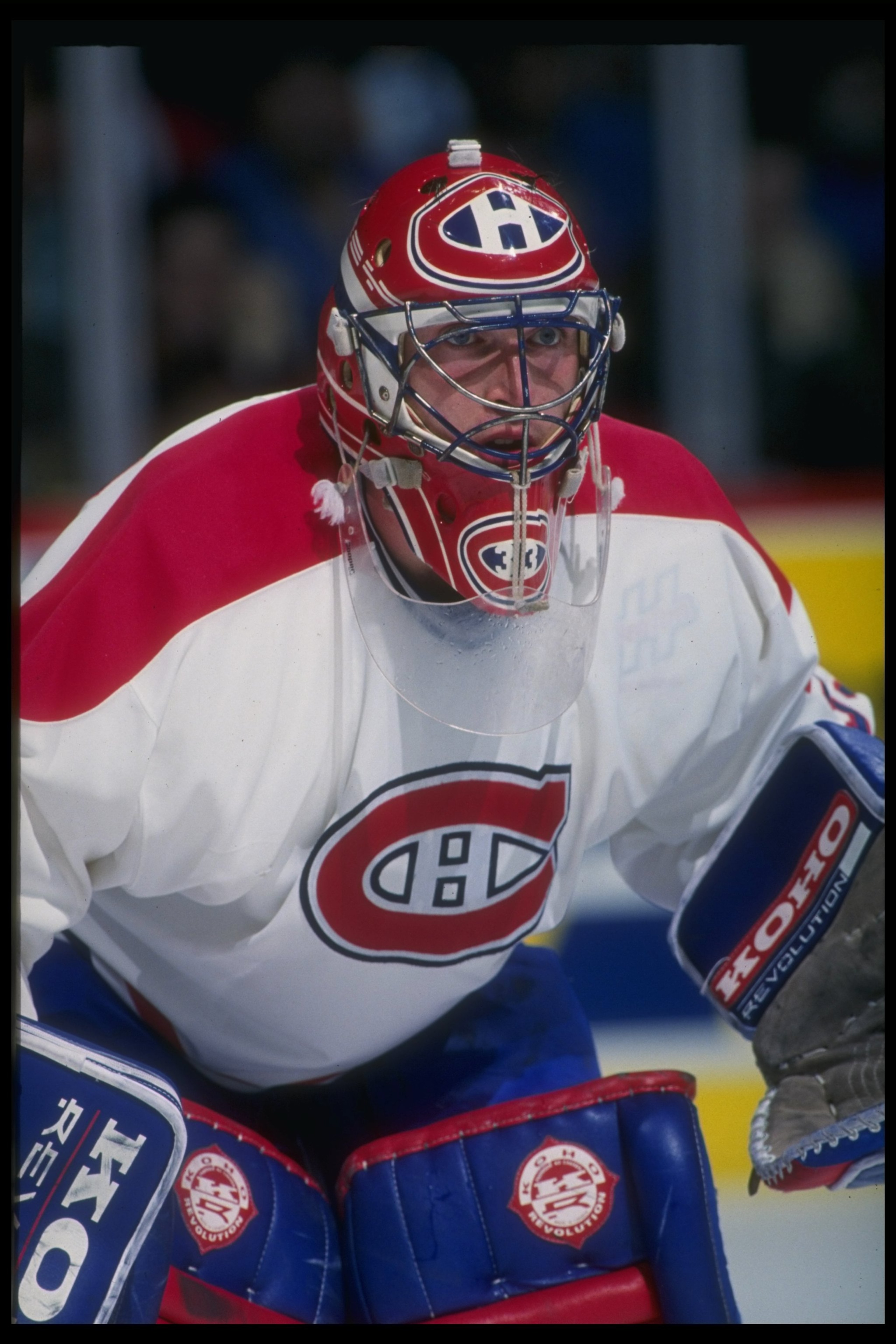
Career statistics: Regular season (NHL): 1029 GP, 551-315-131, 2.54 GAA, .910 S%, 66 SO; Playoffs: 247 GP, 151-94, 2.30 GAA, .918 S%, 23 SO, Conn Smythe Trophy (1985-86, 1992-93, 2000-01), Vezina Trophy (1988-89, 1989-90, 1991-92), Jennings Trophy (1986-87, 1987-88, 1988-89, 1991-92, 2001-02), All-Star (1988, 1990, 1991, 1992, 1993, 1994, 1997, 1998, 2001, 2002, 2003), Stanley Cup (1986, 1993, 1996, 2001)
Patrick Roy began his career in 1985-86 with the Montreal Canadiens and almost immediately brought back memories of Ken Dryden, as he came in as a rookie, stole the show and brought home a Stanley Cup title for the Canadiens, winning the Conn Smythe Trophy along the way. He became just the third Canadiens goalie, joining only Dryden and Jacques Plante as guys to win the Cup as first-year players for Montreal. It was only a sign of things to come for Roy, who displayed one of the strongest and most effective wills to win in league history. His share of great saves in clutch situations are too numerous to list.
Roy would play 10 years with the Canadiens on teams of various skill levels, but would always have the bedrock of Patrick Roy to keep them in games and more often than not, be victorious. On December 2, 1995, Roy gave up nine goals to the Detroit Red Wings and felt embarrassed by Head Coach Mario Tremblay. Roy would demand a trade and indicated it was the last game he would play in a Canadiens uniform. He would be dealt days later with Mike Keane to the Colorado Avalanche for Andrei Kovalenko, Martin Rucinsky and Jocelyn Thibault, a deal that clearly was one sided, but Montreal definitely had their hands tied a bit due to the trade demand.
In Colorado, Roy joined a team that had a lot more star power than Roy was accustomed to, joining a team with the likes of Joe Sakic, Peter Forsberg, Adam Foote and former Habs teammate Claude Lemieux. The Avalanche were desperate to add a big-time goaltender and Roy was exactly what they needed. Roy would play eight seasons with the Avalanche, and would post only one GAA above 2.40, and that was his first season, where his 2.68 GAA led to Roy's third and Colorado's first Stanley Cup title. Five years later, they would strike again, defeating the New Jersey Devils in seven games.
One example of Roy's will was the 1996 Stanley Cup Finals, after a Ray Sheppard goal in Game 3 was scored, it is alleged Roy stated to his teammates there would be no more rats. Roy didn't let up another goal the rest of the series as the Avs completed a four-game sweep. Roy had his share of slipups, but when at his best, there was no one better. His storied career places Roy at number 3 in my top 100.
Best season: Roy's best year came in the 1991-92 season, when he posted a 36-22-8 record in 67 games for the Montreal Canadiens, and posted a league-best 2.36 GAA, .914 save percentage and five shutouts. For his efforts, Roy picked up the Vezina and Jennings Trophies, as well as his fourth All-Star appearance. After defeating the Hartford Whalers in seven games in the first round, the Habs would get swept by the Boston Bruins in the division finals.
No. 2 Martin Brodeur
99 of 100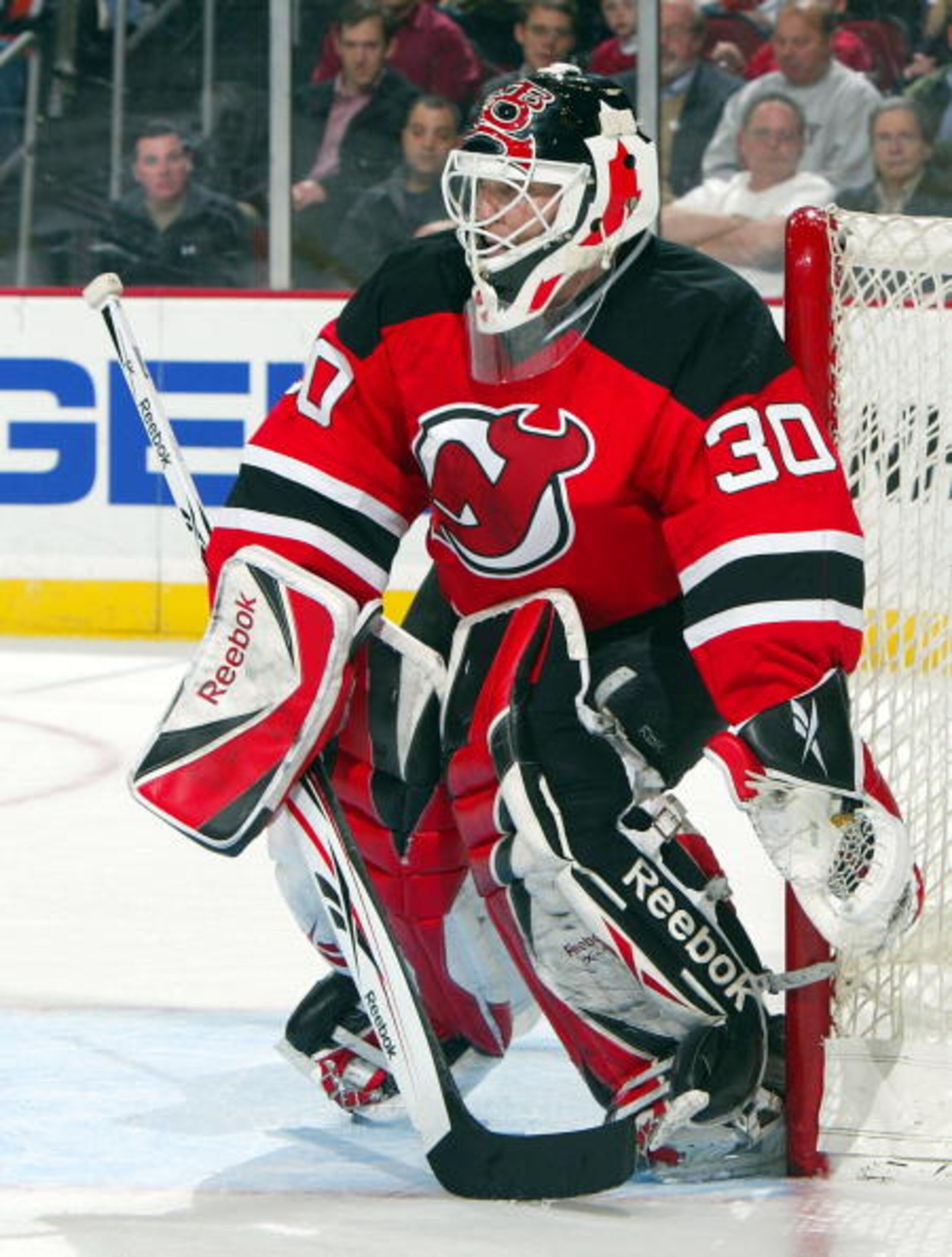
Career statistics: Regular season (NHL): 1132 GP, 625-350-137, 2.22 GAA, .913 S%, 116 SO; Playoffs: 181 GP, 99-82, 2.01 GAA, .919 S%, 23 SO, Calder Trophy (1993-94), Jennings Trophy (1996-97, 1997-98, 2002-03, 2003-04, 2009-10), Vezina Trophy (2002-03, 2003-04, 2006-07, 2007-08), All-Star (1996, 1997, 1998, 1999, 2000, 2001, 2003, 2004, 2007)
Where do you start with the career of Martin Brodeur? He is the NHL's all-time leader in wins, shutouts, games played (for a goalie), saves, minutes played, and shots against. He has a Calder Trophy, nine All-Star appearances, five Jennings Trophies and four Vezina Trophies to mix with three Stanley Cup titles on his resume. His seven career 40-plus victory seasons (including all-time high of 48 in 2006-07) and twelve consecutive (13 overall) 30-plus win seasons are in a class by them self. Statistically speaking, there's Martin Brodeur and then everyone else.
As a child, Brodeur had rare access to the famed Montreal Canadiens, with his father Denis being the long time team photographer, making Martin feel comfortable in NHL surroundings at a young age, something that has worked well for the laid back Brodeur throughout his career. Brodeur has always had outstanding positioning and his ability to read the play is unparalleled, allowing Brodeur to often make the great save look easy. His puckhandling effectiveness revolutionized the sport, at times giving the Devils the feel of having a third defenseman at times, and even adding goals in both the regular season and playoffs. The "Martin Brodeur Rule" was put into place by the NHL to create the trapezoid with the distinct purpose of trying to limit or curtail opportunities for Brodeur to be able to play the puck. That goes to show you how well he handled the puck that certain GM's felt a rule change was needed to offset his talent.
Brodeur has shown to be the consummate professional, looking out for the best interests of his team, and taking pride in the only organization he has called home in his NHL career. In 2006, Brodeur signed a well below market value contract extension to allow the Devils enough salary cap space to keep most of their team intact, helping the franchise earn 13 consecutive playoff berths, a streak only broken this past season. Marty further showed his team-first attitude this past year by stepping aside for a few games for backup goalie Johan Hedberg to play when Brodeur realized he was struggling and needed to work his way out of it with extra practice time.
Brodeur has rarely shown emotion (with one obvious exception) on the ice and is unflappable regardless of what is taking place around him. By looking at his and his expression, it is hard to tell if its the first period of an exhibition game or the overtime of a playoff Game Seven. It would be very easy for this Devils fan to put Brodeur at the top of this list and I'm sure many of you reading this may think Brodeur is too high at number 2, but I think his career resume is too full to place him any lower. Yes, he played in a defense-first system most of his career, with great defensemen in front of him like Scott Niedermayer, Scott Stevens and Ken Daneyko, but those guys benefited as much from Brodeur as he did from them. Hands down, at least until best by someone else, Martin Brodeur will go down as the best goaltender I have ever seen (meaning I never saw my number one play).
Best season: Having watched Brodeur more than any other goalie, I think this selection is easier than one might think. Brodeur had many incredible seasons, but the one that stands out the most to me is his performance during the 2007-08 season was his bet work. The Devils had a bit of a patchwork backline and Brodeur had pressure on him like no other year, and he rose to the occasion, putting up a 44-27-6 record in a league-best 77 games, with a 2.17 GAA and .920 save percentage and four shutouts. It wasn't his best statistical season necessarily, but does stand out to me as his best work in a magnificent career portfolio.
No. 1 Jacques Plante
100 of 100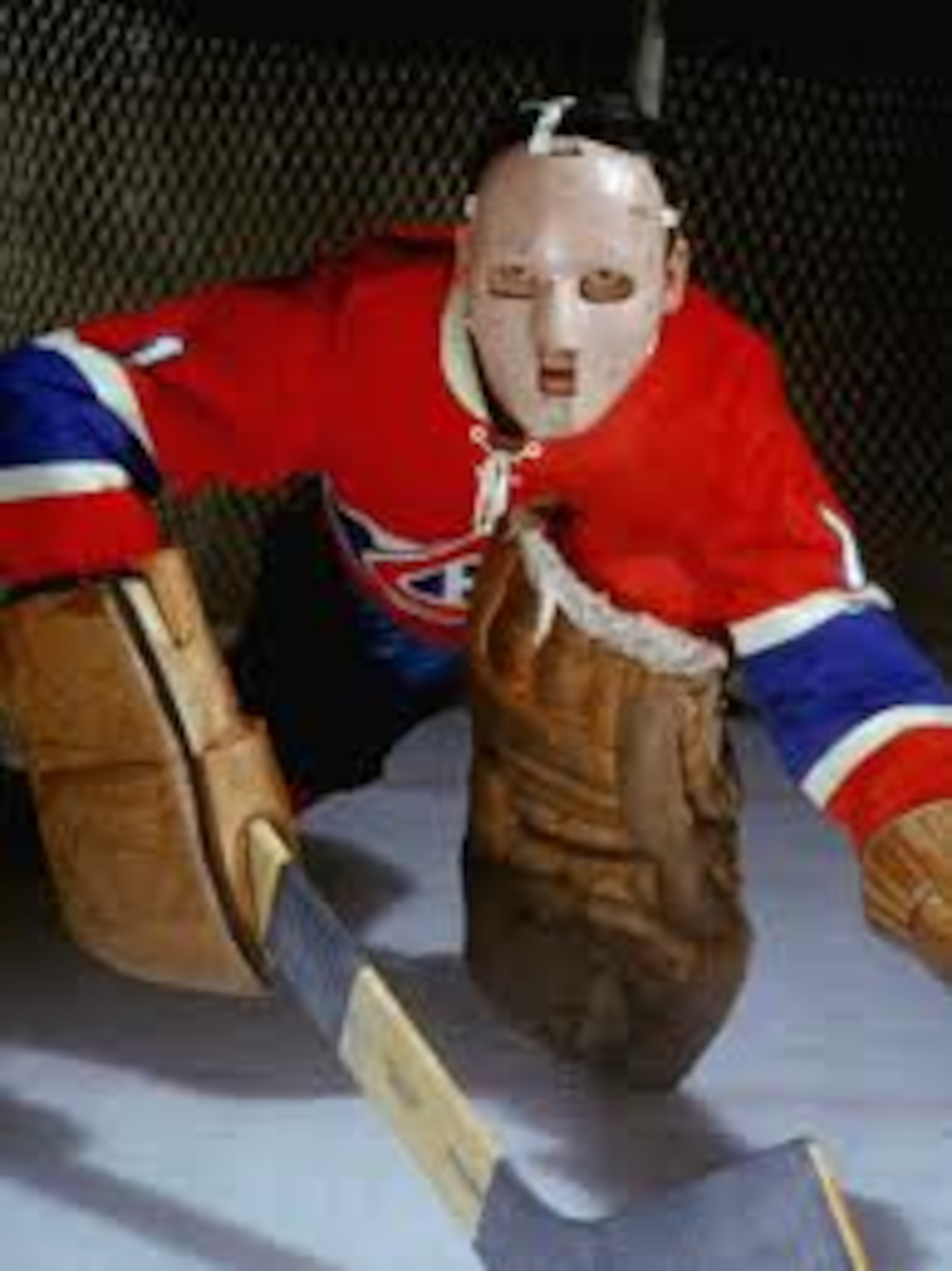
Career statistics: Regular season (NHL): 837 GP, 437-246-145, 2.38 GAA, 82 SO; Playoffs: 112 GP, 71-36, 2.14 GAA, 14 SO, Hart Trophy (1961-62), Vezina Trophy (1955-56, 1956-57, 1957-58, 1958-59, 1959-60, 1961-62, 1968-69), All-Star (1956, 1957, 1958, 1959, 1960, 1962, 1969, 1970), Stanley Cup (1953, 1956, 1957, 1958, 1959, 1960)
When you crunch the numbers, read about the history and put it all together, the name that stands alone at the top is Jacques Plante. seven Vezina Trophies, a Hart Trophy, eight All-Star Games and six Stanley Cup titles, all while playing to a regular season GAA of 2.38 (2.14 in playoffs) gives Plante the nod over the rest of the field. After all, what more could you want out of a career than what Plante did? If his goaltending resume isn't enough, how about being the father of the goalie mask? Plante wore a goalie mask on the ice in a game for the first time in 1959, and many goalies today are thankful to Plante for it.
Anyone who read my article on the top 10 players to wear jersey number 1 shouldn't be surprised by this selection. He spent the first eleven years of his career with the Montreal Canadiens, where he won six Stanley Cups, including five straight from 1955-56 to 1959-60. To show how special his career was, he began his NHL career with a shutout on April 4, 1953. It would be the first of 82 shutouts in his famed career.
After playing in Montreal, he was traded to the New York Rangers, where he spent two seasons, before being claimed by the St. Louis Blues in the Intra-League Draft in the summer of 1968, where he would win his seventh Vezina Trophy and make his last two All-Star appearances in his two years there. In May 1970, he was sold to the Toronto Maple Leafs, where he spent two-plus seasons, picking up his eighth goals against title, posting a 1.88 GAA in 1970-71. He would spend additional time with Boston and a season with Edmonton in the WHA before calling it a career. Jacques Plante is as big a legend as you can get in the nets and with his body of work and impact on the NHL, he is very deserving of the top spot on this list.
Best season: 1955-56, at the age of 27, Plante went 42-12-10 with a 1.86 goals against average and seven shutouts, picking up his first career Vezina Trophy, and followed it up with an 8-2 record in the playoffs, with a 1.80 GAA and 2 shutouts, as the Canadiens would win the first of five straight Stanley Cup titles.
.jpg?w=2560 "NHL Trade Grades Connor Hellebuyck")





.jpg?w=2560 "Latest Peyton-Colts Rumors")
.jpg?w=2560 "Chiefs, Steelers Eye WR Trades")