
How NBA's Most Notable Busts Can Still Flip the Script
There isn't a more damning, deflating label in the sports lexicon than bust.
But it isn't as concrete as it sounds.
While history remembers the biggest draft busts in the least favorable light, it forgets all of the times a potential bust turned things around before it was too late. NBA fans have seen that phenomena play out several times this season.
Although that word might still bounce around these players, it's no longer as clearly affixed to Markelle Fultz, Ben McLemore or even Josh Jackson (if the recent heater is sustainable).
While the word bust seems like a know-it-when-you-see-it kind of thing, we're applying it here to recent top-10 picks who have fallen severely short of expectations. A number of players could qualify, but we're limiting it to the most notable—for prominence of draft position, NBA market or both—and also those we feel are capable of potentially kick-starting their stalling careers.
After identifying each bust, we'll examine how they can shake the label for good and change their NBA trajectory in the process.
Dragan Bender: Boost the Splash Rate
1 of 5
Beyond his 7'0" frame, Dragan Bender's selling point was supposed to be his across-the-board assortment of skills. When he self-assessed, he saw some elements of Draymond Green 2.0.
Given how close Bender now is to the NBA exits—he's on his second 10-day contract with the Golden State Warriors—you've probably figured out he isn't a Draymond clone. But it's hard to figure out what type of player he is. You can trace over his stat sheet with a fine-tooth comb, but nothing comes to the surface.
"I think his versatility can work against him," former Phoenix Suns head coach Igor Kokoskov said, per Bright Side of the Sun's Dave King. "He can do everything a little bit, but nothing really [good]. This is a league of extremes. You have to be extremely good at something."
If Bender establishes a base of elite three-point shooting, then he can still construct a solid NBA career around it.
His mechanics look good, and the results have been encouraging at times (118 made treys at a 36.6 percent clip in 2017-18), but the consistency isn't there. He isn't carving out his niche as a perimeter sniper by hitting 32.2 percent of his career long-range looks.
But if he figures out how to get that mark into at least the high 30s, his outlook can change overnight.
If defenses must respect his outside shot, that would give him more room to flash his handles and distributing skills. Add a pinch of defensive versatility—mobility on the perimeter, length around the basket—and suddenly you discover how he once arrived as the fourth overall pick in 2016.
He's dangerously close to busting out of the Association, but he's still only 22 years old. If he can ever fine-tune his three-ball, he could have plenty to offer an NBA employer.
Michael Kidd-Gilchrist: Ditch the Wing
2 of 5
The Charlotte Hornets should have known better than to ask Michael Kidd-Gilchrist to save them. He was their fourth top-five pick of the 2000s (No. 2 in 2012), and considering the first three were Emeka Okafor, Raymond Felton and Adam Morrison, they already knew top-five selections weren't promised superstardom.
But Charlotte surely envisioned something better than this.
Kidd-Gilchrist spent seven-plus seasons with the Hornets, averaging double-digit points in only two of them and twice exceeding the league-average mark in player efficiency rating (15.0). His playing time declined each of the past four seasons, and it effectively evaporated this year before the Hornets unceremoniously waived him on Feb. 8.
Kidd-Gilchrist had—and still retains—value as a multipositional stopper, but one-trick stone walls are a dying breed in modern basketball. Bigs can (somewhat) get away with offensive shortcomings in today's game, but those are deal-breakers for wings.
While Kidd-Gilchrist has spent 80 percent of his career minutes at the 3, he doesn't have the shooting touch to stay there (28 triples in 442 games, 27.2 percent). As The Ringer's Jonathan Tjarks opined in October 2018, Kidd-Gilchrist could have a future at the 5:
"Kidd-Gilchrist is an excellent screener, cutter, rebounder and interior defender, and he has the tools to be a small-ball 5. He's about the same size (6'7" and 232 pounds with a 7-foot wingspan) as Draymond (6'7" and 230 pounds with a 7'1" wingspan). Both are built like NFL linebackers, with a thick chest, strong hands, and quick feet. MKG has the same combination of athleticism, tenacity and basketball IQ that allows Green to bang with bigger players inside and rotate quickly as a help-side defender."
Kidd-Gilchrist has the motor to get end-to-end, the athleticism to finish plays at the basket and enough vision to find open teammates on the move. He has NBA skills; he just needs to find the position where his weaknesses aren't fatal flaws.
Kevin Knox: Maximize Physical Gifts
3 of 5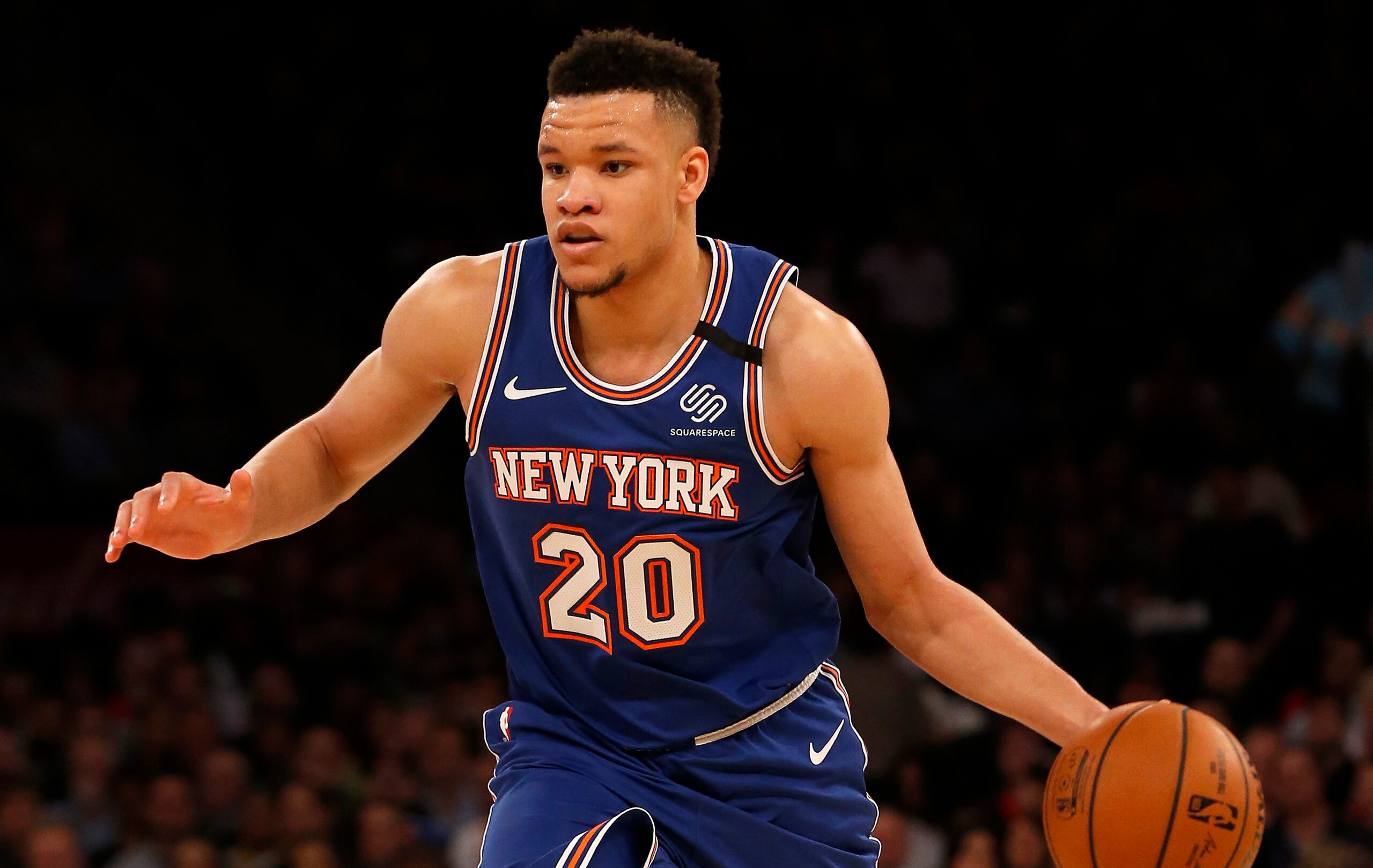
Kevin Knox's initial NBA campaign was more or less a season-long collision with the rookie wall. By year's end, he had assembled the league's worst real plus-minus (minus-7.47, per ESPN.com), and it wasn't close.
He has at least made progress on that front this season, although his minus-3.33 mark is still tied for the fourth-worst in the Association. He's also averaging about half as many points (6.5), shooting worse from every level (35.9/31.8/64.9 slash) and backtracking in PER (8.2, down from 8.7).
It all makes you wonder how the New York Knicks ever deemed him worthy of the No. 9 pick in 2018—a draft class he now entirely trails in win shares (minus-1.3). Knox was always a long-term investment, sure, but the Knicks assuredly wouldn't mind seeing a clearer sign that he will eventually turn his career around.
Knox, who won't turn 21 until mid-August, can be a lot better than this. He has length, athleticism and versatility, all of which could be far more significant if utilized properly.
He should seek out more attack lanes, as less than 20 percent of his shots come within three feet. He must ramp up his defensive motor since his length should bother opponents, but they're shooting 2.1 percentage points better against him than they do on average. He needs to get bigger and stronger, so he's more of a defensive presence as a rebounder (career 5.6 per 36 minutes) and shot-blocker (0.6 per 36 minutes).
Time is theoretically on Knox's side, but it seems to pass quicker in New York than anywhere else.


.jpg?w=2560)
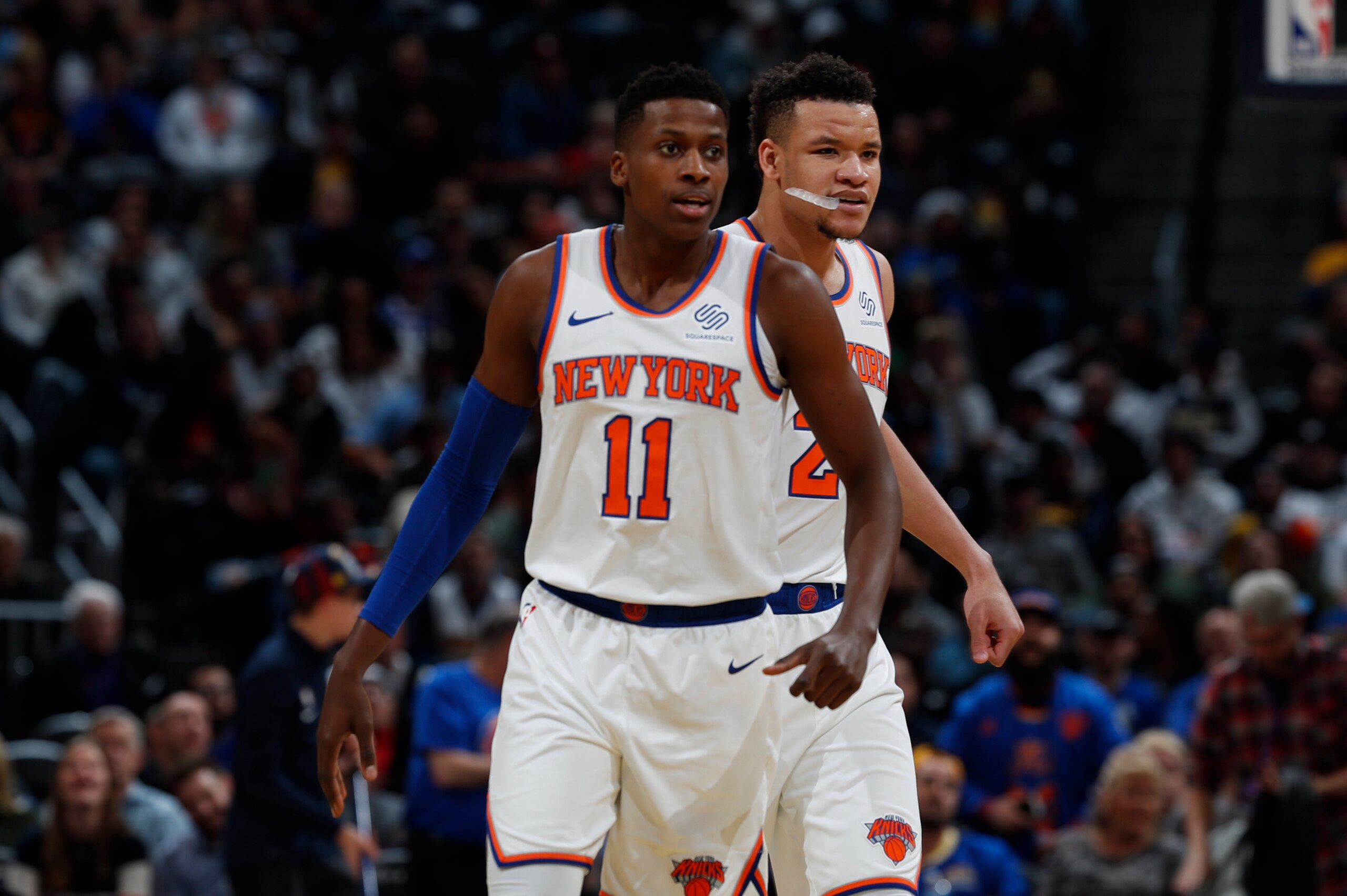
Frank Ntilikina: Find a Serviceable Three-Ball
4 of 5
Frank Ntilikina has the length, strength, speed and quickness to be a nightmare matchup for opposing scorers of nearly all sizes. However, he's just as terrifying on offense—and not in a good way.
His 42.1 effective field-goal percentage is the worst among the 323 players to log at least 2,000 minutes since 2017-18. Kevin Knox (43.8) and Stanley Johnson (44.1) are the only other players south of 45 percent, and just 89 are on the wrong side of 50.
Ntilikina won't have an NBA gig much longer if he can't improve his conversion rate. But when you're talking about a career 77.9 percent free-throw shooter, this hardly seems like an impossible ask.
And if he does develop some semblance of an outside stroke, look out, as The Ringer's Kevin O'Connor noted:
"I'd love to see Ntilikina on a team with an assistant coach that has a track record of improving shooters ... before giving up. Ntilikina was a lottery pick for good reason. He can run a pick-and-roll, facilitate, and defend well. At 6'4" with a thick frame and long arms, Ntilikina has defensive versatility that enables him to lock down quicker guards and stronger wings. A team that can fix his shot would turn him into a valuable three-and-D player who can handle the ball competently, which is a recipe for winning basketball."
The Knicks could do Ntilikina some favors, like letting him run more pick-and-rolls and putting more sharpshooters around him. Even if he finds a workable three-point shot, it will never become the sharpest weapon in his arsenal. He might always be a pass-first player on offense, and his willingness to attack the paint helps make the most of his natural gifts.
But if he gets to even passable from the perimeter, that could turn his entire career around. His coach suddenly would go from constructing lineups to work around his weakness (or deciding it isn't even worth the trouble) to having a two-way contributor who fits with everyone.
Ntilikina can still be a valuable puzzle piece, even if his league-worst shooting rates are howling at the suggestion.
Jahlil Okafor: Go Where He's Wanted
5 of 5
To borrow a phrase from the late, great Dennis Green, New Orleans Pelicans big man Jahlil Okafor is who we thought he was.
Before he even left Duke ahead of the 2015 draft, he was being celebrated for a "polished, advanced post game," which was buoyed by his "overwhelming strength," "textbook footwork" and "giant, soft hands," as B/R's Jonathan Wasserman wrote. Fast-forward to now, and those same assets have yielded Okafor with career marks of 19.4 points on 56.3 percent shooting and 8.9 rebounds per 36 minutes.
Basically, the big fella is a walking double-double—or rather, he could be if teams still handed out major minutes to low-post specialists. Instead, he's been reduced to sporadic, instant-offense stints off the bench.
On the rare occasion New Orleans has a huge opportunity available, he usually seizes it. He's topped 24 minutes four times this season, and he averaged 20 points, 9.5 boards and 1.5 blocks in those contests.
But the Pels have mostly decided they don't need him. Considering they play at the third-fastest tempo and average the eighth-fewest post-ups, it's an easy call to make—and a sign that Okafor should seek greener pastures this summer.
His post game works, but only if a team actually tries to use it. New Orleans has taken a different path, so he should do the same.
Why can't he fill the same quick-scoring, glass-cleaning role as Enes Kanter? It's hard to imagine Okafor changing his game, so he should change his circumstances in a way that highlights his game.
All stats, unless otherwise noted, courtesy of NBA.com and Basketball Reference and accurate through games played March 8.
Zach Buckley covers the NBA for Bleacher Report. Follow him on Twitter, @ZachBuckleyNBA.
.png?w=2560)
.jpg?w=2560 "Monday Night Raw Blog 🔴")