

Broncos Committing Cardinal NFL Sin Trusting an Unproven QB Without Competition
Case Keenum took the reins of the Broncos at this week's OTAs for the first time as their undisputed starting quarterback. By all accounts, he did just fine. He was no towering specimen of bazooka-armed mega-talent, but that's not what the Broncos need. He was poised, confident and leader-like.
You know: all the nice things we say about ordinary quarterbacks.
Keenum, the 30-year-old undrafted rookie-turned-knockaround backup-turned-breakout 2017 star, sounded happy with his new role as a peerless leader who doesn't have to compete for every rep.


.jpg?w=2560 "Cardinals Giants Football")
"It feels different. It feels good. I like it. I think that that puts different things at ease and lets you go out there and play. It lets you cut it loose. It's nice," he said Tuesday, per Rod Mackey of Denver's 9News.com
Veterans like Emmanuel Sanders also sound thrilled to have Keenum on board. Or at the very least, they're thrilled to be off a two-year merry-go-round of competitions among untested prospects.
"I remember when I got out here, I went out to the team store and I saw Case Keenum jerseys," Sanders said before OTAs, per Andrew Mason of the Broncos website. "Thank God I don't have to deal with that again."
Everyone is acting like it's perfectly normal for a quarterback who was held in about as high regard at this time last year as Chase Daniel and Matt McGloin to be handed an uncontested starting job for a veteran-laden team that talks about itself like it's a Super Bowl contender.
It's not normal. It's actually a super risky gamble.
Keenum leveled up from career benchwarmer status when he climbed off the bench to throw for 3,547 yards and 22 touchdowns in 14 starts last year, leading the Vikings to an 11-3 record and taking them to the NFC Championship Game.
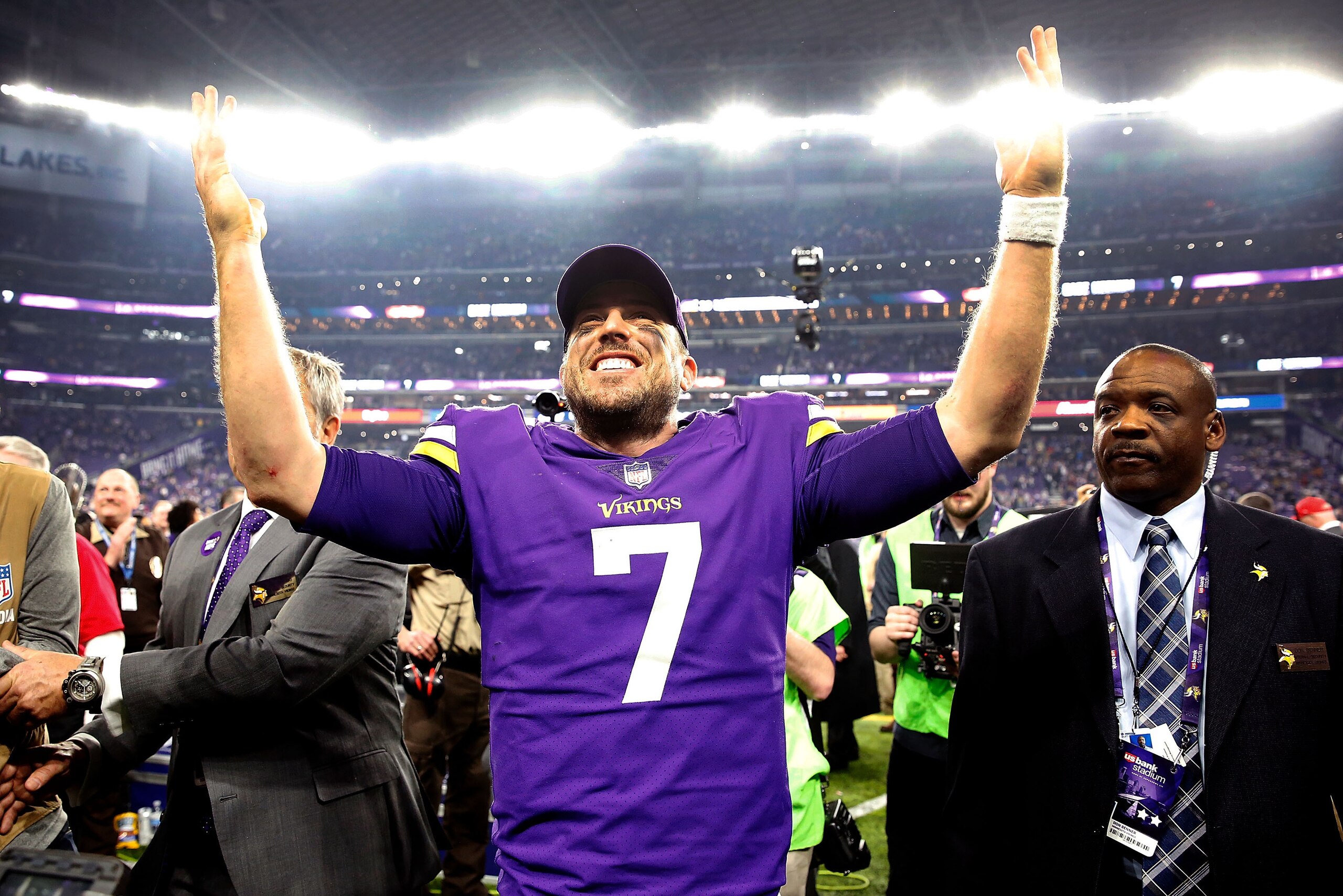
He earned a Provisional Franchise Quarterback Learners Permit with that performance. He now makes sense as a bridge quarterback for some rebuilding team with a hotshot rookie, or as the backup who pushes a fading veteran. He deserves a chance to prove he can replicate his 2017 success, but with a rock-solid Plan B in place if he cannot.
But there are no challengers at all in Denver. Keenum's backups are Paxton Lynch, who went 0-2 with a 72 quarterback rating last year, and Chad Kelly, a seventh-round rookie. In other words, your college roommates: The guy who skipped class to play Overwatch all day and the one who kept getting out of trouble because his uncle was a big deal in the alumni association.
The Broncos are actively avoiding quarterback competitions after two years of juggling Lynch, Trevor Siemian and Brock Osweiler. They believe they can win a Super Bowl with great defense and ball control, because they just did so three years ago. They wanted a veteran starter and a drama-free offseason, and they weren't about to get picky.
Keenum will certainly be better than Huey, Dewey and Louie were last year. (And if you are now picturing John Elway as Scrooge McDuck, my work here is done.) But that's not the goal the Broncos should be shooting for. The real question is whether Keenum will bring anything more to the Broncos than firm handshakes in the locker room and a commanding voice in the huddle. No one seems to want to ask or answer that right now.
If it turns out the Broncos paid $36 million for a guy who rode a hot streak and an ideal situation to a career year, then backed him up with no one but Harold and Kumar, they will have set themselves back years.

The good news is that Keenum's advanced statistical profile looks great, at least at first glance. He finished second to Carson Wentz in ESPN's Total QBR. He led the league in Football Outsiders' DVOA, which is usually a useful tool for identifying a mediocre quarterback riding a hot streak. He ranked 51st on the NFL Network's Top 100, though that countdown always looks like it was selected by players swiftly checking off some boxes before grabbing their fishing poles and golf clubs.
But the deeper we dive into the data, the more trouble we find.
Football Outsiders uses a metric called ALEX, designed by Scott Kacsmar, to determine how often a quarterback throws past the first-down markers on third and fourth downs. ALEX is pretty intuitive: An ALEX of 1.5 means that the quarterback's average third- and fourth-down throw traveled 1.5 yards past the first down marker; a -1.5 means the quarterback is a dreaded dink-and-dunker, throwing his average third-down pass a yard-and-a-half in front of the sticks.
Keenum's ALEX of 0.1 ranked 31st in the league. By contrast, Aaron Rodgers led the NFL with an ALEX of 4.0, Carson Wentz was second at 3.3, Tom Brady fourth at 2.5. The NFL average is 1.1. At 0.1, Keenum shares a neighborhood with a Hall of Famer (Drew Brees, often a statistical outlier), an up-and-comer who also benefited from a great situation (Jared Goff)—and then a rogue's gallery of Josh McCown, Jacoby Brissett, Blaine Gabbert, Brian Hoyer and the innovator of the dump-n-shrug offense: Jay Cutler.
Here's where the data gets kooky: Keenum didn't throw past the sticks often, but his third-down conversion rate of 46.3 percent ranked fifth in the NFL. So somehow Keenum's short passes got results.
Maybe Keenum is a newly discovered Brees, a pinpoint short-passer and brilliant decision-maker who puts receivers in position to gain yards after the catch. But it's more likely that Adam Thielen, Stefon Diggs and the deep corps of Vikings weapons excelled at turning short receptions into first downs and making their quarterback look good.

There's more bad news. Football Outsiders' John Kinsley created an Efficiency Score metric for deep passes, using film study to adjust for the lengths of passes, dropped passes, dropped interceptions and heroic efforts by receivers to turn bad throws into big plays. Kinsley's research ranked Keenum as the least accurate downfield passer in the NFL last year.
Yes, I'm skeptical of these home-brewed "efficiency scores," too, even when trusted colleagues are publishing them. (I always picture someone holding a caliper up to their laptop screen while watching NFL Game Pass and totally missing the point.) But one item from Kinsley's research leaps out: Keenum benefited from a league-high 15 inaccurate completions—long passes where his receiver turned a poor throw into a big gain.
Fifteen gifts that result in big plays across a season can skew both the numbers and our perception of a quarterback, especially when his team's defense is so good that one or two big plays are enough to provide a lead that isn't going to be blown.
OK, class: The math lesson is over! To sum it up, the numbers show that there are reasons to worry that Keenum was a product of the Vikings environment. But don't take math's word for it. The Vikings themselves paid an $84 million premium to sign Kirk Cousins instead of keeping Keenum, which speaks to their impression of him as a something other than a championship-caliber quarterback.
It might be that the Broncos need to surround Keenum with Vikings-like talent to get 2017-caliber results. But Sanders is 31 and coming off an injury-marred year. Demaryius Thomas is 30, dropped 10 passes last year and has declined statistically for four straight years. The tight ends, running backs and slot receivers are a bunch of rookies and medical redshirts, and the Broncos have been whiffing in the draft and on project players for years. Their defense did finish 10th in the NFL in the Football Outsiders rankings last year, but the Vikings finished second.
For now, everyone's happy. The Broncos have the veteran winner and drama-free offseason they were hoping for at quarterback. As long as the bar stays low, the Broncos offense will clear it.
But if the Broncos have convinced themselves they can win a Super Bowl with a merely OK quarterback, they are setting themselves up for disappointment—in both Keenum and themselves.
Mike Tanier covers the NFL for Bleacher Report. Follow him on Twitter: @MikeTanier.
.jpg?w=2560 "Jets Dolphins Football")
.jpg?w=2560 "Ward Nearly Walks Out of Presser ▶️")
