Is Sam Bradford the Problem, or Do the Minnesota Vikings' Issues Run Deeper?
The Minnesota Vikings placed quarterback Sam Bradford in an impossible situation.
When the organization traded its 2017 first-round pick and a 2018 conditional fourth-round draft selection to the Philadelphia Eagles in exchange for the former No. 1 overall pick, the franchise unwittingly anointed him its savior.
Bradford never had a chance to live up to the expectations placed upon a roster with Super Bowl aspirations.
TOP NEWS
.jpg?w=2560 "Titans Giants Football")
OBJ Calls Out Giants After Release

Live Live: Updates from every NFL game
Lamar Exits with Injury
Before Week 3 ended, the team couldn't rely on future Hall of Fame running back Adrian Peterson nor left tackle Matt Kalil. These losses severely hampered its scheme because Bradford never showed the propensity in his career to overcome these types of injuries and carry an entire offense, but the team's problems are rooted far deeper.
An anemic running game coupled with a ramshackle offensive line and an out-of-touch offensive scheme led to the Vikings' recent failures.
For five weeks, Minnesota fooled everyone. A 5-0 start behind the strength of the NFL's then-No. 1-ranked defense masked these issues.
Even during that stretch, the Vikings offense averaged nearly 303 yards per game. During their three-game losing streak, Bradford and Company have managed 292.3 yards per contest. Obviously, the difference isn't extreme, but either way, the Vikings rank dead last in total offense.

Bradford has played well considering the circumstances. Among regular starters, his 68.3 completion percentage ranks fourth overall only behind legit MVP candidates Tom Brady, Drew Brees and Matt Ryan. His 99.0 quarterback rating is the league's seventh-best. And his touchdown-to-interception ratio is a sterling 9-1 overall.
When incumbent starter Teddy Bridgewater crumbled to the ground during what appeared to be a benign practice play on Aug. 30, Minnesota's prospects at the quarterback position appeared bleak. But general manager Rick Spielman shocked the NFL when he acquired Bradford.
On the surface, the difference between these two signal-callers from last season to this year has been negligible. Bradford is completing 68.3 percent of his passes, while Bridgewater completed 65.3 percent in 2015.
Upon closer inspection, Bradford has played better over the first half of this season than Bridgewater did a year ago.
| Player | Year | Comp.% | Yards | YPA | TD | INT |
| Sam Bradford | 2016 | 68.3 | 1,715 | 7.06 | 9 | 1 |
| Teddy Bridgewater | 2015 | 64.2 | 1,670 | 7.20 | 6 | 6 |
Note: Bradford didn't play Week 1.
The Louisville product displayed marked improvement over the second half of the season, but he had three advantages Bradford doesn't.
A healthy Peterson is a wonderful crutch for any quarterback. The future Hall of Fame running back led the league last season with 1,485 rushing yards. If the passing game never got off the ground, the Vikings could always turn to Peterson. Bradford doesn't have the same luxury.
Peterson's absence has proved to be the most difficult to overcome.
The Vikings average 72.6 rushing yards per game with a woeful 2.7 yards per attempt. The last time a team averaged fewer than three yards per carry for an entire season came 22 years ago, when the New England Patriots, led by quarterback Drew Bledsoe and running back Marion Butts, averaged 2.8 yards per attempt.
The team doesn't necessarily need Peterson to succeed, but it needs more from its stable of running backs. Matt Asiata is a tough yet limited runner. Jerick McKinnon has dealt with an ankle injury that's limited his production. And the coaching staff sparingly uses Ronnie Hillman.
As a result, the Vikings have become one-dimensional, which allows defensive linemen to pin their ears back and get after the quarterback while defensive backs sit on certain routes.
A shoddy offensive line compounds this issue.
A year ago, the same five blockers started all 16 games. Through eight weeks, head coach Mike Zimmer has been forced to start four different offensive line combinations and replace both starting offensive tackles.
This instability plagues every area of the offense. It starts with an anemic ground game and extends into an inability to protect Bradford, as NFL Network's Dan Hellie noted:
That stat came before the Vikings' 22-16 overtime loss to the Detroit Lions on Sunday. The Lions defense sacked or hit Bradford eight more times.
Kalil and Andre Smith aren't the world's best offensive tackles, nor should the pair be portrayed as such despite the Vikings' struggles. For example, Smith played poorly in his first three starts, and Pro Football Focus graded the right tackle among the NFL's worst until a triceps injury placed him on injured reserve.
However, the Vikings organization expected far more from this group after making it the league's highest paid. Injuries stunted the unit's ability to establish any cohesion, and the entire offense suffers as a result.
Even so, Bradford continues to perform at a level comparable or better than Bridgewater.
Despite concerns about being able to hold up physically, Bridgewater is as good as any quarterback in the league when asked to stare down an oncoming blitzer and still deliver a well-placed pass. The 24-year-old signal-caller excels with his accuracy, particularly when under duress.
Bradford has done as well or even better in both of those areas as a member of the Vikings.
Last season, Bridgewater finished first in Pro Football Focus' adjusted completion percentage—which excludes dropped passes, throwaways, spiked balls, batted passes and passes where the quarterback was hit while he threw the ball. At 79.3 percent, his performance ranked third-best among any signal-caller of the past three seasons.
Bradford owns a 79.0 adjusted completion percentage halfway through the 2016 campaign.
The Oklahoma product also showed a level of toughness not previously seen in his career. He continues to take shot after shot yet complete pass after pass. Bradford completed 57.5 percent of his passes when pressured, while Bridgewater completed 50 percent a year ago.
When everything is falling apart around a quarterback, he still needs to stand tall in the pocket and deliver the ball. Bradford has done so.
The issues extend beyond the field too.
Bridgewater had the same offensive coordinator over the past two years, but on Nov. 2, Norv Turner stepped down from his position. Turner explained his abrupt resignation, per NFL Media's Ian Rapoport:
"It's something people may not understand. It's not me against somebody else. The situation was such ... I don't think I could get done the things we needed to get done. It wasn't something you just wake up and decide. It's been building. It wasn't going to work with me. So let me get out of the way and let them have a chance to make it work.
"
The former offensive coordinator's scheme has been highly successful in the NFL for nearly 25 years. But there is a point when the game surpasses everyone.
"I think it's just we have different views on where the offense was going," Turner said after he met with Zimmer, per ESPN.com's Ed Werder.
Since being the Dallas Cowboys' play-caller, Turner relied heavily on a run-first scheme coupled with a vertical passing attack. When reviewing his last game as a member of the Vikings staff, the approach remained the same.
Bradford threw 37 passes in the loss to the Chicago Bears; only nine of them weren't to vertical or out-breaking routes. This approach contrasts the quarterback's skill set. He's a rhythm and timing passer.
Once Pat Shurmur took over the offense, his presence was immediately felt. A toss to the flat, bubble screen and a checkdown to the tight end comprised Bradford's first three throws against the Lions. None of those throws flew deeper than four yards beyond the line of scrimmage.
Both sacks came when Shurmur returned to the vertical passing game. Below is an example of what happened in these instances:
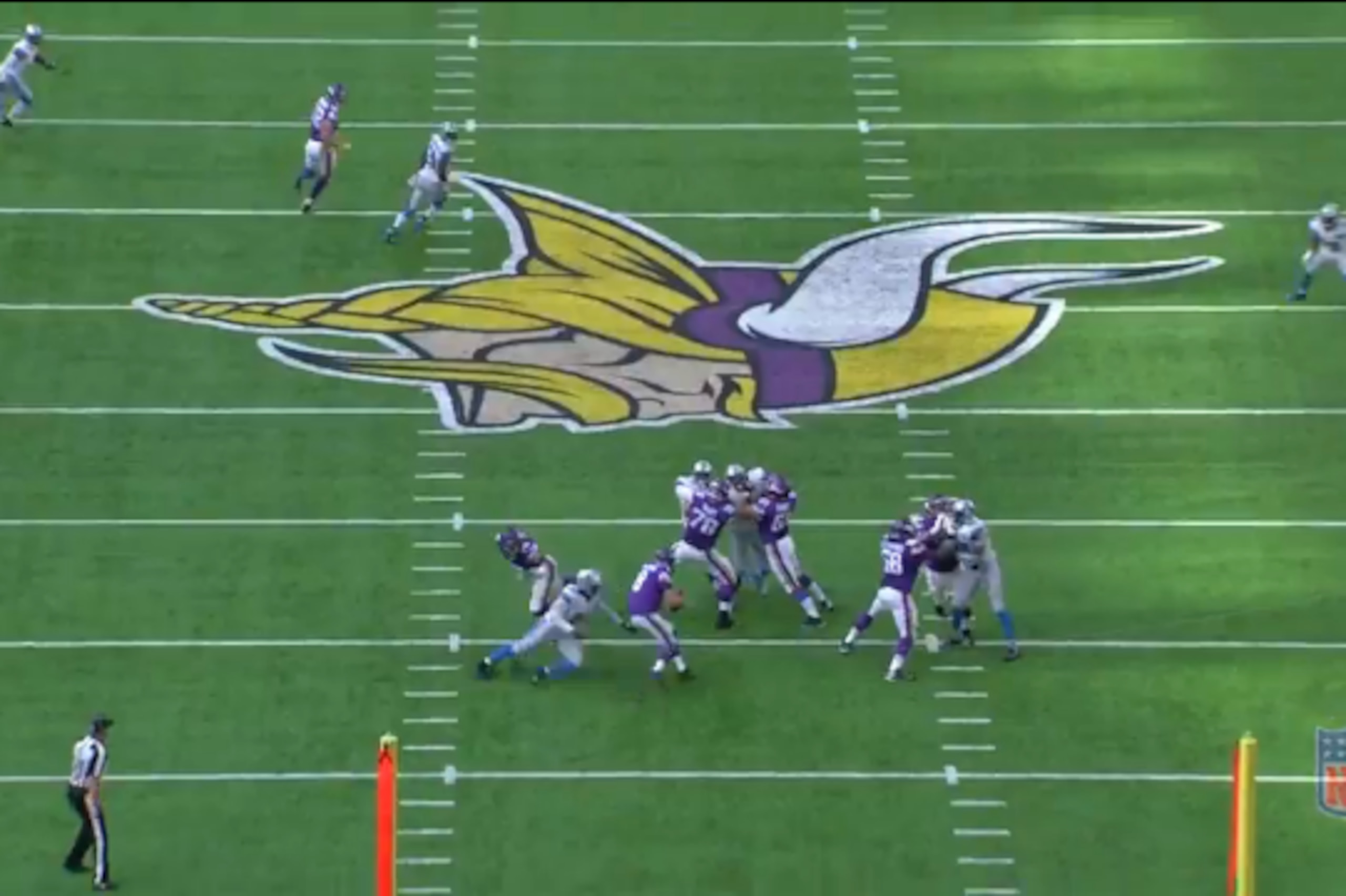
The Vikings ran four vertical routes. Bradford didn't even have a chance to set up in the pocket before his protection fell apart. No opportunity arose to attempt a pass because of the poor play up front.
Despite these types of looks, it seems Shurmur still plans to threaten defenses with the deep pass, per the St. Paul Pioneer Press' Chris Tomasson:
In order to do so, the Vikings will need to provide different looks because deep dropbacks while providing little help to the offense line isn't getting the job done—whether Turner or Shurmur is calling the plays.
As the offense tries to redefine itself, the defense must hold up its end of the bargain.
There's no denying the fact the Vikings own one of the league's best defenses. However, it hasn't been as dominant in recent weeks.
During the team's five-game winning streak, Minnesota's defense surrendered 287.6 yards per game, secured 19 sacks and created 12 turnovers. Since the team returned from its bye week, it has allowed 317.7 yards per game and only managed two sacks and five turnovers.
A symbiotic relationship must develop between an offense and defense. An offense helps its defense by moving the ball, keeping the other side off the field and, of course, scoring points. The defense can help an offense by getting three-and-outs, turnovers or preventing scoring opportunities. Neither of these things are happening in Minnesota.
By every estimation, the Vikings' recent downturn isn't a byproduct of poor quarterback play. Bradford isn't the problem; the team around him is failing.
Brent Sobleski covers the NFL for Bleacher Report. Follow him on Twitter: @brentsobleski.
.jpg?w=2560 "Saints Lions Football")
.jpg?w=2560 "Vikings Buccaneers Football")