

MLB Draft 2016: 1st-Round Mock Draft, Breakdown of Top Prospects
While the Major League Baseball season is in full swing, all 30 teams are also focusing on the future this week with the 2016 MLB draft starting Thursday in Secaucus, New Jersey.
The Philadelphia Phillies, who are falling back to earth after a strong start this season, own the first pick. This is the second draft for general manager Matt Klentak, who is doing all he can to expedite the franchise's rebuilding efforts with strong draft classes and shrewd trades to add high-impact young talent.
This year's crop of players is not deep, as there are no obvious star talents, but there are always some names who rise to the forefront and make themselves into something greater than their initial scouting reports would suggest.
TOP NEWS
Brewers Stun Padres in Game 2 😧
Braves' Opener Shines vs. LA 💪

Every MLB Team's Biggest Surprise and Disappointment ⚾
| 1 | Philadelphia Phillies | A.J. Puk, LHP, Florida |
| 2 | Cincinnati Reds | Delvin Perez, SS, Puerto Rico |
| 3 | Atlanta Braves | Kyle Lewis, OF, Mercer |
| 4 | Colorado Rockies | Jason Groome, LHP, Barnegat High School (New Jersey) |
| 5 | Milwaukee Brewers | Josh Lowe, 3B, Pope High School (Georgia) |
| 6 | Oakland Athletics | Nick Senzel, 3B, Tennessee |
| 7 | Miami Marlins | Riley Pint, RHP, St. Thomas Aquinas (Kansas) |
| 8 | San Diego Padres | Matt Manning, RHP Sheldon High School (California) |
| 9 | Detroit Tigers | Corey Ray, OF, Louisville |
| 10 | Chicago White Sox | Blake Rutherford, OF, Chaminade Prep High School (California) |
| 11 | Seattle Mariners | Anfernee Grier, OF, Auburn |
| 12 | Boston Red Sox | Zack Collins, C, Miami |
| 13 | Tampa Bay Rays | Mickey Moniak, OF, La Costa Canyon High School (California) |
| 14 | Cleveland Indians | Ian Anderson, RHP, Shenendehowa High School (New York) |
| 15 | Minnesota Twins | Justin Dunn, RHP, Boston College |
| 16 | Los Angeles Angels | Dakota Hudson, RHP, Mississippi State |
| 17 | Houston Astros | Braxton Garrett, LHP, Florence High School (Alabama) |
| 18 | New York Yankees | Taylor Trammell, OF, Mount Paran Christian (Georgia) |
| 19 | New York Mets | Will Craig, 3B, Wake Forest |
| 20 | Los Angeles Dodgers | Gavin Lux, SS, Indian Trail Academy (Wisconsin) |
| 21 | Toronto Blue Jays | Joey Wentz, LHP, Shawnee Mission East High School (Kansas) |
| 22 | Pittsburgh Pirates | Nolan Jones, SS, Holy Ghost Prep (Pennsylvania) |
| 23 | St. Louis Cardinals | T.J. Zeuch, RHP, Pittsburgh |
| 24 | San Diego Padres | Cal Quantrill, RHP, Stanford |
| 25 | San Diego Padres | Forrest Whitley, RHP, Alamo Heights High School (Texas) |
| 26 | Chicago White Sox | Robert Tyler, RHP, Georgia |
| 27 | Baltimore Orioles | Joe Rizzo, SS, Oakton High School (Virginia) |
| 28 | Washington Nationals | Bryan Reynolds, OF, Vanderbilt |
| 29 | Washington Nationals | Kevin Gowdy, RHP, Santa Barbara High School (California) |
| 30 | Texas Rangers | Drew Mendoza, SS, Lake Minneola High School (Florida) |
| 31 | New York Mets | Cody Sedlock, RHP, Illinois |
| 32 | Los Angeles Dodgers | Corbin Burnes, RHP, St. Mary's College |
| 33 | St. Louis Cardinals | Buddy Reed, OF, Florida |
| 34 | St. Louis Cardinals | Zack Burdi, RHP, Louisville |
A.J. Puk, LHP, Florida

In terms of raw talent, Florida southpaw A.J. Puk isn't at the top of this class. There have been some erratic moments, as he walked 31 hitters in 65.2 innings before the NCAA tournament began, but left-handers with his combination of size and stuff are always going to be looked on favorably.
Per Florida's athletic website, Puk is 6'7" and 230 pounds. There's no denying his physical maturity and his readiness to stand on the rubber in professional baseball. Combine that with the fact he's averaged more than one strikeout per inning while pitching in the SEC, and it's no wonder he's in the mix for the No. 1 overall pick.
Per MLB.com's scouting report, there may not be any other arm in this class who can match Puk in terms of pure stuff:
"Big and strong, Puk arguably has the best raw stuff of any arm in the class, with the chance to have three plus pitches. He's capable of touching 96-97 mph with his fastball regulary. Ironically, he might have been at his best in the one inning he threw before his back acted up, showing a 96-99 mph fastball and a plus slider at 88-90 mph. He can maintain his velocity deep into starts and while his changeup is his third pitch, it should be Major League average in the future.
"
The major knock against Puk is how he can lose his release point, as MLB.com's scouting report only graded him with a below-average 45 in control.
Puk did put on a terrific performance in the SEC tournament opener against LSU, allowing just two runs on six hits with two walks and seven strikeouts in 7.1 innings, which may have helped seal his spot as the Phillies' choice at No. 1.
While Puk's size should be an asset, it can be a hindrance. He's long and lanky, which makes it more difficult for him to repeat his delivery and leads to higher walk totals than a typical top pick should have. If you see him on the right day, though, there's a No. 2 starter ceiling.
Jason Groome, LHP, Barnegat High School
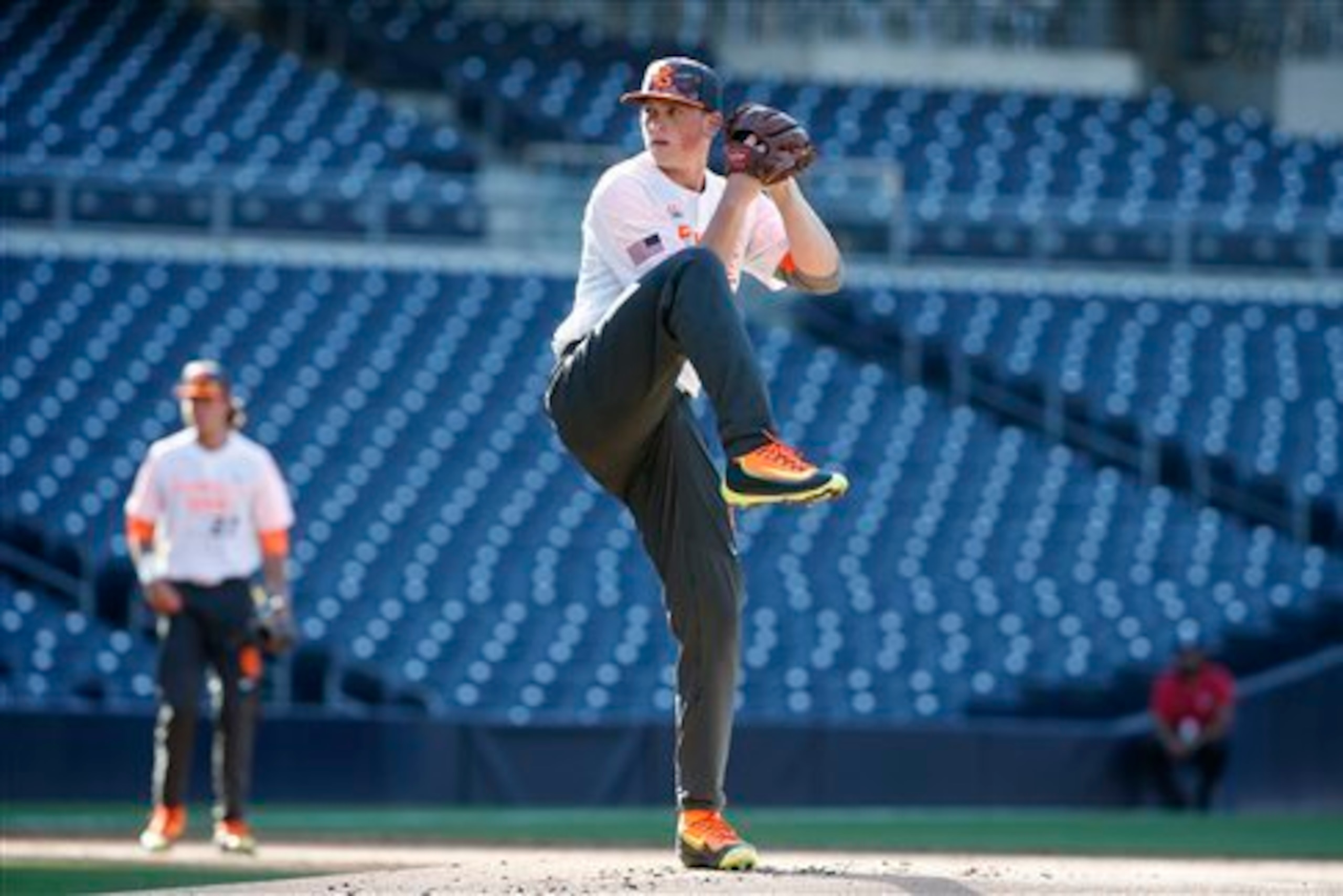
Jason Groome is the name draft aficionados have been keeping an eye on all spring. He's drawing some rave reviews, which also leads to unrealistic comparisons and expectations.
Any prep left-hander with size, athleticism and a curveball will inevitably lead to at least one person comparing him to Clayton Kershaw. Fans hear that and think of Kershaw right now, who remains the best pitcher on the planet, instead of the teenager who was drafted in 2006.
Groome did fan the Kershaw flames earlier this year by telling MLB.com's Jonathan Mayo he models his game after the Los Angeles Dodgers ace: "I want to be one of the youngest. In my second year of pro ball, if I sign out of high school this year, I'll still be 19. I'm looking to climb the leagues and get to the big leagues as quickly as I can."
ESPN's Keith Law saw the 6'6", 220-pound prospect pitch in early April, when unseasonable temperatures made pitching conditions less than optimal, and loved what he saw from the New Jersey native:
"Groome wasn't throwing at full effort while working in 45-degree weather in his second real outing of the year and on a 60-pitch limit, working 89-93 mph, with one 94 in the first inning and an 88 or two in his last inning. The curveball was the standout pitch, however, easily plus, a 65 or 70 grade (on the 20-80 scouting scale) if you're a generous grader (and I am when the curveball looks like this). He also threw two changeups that were both at worst solid-average, with some downward fade on the harder one at 82 mph.
"
Assuming Groome is going to be like Kershaw, it would stand to reason that he'd be the No. 1 overall pick without any hesitation. He's still a raw high school player who needs to refine his command before finding consistent success in professional baseball.
The individual pieces are there for Groome to be a true top-of-the-rotation star who could easily end up becoming the best player taken from this draft. He's not there yet, but his future is as bright as any player in this class.
Corey Ray, OF, Louisville
This isn't a great class for bats, but Louisville star Corey Ray is a clear standout. He has shown the ability to hit for average and power in college, setting a career high with 15 home runs in 2016.
Ray doesn't stand out in a crowd at 5'11" and 185 pounds, per Louisville's official athletic website, yet there is nothing he doesn't do well on a baseball field. He hits well, makes consistent hard contact, has good speed and is a solid defender in center field.
MLB.com graded Ray out with all five tools—hit, power, run, arm, field—average or better, though he doesn't possess one elite tool. His best grade is speed (60) with everything else falling in the average (50) or above-average (55) range:
"Ray uses the entire field well and has done a better job of managing the strike zone and making consistent contact this spring.
Ray has plus speed and knows how to use it well on the bases. Though he has spent most of his career at Louisville in right field, he runs well enough to play center field. Ray has the offensive production and arm to profile at all three outfield positions, and obviously he'd offer the most value if he can play in the middle.
"
If Ray's speed and glove play well enough to let him stay in center field, he will have All-Star upside as a player who is capable of posting solid batting-average, home run and stolen-base totals.
Ray won't put up huge offensive stats in his career, but he has no real weaknesses. He could end up as a late-era Brett Gardner type of player who hits .250-.260 with solid on-base totals, 12-16 homers and 15-20 stolen bases.

.jpg?w=2560 "NFL investigating 2 referees for separate viral exchanges")

.jpg?w=2560 "Report: Chiefs Contact Hill's Agent")
.jpg?w=2560 "OBJ Calls Out Giants After Release")
.jpg?w=2560 "Tyreek makes another cryptic post amid Chiefs rumors")


.jpg?w=2560 "Greenlaw Talks Payton Exchange")
