What’s wrong with the Oakland Raiders' rushing attack? The coaching staff will spend a large portion of the bye week coming up with a solution to the biggest problem on the offensive side of the ball.
Head coach Jack Del Rio's conservative use of starting running back Latavius Murray down the stretch in the previous two outings compounded the issues in the backfield.
Del Rio didn’t seem particularly down on Murray during Wednesday’s press conference, and it’s safe to say that he’ll continue to shoulder the bulk of the load coming out of the bye.
TOP NEWS
.jpg?w=2560 "Colts Football")
Jonathan Taylor Landing Spots
.jpg?w=2560 "NFL Paris Football")
NFL House in Paris Closes for Protests (AP)
.jpg?w=2560 "Seahawks Chiefs Football")
Trevon Diggs Cut by Seahawks
So, what’s wrong with the ground attack? We’ll explore some theories floating around the web.
Does Murray Need More Carries?
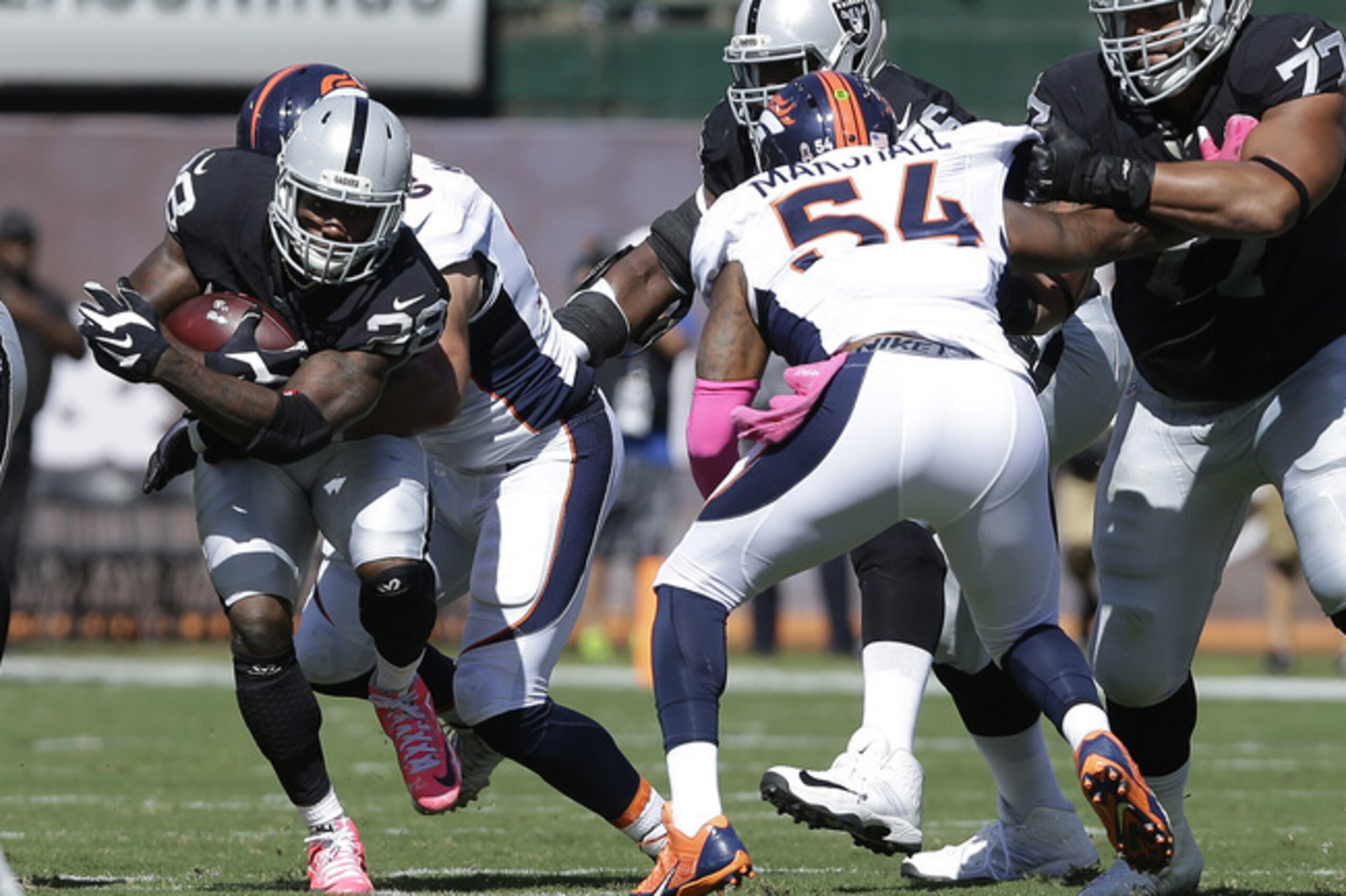
This isn’t the problem. The league has changed. Teams no longer feed their workhorse running backs 20-plus carries per game consistently. Defensive players are entering the league more athletic, in better shape and more capable of crushing running backs, which shortens careers at the position.
Murray ranks seventh in the league in rush attempts and averages 16 carries per game. His workload is in the upper echelon of today’s NFL. Chicago Bears running back Matt Forte stands as the only tailback averaging 20 or more carries per game. There’s nothing inadequate about Murray’s average in rush attempts.
| Player | Team | Rush Attemps | Yards Per Carry |
| Devonta Freeman* | ATL | 106 | 4.8 |
| Matt Forte | CHI | 102 | 4.3 |
| Doug Martin | TB | 90 | 4.5 |
| Justin Forsett | BAL | 87 | 4.5 |
| Carlos Hyde | SF | 83 | 4.5 |
| T.J. Yeldon | JAX | 81 | 3.6 |
| Latavius Murray | OAK | 80 | 4.0 |
*Played on Thursday night of Week 6.
However, the Raiders need solid productivity from the backup running back position. Despite Murray’s decent share of carries, Oakland ranks 29th in rush attempts at approximately 22 rush attempts per game.
The backups are averaging approximately six carries per game, which shows that the problem extends beyond Murray's productivity. The Raiders' starting running back banged up his shoulder, which likely factored into his struggles within the first five weeks. None of the reserve tailbacks picked up the slack in his absence.
Does Bill Musgrave Lack Creativity?
Coaches usually receive the majority share of culpability when plans go south and rightfully so. Offensive coordinator Bill Musgrave earned his share of the blame, but is it all his fault? Not exactly.
The Raiders' rushing attack falls short of innovative and becomes a mundane approach that any defense can sniff out on the field. The solution to stopping Murray focuses on clogging the middle in between the guards.
The table below expounds on a previous discussion concerning the Raiders’ predictable rushing attack with an added row for league averages for perspective.
| Left End | Left Tackle | Mid Guard | Right Tackle | Right End | |
| Raiders | 7% | 8% | 71% | 8% | 6% |
| League Average | 12% | 13% | 51% | 13% | 11% |
The Raiders direct more than 70 percent of their run plays between the guards. Oakland doesn’t attack the perimeter or test the edges. Based on league averages, the ground game shows deficiencies in four particular areas.
Why have Murray and Musgrave been tentative about testing other areas on the ground? Here's why.
Raiders Struggling in Run Blocking
| Player | Snaps | Run-Blocking Grade | Penalties/Overturned |
| Donald Penn | 341 | -1.6 | 2/0 |
| Gabe Jackson | 341 | 6.2 | 1/0 |
| Rodney Hudson | 341 | -2.3 | 2/0 |
| J'Marcus Webb | 341 | -5.2 | 2/0 |
| Austin Howard | 341 | -2.2 | 6/2 |
As a unit, the Raiders have struggled tremendously in holding blocks, sealing the edge and opening lanes for the ground attack. That particular problem makes Musgrave’s creativity and the number of rushing attempts for any running back a moot point.
Regardless of the designed play or who handles the ball, the guys in the trenches need to do their job by winning battles up front. Guard Gabe Jackson graded as the only offensive lineman capable of run blocking at an average to above average level.
Guard J’Marcus Webb graded as the biggest culprit in allowing defenders the advantage on run plays. As a run-blocker, he ranks 68th among 77 qualifying guards in the league, per Pro Football Focus.
The Raiders tackles graded slightly below average as well, which may explain the hesitation to direct runs toward the edges. The difficulties become evident when viewing the film
Film Study No. 1
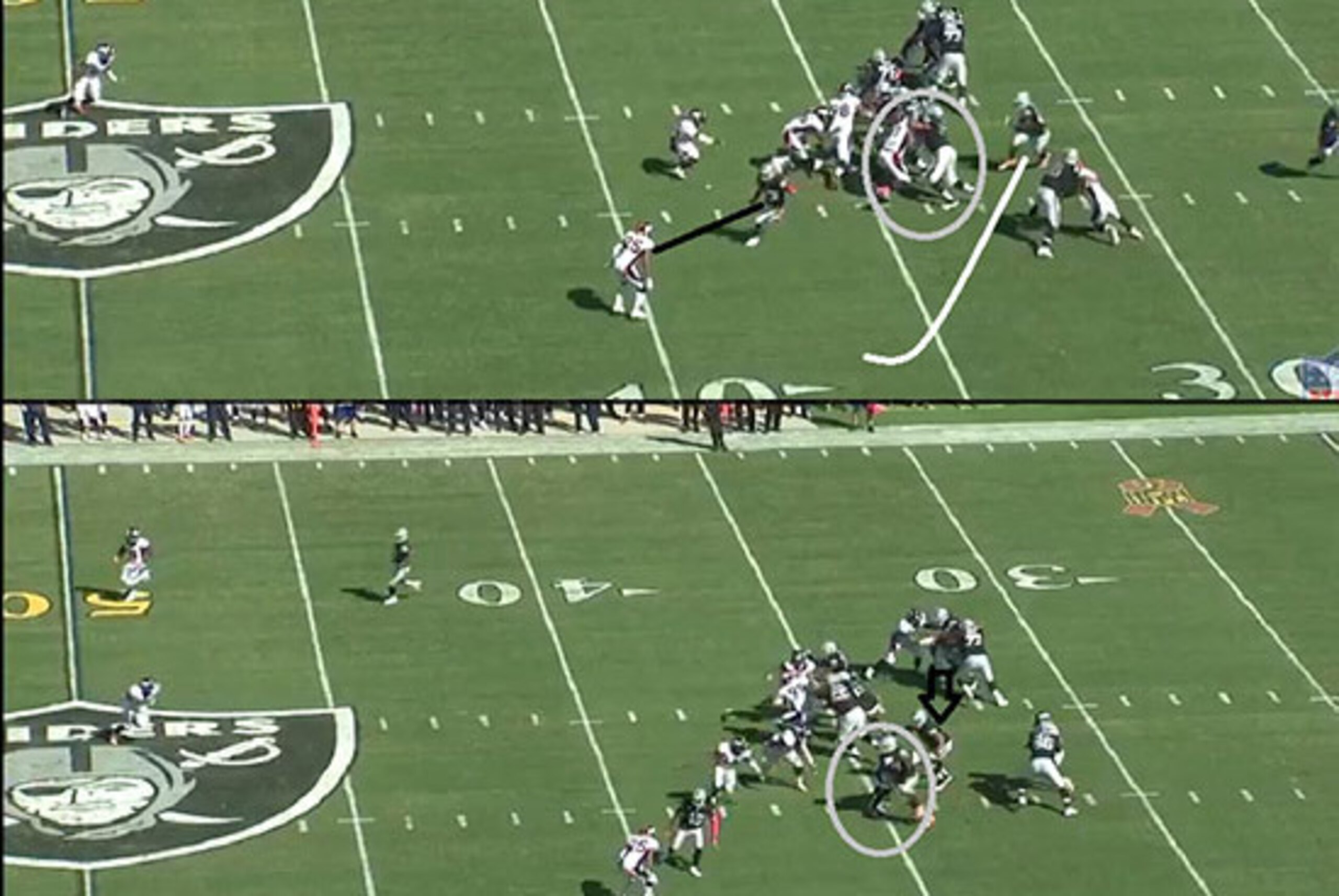
In the first example, tackle Donald Penn attempts to seal off a defender to spring the running back for a significant gain. Murray notices the lane, but the defender sheds Penn’s block to make the tackle after three yards.
Marcel Reece stood in perfect position to seal the block down the field, but Penn couldn’t keep his defender engaged long enough for Murray to squeak by the defender. This becomes the difference between a three-yard gain and a 10- or 15-yard burst up the field.
Film Study No. 2
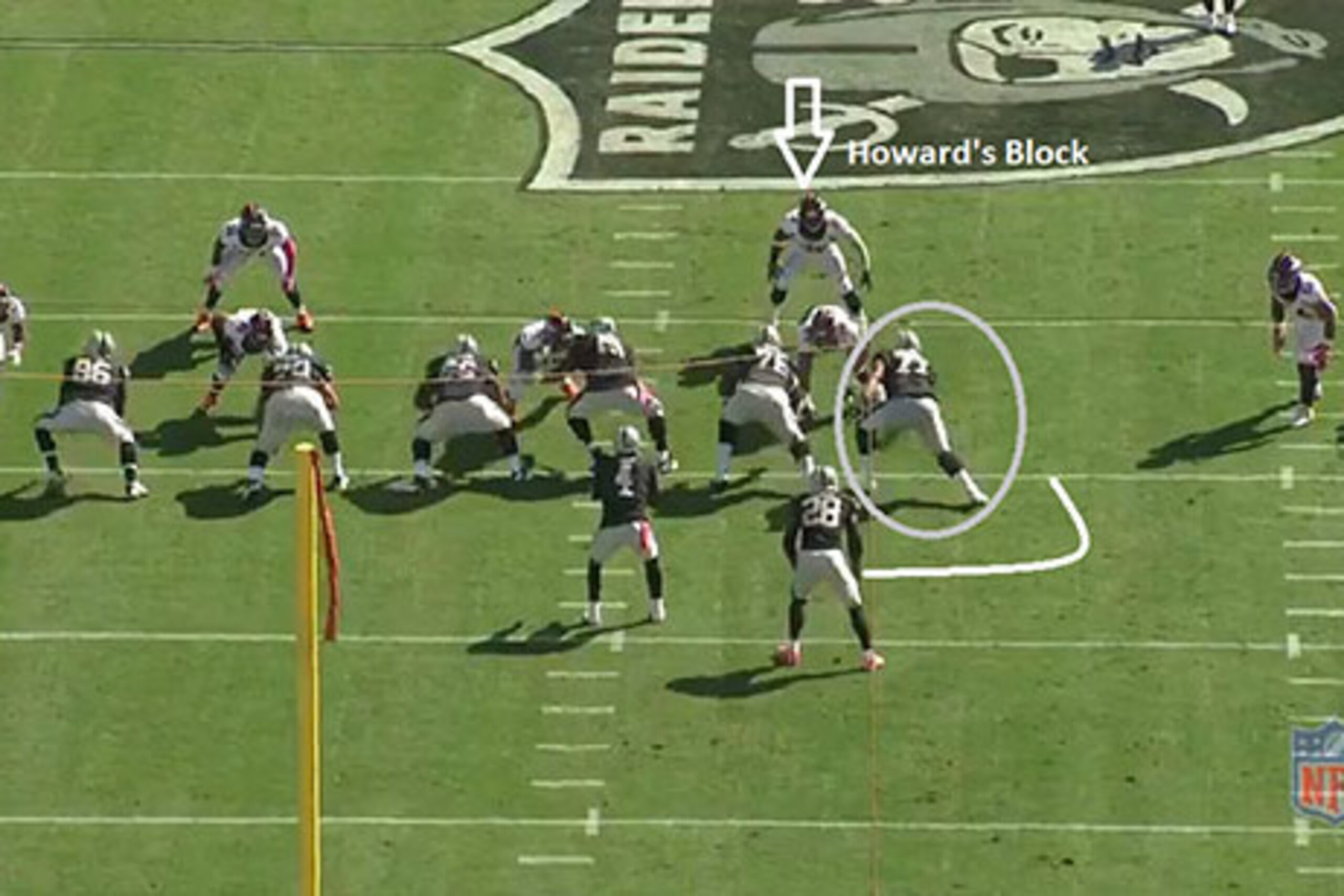
Tackle Austin Howard makes a bigger blunder that stuffs the Raiders at the line of scrimmage in the second example. As the play develops, Murray should find room to run once Howard makes a push on the linebacker.
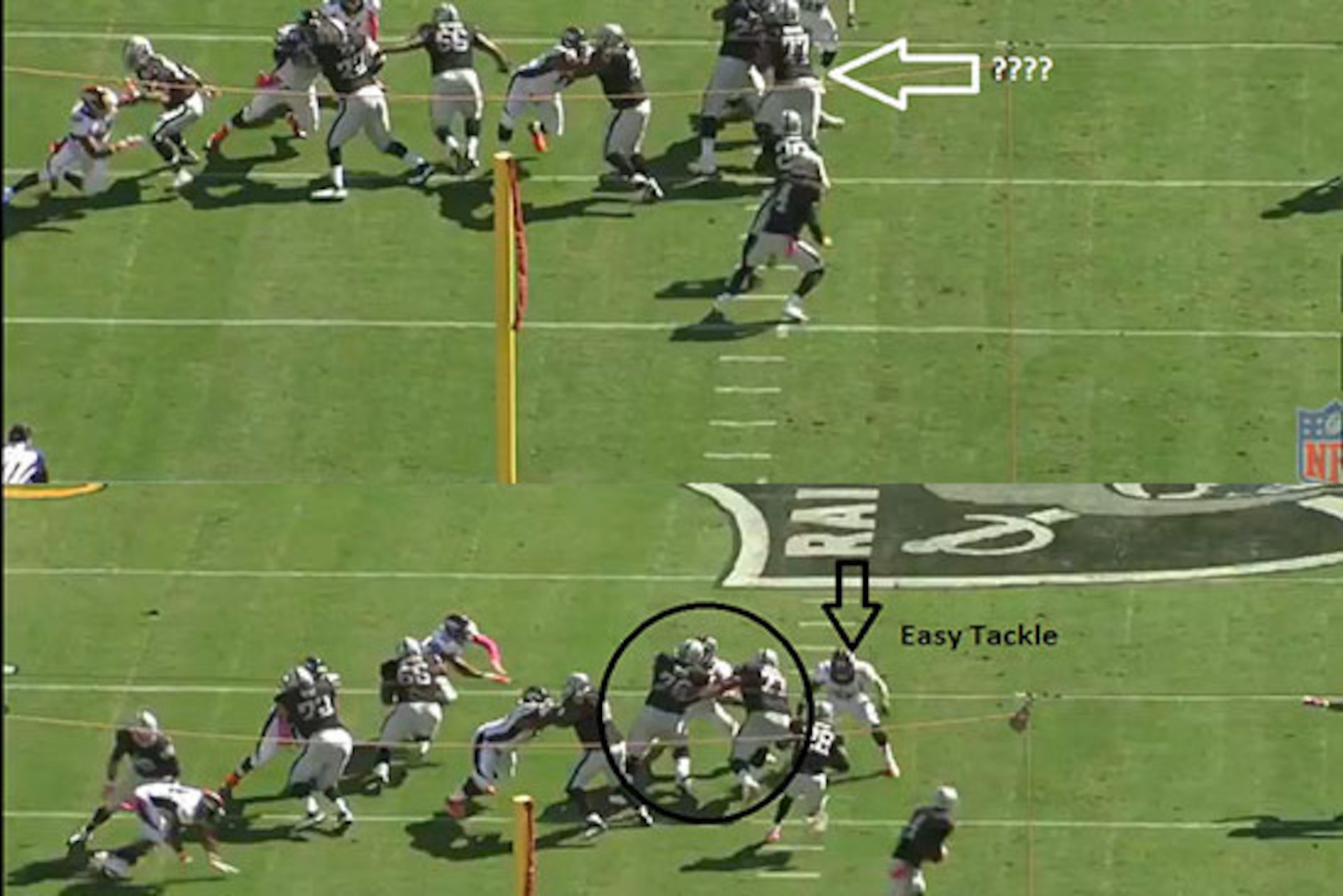
Murray takes the carry to the right, expecting to see open real estate, but Howard’s confusion leaves the defender open for an easy open-field tackle. There’s no justifiable explanation for a double-team on Webb’s defender, who's clearly blocked and further away from the action.
The unblocked linebacker wraps Murray up at the line of scrimmage for no gain. It’s hard to trust runs toward the edge with that type of miscommunication up front.
Film Study No. 3
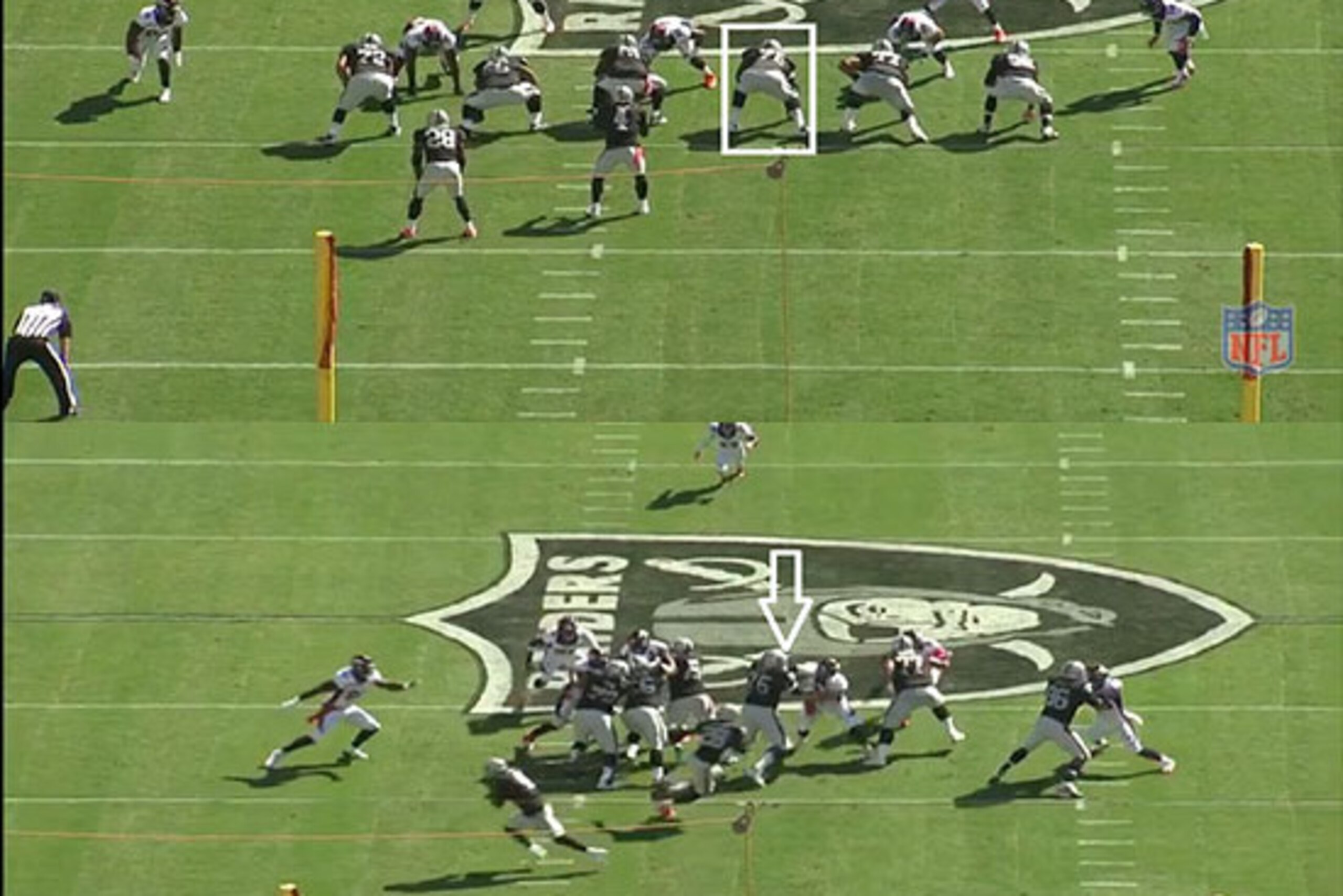
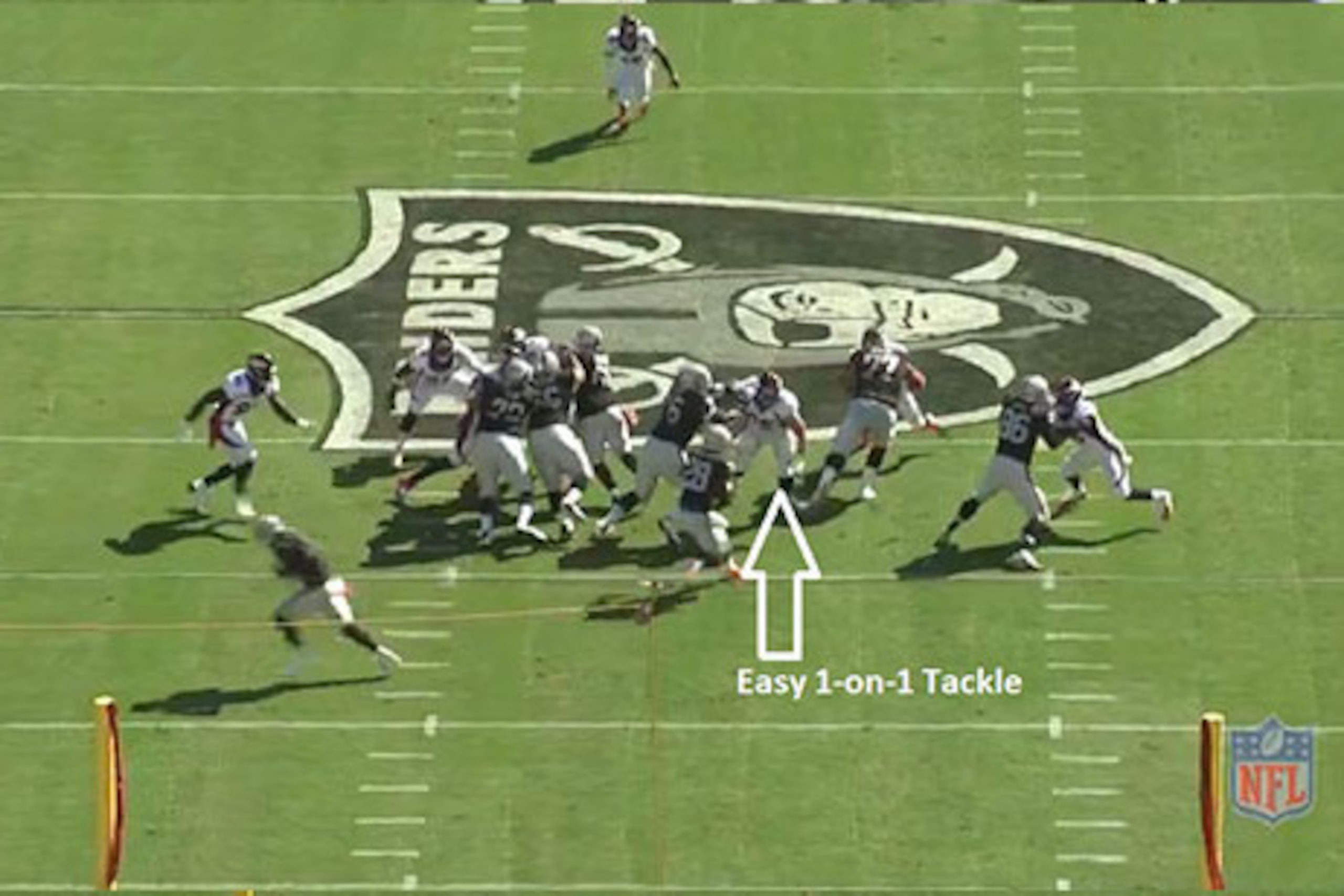
Webb fails to hold a simple one-on-one blocking assignment in the third example. He’s clearly beaten by his defender, which doesn’t leave Murray any space to escape.
Perfection isn’t expected, but according to Webb’s run-blocking grade, he’s been losing a lot of battles in the trenches.
The fact that the Raiders run 71 percent of their plays in between the guards indicates that Jackson's area as the strongest point of the offensive line. He’s clearly the shining star within the unit, but once the runs reach a predictable pace, there’s nothing Musgrave can do about poor blocking in other areas.
The push to spark the ground attack starts up front. Cleverly designed runs and more carries cannot thrive behind loose blocks and narrow lanes.
Offensive line coach Mike Tice has done a solid job in coaching pass-blocking techniques. All the offensive linemen, except Webb, grade positively as pass-blockers.
However, the bye week should focus on run blocking to help balance the offense. Murray’s four yards-per-carry average can move closer to five yards per carry with solid run protection.
Follow Maurice Moton on Twitter for news, updates and intriguing discussion about the Oakland Raiders.
All statistics are provided by Pro-Football-Reference.com, Pro Football Focus and Team Rankings unless otherwise noted.
Week 5 statistics and play-by-play analysis provided by NFL.com.
.jpg?w=2560)