
Conor McGregor, Demetrious Johnson and the Rewards (and Costs) of Going Big
First things first. Demetrious Johnson is a titan of fighting.
A 5'4" giant. Versatility, fight IQ, adaptability, speed, technique. It's all there in a package so finely crafted that few can even appreciate the blur they’re seeing. This isn’t about that. This is about everything else. The stuff that causes debates and hand-wringing and usually ends with the UFC flyweight champion flailing at questions regarding his marketability or lashing out at fans for their criticism.
It all feels like a torturous cycle, doesn’t it? Last week was especially trying. The questions, the boos, the fans leaving mid-performance. And that was just fight night.



Last Friday, the UFC hosted a Las Vegas press conference to trumpet future events. It was entitled "Go Big," a curious suggestion/declaration coming 24 hours before asking fans to shell out $60 to watch the tiniest champion on the roster attempt to defend his belt. In reality, they were taking advantage of a captive audience, even though it kind of felt as if they were apologizing for UFC 191 with a preemptive star-power strike.
You could almost imagine a dispirited Johnson reading the tag line. “Go big? Really, guys? I’m standing right here.”
Because really, who can concentrate on anything else in the room—maybe even the area code—in the presence of Conor McGregor? The man demands spotlight as if it's replaced oxygen in his chemical composition. (In this analogy, conflict is carbon and controversy would be hydrogen.)
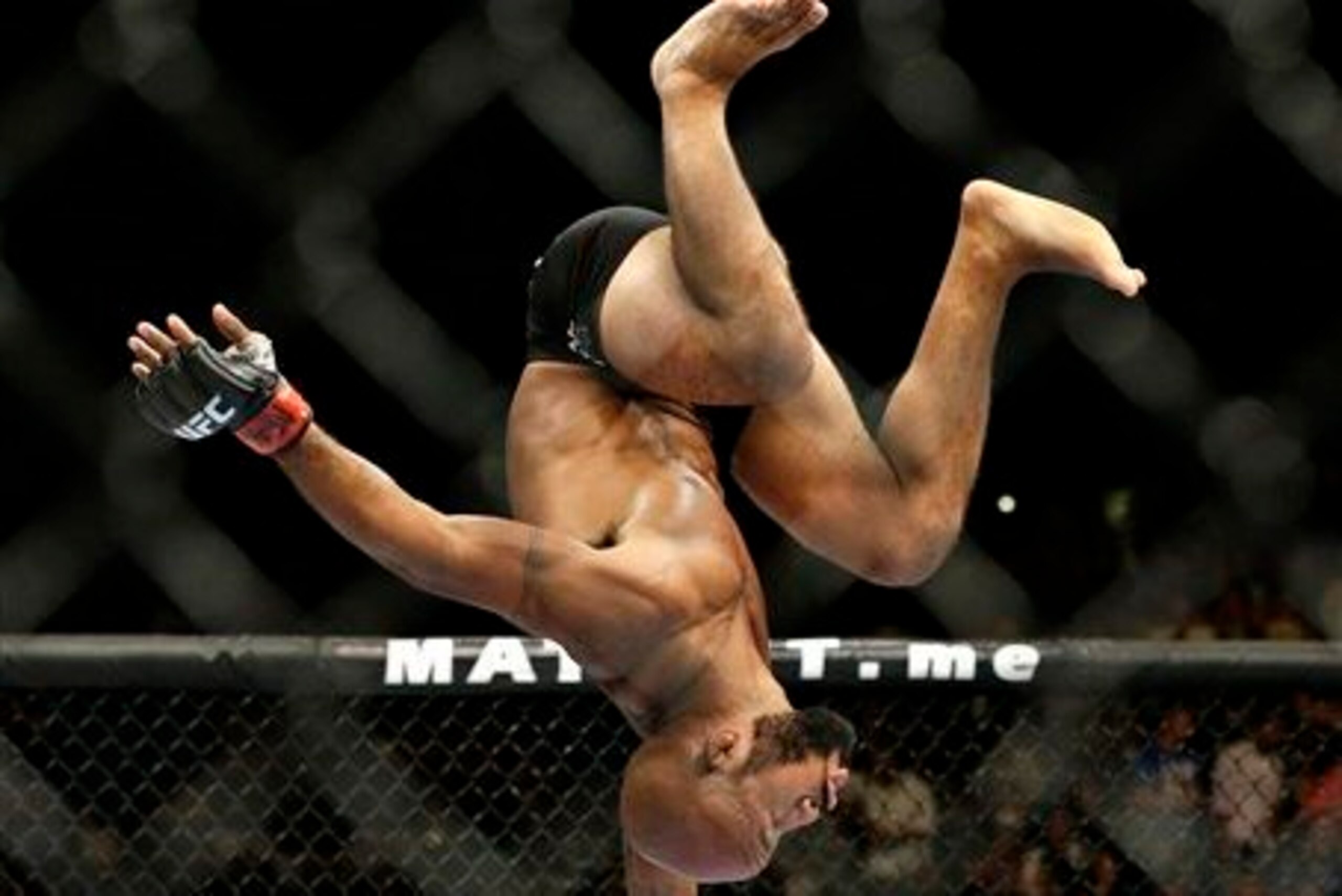
The irony is that McGregor goes big, even if he actually isn’t. At 5'9" and 165 pounds between fights, he is exactly average in height and lighter than your everyday Joe. Still, the man manages to exude a presence that portrays him as a giant. In the shadow of McGregor, it seems unfair, almost dishonorable, to compare Johnson. Yet compare them we must.
Over three years into the flyweight experiment, the division continues to sputter at the box office. While preliminary UFC 191 pay-per-view buyrate estimates won't be available for at least a few days, the event drew a gate of $1,362,700, which, according to MMA Junkie stathead Mike Bohn, is the lowest drawing Las Vegas-based pay-per-view card the promotion has produced since UFC 49 just missed the $1.3 million mark back in 2004.
When it comes to the greatness of a professional prizefighter—and Johnson is indisputably great—these kinds of numbers shouldn't matter. Yet they do. Absent the swarm of stats that other sports can point to in quantifying success, MMA mostly boils down to to wins, losses and drawing power.
Johnson is only left wanting in one of those categories, even if he doesn’t seem to care.
To the rest of the world, it’s a way of keeping score (just notice McGregor’s continual proclamations of escalating salary claims). To Johnson, it’s extraneous information that clouds focus.
"I don't think about it,” he said during a pre-UFC 191 interview with the media. “People keep asking me that. I'm over the legacy talk. Either I leave one or I don't, you know? For me, I'm just thinking about having a successful career, that way when I'm done fighting, I'm not broke."
Johnson is a smart man, but it seems that the connection between audience engagement and post-career finances is frayed. Somewhere along the way, he dissociated himself from actively cultivating the very thing that pumps cash into his pocket.
“Why does it always come down to blaming the athlete for not selling the product?” he once asked. And the answer is, because you are the product.
MMA is no longer new or a novelty. Shows are televised regularly and often on free TV. Scarcity used to make it special. Now, the notability of an event is almost directly proportional to its star, as McGregor proved last time out by drawing over 800,000 buys despite facing a late replacement (Chad Mendes) who has never been a star gate attraction.
At this point, we can no longer blame the unfamiliarity of the audience for Johnson’s box-office struggles. He has fought 12 times under the UFC banner, including three times on Fox broadcast television as a main event. He's fought under Jon Jones. He's fought twice near his home market in Washington. He's fought rematches with rivals. Nothing has seemed to click.
Johnson hears this kind of talk all the time. It often supersedes conversation about his success or future challengers or his place in the pantheon. By now, it’s probably white noise, so much so that despite all of the times he’s had to address it, he still struggles.
"I don't see myself as a prizefighter,” he told the media last week. “Yes, I fight for money, but I don't see it as my prize. I see it as my income. It's a hard question to answer."
It’s apparently an even harder question to face, because in the end, if we’re going to be blunt, it’s going to cost him a lot of money.
Particularly when you’re a champion, your pay is directly tied to your notoriety. That’s something McGregor is routinely reinforcing, even if his fellow fighters are not always paying attention. At that level, being able to perform is fantastic, but it’s also kind of a given. People hear the word “champion” and automatically assume them to be the best.
It’s the intangibles that make a fighter magnetic and a show transcendent. Talking trash. Dressing to the nines. Engaging your opponent. Cage showmanship. All of it matters because the show never stops. All of it matters because it makes you feel something. It heightens your emotions. It changes your investment in the outcome.
When McGregor was up on stage praising himself and torching the rest of the roster, he was putting money in the bank, because while some part of the audience thought it was hilarious, the remainder were storing their anger in a mental file cabinet to be redirected toward him at the proper time of comeuppance.
This kind of approach isn’t for everyone, but it’s also not the only kind of approach. Be funny, be aggressive, be confrontational, be something past our expectations. Because while there might be a price to pay for increasing your own price, there is definitely a price to pay for refusing to address it. For Demetrious Johnson, it’s a cost that will never be recovered.




.jpg?w=2560 "Weather Channel Trolls Texans-Titans 💀")

.jpg?w=2560 "Grading WWE Raw 🔠")