Pump the Brakes on Xavier Rhodes Hype Train, CB Has Work to Do
Xavier Rhodes is entering a pivotal stage of his career.
The former first-round pick of the 2013 NFL draft is entering his third season in the league. He became a full-time starter for the Minnesota Vikings last season, after playing in 13 games as a rookie. Rhodes received plenty of plaudits for his play in 2014, but it may be premature to call it a breakout season.
As a second-year cornerback, inconsistency is to be expected. It is a position that regularly requires a development period after the draft that can stretch on for multiple seasons. In recent years, players such as Jimmy Smith and Kareem Jackson have struggled early before later establishing themselves as quality starters.
.jpg?w=2560 "Texans Titans Football")
.jpg?w=2560)
.jpg?w=2560 "Cardinals Giants Football")
In his third and fourth seasons, Rhodes will be expected to consistently play to his potential and establish himself as a high-quality starter.
Despite playing so little, some already consider Rhodes a high-quality starter. At least one analyst, Bleacher Report's own Matt Miller, already considers Rhodes as a top-10 player at his position:
As with most on-field aspects of the Vikings these days, the positivity and optimism is becoming overwhelming. Because of his relative youth, who he plays for and the stage of his career he is entering, Rhodes is one of the more fascinating young players in the NFL.
Considering that, he is a prime candidate to undergo the Pre Snap Reads cornerback analysis.
Explaining the Process
Qualifying Plays
Plays that count
- Every snap that has the cornerback in man coverage no matter where the ball is thrown.
- The above includes sacks, quarterback scrambles and plays where the defensive back has safety help.
- Every snap in zone coverage where a one-on-one situation is naturally created. For example, a sideline route from a wide receiver who lined up directly across from the cornerback when that cornerback is covering the deep third in Cover 3.
Plays that don’t count
- Screen plays. Even if the receiver isn't part of the screen, these plays do not count.
- Plays where either the receiver or cornerback doesn't follow through his whole assignment.
- Zone plays that don't create one-on-one situations. Any ambiguity in this area will disqualify a play.
- Any prevent coverage situations.
- Receptions in the flat without a route run.
- Running plays, including designed quarterback runs.
Failed Coverages
The ball does not have to be thrown in the defensive back’s direction for the coverage to fail. This is not an analysis of how many completions the cornerback allowed (that can be found elsewhere)—this is an analysis of how good his coverage is on any given play.
Failed coverages can come at any point of the route, but it is subjective to where the players are on the field in relation to the quarterback. Typically, defensive backs must be within arm's reach for underneath/intermediate routes. On deeper passes, there is greater leeway given to the defender.
Failed coverages can be subjective. They must be determined by the situation considering the length of the play and other such variables.
In Position
This is the opposite of a failed coverage. In order to be "in position," a defensive back has to be in a position to prevent a relatively well-thrown pass to his assignment.
Individual Matchups
| 1. | Brandin Cooks | 6/7 | 86% |
| 2. | Kelvin Benjamin | 7/9 | 78% |
| 3. | Davante Adams | 12/16 | 75% |
| 4. | Pierre Garcon | 6/8 | 75% |
| 5. | Aaron Dobson | 3/4 | 75% |
| 6. | Jeremy Ross | 3/4 | 75% |
| 7. | Kenny Stills | 3/4 | 75% |
| 8. | Vincent Jackson | 5/7 | 71% |
| 9. | Alshon Jeffery | 13/19 | 68% |
| 10. | Eric Decker | 10/16 | 63% |
| 11. | Sammy Watkins | 6/10 | 60% |
| 12. | Corey Fuller | 3/5 | 60% |
| 13. | Roddy White | 3/5 | 60% |
| 14. | Chris Hogan | 4/7 | 57% |
| 15. | Julio Jones | 4/7 | 57% |
| 16. | Mike Wallace | 7/13 | 54% |
| 17. | Corey Brown | 2/4 | 50% |
| 18. | Brian Quick | 2/4 | 50% |
| 19. | Mike Evans | 2/5 | 40% |
| 20. | Calvin Johnson | 3/8 | 38% |
| 21. | Jordy Nelson | 3/8 | 38% |
| 22. | Julian Edelman | 3/10 | 30% |
Only receivers with at least four qualifying snaps against Rhodes were included on this chart.
Weekly Breakdown
Rhodes' success rate for the season was unimpressive. He finished the season with a 62.7 percent rating.
For most of the year, Rhodes simply lined up at right cornerback and covered whoever came his way. He lined up at right cornerback on 176 of his 181 qualifying snaps over the first 13 games of the year, only moving into the slot on rare occasions.
After Week 13, he followed specific receivers around the field most of the time: Calvin Johnson, Mike Wallace and Alshon Jeffery. His success rate over these games dropped to 56.4 percent, after standing at 64.1 percent up until that point of the season.
| St. Louis Rams | 7 | 5 | 2 |
| New England Patriots | 16 | 7 | 9 |
| New Orleans Saints | 13 | 11 | 2 |
| Atlanta Falcons | 14 | 9 | 5 |
| Green Bay Packers | 15 | 9 | 6 |
| Detroit Lions | 10 | 6 | 4 |
| Buffalo Bills | 21 | 11 | 10 |
| Tampa Bay Buccaneers | 14 | 8 | 6 |
| Washington | 12 | 9 | 3 |
| Chicago Bears | 11 | 8 | 3 |
| Green Bay Packers | 11 | 7 | 4 |
| Carolina Panthers | 17 | 12 | 5 |
| New York Jets | 20 | 14 | 6 |
| Detroit Lions | 9 | 4 | 5 |
| Miami Dolphins | 16 | 9 | 7 |
| Chicago Bears | 14 | 9 | 5 |
| Total: | 220 | 138 | 82 |
Compared to other cornerbacks across the league, Rhodes struggled in coverage. Other young cornerbacks in the NFL were significantly more effective. Desmond Trufant finished the 2014 season with a 76.6 percent success rate. Stephon Gilmore finished with a 80.6 percent success rate, and Jimmy Smith had a 76.8 percent success rate.
Young cornerbacks typically struggle in the NFL. Some of them are simply poor players, but others take time to adjust to the complexity and athleticism of the professional level.
What the Vikings must wonder with Rhodes is if he has showcased enough of his talent to suggest that he is simply still adjusting to the NFL or if this is the type of player he is. To get a better understanding of that, you must look past his success rate and analyze his tape.
The Tape
At 6'1", it's no surprise that Rhodes plays a lot of press coverage.
Like with any cornerback playing press coverage, being effective at the line of scrimmage is crucial for success. This was one of the most notable issues with Rhodes' ability to cover his assignments in man coverage.
Too often receivers were able to threaten in breaking routes at the snap, such as slants or seam routes to create huge separation down the sideline. Rhodes' heavy feet and inability to keep his hips and shoulders square to the receiver threw him off balance on a regular basis.

On this play against the New England Patriots, Rhodes is on top of Julian Edelman at the line of scrimmage. Edelman runs directly into his inside shoulder at the snap. Rhodes attempts to put his hands on Edelman at this point, but he lets his weight draw him forward more than he should.
Edelman uses this mistake from Rhodes to knock him further infield as he turns back toward the sideline outside.
From there, Edelman stumbles to give Rhodes a chance to recover. Rhodes had drifted so far infield that he couldn't recover immediately, but he could use his athleticism to catch up to Edelman further down the sideline.
If Tom Brady had thrown the ball ahead of Edelman further downfield, Rhodes may have had a chance to recover. Instead, the quarterback threw a back-shoulder throw that Rhodes couldn't see, allowing Edelman to make the reception and continue downfield for a big play.
On this play against the Carolina Panthers, Rhodes is lined up against undrafted receiver Corey Brown. Brown is on the line of scrimmage, but Rhodes allows for a pocket of space between the two by not lining up as close as possible.
Rhodes drops back at the snap with Brown as he releases slightly toward the outside.
As Brown enters his route, Rhodes is turning his shoulders to usher him toward the sideline. Brown makes one sharp movement toward Rhodes, which causes the cornerback to drop his backside and stop his feet. As soon as Rhodes does that, Brown accelerates toward the space down the sideline.
For a couple of yards, it appeared that Rhodes was going to be able to recover and run with the receiver. However, the receiver quickly began to pull away from the cornerback after that initial acceleration. Pressure upfront forced Cam Newton to scramble, saving Rhodes' blushes.

On this play against the Green Bay Packers, Rhodes begins the play on the line of scrimmage, but Jordy Nelson creates a pocket of space by lining up further behind the line of scrimmage. Nelson releases inside, angled past Rhodes' inside shoulder, before immediately breaking back outside.
Rhodes was so aggressive in trying to cover Nelson inside that the receiver was able to use his outside hand to punch the defensive backs upper arm/shoulder to push him further infield.
Nelson was able to run wide-open down the left sideline for what would have been an easy, long touchdown reception. Aaron Rodgers was late to recognize that Nelson was open, and when he did throw the ball, he underthrew it, giving Rhodes a chance to recover.
The ball still arrived in a spot for Nelson to catch it, but the receiver had to stop and deal with Rhodes' presence. He ultimately dropped the ball.
Rhodes clearly wants to be an aggressive cornerback. He gave up the sideline on a number of occasions trying to overplay in-breaking routes, but he also did the opposite on occasion. This play occurred against the Buffalo Bills' Sammy Watkins.
It's important to note that Rhodes is going to attempt to trail Watkins, overplaying underneath routes with a safety over the top, by design. Watkins lines up tight to the formation instead of wide outside the numbers, and Rhodes shades to his outside at the beginning of the play.
To release up the seam, Watkins makes one hard step outside. Rhodes immediately bites on it and jumps forward.

Watkins is running a deep out route. He comes wide-open because Rhodes was too far away from him after initially biting on the false step in his release. Kyle Orton's pass was too far inside of Watkins, though, meaning the receiver couldn't make take advantage of his successful route.
This image perfectly highlights the difference between Rhodes' coverage and what Rhodes' coverage should have been. The other cornerback to the top of the screen is much tighter to his assignment than Rhodes is.
A lack of initial discipline is something that permeates through everything Rhodes does in coverage. When responsible for zones, Rhodes is often late passing off the first receiver he sees if two run through his zone. This also becomes an issue when the offense throws off of play action.
One of the other most notable aspects of Rhodes' season was how teams went after him at decisive moments.

This play comes from the Vikings' game against Washington. There is just 01:09 left in the fourth quarter, with the Vikings leading by three points, 29-26. It's 4th-and-6 close to midfield. Rhodes is lined up against Pierre Garcon to the top of the screen.
As soon as the ball is snapped, the defense rotates into Cover 2 man, meaning Rhodes is in aggressive man coverage against Garcon.
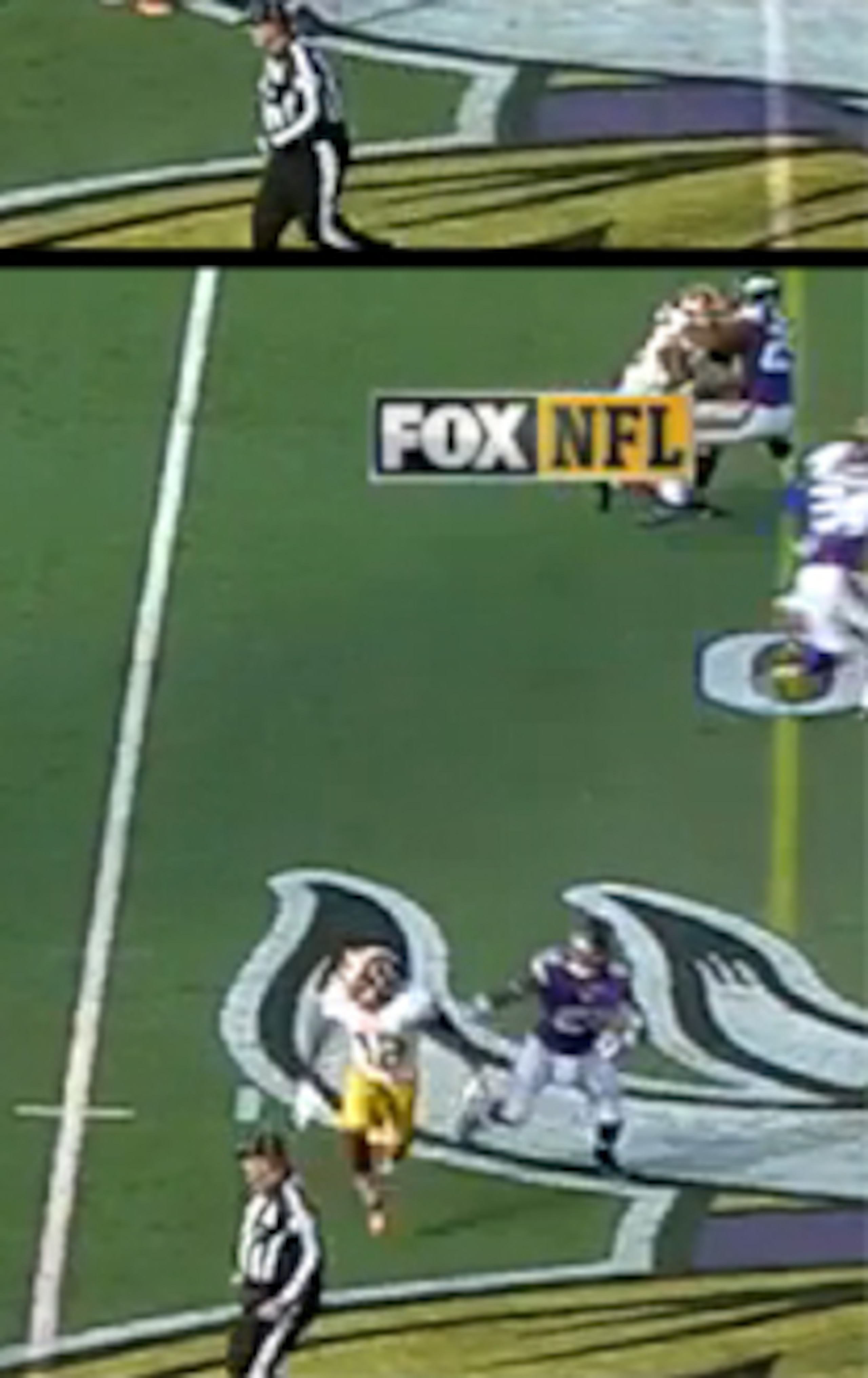
With the safety help in place over the top, Rhodes smartly shows Garcon the sideline. His shoulders are square to the line of scrimmage by the time Garcon advances downfield to reach him. Garcon doesn't want to run where Rhodes is showing him, though.
Instead, Garcon wants to run an in-breaking route—a route that would go right through Rhodes coverage, giving Rhodes a chance to hold his position and redirect/turn with the receiver.

Despite his favorable positioning, Rhodes bounces off Garcon as he advances in his route. He doesn't show off the footwork to swivel and run with the receiver, and he did not show off the strength to hold his position and force the receiver to work around him rather than through him.
Garcon was wide-open over the middle of the field with space to run into. He would have had a first down with an accurate pass, but Robert Griffin III threw the ball into the ground.
This lack of strength showed up repeatedly through the 2014 season for Rhodes. It's a major concern because if he is going to become one of the better cornerbacks in the NFL, he will likely need to do it primarily as a boundary cornerback. He doesn't have the feet to be more versatile than that.
Other young cornerbacks such as Jimmy Smith and Stephon Gilmore, as well as veterans such as Brandon Browner and Antonio Cromartie, show off the strength to lean on receivers and hold their established positions. When working near the sideline, those become very valuable traits.
Without them, it's hard to be effective as a slow-footed cornerback in the NFL.
That missed pass allowed the Vikings to take over possession against Washington and ultimately win the game. Similar fortune didn't shine on the defensive back against the Miami Dolphins later in the season, though.
On that occasion, Rhodes was playing off coverage against Mike Wallace on 3rd-and-long deep in Vikings territory. The Vikings had a seven-point lead with roughly one minute left in the game. That lead disappeared soon after Rhodes was called for pass interference in his own end zone.
The disappointing part of that play was how Rhodes approached Wallace. He turned into the receiver, extending his arms toward him and aligning his shoulders to him, even though he was looking up for the ball.
Rhodes doesn't need to approach receivers in this way because he has impressive length and athleticism to adjust to the ball in the air.

The NFL officially assigned 18 pass deflections to Rhodes for last season. That is a large number, but it doesn't account for the disruption he was able to cause with his length when he didn't touch the ball. On this play, Rhodes was beaten down the sideline by Devin Hester.
Hester caught the ball with both hands extended away from his body. Rhodes wasn't able to get to the ball, but he hit Hester's wrists, and that caused the ball to come loose.

These traits don't just stand out against lesser receivers either. From that same game, Rhodes was able to show off his athleticism and length against one of the most athletic receivers in the NFL, Julio Jones. It's these kinds of plays that excite analysts and fans alike.
If Rhodes can figure out his feet and show better strength against receivers through their routes, he could become one of the best boundary cornerbacks in the NFL.
However, flashing talent every so often isn't what makes players great at this level. It's especially not very valuable when you play a position that builds success on the idea of not giving up yards and touchdowns. As he is right now, Rhodes is still a solid starter in the right situation.
With Zimmer and the Vikings' defensive front, the right situation appears to be in Minnesota.
Conclusion
Rhodes is an average starter with the potential to become much more.
Average is a term that has become a negative over recent years. Because of the widespread league coverage and the extreme opinions that sell ad spaces, calling any player average is received as a slight. Yet, being an average starter in the NFL at any position is a great achievement.
Being average means that you are better than half of the players starting at the position across all 32 rosters. An average starter is a valuable player. Rhodes is a valuable player. He is entering a crucial stage of his career as the next two or three years are going to determine just how valuable he can ultimately be.
There is still work to do.
.jpg?w=2560 "Broncos Chargers Football")

.jpg?w=2560 "MHJ Bought Own Jugs Machine")