

3 Matchups to Watch in Los Angeles Clippers vs. Houston Rockets 2nd-Round Series
The Houston Rockets finally know who their opponent is in the second round. After a series for the ages, the Los Angeles Clippers won the right to advance over the San Antonio Spurs. The second round probably won’t live up to that level of theater, but there are three matchups especially worth watching.
Houston and Los Angeles squared off on four occasions this season, splitting them evenly, but it would be a bit of an overstatement to say the two “teams” did. The rosters that will face each other in the postseason have not yet bumped heads.
Dwight Howard missed all four games for the Rockets. They hadn’t yet acquired Josh Smith or Corey Brewer for the first tilt. Terrence Jones was out for two games. And a number of players, including Patrick Beverley, Donatas Motiejunas and even Tarik Black, logged significant minutes in one or more contests but aren’t on the playoff team.



Blake Griffin missed two for the Clippers, and Jamal Crawford missed one, so they aren’t exactly the same either.
When considering the matchups and what to watch for, it’s important that we look at not only what did happen but also what didn’t because of the lineup variances.
Chris Paul vs. the Rockets’ Help Defense
During the postgame on TNT, there was a lot of discussion about how much Patrick Beverley will be missed for the next series because now Jason Terry will be guarding Chris Paul. To an extent, that’s true, but it’s also easily overstated.
The concerns are mitigated, at least for Game 1, because Paul is not expected to play, per Shawn Krest of CBS Sports, who reports that head coach Doc Rivers “expressed doubts” that Paul would be ready to go due to a pulled hamstring.
Once Paul returns, even if he’s 100 percent (which is unlikely), he’s not likely to dominate. A cursory look at the on/off stats at NBA.com reveals that Beverly was, indeed, effective. Paul shot 32.1 percent when Beverley was on the court and 40.6 percent when he wasn’t.
Head coach Kevin McHale told Fran Blinebury of NBA.com that he isn’t looking to make excuses for the loss of his starting point guard, though:
"It's not always pretty, and it's not always perfect. If you want to win championships, you've got to like it when it gets dirty and nasty, because that's the way it gets a lot of times. A lot of times, it becomes a fistfight game. Playing in a lot of them, the rim doesn't get bigger in Game 7. It gets smaller. It tightens up.
You've just got to enjoy the grind. You've got to enjoy a dirty, nasty, knock-down brawl. Everything wasn't perfect, but you just have to find a way to win.
"
Peeling things back a bit indicates that McHale isn’t just blowing smoke. The loss of Beverley might not be as big as advertised because defending Paul has actually been a scrappy team effort for the Rockets all season.
Beverley, even when he was on the court against Paul, was not the whole defense. The Rockets like to switch on screens, so they shared the responsibility of guarding Paul. Thus, the notion that this should be viewed as some sort of one-on-one situation between Terry and Paul is inaccurate.
Using the box scores at NBA.com, I looked at all 60 shots Paul took this year against the Rockets—and who was defending him on each one. Fifteen of them were uncontested. The other 45 were defended accordingly:
| Defender | FG | FGA | FG% |
| Donatas Motiejunas | 5 | 12 | 41.7% |
| Patrick Beverley | 0 | 6 | 0.0% |
| Terrence Jones | 3 | 5 | 60.0% |
| Trevor Ariza | 1 | 5 | 20.0% |
| Jason Terry | 2 | 4 | 50.0% |
| Joey Dorsey | 1 | 4 | 25.0% |
| James Harden | 2 | 3 | 66.7% |
| Kostas Papanikolaou | 1 | 3 | 33.3% |
| Josh Smith | 0 | 2 | 0.0% |
| Clint Capela | 0 | 1 | 0.0% |
| Total | 15 | 45 | 33.3% |
So, yes, Beverley did a good job of defending Paul. So have the rest of the Rockets. Even if you exclude Beverley, Paul is just 15-of-39 on contested shots against Houston.
Furthermore, when Paul had the ball in his hands and the chance to win the game March 15, Trevor Ariza shut him down:
However, that doesn’t mean it’s going to be an easy win for the Rockets. The Clippers’ effective field-goal percentage against Houston when Paul is on the court is 53.3. When he sits, it’s 45.0. And 61.2 percent of Los Angeles' field goals come on assists when he’s on, compared to 51.4 percent when he’s not.
Paul’s brilliance is not just as a scorer but also as a passer. The Rockets stopped him from scoring, but he found the open man because that’s what Paul does. The help defense was there to stop his penetration, but no one “helped the help.” If that continues, there will be consequences.
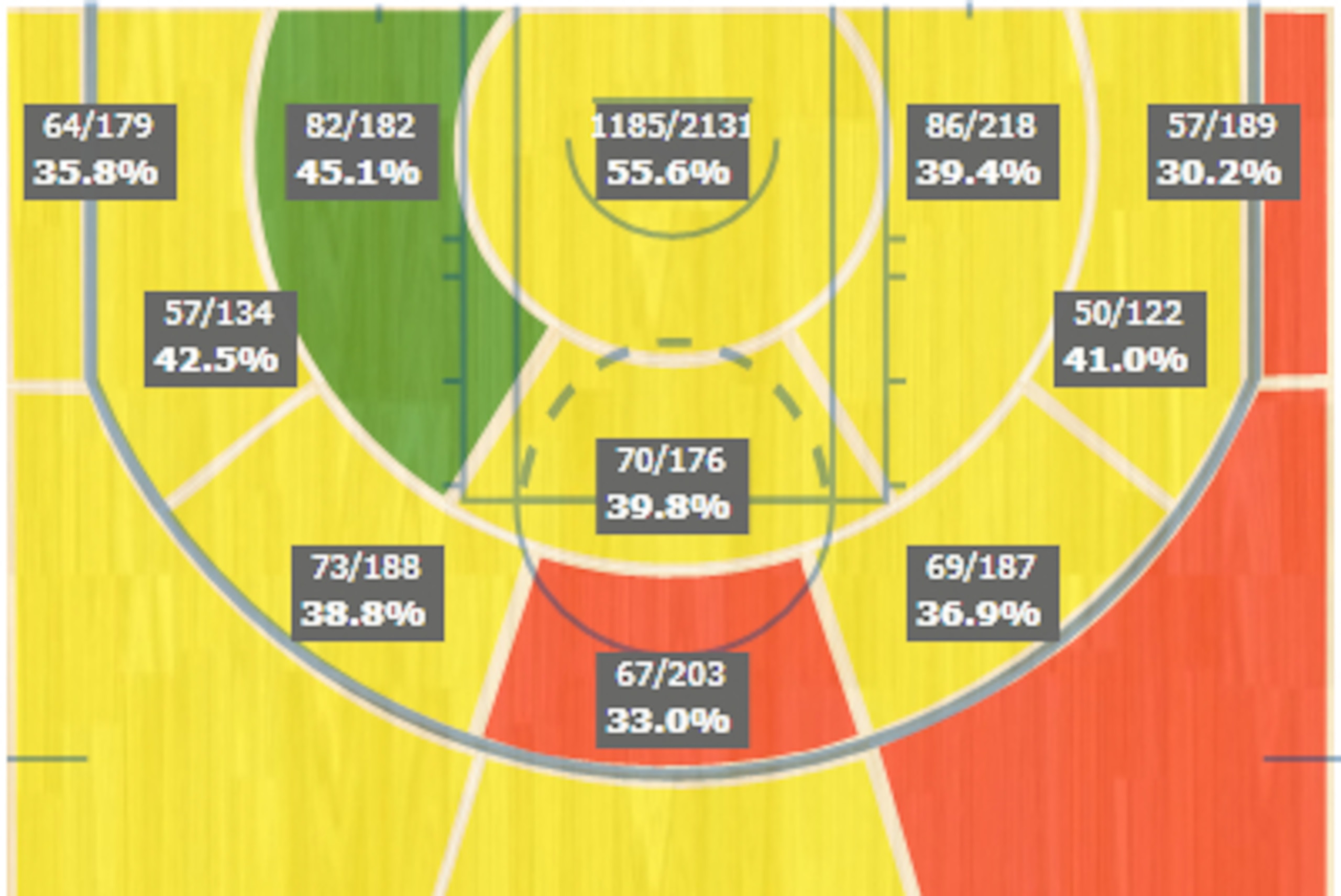
The key to solving that could be the presence of Dwight Howard. Remember, he was absent in the first four contests. He has a domino effect across the court. Because he protects the paint so well, defenders can guard their opponents more closely, thus reducing their shooting percentages.
Here are the shot charts from NBA.com. See the difference when Howard doesn't play:
And when he does play:
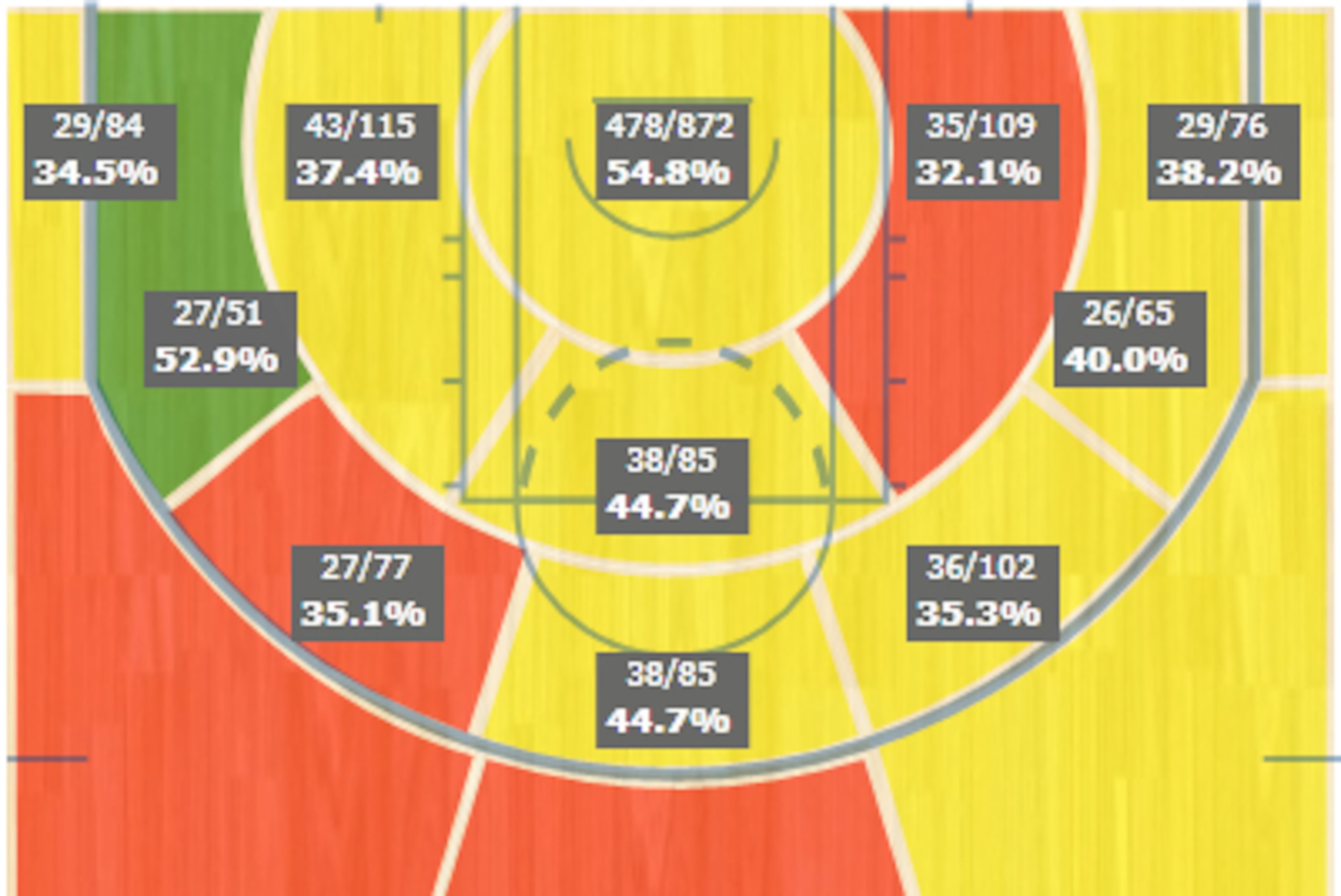
Notice how the Rockets are even better outside the paint. Howard effectively shrinks the court. That means there should be shorter distances for defenders to travel to the open man before Paul’s pass arrives, thereby cutting down his assists.
Paul is going to be a threat, regardless. The goal is to slow him down, not stop him. The battle here will be between Paul’s brain and the Rockets’ help defense, not between Paul and Terry.
James Harden vs. DeAndre Jordan
The next major matchup is between James Harden and DeAndre Jordan. Again, this is a case of not oversimplifying and just thinking of a player guarding his counterpart. The presence of Jordan on the court has changed Harden’s shooting habits.

The above GIF, with two charts provided by BBallBreakdown.com, illustrates how much. The "Frequency" chart shows how often Harden shoots from each distance. The "Field-Goal Percentage" one indicates his percentages on those shots.
The green line is his split against the Clippers. The red line is what he does against the rest of the league. When you put them together, you see a pattern. Harden is taking fewer shots inside and more shots from mid-range and deep, but the outside shots are going in less frequently.
This is a classic indication of a player who is settling for shots. Harden is less aggressive against Jordan, a well-renowned shot-swatter. He’s been reluctant to charge the lane.
The eye test confirms this. For example, in this play, we’d usually see Harden torture J.J. Redick with a crossover and drive to the basket, but the presence of Jordan seems to deter him. So he settles for a three that isn’t a good look.
When Harden is attacking though, Harden is doing things like this:
This is another place where the presence of Howard could make an impact. Having him as a threat down low will make Jordan think twice about leaving to help against Harden, particularly with Harden being the passer that he is.
For the Rockets to win this series, Harden needs to play unintimidated and attack the paint, whether Jordan is there or not.
Blake Griffin vs. Depth
Griffin is coming off one of the most complete series in history. He tallied totals of 169 points, 52 assists and 73 rebounds. Per the Play Index at Basketball-Reference.com, no player has hit those numbers in the first round—or any other—since at least 1985.
Griffin is playing like a superstar, something Paul has been missing in his career to date. The pair makes for an incredible one-two punch.
But the truth of the matter is that the Spurs—as great as they are, and as great as Tim Duncan is—didn’t have anyone who can guard Griffin.
Duncan might be a better player in general than Jones or Smith, but he’s not better to have against Griffin. His Jedi tricks go only so far in covering up the fact that he’s a 39-year-old man. He doesn’t have the speed or athleticism to guard Griffin.
Howard, Smith and Jones (nickname idea: The Law Firm) do.
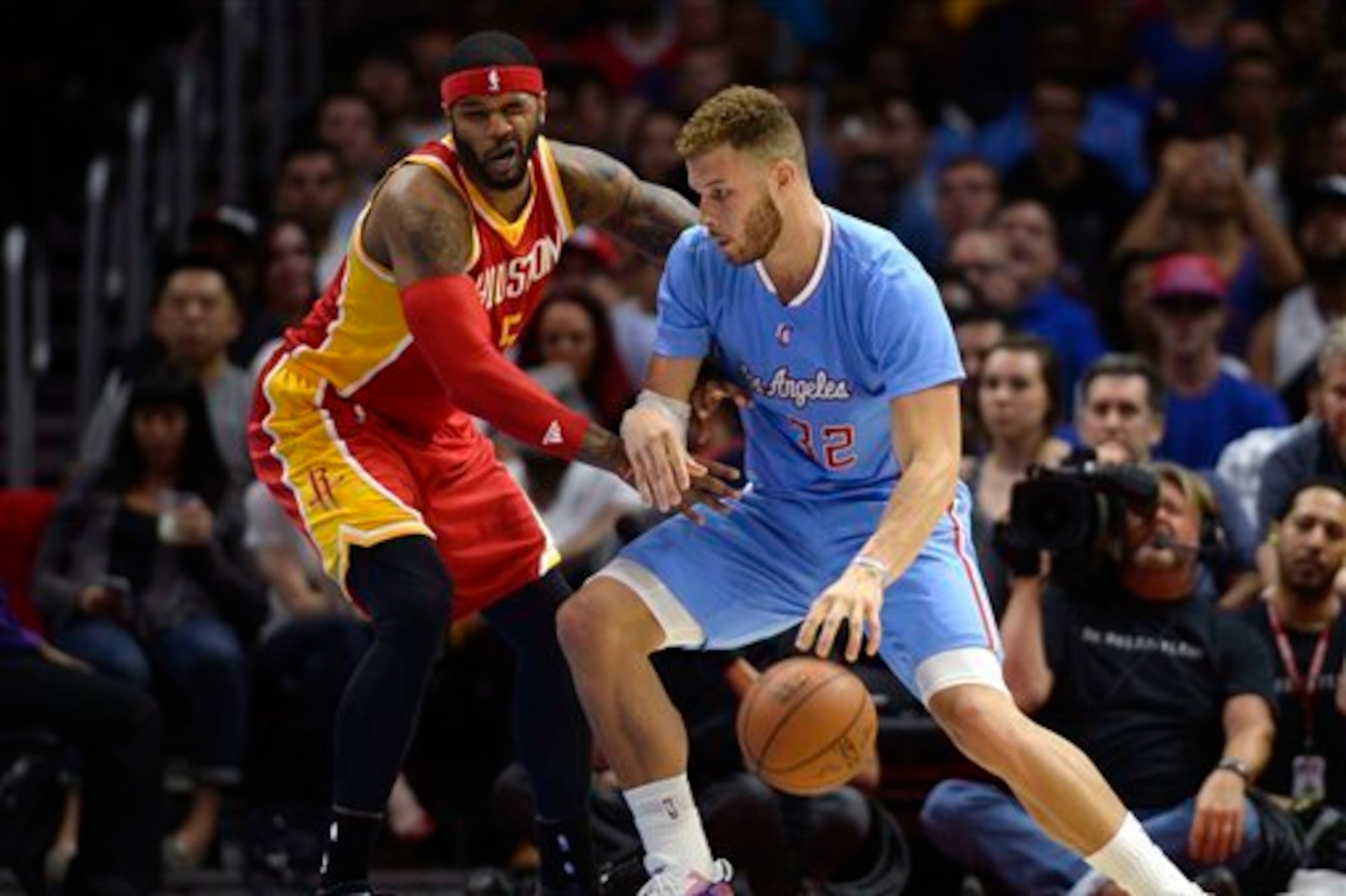
Duncan is a better offensive player than they are, but he doesn’t have their range or legs. Smith and Jones can also both stretch the court (though to say Smith is streaky would be an understatement). That can make Griffin run more on defense, which would result in less energy for him to burn on offense.
The Rockets also have Clint Capela and Joey Dorsey if they need to fill minutes. They can swap out their bigs with regularity, keeping a fresh man in.
After Griffin and Jordan, the Clippers have Big Baby Davis and Spencer Hawes—place-fillers to give their starters enough of a blow to not collapse. The Rockets’ edge in depth is—pardon the pun—big.
On both sides of the ball, Houston can make Griffin work hard, and it can do so while staying fresh. The Rockets can’t stop him, but if they can contain him, and perhaps exhaust him, the Clippers will have a hard time winning this series.
Which Team Comes Out on Top?
There are some other X-factors to watch for. Will Trevor Ariza get the upper hand over Barnes, as he should? Will Corey Brewer be able to sustain his three-point shooting and outplay Jamal Crawford off the bench?
But the key to this series is how the superstars play. Will Howard’s defense be enough to dull the edge of Paul’s passing game? Will Harden be aggressive and not intimidated by Jordan? Will Howard help Harden by playing strong in the post? Will Howard and the rest of the Rockets bigs nerf the effectiveness of Griffin?
These questions will determine which superstars rise to the top. And at this point in the playoffs, series are won and lost by the superstars. The Rockets stars are healthier and better rested. That’s the difference in this series.
Rockets in six.

.jpg?w=2560 "Raiders Could Start Mendoza")

.jpg?w=2560 "Rodgers Iced Out on Plane 💎")
.jpg?w=2560 "🚨 Week 8 AP Top 25 Poll")
.jpg?w=2560 "Packers Safety Slams Refs 🤬")

.jpg?w=2560 "Fantasy Waiver Wire Stars 🤩")