

San Antonio Spurs Aren't Doing Enough with Kawhi Leonard
Kawhi Leonard has made his point by now.
His point was crystal clear after a career-high 32 points in that one-sided 100-73 Game 3 victory over the Los Angeles Clippers last Friday, and his point was simple: He's become the most important piece for the Spurs on both ends of the court.
Don't let that Defensive Player of the Year Award fool you. Leonard has become the scorer San Antonio desperately needs.
TOP NEWS

Brown with an all-time summary of relationship with Tatum

Heat, Giannis were down by 20+ in each of their 3 losses
Worst NBA Predictions 🫣
Leonard rattled off another 26 points in Sunday's 114-105 Game 4 loss but needed to do more—not that doing anything less was even remotely his fault. The 23-year-old was 10-for-19 from the field, the fourth time in the series' four games that he's made more than half of his field-goal attempts.
So far, Leonard is averaging 24.8 points per contest while making a full 60 percent of his attempts from the field in the series. He's vying with Chris Paul and Blake Griffin for best-all-around-player-on-the-floor status, and—put simply—he needs some help.
That means touches. Lots of them.
San Antonio has no choice but to build on that Game 3 explosion, feeding the fourth-year veteran the rock as much as the team's ensemble offense will allow. There may well be times for unselfish ball movement, but now's the time to exploit Leonard's fearless efficiency.
Leonard hasn't attempted more than 19 shots yet in the series. That he continues to convert at a high rate is a testament to his ability to create—and make—an increasingly wide array of shots.
As USA Today's Sam Amick put it in the wake of Game 3, "This kind of offense—the isolations, the post-ups, the soaring dunks on the break—is enough to re-spark the conversation about where Leonard's potential truly ends."
The remaining games in this series make for a prime opportunity for Leonard to realize some of that potential—as long as his teammates let him.
A Disappearing Supporting Cast
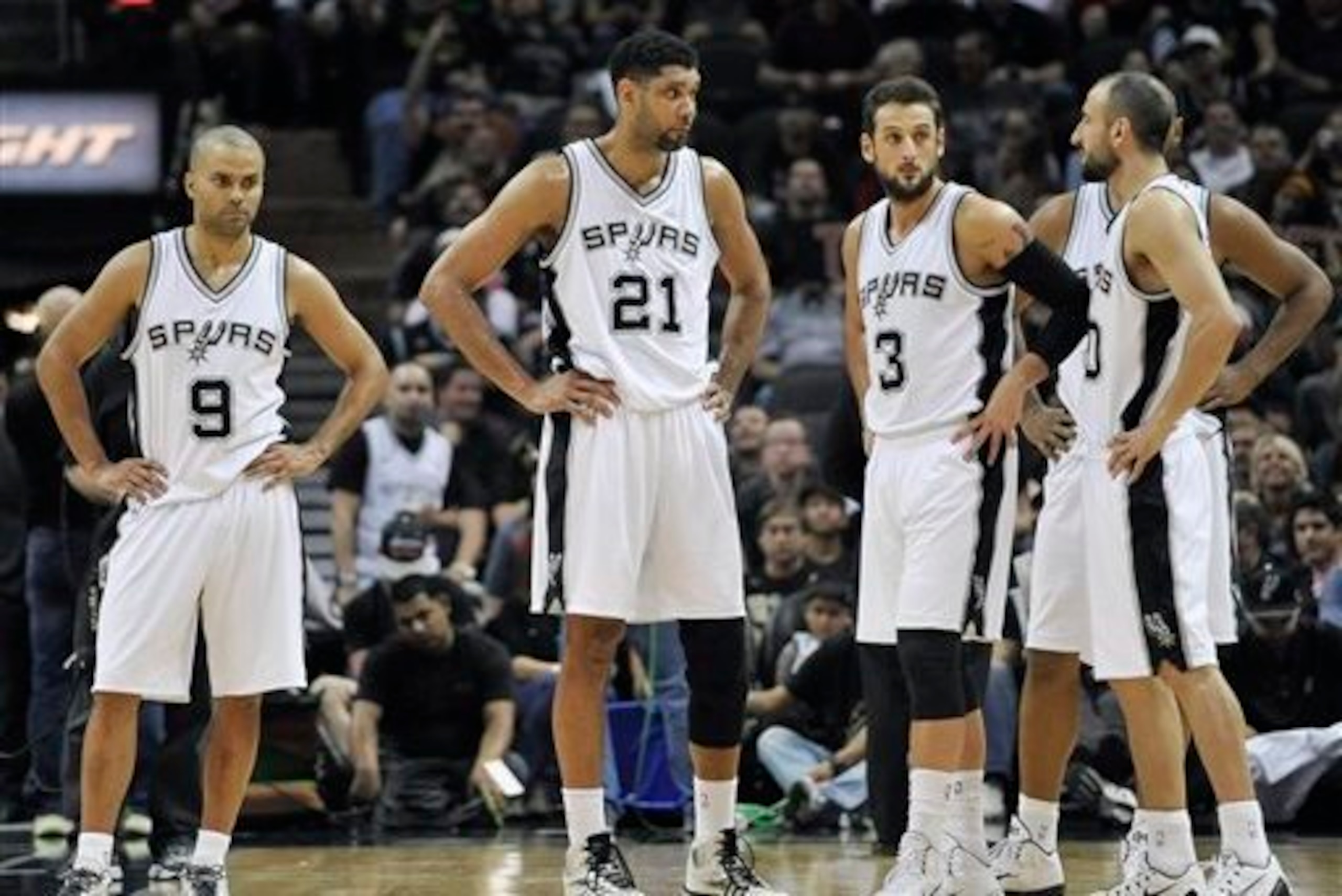
It seems strange to think about Leonard having a supporting cast, but that's the world we now live in. He's the club's leading scorer, and his ability to create space for his shot is unparalleled in this rotation.
Tim Duncan remains consistent on the offensive end but often finds himself facing the bigger, more athletic DeAndre Jordan. The Spurs didn't need Duncan's offense—all four points of it—in Game 3, but he's otherwise been the team's most reliable scorer this side of Leonard.
Meanwhile, Tony Parker has been enigmatic in the worst way, likely becoming a third or fourth option in the process. He had his best game of the series in Game 4 (with 18 points) but only collected one assist—the second time this series he's assisted on just one bucket.
| Game | Min | Pts | FGM-FGA | Ast | Reb | Stl |
| Game 1 | 29 | 10 | 4-11 | 1 | 2 | 0 |
| Game 2 | 30 | 1 | 0-6 | 5 | 2 | 0 |
| Game 3 | 26 | 6 | 3-11 | 3 | 3 | 1 |
| Game 4 | 29 | 18 | 7-15 | 1 | 2 | 0 |
Between Parker's ineffectiveness as a scorer and his inability to get Leonard (or others) the ball when they're in scoring position, the Spurs have themselves a bit of a problem.
Sure, this is where the bench guys are supposed to step in. But excepting Patty Mills and Boris Diaw's timely contributions, the secondary has been largely underwhelming by this team's standards.
And what about Danny Green? He made just one of 13 combined field-goal attempts in Games 1 and 4, all but thwarting San Antonio's ability to shoot itself back into either contest. Without significant contributions from either Manu Ginobili or Marco Belinelli, head coach Gregg Popovich's perimeter rotation suddenly looks deeply flawed—and maybe even more desperate.
So too does this team's old guard. They may be the winningest trio in playoff history, but Duncan, Parker and Ginobili combined for just 12 points in Game 3.
San Antonio's core isn't finished by any means, but here are the facts: Parker isn't 100 percent healthy, Duncan just turned 39 and Ginobili's Game 4 will be remembered for poor fouls and turnovers. As is, they might still be good enough to handle most teams.
But the Clippers' efficient and explosive offense is another story. Keeping pace with that will require a little something extra.
An Emerging Solution

Game 3 was an argument for doing things a little differently, relying more heavily on the kind of "hero ball" this franchise has traditionally eschewed. But there was a time when Duncan needed the ball in his hands and a time before that when David Robinson was responsible for carrying the offensive load. There's a precedent here.
Leonard's earned that kind of responsibility. San Diego State head coach Steve Fisher told Amick that his alum's Game 3 breakout was a sign of a player who's arrived.
"What a phenomenal game. At both ends of the floor, just incredible. If you're around him like we were for two years, you saw the work ethic that he had and the competitiveness to where you knew that he was going to continue to get better. But to see him play like this, I just smile and shake my head. It's absolutely incredible. But he's got that inner confidence. He's good, and he knows he's good.
I've never had a guy work the way he does when nobody is watching. He just wants to get in the gym, doesn't want anybody to know. But he wants to be in that gym 24-7. And he's in there to work on his game. He doesn't just put in time. He's working.
"
And the results speak for themselves.
| Game | Min | Pts | FGM-FGA | Reb | Ast | Stl | Blk |
| 1 | 33 | 18 | 7-12 | 6 | 3 | 4 | 0 |
| 2 | 39 | 23 | 9-16 | 9 | 3 | 1 | 1 |
| 3 | 29 | 32 | 13-18 | 4 | 1 | 3 | 2 |
| 4 | 40 | 26 | 10-19 | 7 | 5 | 0 | 1 |
Duncan similarly gave credit where it was due after Game 3, via Amick:
"He put on a show tonight. (And) he did it the right way. He stayed within our offense. He got some shots going early on, and then I think he just kind of got comfortable and kind of got on a roll, and then you see his level of difficulty kind of going up, shooting over double teams, fading away, making plays.
From there, he was off to the races. He did it the right way. He continues to impress me every time he's out there. And if he can put on a show like that in a situation like this, it's obviously great for us, but it's impressive to watch."
"
Paradoxically, it may be time for Leonard to start getting some of his points the wrong way, asserting himself independently of San Antonio's usually flawless, free-flowing offense. That offense only looks right when the long-range shots are falling. When they aren't, San Antonio needs a go-to option.
| Off. Efficiency | Def. Efficiency | Net Rating | |
| On the floor | 109.1 | 97.1 | 12.0 |
| Off the floor | 103.2 | 102.2 | 1.0 |
Duncan alluded to this need when citing those high-difficulty shots—the fadeaways and well-contested jumpers. For all the modest comparisons to guys like Shawn Marion, Leonard ever so briefly looked a lot more like a Kobe in Game 3—his spin, his fade and his poise all reminiscent of a certified scorer.
There's work to be done, yes. Leonard's handles could be better. His decision-making is still a work in progress. Reacting to those double-teams is still new to him.
But most of the adjustments aren't Leonard's to make. The real change has to happen around him, in passers like Parker, Ginobili and Diaw—in the play-calling, too. These Spurs have adapted before, evolving from a Duncan-centric post operation into an uptempo pick-and-roll team infused with heavy doses of Parker's penetration and pull-up game.
It's time to evolve again, and in short order. San Antonio's first-round fate could well depend on it.



.jpg?w=2560 "5 Teams Eyeing Jonathan Taylor")
.jpg?w=2560 "Mahomes Told Teammate to Leave Meeting")


.jpg?w=2560 "Jonathan Taylor Landing Spots 📍")
