Big Names, Big NFL Cap Hits: What Does Future Hold for Contenders, Key Players?
The Super Bowl is under two weeks away, dear fan. Where is your head at?
Unless you are a New England Patriots or Seattle Seahawks fan, your head is not in the clouds. It's not yet in Glendale, Arizona, either, unless the rest of you is in Glendale, Arizona.
Maybe your head is still spinning on the coaching carousel. Perhaps it's where my head (and the rest of me) is headed: Mobile, Alabama, where Senior Bowl practices represent the unofficial kickoff of speculation season. Maybe your head is in hockey or basketball land, or still hiding under the covers after your football team's disappointing season.
.jpg?w=2560 "Seahawks Chiefs Football")

Well, it's time to get your head back in the game or, more specifically, your mind on the money. One of the best free-agent classes in history is about to hit the market. But teams cannot go Jason Pierre-Paul shopping until they know how much they can spend.
There are several knotty contract conundrums looming around the NFL. Some involve high-priced veterans who may be unceremoniously released, others involve players who are only kinda-sorta under contract (cap economics, like quantum physics, does not always follow the rules of our three-dimensional world) and must be cleared off the books like an old student loan. These dilemmas are top-priority decisions for many franchises, business that must be taken care of before anyone fills a draft board or starts speed-dialing free agents' agents.
A full listing of all the contract quandaries would take a dozen articles. Your head probably isn't there yet. And some questions just fall too far outside the realm of speculation: Who knows what the Bears plan to do with Jay Cutler (or the Broncos with anyone) when they are still filling out their coaching staffs?
But the following creme-de-la-creme contract problems, each involving a team with high expectations, will shape what's to come in both draft and free-agency season.
All cap data courtesy of Over the Cap.

The Problem in a Nutshell
Fitzgerald's cap figure is $23.6 million for 2015. The Cardinals are in cap purgatory, with over $158 million committed for 2015 (that puts them above even the most optimistic cap estimates).
Fitzgerald turns 32 next season and is coming off his worst year as a pro. His contract beyond 2015 is larded with $51 million in phony baloney money, so "restructuring" is not really an option, and neither party sounds eager to start over.
The Future
Fitzgerald was once the face of the Cardinals franchise. Under past regimes, he enjoyed the kind of "in the loop" treatment about personnel decisions reserved for Peyton Manning-level superstars. Now, Fitzgerald appears likely to meet the same fate as former teammate Anquan Boldin.
The Cardinals may trade one of their most recognizable players for a midround pick in the name of cap relief. And that looks like the best-case scenario.
Fitzgerald's future value is hard to gauge. Few truly great wide receivers in history have been held back by their quarterbacks the way Fitzgerald has. Quarterbacks from Kevin Kolb and Derek Anderson to Drew Stanton and Ryan Lindley have cost Fitzgerald well over 100 career receptions, and two of the last three seasons have been marred by long stretches of hapless passing.
Fitzgerald's two best games of 2014—a 7-160-1 performance against the Eagles and 9-122-0 against the Rams—came when Carson Palmer was healthy. Suitors might not see a 100-catch Pro Bowler anymore, but they well may envision a productive possession receiver eager to once again pair up with a healthy, quality quarterback.
Like Boldin, Fitzgerald will be appealing as a veteran stabilizer for a contender seeking a third-down target. Here's a scary thought: Fitzgerald assuming Deion Branch's old role as a committee receiver for Tom Brady. Here's another spine-chiller: Fitzgerald as Russell Wilson's security blanket, catching four passes for 48 yards every week: four 12-yard passes on 3rd-and-10.
Just as likely: a homecoming for the former Vikings ball boy, where he becomes a mentor for Cordarrelle Patterson, a reliable target for Teddy Bridgewater and a kick in the pants for Greg Jennings.
The Cardinals stand to take a $14 million cap hit even after they part ways with Fitzgerald, and they have a decision to make about Darnell Dockett, another expensive holdover from the Super Bowl era. Look for them to work the trade wire on Fitzgerald: They need something to make that cap medicine easier to swallow.
Ndamukong Suh (and Nick Fairley)
The Problem in a Nutshell
Suh has a quasi-contract that expires the week after the Super Bowl. It's basically a legal fiction designed to cram $9.7 million in old bonus proration into a faraway future that eventually became next month.
The $9.7 million cap hit is like the balloon payment for refinancing your house five times: Suh restructured his contract several times to help the Lions' cap situation, and now there's a bill to pay which cannot be moved or lowered by any conventional means. The Lions cannot turn salary into bonus because there is no salary. If they sign Suh to an eight-year deal and prorate the bonus, it won't budge this old prorated bonus.
The team also chose not to trigger Fairley's fifth-year rookie option last season for a variety of pretty good reasons. He is now slated for free agency. The Lions' fearsome defensive tackle tandem is at risk of turning into a very expensive sinkhole.
The Future
General manager Martin Mayhew made lots of soothing noises at the Lions' end-of-year press conference about Suh and the team's mutual desire to remain together.
"He certainly is a big priority for us, and he's been an important part of our football team the last five years," Mayhew said. "I think the world of him. I had an opportunity to sit down and talk with him...we had a good conversation. We look forward to working with him to try to get a deal done."
That's pretty strong stuff by the standards of end-of-year pressers. If not for the $9.7 million accounting horror show, the Lions would happily make Suh the highest-paid defender in the NFL. There is also some logic to doing whatever's necessary to swallow the cap poison and sign Suh: If you are going to be paying for him either way, why not retain his services?
But there are all kinds of extenuating circumstances. On the open market, Suh will fetch somewhere between Richard Sherman's four-year, $56 million reported deal and J.J. Watt's six-year, $100 million reported deal, with a lean toward Watt once the bidding starts.
That big balloon payment takes away the Lions' wiggle room for creating a contract of that nature: There is only so much "lower the base salary and hide the bonus" roulette you can play when designing a contract with nine digits.
If you are wondering, Suh's rep as a troublemaker won't have much impact on his market value. He has committed five "roughness" penalties (from roughing the passer to facemask fouls to tripping) in two seasons. Aaron Rodgers stomping aside, that's par for the course for a defender who hits quarterbacks for profit in the 21st century.
Some teams may be haunted by memories of Albert Haynesworth, who might still be napping under a tarp somewhere at FedEx Field, but Suh is not the resident malcontent he is often made out to be.
Mayhew held out the possibility of franchising Suh, which could be a disaster. Not only would the Lions eat up about $20 million in cap space for a disgruntled player (the defensive tackle cap figure is estimated by CBSSports' Jason La Canfora at around $11 million for next season), but they also risk a potential Jimmy Graham situation.
The franchise tag value for a defensive tackle is expected to be around $11 million, while defensive ends and linebackers come with $13-$14.5 million tag values. Suh is a pure defensive tackle, but he could argue that he has the impact of a sack-producing end or linebacker, or at least use that argument to grouse through the summer.
Unless Suh grants one of history's largest hometown discounts or the Lions plan to enter 2015 with 25 players making the league minimum on the roster, it is hard to picture Suh back in Detroit next season. Wishing Suh well in Oakland would allow the Lions to negotiate with Fairley, who played very well when healthy in the first half of the season.
Fairley's health history and lingering concerns about his conditioning (which Mayhew asserts are in the past) should make him affordable to keep. That said, Mayhew gushed over Suh and got vague when speaking of Fairley. Maybe it was a media message to keep one player happy and the other in the gym. But maybe it's a sign that the Lions are willing to tie their salary cap in knots after a satisfactory 2014 season.
Vernon Davis and Ahmad Brooks
The Problem in a Nutshell
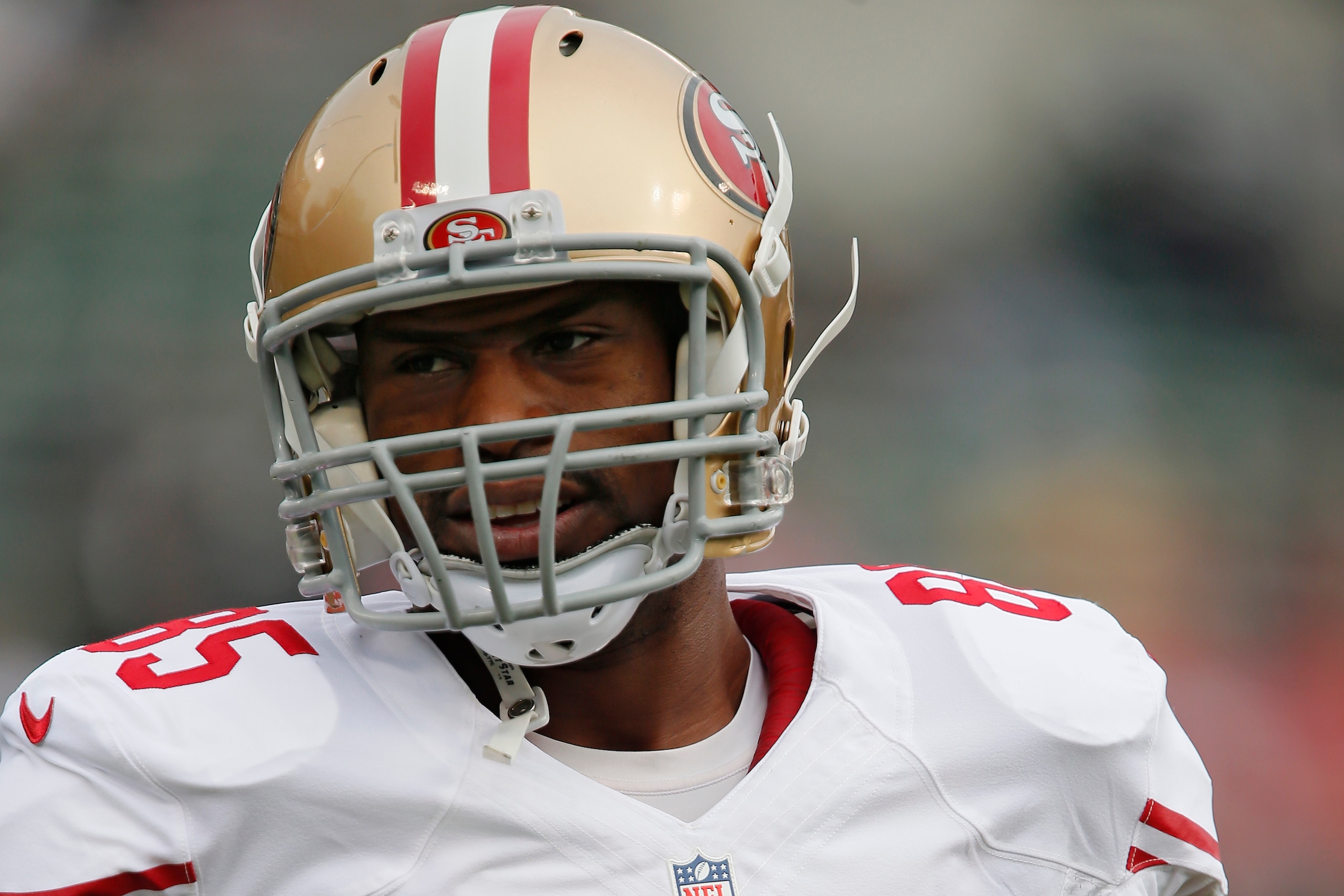
Brooks and Davis are veterans coming off down years who are slated to eat up nearly $17 million in combined cap space. The 49ers are undergoing both scheme and regime changes, and they have $152 million currently committed to the 2015 salary cap.
Former 49ers personnel guru Scot McCloughan is now the general manager of the Redskins, and he might come looking for players he brought to San Francisco.
The Future
The McCloughan angle is about 99 percent speculative fiction. In the past, the Redskins have overspent on veterans like Brooks, Davis or Frank Gore (an unrestricted free agent) when they should have committed to youngsters like Trent Murphy, Jordan Reed and Alfred Morris.
The Redskins are trying to avoid the mistakes of the past (I have copied and pasted that phrase for 13 years, but never mind), and McCloughan was hired to make future discoveries, not relive past ones.
Davis is close to new 49ers head coach Jim Tomsula; they are neighbors whose children play on the same flag football team, according to ESPN.com's Paul Gutierrez. Tomsula doesn't exactly wield Bill Parcells-level personnel power, but neither he nor Davis will agitate for a change. Davis' contract expires at the end of this season, and the 49ers might opt to enjoy a "contract year" from a happy and motivated Davis, albeit at inflated prices.
Brooks is another matter.
The 49ers are switching to a 4-3 defense, and Brooks is the most likely the odd man out of their linebacker corps. His cap figure is a whopping $9.6 million. If GM Trent Baalke wants to play hardcore Moneyball—and the last six months of 49ers history suggest that's exactly what he wants to do—Brooks will be an easy cut.
If released, Brooks joins a crowded free-agent field at outside linebacker; we are about to meet someone else who will compete for roles and free-agent bucks with the likes of Brian Orakpo, Jason Worilds and Pernell McPhee.
The 49ers will turn their attention to other cap cuts while making free-agent decisions easy (farewell, Gore) and difficult (Michael Crabtree). Brooks will likely have a cheaper price tag than Orakpo, so a relocation to Washington is not completely unlikely. But if all the old 49ers show up in Washington: a) I will eat my laptop, and b) it will not be cause for enthusiasm.
Tamba Hali

The Problem in a Nutshell
Hali has a $12 million cap figure this season, and the Chiefs can clear $9 million by releasing him. Fellow pass-rusher Justin Houston is a free agent coming off a 22-sack campaign, while Hali recorded just six sacks last season.
Rookie Dee Ford was trapped behind Houston and Hali all season and looks like an obvious replacement. The Chiefs have $148 million in cap space committed for 2015, so they need to create some maneuvering room just to re-sign Houston, let alone get better.
The Future
Despite the low sack total, Hali can still play at a high level. He is also a well-regarded locker room citizen. He's a prime candidate to have a Julius Peppers renaissance once he changes scenery. Kansas City would love to keep him, but Houston (who turns 26 Wednesday) is a massive-priority player, and the Chiefs are trying to remain in the playoff picture while clawing their way out of a cap snake pit.
Hali is just the tip of a financial iceberg for the Chiefs. Dwayne Bowe carries a $14 million cap hit for 2015 and $13 million the next two seasons. He would not quite be a bargain at half that. Some restructuring may be possible for Bowe, but the Chiefs would eat $9 million in cap space if they released him, and Alex Smith would have to spend the 2015 season throwing the ball up in the air and catching it himself.
Sam Mellinger went into detail early in the month for The Kansas City Star about just how the Chiefs can fit Houston onto the ledger while still clearing enough free-agent cash to pursue help at wide receiver. The scenario starts with releasing Hali. All scenarios really start with releasing Hali.
Reuniting Hali with Scott Pioli in Atlanta would be the lazy sportswriter thing to do. But then, the Falcons have cap space and need a pass-rusher, and Tyson Jackson already established the Pioli pipeline, so let's do it! (Now to play Modern Warfare for six hours instead of working.)
If the Chiefs come out of this cap crunch with Houston-Ford as their pass-rush tandem and Bowe-Someone-Better-Than-Bowe as their top receivers, it will be an impressive feat of cap tap dancing.
Darrelle Revis

The Problem in a Nutshell
Revis signed a two-year, $32 million contract with the Patriots last season that both sides knew was a one-year, $11.5 million contract. The Patriots stuck a $12.5 million roster bonus horse pill in the deal for 2015 that would make Revis' cap figure $25 million.
Alternately, the Patriots can release Revis before NFL New Year (March 10, the day the salary cap for 2015 becomes a hard roof) and eat $5 million in dead money that they probably planned to eat the moment they signed the deal.
It was basically Super Bowl rental insurance. (It worked.)
The Future
Cue the "sad Hulk walks away" music.
Revis seems content as a roving mercenary, and a season of minor dust-ups with Bill Belichick's coaching staff guarantees that no one will be exercising any eight-figure options. The Patriots are like your annoying brother-in-law who manages his finances so precisely that he can absorb a little luxury debt without batting an eyelash: A $5 million hit is an inconvenience, but it's not a serious issue.
The sojourning Revis will find that next year's contenders are short on cash and cap space, but he played very well this year, and there will always be takers for a cornerback who can put your defense in another category for a year or two (probably one).
Yes, Rex Ryan will call from Buffalo with a suitcase full of hockey bucks. Here's another thought: The Texans may well clear Jonathan Joseph's $8.5 million salary off the books, whether via cut or renegotiation. Watt on the line. Revis at cornerback. Who's the quarterback? Who cares?
As for the Patriots, they make deals like the Revis contract with wide-open eyes. They will just turn around and make a similar deal with Fitzgerald. Or Hali. Ndamukong Suh? Seems insanely unlikely, just like signing Revis seemed until the moment it happened.
Once teams start getting desperate with their cap cuts, don't rule anything out.
Mike Tanier covers the NFL for Bleacher Report.
.jpg?w=2560 "Raiders Saints Football")