
Book Review: Why England Lose
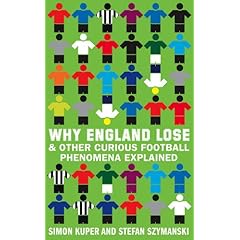 Why England Lose: and Other Curious Phenomena Explained, By Simon Kuper and Stefan Szymanski.
During this period of transfer window gossip and rumour, it is encouraging that there are those who are thinking deeply about the “Beautiful Game,” to shatter some of the myths we hear daily. Simon Kuper (author of the excellent “Football Against The Enemy”) and sports economist Szymanski, delve about as far as is possible from the “will-he-won’t-he” type journalism we are served up every day, to analyse a number of major talking points.
The title of the book will no doubt help sell a number of copies with less than a year to go until the World Cup. In truth this is not the strongest part of the book but it does put England’s place in world football in perspective and should be required reading for every fan of the Three Lions before South Africa 2010.
TOP NEWS

Live Ballon d'Or Ceremony Winners 🎉
Alexia Wins Ballon d'Or 🏆

Final Men's Ballon d'Or Rankings 📊
Kuper and Szymanski come into their own in the following chapters on the transfer market and why football clubs don’t make money. Using examples such as Arsene Wenger and Brian Clough and Peter Taylor, the book provides an excellent guide to how to play the transfer market and after reading this chapter you will be praying that someone at your club will take some notice.
Lyon are held up as a prime example of how a club can significantly improve its standing by playing the market and there are clear echoes of the ground-breaking baseball book Moneyball by Michael Lewis. The advice that it is crucial to help new signings relocate is almost so simple that it is unbelievable that some of the biggest clubs in the world have been guilty of leaving their star players to fend for themselves after they join (e.g. Nicolas Anelka at Real Madrid and Didier Drogba at Chelsea). For a taste of this chapter see here.
Chapter four describes football as the “worst business in the world” and by doing some simple number crunching puts Premier League clubs in their place. As the authors write: “no football club is a big business… by 2008 the average club in the Premier League had a turnover of £75 million, compared with £50 million for the average Tesco supermarket. However, since Tesco has 600 supermarkets/superstores, the average takings of the twenty largest are probably still much larger than those of the average club. And unlike most clubs, Tesco actually makes a profit.”
Among the other myths exploded in “Why England Lose” is the commonly held perception that fans are bored of the same teams winning every season. As Manchester City look to break the dominance of the “Big Four” in England, Kuper and Szymanski prove that fans do in fact prefer unbalanced leagues.
Among the other intriguing phenomena explained in the book includes why the US, Japan, Australia, Turkey and India could become the next football superpowers. The anecdotal evidence brought throughout is a joy to read and in particular some of the insights help make much of the statistical analysis easier to deal with.
“Why England Lose” suffers at the end of the book from the lack of a clear direction but the overriding impression from this tome is that Kuper and Szymanski’s work could be as significant for football as Moneyball was for baseball (and other sports) and Freakonomics for Economics.
Further reviews of Why England Lose, which are all highly complimentary, can be read from The Sunday Times, Financial Times and Bloomberg.

.jpg?w=2560 "Seahawks Chiefs Football")





