* RK review: More baseball fiction
A version of this review originally appeared on Purebaseball.com in 2001.
Summer is firmly entrenched. So is your favorite team … in last place. The time for spring training optimism is over. Face it, it’s the cellar for sure. Now what?
Time to tum off the radio, shut the TV and head for the great outdoors. Turn your mind from the daily grind of newspaper accounts and statistics and relax with a good baseball book. Not necessarily one about the majestic history of the game or a particular team or player. Try fiction for a change.
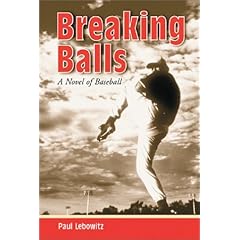 Breaking Balls, by Paul Lebowitz (McFarland) looks at three years in the life of Brett Samuels, a minor league pitching prospect of the sandlots of Brooklyn. Author Lebowitz accounts not only for life on the field, but off as well. Many young players are away from home for the first time and must deal with mundane matters for the first time, too. Laundry, setting up a bank account, eating properly — things their parents took care of for them, are the day to day doings that the author presents in a realistic yet never boring manner.
While there is a diverse group of young men, there are very few of the ethnic stereotypes that one often finds in sports novels, a most welcome change and a sign of maturity. Having said that, however, Samuels is deemed by his teammates to be something of a brain, relatively speaking, by dint of his Jewish heritage. Some things never seem to change.
Lebowitz takes Samuels through a believable apprenticeship, complete with teammates of greater and lesser ability, and managers both keen and incompetent. There’s little in the way of drama, but Breaking Balls is one of those books that could be termed “a nice summer read.”
* * *
 About 80 Percent Luck: A Novel (Total Sports) is another relaxing story, this time from the perspective of the sportswriters. Gene Wojciechowski, an analyst for ESPN, makes a realistic go in his novel of Joe Riley, a poor Chicago hack for one of the windy city’s newspapers, thrown into the middle of a labor dispute, forced to cover the Cubs during spring training. In a case of publish or perish, he must overcome the petty rivalries with his brethren media, angling for exclusives in an atmosphere of, at best, the players’ benign neglect or, at worst, physical intimidation.
What was previously mentioned about stereotypical characters in Breaking Balls doesn’t apply as much here, although it is still an improvement over prior writings. There are Hispanics who don’t want to learn English, rednecks who can’t abide anyone who speaks in words of more than one syllable, prima donna superstars … the works. Even the front off personnel are shown with the light of suspicion and contempt.
There are a few twists and turns to keep the pages turning, along with some cliched storylines, but all in all Eighty Percent gets lucky enough to win over its reader.
* * *
 Sut McCaslin: A Baseball Romance (Steve Spoerl, Writers Club Press) is a much deeper and introspective attempt. The Washington Senators of the 1950s are in their usual doldrums, bringing up the rear of the American League. McCaslin, an outfielder trying to hang on, is something of an anomaly, a mediocre athlete with more on his mind that RBI and home runs. In fact, his teammates consist of an unusual company of locker room philosophers, spouting off on such topics as the McCarthy hearings and communism and race relations.
The daily grind wears on McCaslin, who questions the path his life has taken. It’s a heavy piece of fiction that almost seems to be a metaphor for the ambiguity of life. This is not one of your more lightweight beach books, and definitely not for those who prefer Susan Isaacs to Isaac Newton.
* * *
 Shadow Ball: A Novel of Baseball and Chicago (Peter M. Ruckoff, McFarland considers what might have happened to the 1919 White Sox had Charles Comiskey been able to sign Pop Lloyd, one of the early stars of the Negro Leagues, as a mid-season addition. Author Ruckoff’s research is comparable to Troy Soos, author of the Mickey Rawlings murder mysteries, in the attention to detail of the time period.
In the years surrounding World War I, southern blacks migrated northward in. hopes of finding jobs left by those who had entered the service. With the end of the hostilities, and with the soldiers returning home to reclaim their employments, the depiction of racial tension between Chicago’s white and African American communities is palpable. This goes for the effects of having a black man on the White Sox as well.
The main characters include Comiskey, the legendary owner of the White Sox; Rube Foster, one of the pioneers of the Negro Leagues; Pop Lloyd, dubbed “the black Honus Wagner,” and two minor characters, Sam Weiss, as the stereotypical Jewish lawyer, and Kid Douglas, a torch singer working as domestic for Comiskey and the object of Sam’s unrequited affections. There are also appearances by the infamous Black Sox: Risberg, Gandil, Cicotte, Williams and Jackson, and their nemesis, Eddie Collins.
Shadow Ball (the pre-game warm ups sans baseball performed by Negro players for the amusement of the crowds) revolves around Comiskey’s attempt to land Lloyd, looking to light a fire under his team (not to mention beating New York Giants manager John McGraw to the punch). Ruckoff artfully depicts Comiskey’s machinations as he browbeats subordinates, fences with Foster and generally bullies his way around.
The book is full of moralizing, pondering the evils of racism and the injustices of denying black athletes, in many cases far superior to their Caucasian counterparts, th~ chance to play in organized baseball. It winds its way to a roller coaster ending, an almost sci-fi foreshadowing of the ramifications of Comiskey’s actions. At times the story meanders. In fact, one might wonder about the necessity of the Kid Douglas character at all, as she plays no useful purpose other than to give Sam something to think about.
Ruckoff makes his characters almost caricatures: Comiskey is a loud, insulting boss, spouting racial epithets as a matter of course, albeit with equal disdain towards all minorities. One wonders if the most odious plantation owner could be any worse than the “Old Roman.”
* * *
 Like the books by W.P. Kinsella mentioned in the previous entry, Murderer’s Row: Baseball Mysteries (edited by Otto Penzier, new Millennium Press) is another collection of baseball variations on a theme. You’ve got your hit men; you’ve got your witnesses in hiding; you’ve got your basic detective searching for the murder of Eddie Gaedel, pint-sized pinchhitter for Bill Veeck’s St. Louis Browns. All in all, the proverbial something for the hybrid mystery/baseball fan. The quality herein ranges from all-star to rookie and includes contributions from such well-known mystery writers as Elmore Leonard; Robert B. Parker, author of the Spenser detective series; sports columnist Mike Lupica; and Tory Soos. Editor Otto Penzler offers further reading suggestions in a lengthy bibliography.





.jpg?w=2560 "Chiefs, Steelers Eye WR Trades")