

Denver Nuggets Should Think Twice About Overpaying Kenneth Faried
Of all who observed Team USA’s gangbuster gold-medal performance at the 2014 FIBA World Cup in Spain, perhaps no one bore more conflicting thoughts than Denver Nuggets general manager Tim Connelly.
To be sure, watching Kenneth Faried turn the tournament into his own international coming-out party bodes nothing if not well for the future of the franchise.
At the same time, Faried and his representatives are sure to continue using the forward’s performance as leverage in the weeks leading up to October 31, the deadline for NBA teams to extend players currently under contract.
TOP NEWS

Buzz: Bron Chopper Part of Deal 🚁

MJ Makes Record-Setting Donation 🙌
Buzz: Knicks' KAT Offer Revealed
But while the Nuggets would be wise to reward Faried for his performance—both at FIBA and in the three solidly productive seasons now behind him—Connelly must be careful about overpaying too steeply for a player whose skill set remains very much a work in progress.

Nowhere are the red flags more glaring than in the high-energy forward’s thus-far-futile attempts at expanding his range.
To wit, here’s his rookie-year shot chart:
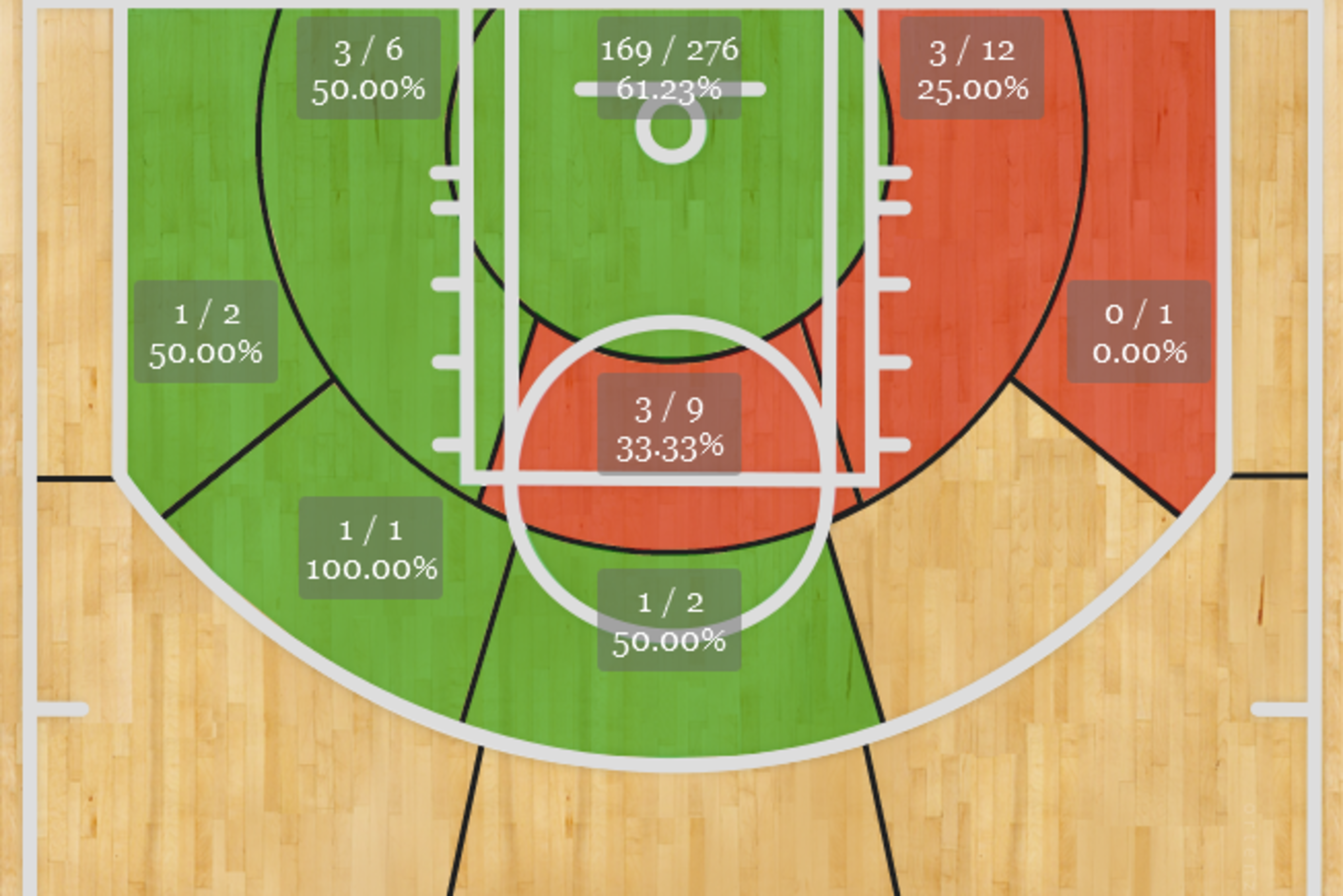
While Faried’s range was certainly limited, the lack of attempts from deep suggested he at least respected those limitations.
However, the following season (2012-13) saw the spark-plug forward try his hand a bit more from mid-range, while regressing somewhat in terms of overall efficiency.
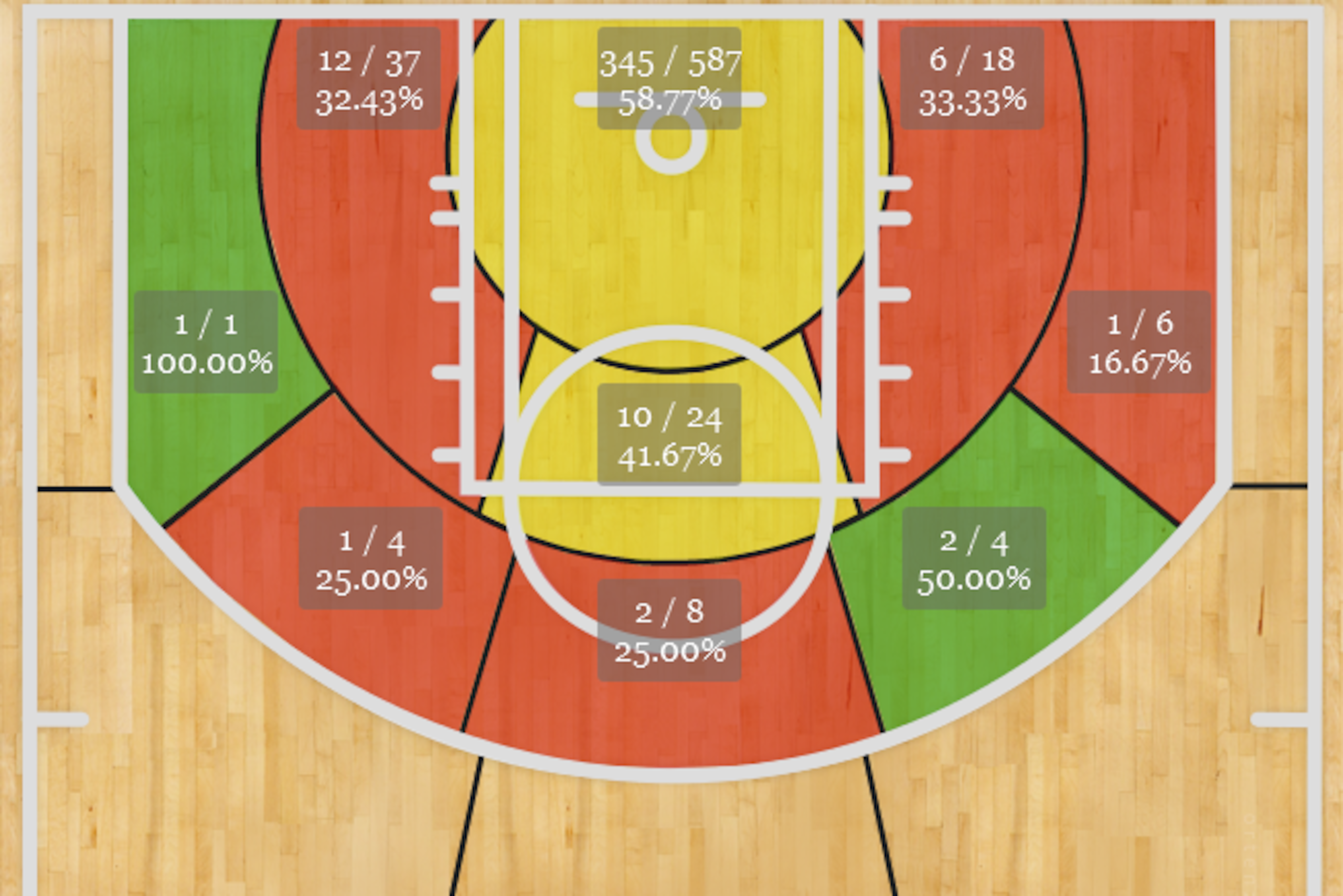
The 2013-14 campaign once again found Faried hoisting a bit more from distance, with his overall shooting efficiency remaining exactly the same (a 57 percent true-shooting percentage) as in the previous year.

Faried has certainly been more ambitious with respect to honing his offensive skill set. It’s just that the net results haven’t shown much in the way of marked improvement.
And while Faried’s improvement as a help defender was on full display during Team USA’s dominant run through the FIBA field, the competition deficit alone is enough to make one wonder how much of an anomaly that supposed growth really was.
From a purely strategic perspective, Denver is understandably loathe to roll the dice on a large extension, why with the Nuggets able to match anything beyond the $3.4 million qualifying offer pegged to Faried for the 2015-16 season.
Of course, there’s an inherent risk in the opposite direction as well. For instance, if Faried were to author an All-Star-level 2013-14 campaign, any number of teams might be willing to offer him something close to a maximum contract. At that point, Denver would face the unenviable dilemma of either having to match the offer and hoping for similar future production or neglecting to match and hoping for the exact far different outcome.
This naturally invites the question: Based on both past performance and future prospects, what, exactly, is Faried worth? Recently, SportingNews.com’s Sean Deveney attempted to contextualize what the market might look like:
"Is Faried worth a contract that pays, say, $58 million over four years? Remember that players like Chandler Parsons and Gordon Hayward each got deals starting at $14.7 million. And that Derrick Favors’ extension kicks in this year with Utah, and he is on a four-year, $47 million deal. In that context, a deal starting at about $13 million is fair, or perhaps even low.
"
Faried is doubtless using the example of Derrick Favors as an argument in his favor. Sooner or later, however, the market for potential-laden-but-limited power forwards is sure to retract.
All the same, the Nuggets might be operating under the assumption that the league’s salary cap—slated to be set at $63 million for the forthcoming season—will increase at a rate great enough to justify “overpaying” now for what could prove a bargain a few years down the road.

Which is why Denver’s negotiation strategy ultimately boils down to one seemingly simple (but enormously complex) question: Is Kenneth Faried good enough to be a franchise cornerstone?
You could certainly do worse than building around the unique talents of Faried and point guard Ty Lawson, whose own extension has the water-bug point guard remaining as Denver’s floor general at least through the 2016-17 season, according to HoopsHype.com.
Question is, is that a potent enough one-two punch to which other future free agents will jump to hitch their wagons?

A recent quote from Team USA head coach Mike Krzyzewski underscores just how difficult it is to measure Faried’s impact.
"Overall, from the start of training camp, he's been the biggest and best surprise and has turned out to be a very, very important player for us,” Krzyzewski told ESPN’s Marc Stein. “He’s made that happen. We never call a play for him."
Writing at Bleacher Report, Nick Juskewycz gleans from Krzyzewski’s praise a decidedly optimistic undertone—namely that Faried’s importance is such that he doesn’t need to be a team’s go-to player in order to have a significant impact on the game itself.
That’s all well and good, of course; NBA history is rife with examples of offensively limited players whose fringe benefits made them worth far more than the dollar figures beside their names.
Then again, Krzyzewski’s praise isn’t without its less sympathetic deduction. Indeed, if a player’s skill set is such that one never has to call plays for him, to what extent do the implied limitations bode ill for the team’s future?
As a high-voltage personification of the 110 percent ethos, Faried is the kind of player any coach—regardless of style or system—would love to have wearing his heraldry.
As the frontcourt cornerstone on a team whose near-future prospects are still wholly up in the air? In terms of high-risk deals, the details—both the dollars and what they buy—are as devilish as they come.



.jpg?w=2560 "2 NFL Officials Suspended")
.jpg?w=2560 "Mahomes' Wife Trolls Kubiak 💀")
.jpg?w=2560 "Love's Body Already 'Tired'")