San Francisco 49ers: Why Week 2 Loss Falls on Coaching, Not Kaepernick
If a hypothetical stranger were to say that San Francisco 49ers quarterback Colin Kaepernick committed four turnovers in a Week 2 loss to the underdog Chicago Bears, what would the logical response entail?
That Kaepernick single-handedly cost the 49ers the game, right?
And what if said stranger also indicated that rookie cornerback Jimmie Ward coughed up three touchdowns to Bears wideout Brandon Marshall?
.jpg?w=2560 "Commanders Eagles Football")


That Ward’s inabilities in coverage were the next major factor in this losing effort to an inferior opponent. Were they not?
In a world where the turnover differential is the only means of tangible evidence, perhaps those arguments hold.
But when that seemingly basic—yet intuitively significant—thing called the eye test is at play, this unforgivable home-opening loss falls on the 49ers coaching staff.
On its first offensive series of the game, San Francisco began inside the Bears’ 10-yard line. Rookie Aaron Lynch had provided the tremendous field position with a blocked punt.
After an incompletion and five-yard run by Kaepernick, Michael Crabtree hauled in the short touchdown pass. He made a great catch with his arms fully extended and secured the ball while falling to the ground.
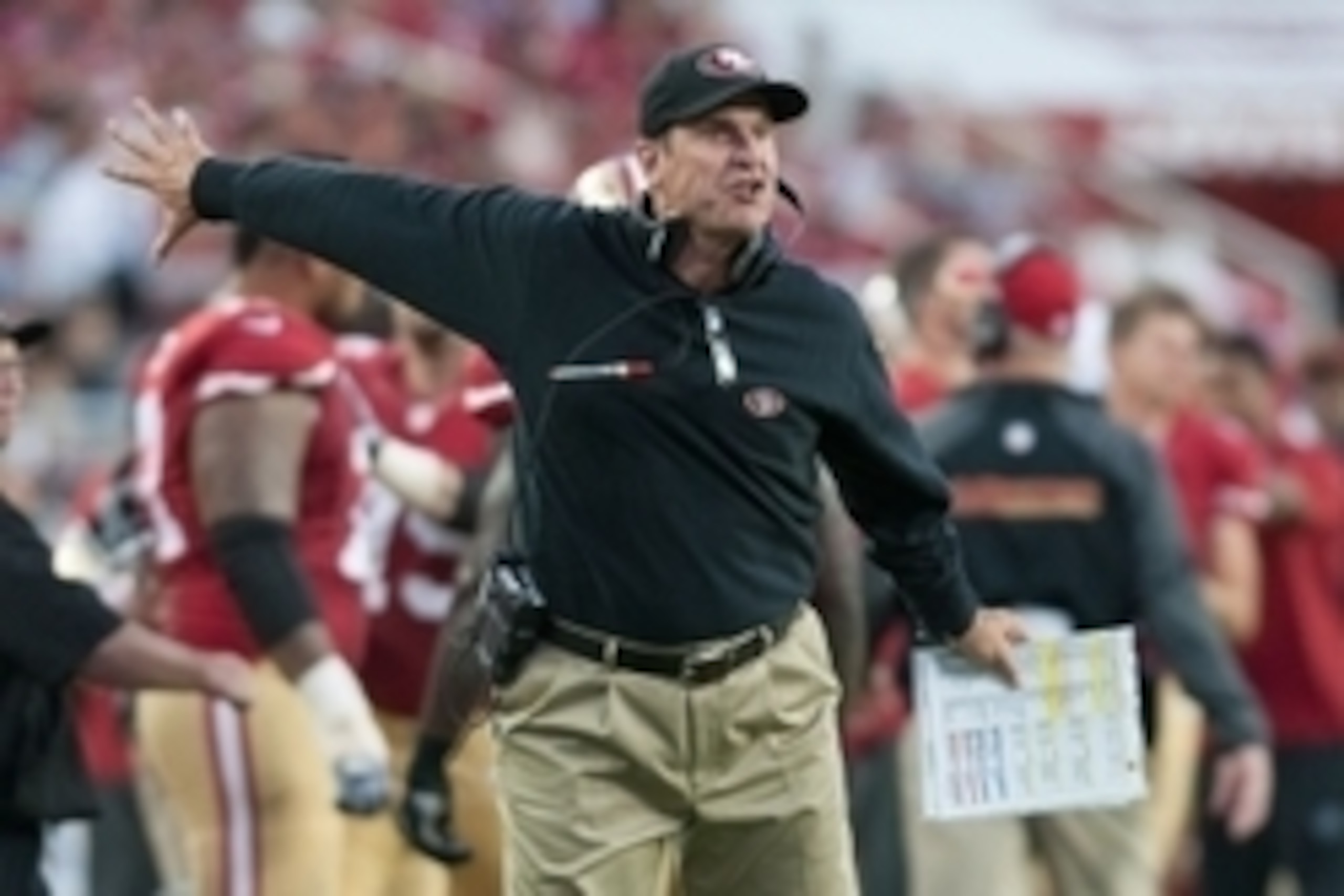
However, the play clock hard already run a full second past zero. Blown call by the refs or not, where was head coach Jim Harbaugh with the timeout?
The 49ers were lucky that this oft-repeated blunder didn’t cost them so early in the game.
Following another dominant series by San Francisco’s defense, the 49ers were once again just outside of the end zone in Bears territory. On 3rd-and-5 from the 9-yard line, right tackle Jonathan Martin committed a false start. The offense then stalled and settled for a field goal.
While Martin deserves plenty of blame, the coaches get some as well. Offensive coordinator Greg Roman failed to devise an effective play during a timeout against a thoroughly overmatched Bears defense.
And more significantly, that penalty was one of 16 totaling 118 yards for the game. That speaks to a lack of preparation by the coaching staff—even if this matchup on Sunday Night Football was egregiously over-officiated.
Moving to the second quarter, Roman called three straight run plays on the 49ers’ opening drive. After Frank Gore gained nine yards on first and second down, fullback Bruce Miller received the handoff and could not advance past the line of scrimmage.

Instead of exploiting an overloaded box by Chicago’s defense with a play-action pass, Roman opted for a predictable interior run. The offensive line must do better in the trenches moving forward, but so must the Niners’ play-callers.
Speaking of which, why was Kaepernick throwing on first down following a three-and-out by the Bears offense? Instead of utilizing the ground game to attack a tired defensive unit that’s susceptible to the run, Roman called for a deep pass play from midfield.
Kaepernick threw a dart to Boldin in a tight window. He was open momentarily, but safety Chris Conte took a gamble and won with a diving interception.
Call it second-guessing, but if Roman switches those last two plays, the 49ers are reasonably up by three scores instead of two.
As for Kaepernick, his decision wasn’t necessarily ill-advised. Conte deserves ample credit for making a tremendous play on the ball. The same goes for Kap’s lost fumble on the 49ers’ next series. Defensive end Jared Allen didn’t quit after initially being beat, and he jarred the ball lose with a well-timed hit.

Then, with San Francisco leading 17-0 with just over two minutes remaining in the first half, the Bears marched 80 yards down the field. Three penalties totaling 20 yards—including an illegal contact by Perrish Cox on third down—clearly aided the drive.
And on 3rd-and-2 from the 17-yard line with just 18 seconds left, Niners defensive coordinator Vic Fangio made one of several crucial mistakes.
On an all-or-nothing play, Marshall caught one of his three scores from quarterback Jay Cutler. Despite making one of the better one-handed catches you’ll ever see, that touchdown simply cannot happen.
Fangio did not put his guys in the right position. He did not ensure that Ward, his 5’11” rookie corner, received help over top and instead left him one-on-one against the 6’4” Marshall. And this wouldn’t be the only time.
As for the halftime score, what should have been 23-0 or even 30-3, was instead 17-7, giving the Bears some pivotal momentum heading into the final two quarters.
Yet, with all that’s been documented and all that transpired in the second half, the critical turning point of this game materialized on San Francisco’s opening drive of the third quarter.
On 1st-and-5 from Chicago’s 6-yard line, Roman once again called for three consecutive runs. Gore went for one yard, Carlos Hyde went backward for two and Gore finished the unimaginative sequence with another futile one-yard gain.
Where was the killer instinct? Where was the creativity in the red zone?
After a long, sustained and soul-crushing drive that hammered the Bears and ate up more than half of the quarter, the Niners’ coaching staff didn’t put the team in place for the knockout blow. They played it safe, settled for a field goal and kept Chicago within reach.
Furthermore, their failure to properly teach how to defend with the new NFL rules in place led to two more illegal-contact penalties on the next series.
The Bears cruised into 49ers territory on a drive that should’ve otherwise ended on their own 21-yard line. Fangio left Ward covering Marshall by himself—again—instead of jamming him at the line of scrimmage with another defender.
Chicago cut the lead to 20-14, scoring the first of its three straight touchdowns to win the game.
On the following two-play sequence, Kaepernick’s second interception resulted from corner Kyle Fuller out-muscling Crabtree for the ball. Niners’ safety Eric Reid then tripped and left 6’7” tight end Martellus Bennett wide open for the easy three-yard score.
Fuller then made another fantastic play when No. 3 tight end Derek Carrier cut off his route instead of continuing down the seam when Kap rolled to his left. What would’ve been a huge downfield completion turned into a takeaway, third touchdown to Marshall and Bears’ 28-20 lead.
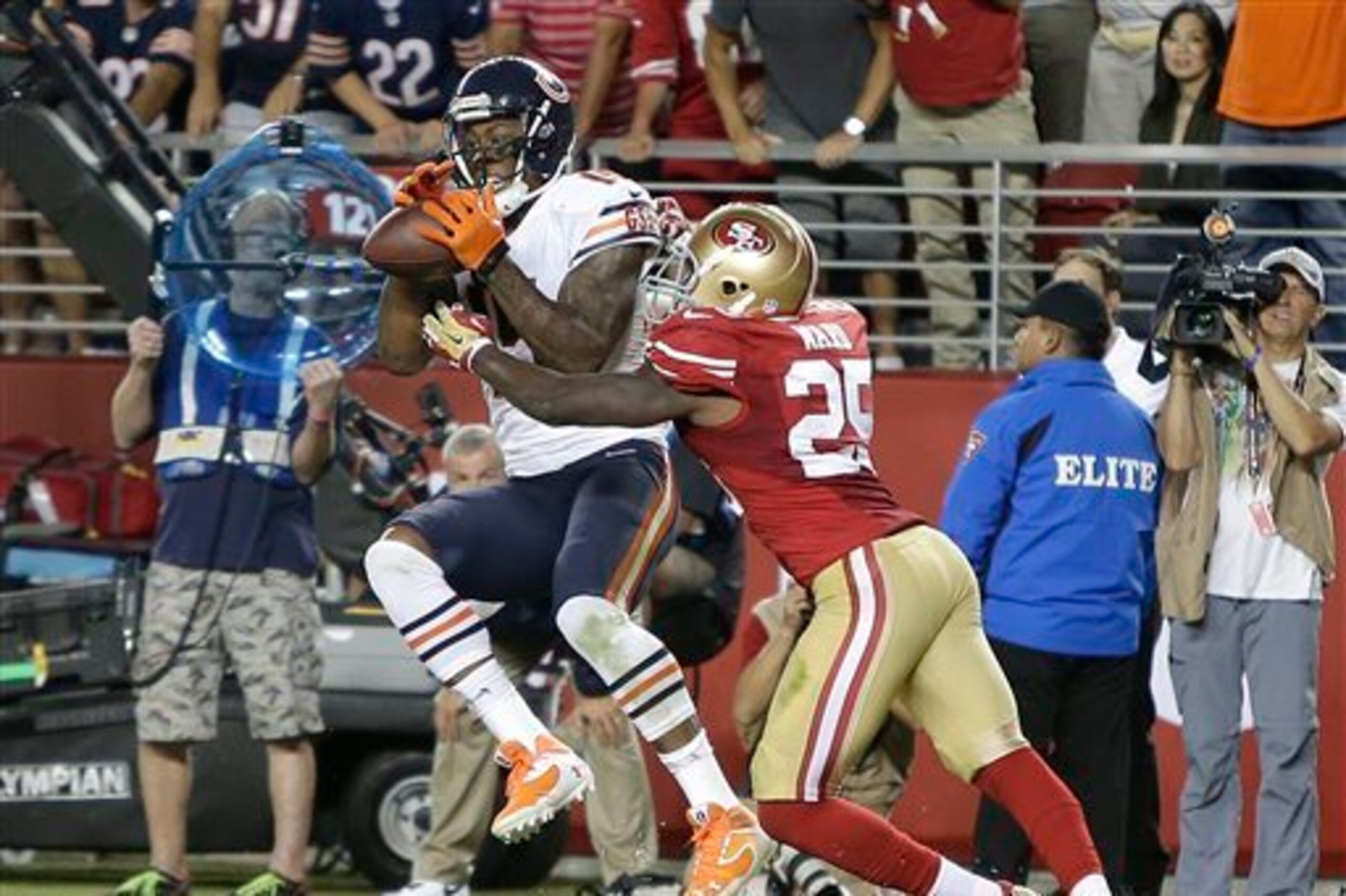
Ward, of course, had the entirely unfair coverage assignment on a corner fade to one of the NFL’s premier red-zone threats.
Even though this game was already decided, Kaepernick managed a fairly impressive last-ditch effort. He helped bring the 49ers to the Bears’ 17-yard line with 1:24 left in the fourth quarter.
Despite two additional instances of clock mismanagement—which falls mostly on the coaches—the 49ers indeed had a chance. Unfortunately, Crabtree stopped just short on his end-zone route, causing an otherwise perfect pass to sail through his hands on fourth down.
But again, this lopsided matchup should never have come down to this deciding moment. It should have been sealed at halftime.
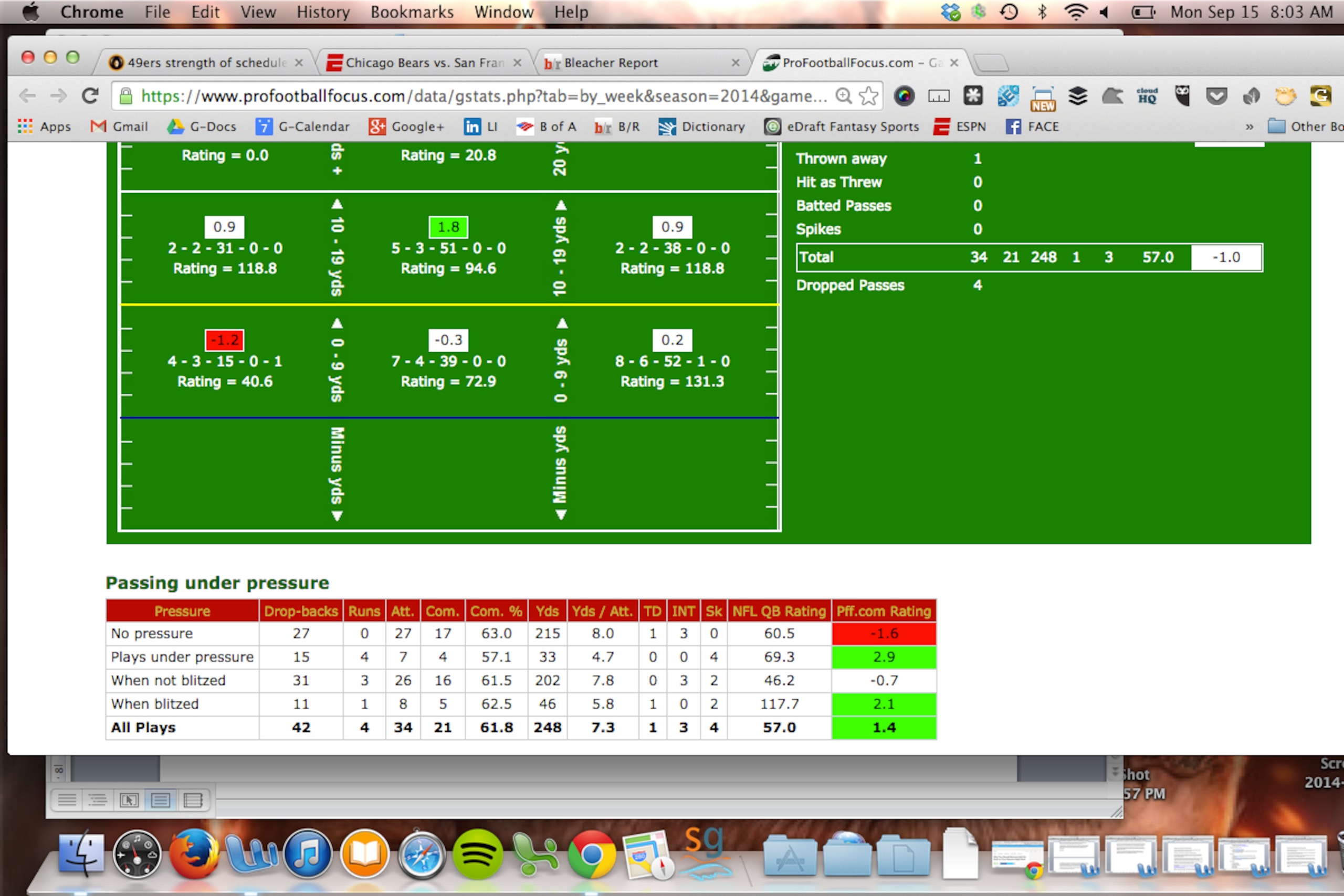
So, while any quarterback who throws three picks and loses a fumble plays a role in his team’s loss, Kaepernick was not the primary reason on this day. Throw away his inconsequential personal-foul penalty and the advanced statisticians at Pro Football Focus would have given him a positive grade (subscription required).
Rather, it was poor play-calling, continued mismanagement of the clock and a total void of killer instinct from the coaching staff that contributed to this heartbreak at Levi’s Stadium.
Thankfully, it was only Week 2.
Team and player stats courtesy of ESPN.com.
Joe Levitt is a Featured Columnist for Bleacher Report, waxing academic, colloquial and statistical eloquence on the San Francisco 49ers. Follow him on Twitter @jlevitt16
.jpg?w=2560 "Chiefs Dolphins Football")
.jpg?w=2560 "Texans-Mixon Released Football")


.jpg?w=2560 "Love's Body Already 'Tired'")