

Biggest Takeaways from Tuesday's FIBA World Cup of Basketball Play
What Day 4 of the 2014 FIBA World Cup lacked in thunderous highlights or shape-shifting upsets, it more than made up for with some stellar individual efforts.
Team USA once again took care of business, riding a breakout performance from Anthony Davis to its third straight win and holding steady atop the Group C Standings.
A couple of NBA staples helped Australia survive a second-half rally from the always formidable Lithuanians, while a double-double from Gustavo Ayon propelled Mexico to an easy win over Angola.
Led by backcourt brethren Goran and Zoran Dragic, Slovenia shook off a shaky first-half performance to dispatch a winless South Korea. Meanwhile, in arguably the day’s most exciting game, Ukraine scored a minor upset over No. 7-ranked Turkey.
In the day’s final tilt, the Dominican Republic—led by Anthony Davis’ former backup at Kentucky, Eloy Vargas—squeaked by Finland to jump to 2-1 in round-robin play.
With the field finally starting to take shape, the next few days will go a long way in determining who amongst the FIBA crop stands a real chance of upsetting heavy favorites Spain and the U.S.
First, let’s break down a bit of what we saw Tuesday afternoon.
“Efficiency” Is Goran Dragic’s Middle Name
1 of 8
Through Slovenia’s first three games (all wins), Goran Dragic is averaging 20.3 points on—wait for it—71 percent shooting from the floor.
That’s not a metric translation, folks. That’s just good old-fashioned efficiency.
But while he remains a full 10 percentage points behind tournament leader Kenneth Faried (81 percent), Dragic is authoring his FIBA superlatives as Slovenia’s unquestioned go-to player.
Together with his brother Zoran, Dragic has helped spearhead one of FIBA’s deftest offensive attacks—an offense predicated on aggressive dribble penetration and hitting open shooters.
Situated as it is in one of the tournament’s weaker groups, Slovenia has a chance to set itself up nicely for the forthcoming knockout round. And Dragic, with his whirling-dervish drives and precise touch, stands to be the man to make it happen.
Sooner or later, Slovenia’s size and lack of consistent defense (we’ll get to that later) are bound to catch up to it. For the time being, though, few players have parlayed last year’s NBA success into full-on FIBA magic quite like Slovenia’s favorite son.
Lithuania's Bigs Fall Flat
2 of 8
Three years ago, you’d have been hard-pressed to find a more tantalizing international combo than Jonas Valanciunas and Donatas Motiejunas, both of whom were selected in the 2011 NBA draft.
Through Lithuania’s first two performances (both wins), that hype held largely true—particularly for Valanciunas, raring as he is to turn his FIBA play into a breakout year with the Toronto Raptors.
Game 3? Not so much.
Lithuania’s two-headed frontcourt monster struggled mightily Tuesday, succumbing to the always plucky Australia, 82-75. The twosome’s final combined line: six points (albeit on 3-of-5 shooting) and seven rebounds over a combined 26 minutes of mostly anemic play. Worst of all, both players somehow managed to register woeful plus-minuses of minus-15, besting only Jonas Maciulis’ minus-16.
It goes without saying that Lithuania’s hopes hinge rather tightly on their NBA bigs. With so many of the tournament’s elite teams fielding frontcourt-heavy squads, Valanciunas and Motiejunas will need to bring their A-game—and not the kind that’s shorthand for “Australia wins.”
Dive Turkey
3 of 8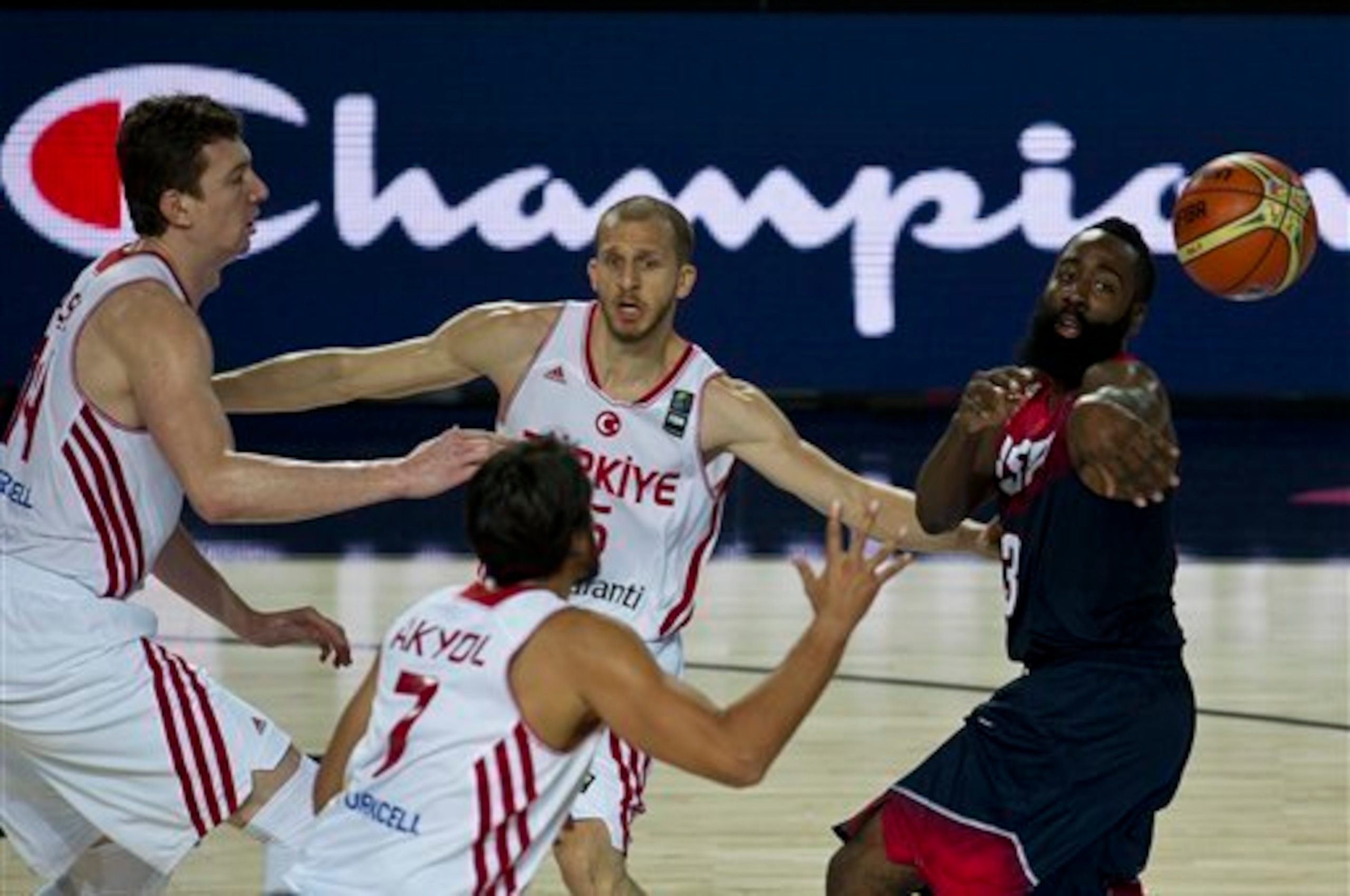
For years, Turkey has existed on the nearest fringes of the FIBA elite—a good team (very good, even), though not quite in the same conversation as the U.S., Spain, Brazil and Argentina.
Even though it's been awarded with one of the week’s breezier brackets, Turkey—now 1-2 after a 64-58 loss to the formidable Ukraine—has hardly looked like the upstart power of tournaments past.
Sure, some big names are missing, with Hedo Turkoglu and Ersan Ilyasova being the most obvious examples. Still, this is a seasoned team that’s been around the block. It's not a threat to win the whole thing necessarily, but it's good enough to upend one of the bracket’s glitzier names.
Through three games, Turkey’s 42 percent field-goal clip ranks 15th, behind the likes of Senegal and the Dominican Republic, and one spot ahead of Iran.
That, to put it mildly, needs to change.
And while Omer Asik has been his steady, solid self, the New Orleans Pelicans center isn’t exactly the kind of go-to option a supposed top-10 team needs.
Turkey remains a heavy favorite to advance to the knockout round, if for no other reason than Finland, the Dominican Republic and New Zealand are still in its bracket.
To have any chance of advancing, however, Turkey will need to do more than merely rely on Asik’s defensive presence to carry the day.


Francisco Garcia's Bigger Stage
4 of 8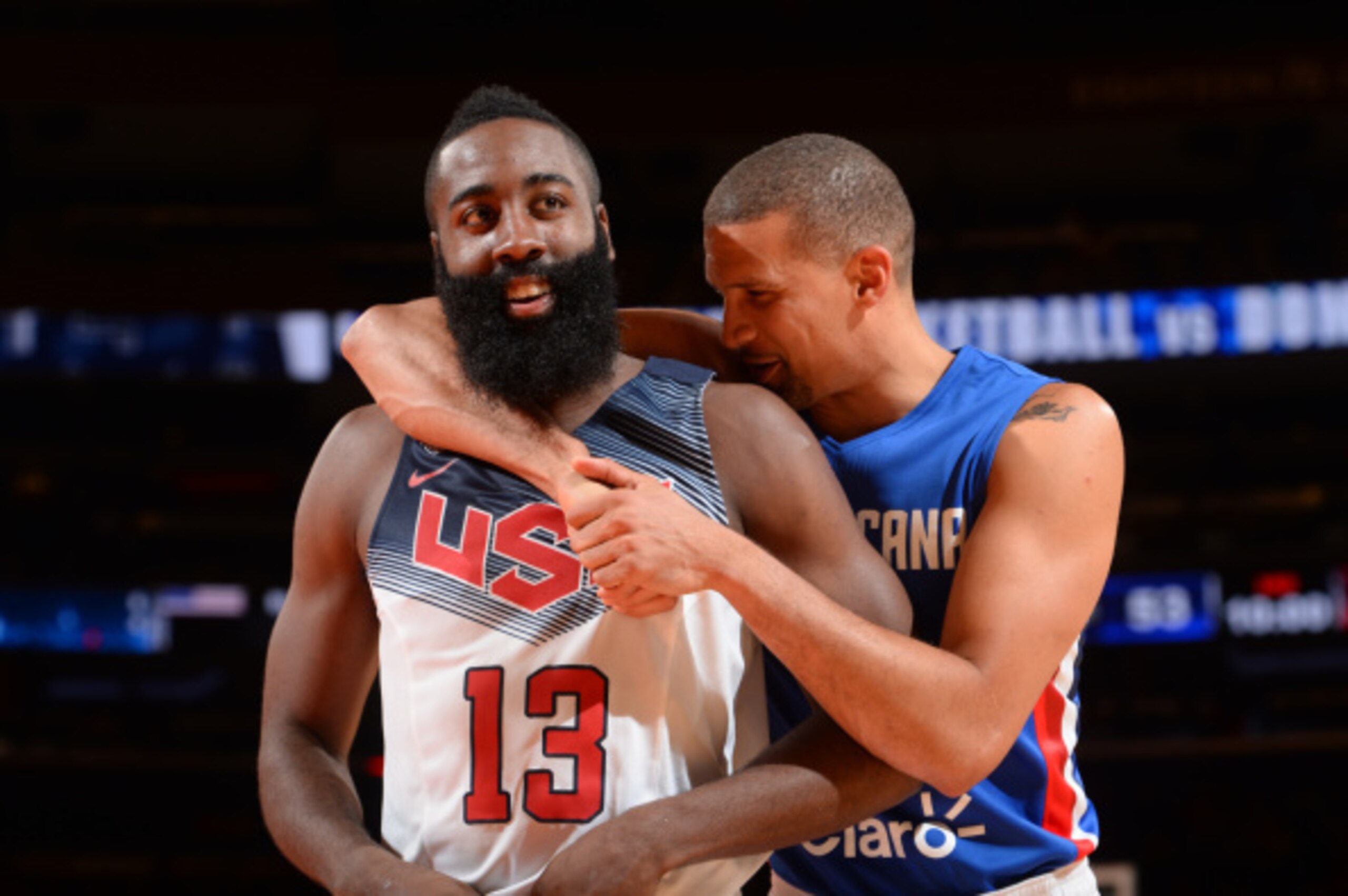
For many a fringe NBA player, FIBA represents a chance to not only represent one’s country, but showcase his talents as well.
Case in point: Francisco Garcia, the Dominican Republic’s unquestioned best player and emotional leader. Through his first three contests, Garcia—lately of the Houston Rockets—has tallied 21 points per game on 62 percent shooting, including an absurd 65 percent from distance.
In so doing, he’s helped propel the D.R. to a tie with upstart Ukraine for Group C’s No. 2 spot (just behind the U.S.).
At 32 years old, Garcia has authored a serviceable, if wholly unspectacular, NBA career. On this stage, however, Garcia is nothing if not a top-tier player—a savvy veteran as renowned for his deadeye shooting as he is his potent locker-room presence.
Garcia’s latest showing: a 16-point, seven-rebound performance in a narrow 74-68 win over Finland on Tuesday afternoon.
He might not boast the NBA star power of a Goran Dragic or Pau Gasol, but as a vessel for a nation’s basketball ambitions, Francisco Garcia is one player you simply can’t take your eyes off.
Team USA's Defense Still Wreaking Havoc
5 of 8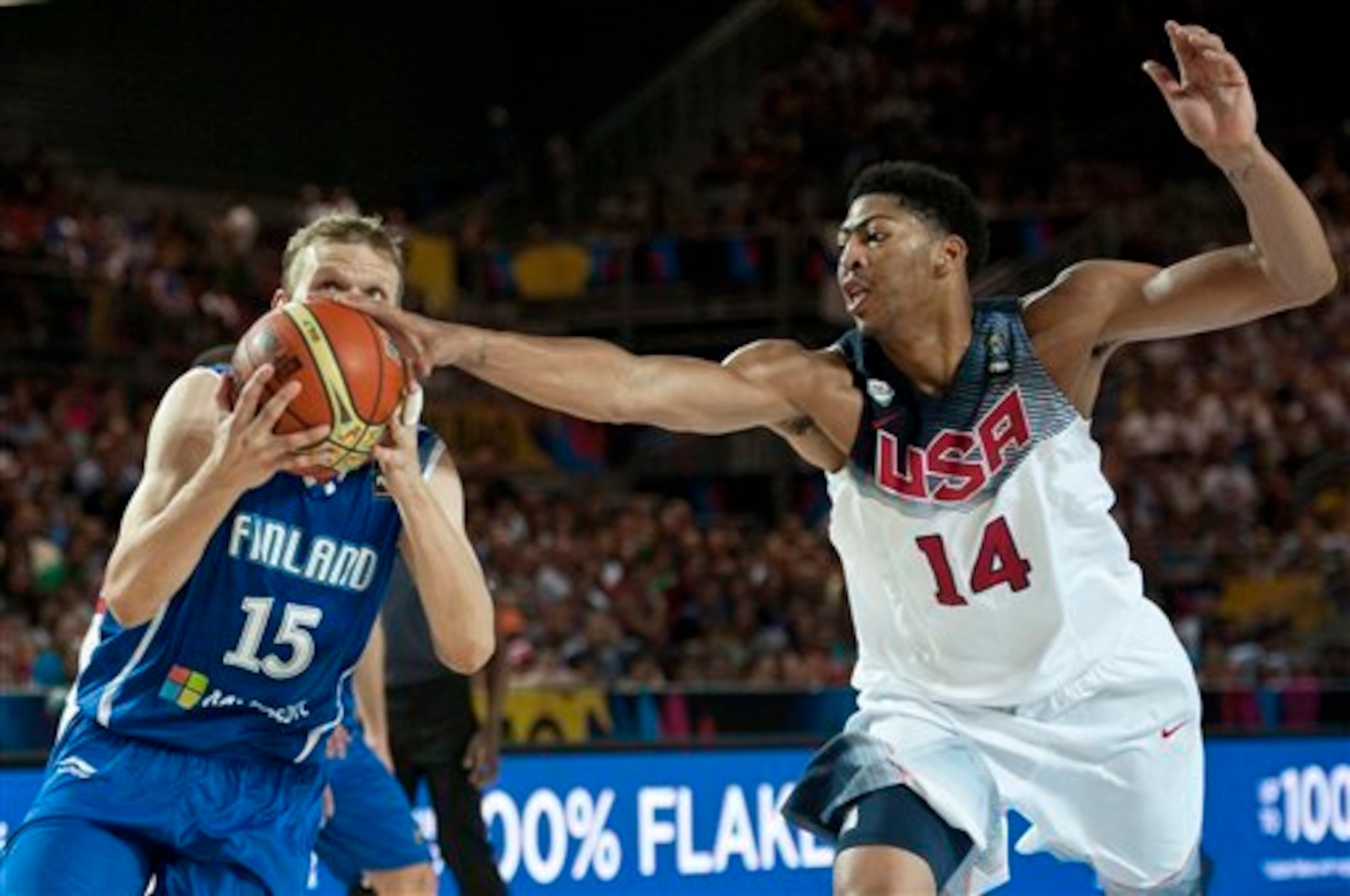
If I’m Mike Krzyzewski, I’m seriously considering throwing the next two games. I mean, not really. But that’s how full-throttle his troops’ swarming, havoc-wreaking defense has been. I get exhausted just watching them.
Three days after forcing Finland into 31 turnovers en route to a 114-55 win over Finland (you read both those things right), Team USA’s "40-Minutes-of-Hell" was back in full force Tuesday afternoon.
This time, it was New Zealand that bore the brunt of the Americans’ defensive wrath, coughing up the rock 21 times in a decisive 98-71 route.
Just how brutal has Team USA’s attack been? Slovenia’s Goran Dragic has some thoughts on the matter.
"Their energy is unbelievable," Dragic told ESPN.com’s Marc Stein following the two teams' recent FIBA tune-up. "It's hard. Especially on the pick-and-roll tonight, I didn't see any solutions."
Sadly, FIBA.com doesn’t have a ready-made stat for turnovers forced, but suffice it to say, Team USA is winning that one going away.
Krzyzewski’s strategy is as smart as it is simple: By using his team’s unparalleled length and athleticism to turn up the heat on opposing backcourts, Coach K is helping mask what is, by all accounts, a fairly weak defensive backcourt in its own right.
Coupled with affording his starters some much-needed rest, it’s a ploy that’s paid enormous dividends for the undefeated Americans.
Whether that strategy can work against a team as deliberate and turnover-averse as Spain, however, remains to be seen.
Slovenia's Defensive Problem
6 of 8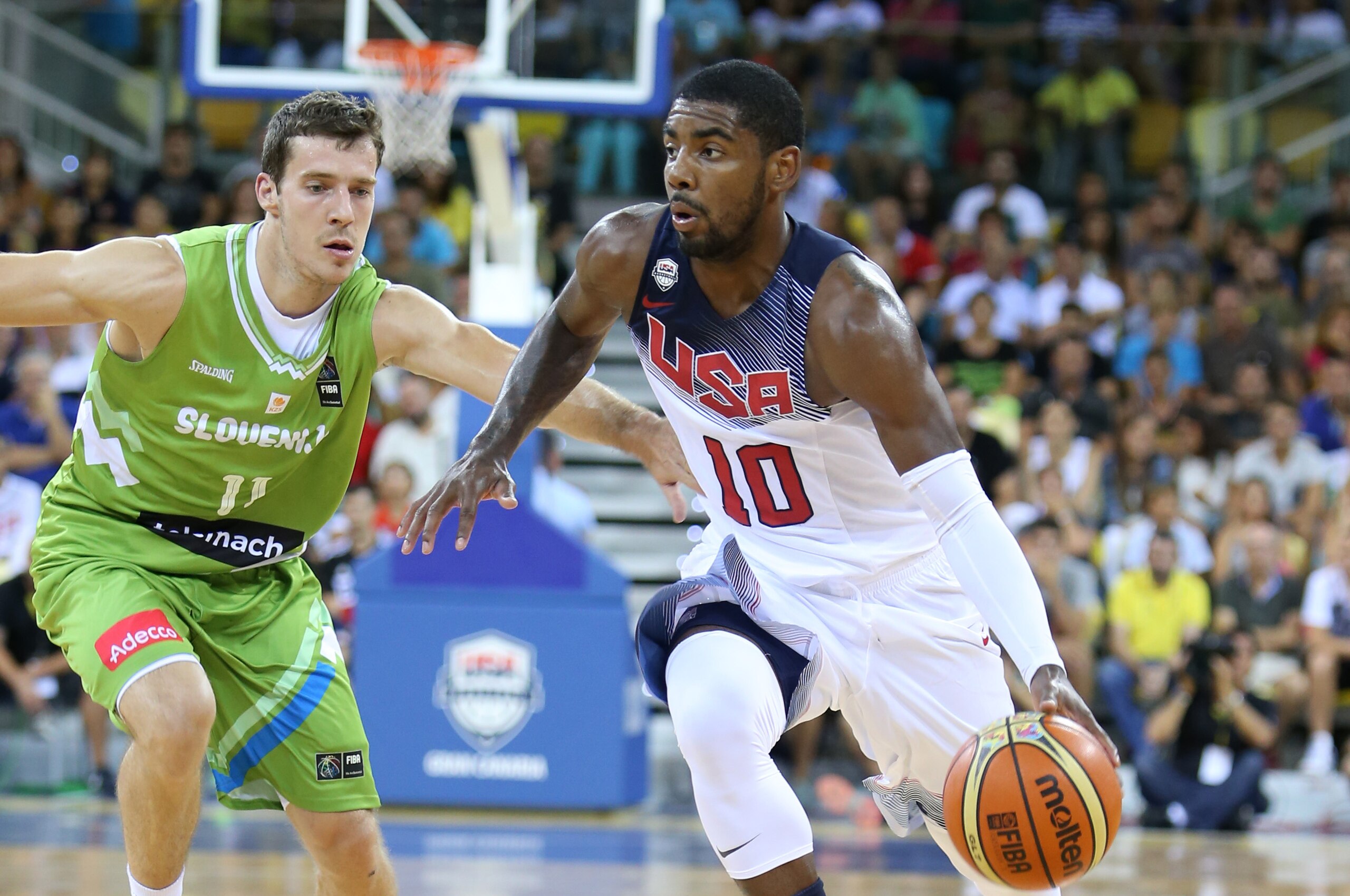
Even if Korea couldn’t quite take its upstart performance the distance, its frenetic style helped expose what could prove a glaring weakness for Slovenia: porous perimeter defense.
The Dragic Brothers, for all their offensive gifts, aren’t exactly Tony Allen out on the wing. Combined with Slovenia’s relatively thin front line, you have a team that’s bound to be exposed sooner than later.
The good news: Through three games, the Slovenians rank second in points per game, first in overall field-goal percentage and second in three-point shooting.
That might hold against teams such as Australia, Mexico and Korea. But once tournament play starts, you’d better believe teams will look to exploit Slovenia where it's weakest: down low and on weak-side help defense.
Ukraine Emerges as Feel-Good FIBA Story
7 of 8
Ukraine entered the FIBA World Cup ranked No. 45 in the world, putting it behind the likes of Chinese Taipei, Japan and Lebanon, just to name a few.
By all accounts, Ukraine had no business even being in Spain, let alone holding fast at its group’s No. 2 spot behind the United States.
Have any casual NBA fan scan Ukraine’s roster; three names—at most—are likely to pop out: head coach (and longtime NBA skipper) Mike Fratello, assistant coach Bob Hill and Eugene “Pooh” Jeter, who had a cup of coffee with the Sacramento Kings during the 2010-11 season.
Yet here Ukraine is, at 2-1, and sitting pretty to make the knockout round. All the while, escalating tensions between Russia and the Ukranian government have helped lend a serious undertone to an otherwise festive affair.
Despite the handful of notable names, Ukraine won’t be on anyone’s short list to plug its way through the knockout bracket.
Based on how it’s played thus far, though, these cagers wouldn’t have it any other way.
Anthony Davis Is Getting Better Every Game and That’s Terrifying
8 of 8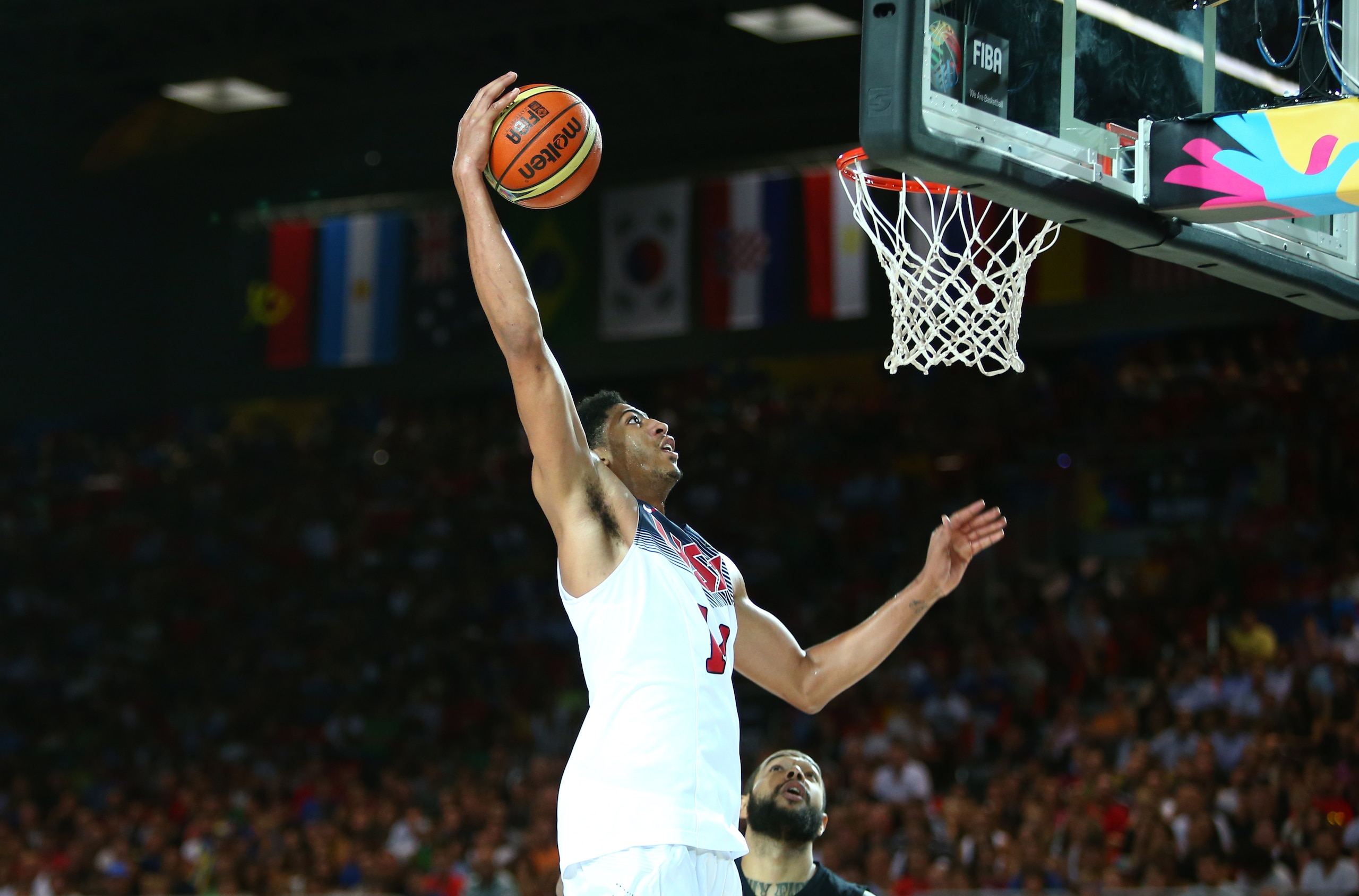
Wait any longer and the only seat left on the Anthony Davis bandwagon will be on the wheels.
Everyone and their brother knew Davis was poised for a breakout performance at FIBA—even if everyone in NBA circles has been singing his praises for years. And with each passing game, the New Orleans Pelicans star is making good on that hype.
Indeed, Davis’ box scores have, like his play for the Pelicans, been a lesson in steady progression, with the 6’10” center registering increases in both points and rebounds in each of Team USA’s three wins.
Following the Americans’ decisive exhibition win over Brazil last month, Bleacher Report’s Sean Highkin put Davis’ breakout gambit into historical context:
"Every incarnation of Team USA is headlined by its established superstars, but defined by the ones it makes. 2010’s FIBA World Championship tournament was a transformative event for Rose, Kevin Durant and Kevin Love. All three used it as a springboard to play the best basketball of their careers the following season, becoming household names in the process.
In the wake of Saturday’s tune-up ahead of September’s World Cup, it was clear that it’s Davis’ turn.
"
Indeed it is.
If and when Team USA faces Spain in the knockout round, Davis’ presence—ditto that of Kenneth Faried and the rest of Krzyzewski’s bigs—will be paramount to stopping the formidable front line of Marc Gasol, Pau Gasol and Serge Ibaka.
Davis can’t do it alone, of course. But that’s not stopping him from making you think he can.
All stats courtesy of FIBA.com unless otherwise noted.
.jpg?w=2560 "Mahomes Told Teammate to Leave Meeting")

.jpg?w=2560 "🚨 Week 8 AP Top 25 Poll")



.jpg?w=2560 "Rodgers Iced Out on Plane 💎")
.jpg?w=2560 "Updates from EVERY NFL Game 🏈")