Dustin Brown Is Los Angeles Kings' Biggest Question Mark for 2014-15
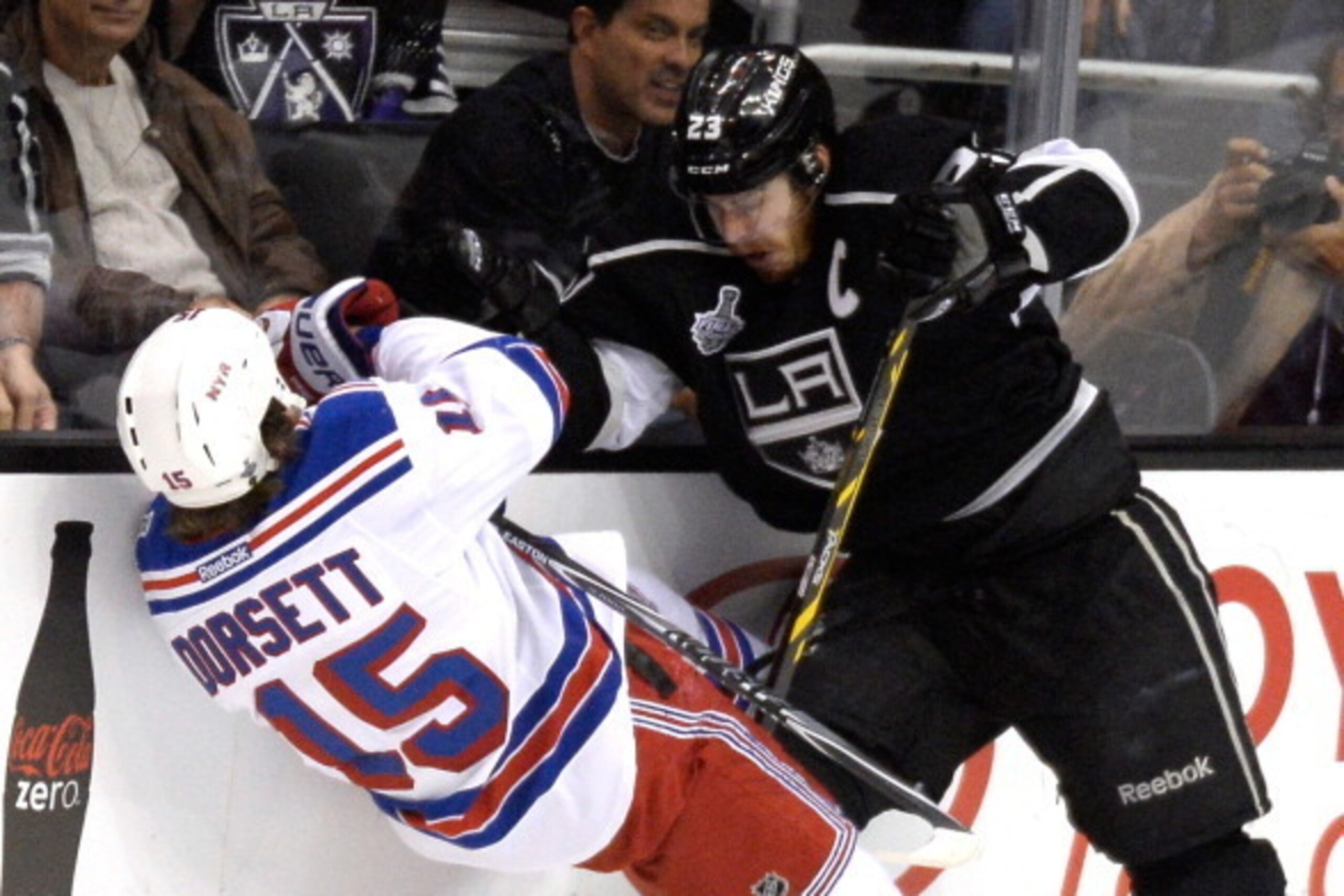
Despite winning two championships in the past three campaigns, Los Angeles Kings captain Dustin Brown has some questions to answer in 2014-15.
He’s coming off a disastrous regular season that saw him post his lowest point total (27) since a 31-game rookie year in 2003-04. He managed more points (29) in 2013’s 48-game year than he did in 79 contests last season.
Now, offensive production is by no means the be-all and end-all of hockey—particularly Kings hockey—but that’s a really, really steep drop.

-(1).jpg?w=2560)

Likely penciled in as the right winger on L.A.’s first line alongside two-way stalwart Anze Kopitar and sharpshooter Marian Gaborik, Brown cannot afford to weigh them down next season. Much of the team’s enviable forward balance depends on his performance.
Is he poised for a bounce-back showing?
Numbers

Though Brown largely maintained his level of physicality (246 hits, ninth in the league) and puck possession (57.9 Corsi percentage) in 2013-14, he fell short where the details of the game were concerned.
He wasn’t enough of a bull in front of the net or along the boards, letting the opposition off the hook rather than forcing the issue in the trenches.
This is reflected in a deceptively major component of his game: penalty differential. After a terrific string of plus-24, plus-35 and plus-27 (prorated over 82 games), his PD dropped all the way down to plus-11 in 2013-14.
Since 2011-12—the last full season prior to last year—the number of calls he’s drawn has withered down from 60 to 37.
Whether officials are no longer granting him the benefit of the doubt or opponents are demonstrating more restraint around him, it’s clear that Brown’s hit count didn't translate to effective hockey in 2013-14.
His nonchalance was also reflected in pitiful defensive effort.
In the play below, Brown spots his man (Taylor Hall) streaking down the ice but inexplicably stops skating, allowing the young Edmonton Oiler winger to blow by for a goal:
Against the Detroit Red Wings, Brown again sees his assignment in the open without caring enough to hustle into position. Dan Cleary scores the 3-1 dagger:
When he’s playing a hard game in the hard areas, he’s pestering the other team into oblivion.
Last season, he was routinely late to the party, content to throw a meaningless hit that ended up in the box score.
Elsewhere, Brown struggled with puck management. He was sloppy in possession, curtailing his team’s attacking forays with questionable decisions and lackluster work ethic.
In addition to breakouts, how the Kings handle the puck is pivotal to how they dictate the flow of traffic in the neutral zone.
Controlling the lion’s share of the biscuit isn’t worth much when that advantage is offset by giveaways. Too often, Brown would fly down the ice with a head of steam only to circle back on himself and ultimately skate into trouble.
This bad habit has dogged him over the past two years.
Before that, he would regularly look to impose his will on the other team’s defense. It may not have always worked, but at least he was attempting to forge ahead instead of turning the puck over cheaply and thus putting his teammates on their heels.
His five-on-five numbers have suffered as a result of the poor choices. In 2011-12, he registered 31 points in such situations. In the last two years, he’s managed 23 (prorated over 82 games) and 21 points, respectively, without much of a fall-off in quality of teammates.
Brown’s relative goals-for percentage was minus-2.8 in 2013-14. In other words, for the first time in four seasons, the Kings scored a greater share of goals with their captain off the ice.
That’s alarming.
Not surprisingly, this is reminiscent of another power forward’s decline.
Brenden Morrow was a menace for many years in Dallas. Though not massive (6’0”, 205 lbs to Brown’s 6’0” and 207 lbs) by any stretch of the imagination, the captain was an absolute wrecking ball who crunched opponents all over the ice and hunkered down in front of the net to create havoc.
However, as his bruising style of play caught up to his body, he could no longer reach the point of attack in time to contribute as frequently.
His production has waned quite dramatically in the span of a few seasons.
Hockey-Reference.com indicates he posted respective point-per-game marks of 0.90 and 0.83 at ages 29 and 30. Since then, his PPG line reads 0.61, 0.68, 0.46, 0.57 and 0.35.
Somehow, the tail end of that nosedive still trumped Brown’s 2013-14 (0.34). Yikes.
Power forwards don’t always deteriorate this quickly, so there is hope that the 29-year-old can right the ship. He’ll certainly boast better linemates than Morrow did at the same stage, which should facilitate a return to form.
Role
With Kopitar as his center, Brown won’t have an excuse for a second consecutive subpar year.
In terms of three-zone pivots, the big Slovenian may not match Jonathan Toews’ incessant motor or Patrice Bergeron’s defensive instincts, but his ability to govern play in every area is rivaled by a select few.
Last season, he ranked second among NHL centers in Corsi percentage (61.0) and first in goals-for percentage (69.1).
Capitalizing on his 6’3”, 224-pound frame and soft hands, Kopitar is a puck-possession machine. He consistently wins 50-50 pucks and then fends off defenders in tight spots to make plays for his teammates.
On left wing, Gaborik is a speedster who just potted 14 goals in 26 postseason games. His reemergence as a legitimate scoring threat fueled a Kings offense that proved unstoppable in the playoffs.
The Slovakian probably won’t sustain that scoring rate going forward, but he should certainly be capable of registering 35 goals and 65 points in 2014-15.
Taking his linemates into account, Brown must realize that the offensive burden does not rest on his shoulders. His primary objective should be to create space for his two more talented partners, generating loose pucks and soaking up attention in the slot.
Brown demonstrated his usefulness in the thick of the action during the Western Conference Final. In Game 5, he intercepts a pass at the offensive blue line and takes a shot with some conviction. Even though it's blocked, he wins the ensuing net-front battle and registers a key goal for his club:
Against the San Jose Sharks in the first round, he receives a breakout pass deep in his zone and simply gets his feet moving. The positive momentum allows him to bypass a would-be obstacle (Logan Couture) and back Marc-Edouard Vlasic way off. He then fires on goal for a Gaborik rebound marker:
How basic was that?
While all this seems elementary for a power forward, Brown often forgets just how tough he can be to deal with when he hits his stride.
Moreover, he often forgets to involve his linemates. When those happen to be the Kings’ top attacking options, that’s a problem.
Above all else, he simply can’t kill plays by stalling on the wall and squandering possession shortly thereafter. The captain must ensure that he’s continually moving toward the opposition’s crease instead of to away from it.
If the road is blocked, then find the available outlet. Quickly.
When he dilly-dallies on the perimeter, he hurts both his offense and that of his team. When he plays a straight-line, crash-and-bang game, he and L.A. reap the rewards.
It's not rocket science, so Brown should stop overthinking the game. He must whittle his efforts down to the bare essentials—skating hard, directing the puck toward the opposition's net—and harness them for 82 games next season.
Playing full-time next to Kopitar and Gaborik, he shouldn't sag any lower than 20 goals and 45 points by mere virtue of being there and putting his nose to the grindstone.
Those aims may seem modest, but he missed them by a mile—five goals and 18 points, to be exact—in 2013-14.
Outlook

As disappointing as both Mike Richards and Slava Voynov were last season, their roads to recovery are fairly easy to chart.
According to Lisa Dillman of the Los Angeles Times, Richards—whose hockey sense and killer instinct remain top-notch—assured general manager Dean Lombardi that he would improve his conditioning in the summer. Meanwhile, Voynov is only 24 years old, so his best has ostensibly yet to come.
With Brown, the picture is much blurrier. Furthermore, his contract will absorb more of L.A.'s salary-cap space than theirs long-term.
A repeat performance in 2014-15 would be nothing short of unacceptable—not only because he’s the handsomely paid captain, but because the team’s forward depth would be thrown out of whack should he struggle once more.
In the event of a protracted slump, Justin Williams would likely jump up from the third line to the first, which would significantly weaken the former.
Consequently, L.A. would shift from a three-line powerhouse to just another strong club.
There’s a reason every Western Conference contender loaded up on top-six talent over the summer. They’re gunning for the Kings, whose balance up front is truly incredible—and still untouchable—when the pieces are clicking.
Brown may not have to score the majority of his team’s goals, but he’s a key cog nonetheless. His abrasive play sets the stage for the first line, which sets the stage for every group behind it.
We saw glimpses of his importance as recently as this spring, when he quit messing around on the outside and decided to bulldoze a path to victory. In flashes, he bombarded goalies with shots from everywhere on the ice and furiously drove play toward the opposition’s net.
Kopitar and—especially—Gaborik benefited from his meat-and-potatoes grind.
Unlike Morrow, Brown appears to have gas left in the tank. His pace is there and he's throwing hits with the same frequency as in prior years, so this is truly a matter of commitment.
In L.A., the little things add up to big things, like two Stanley Cups in three years.
As the apparent leader of this team, he has to embrace those little things—the battles for pucks along the boards and positioning in front of the net—and prove 2013-14 was an anomaly rather than a harbinger. He has to make opponents earn their ice. He has to establish the right tone for a championship contender.
The Kings are built for the playoffs. Getting there hasn’t always been smooth sailing in recent years, though, and the offseason has only served to bolster the Western Conference gauntlet.
For better or worse, Brown will play a large part in determining his team’s regular-season fate.
Advanced statistics courtesy of Extra Skater. Contract information courtesy of CapGeek.com.




.jpg?w=2560 "Panthers Signing Darren Waller")

.jpg?w=2560 "Every NFL Team's Biggest 'What If'❓")
_0.jpg?w=2560 "AEW Dynamite Results & Recap 🔠")