5 Areas the Miami Heat Must Upgrade This Offseason
The only constant in the NBA is change.
Even when an organization is at the top of the mountain, which is a perch the Miami Heat have occupied for several seasons now, it needs to restock and reload to hold off the legions that threaten to overtake it.
It has no choice.
While the Association lacks the brutal physicality of the NFL, professional basketball can be unforgiving too. The 82-game season is long and irregular, and a basketball floor is a hard thing to run on. Players age fast. The great become good, the good become average, and the average become unemployable.
Furthermore, the game itself is changing—with pace and a dynamic three-point attack becoming less luxuries than necessities—and aspiring contenders need a roster that can keep up with the Joneses.
With a league-high 13 potential unrestricted free agents, according to ESPN.com, this offseason figures to be particularly transformative for the Heat. Irrespective of what happens in June or with the Big Three, big changes are in store for the oldest roster in the NBA.
With winter giving way to spring, here are five areas that Miami management may look to upgrade this offseason to keep the championship parades rolling through South Beach.
Shattered Glass
1 of 5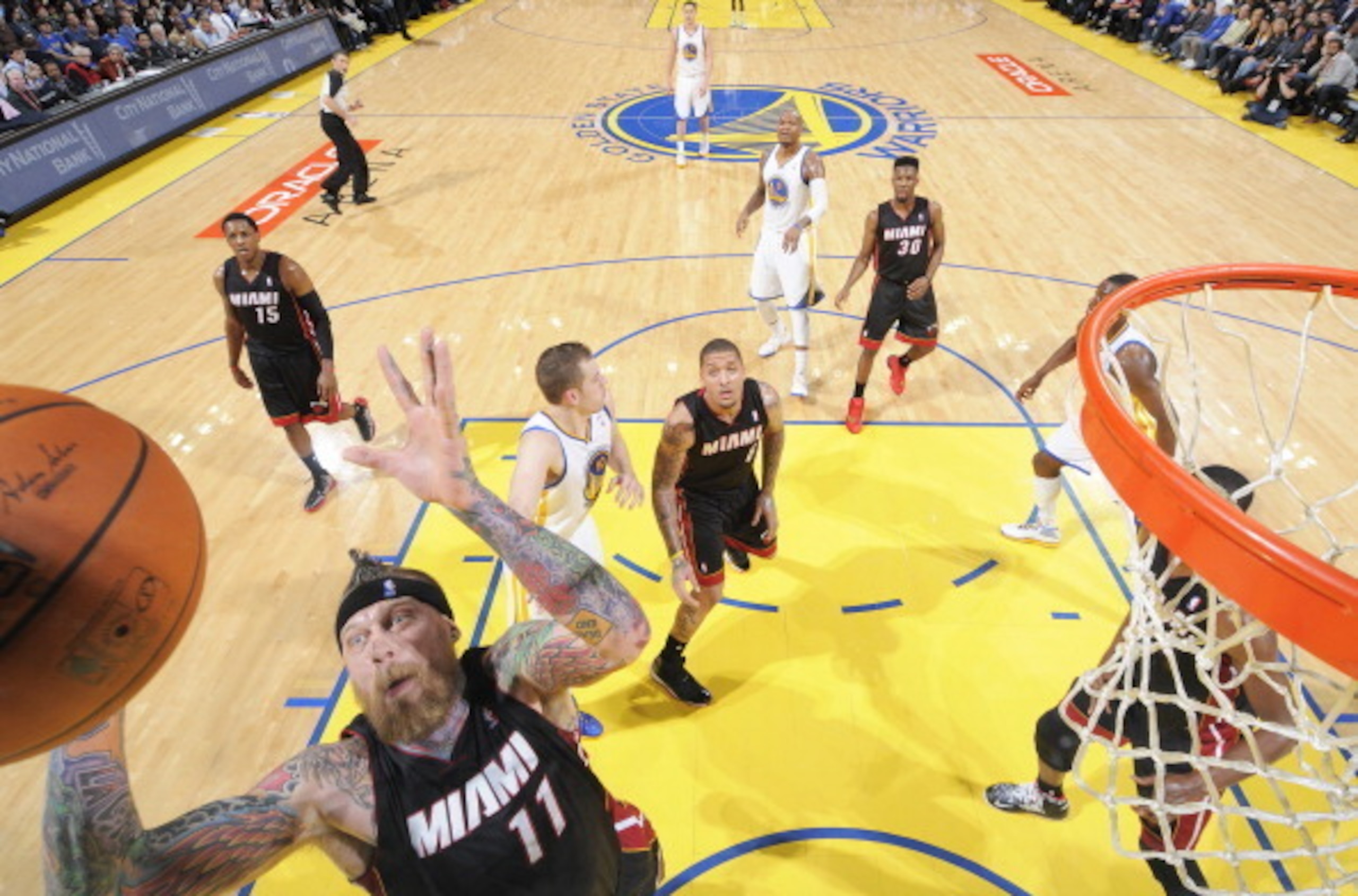
The Heat are the worst offensive rebounding team in the NBA. This isn’t hyperbole: Statistically, they are last in the percentage of available offensive rebounds that they grab. Granted, to an extent, this weakness can be understood not as a personnel deficiency but as a matter of deliberate strategy.
The Heat, like the San Antonio Spurs, retreat on defense rather than hit the offensive glass—trading possessions for stops.
“It’s not really an emphasis. Of all of the things we emphasize, our emphasis is on transition defense, halfcourt defense and good ball movement on offense,” Shane Battier explained to Heat.com’s Couper Moorhead. “Offensive rebounding isn’t something that we’ve stressed.”
The suggestion is that analysts should look at the rebounding situation in Miami, shrug their shoulders and move on.
But then there’s the matter of the other end of the floor. The Heat are also toward the bottom of the league in defensive rebounding rate, pulling down just 72.3 percent of available boards, which is good for 28th in basketball.
Now this is a problem.
Miami is good at getting in a position to take shots and then hitting those shots. It is excellent at denying the same to opponents, but it yields so many extra possessions that it puts itself at a decided disadvantage. The Heat lead the NBA in true shooting percentage, with a ridiculous figure of 59.5 this season.
The problem, though, is this: With its rebounding issues—and recently developed tendency to turn the basketball over—Miami needs to have a near-historically good true shooting percentage to remain elite. That may not be sustainable.
The Heat might believe the solution to the problem is in-house—Greg Oden is progressing nicely, has been productive in limited minutes and is still, incredibly, just 26—but more likely than not, Miami will look to make an offseason addition or two to solidify this area.
Unrestricted free agent Kris Humphries isn’t a perfect option, but he’s a top-flight rebounder and, after an unfortunate stretch of professional and personal bad luck, could be available at a steep discount. Andrew Bynum could fill a similar role. As could the Los Angeles Lakers’ Jordan Hill.
Or rather than specifically targeting big men who can help on the glass, Miami could make it an organization priority to target free agents in its price range who are above-average rebounders at their position, such as Shawn Marion.
A Point of Contention
2 of 5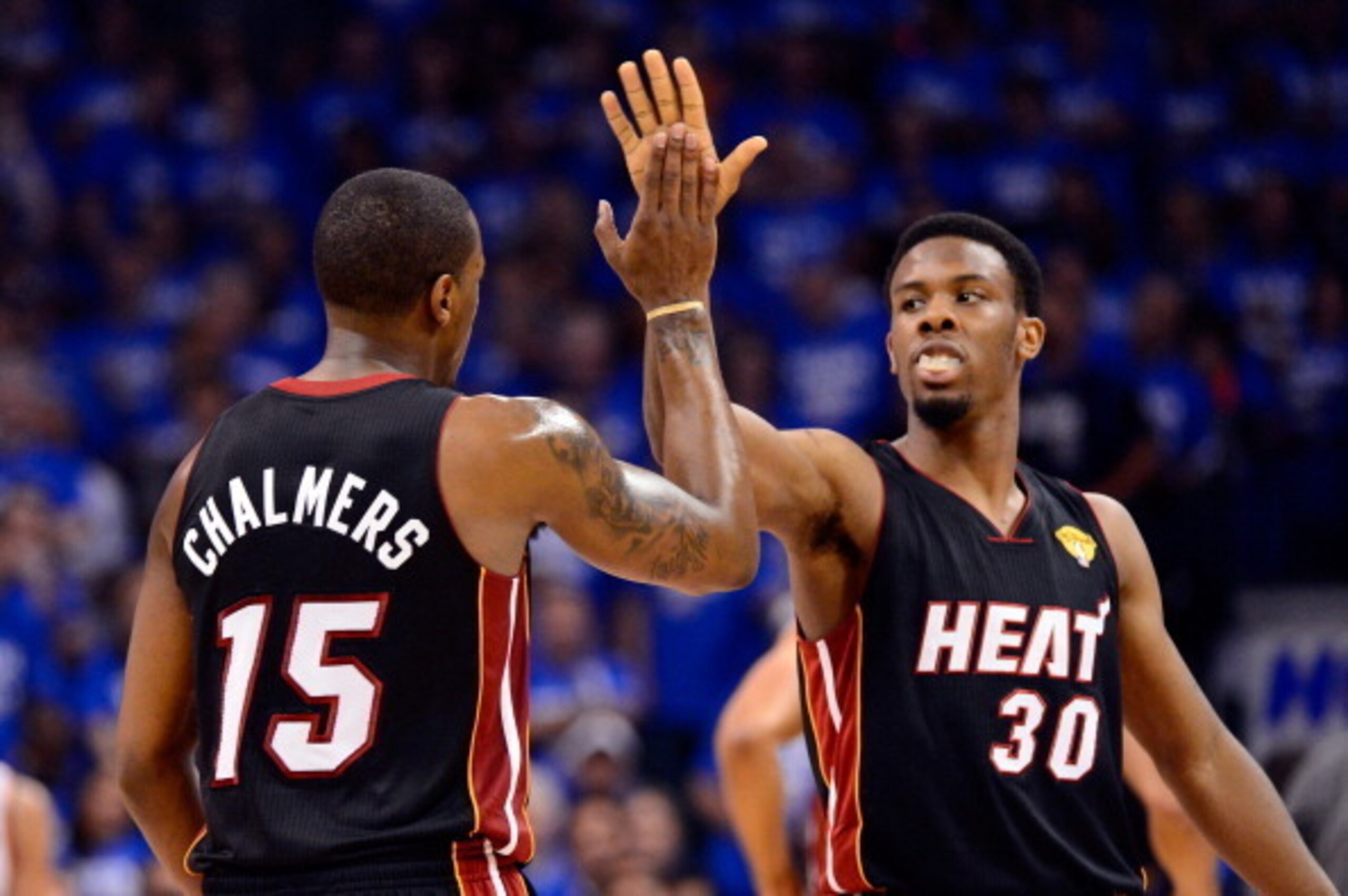
When an organization builds a team around three superstars who are getting superstar money, some components of the roster are going to get short shrift. Which brings us to Miami’s point guard situation.
The Miami depth chart of Mario Chalmers, Norris Cole and now Toney Douglas isn’t terrible, but it’s an area of marked weakness on the roster.
Chalmers is a passable starter. According to Basketball-Reference, while he’s never posted a player efficiency rating above 15, his win shares per 48 minutes is 0.099 on the season thus far and 0.098 on his career, which are almost perfectly average.
Cole, however, is an albatross.
In three professional seasons, he has proved to be, frankly, just bad at every measurable aspect of basketball. According to Boxscore Geeks, he is, relative to other point guards, a sub-average shooter from both two- and three-point range. He’s also less effective than the typical point guard at rebounding, passing, blocking shots and avoiding fouls.
The advanced stats reflect this. His win shares per 48 minutes so far in 2013-14, according to Basketball-Reference, is 0.033. If it holds up, this would be both the highest mark of his career and one-third the production of an average player. That’s not good. Meanwhile, he has never posted a player efficiency rating above 10.
And the less that’s said about Douglas, the better.
Miami can do better here. Douglas and Chalmers will be unrestricted free agents this summer, while Cole will be a restricted free agent in the summer of 2015.
It’s unclear how much of an organization priority upgrading the point is in Miami—that is, it’s not clear how much cash the front office is willing to throw at the problem—but mid-level options like Ramon Sessions, Shaun Livingston and Greivis Vasquez make some sense for the Heat and wouldn’t cost too many cents to bring to Miami.
Marksmen
3 of 5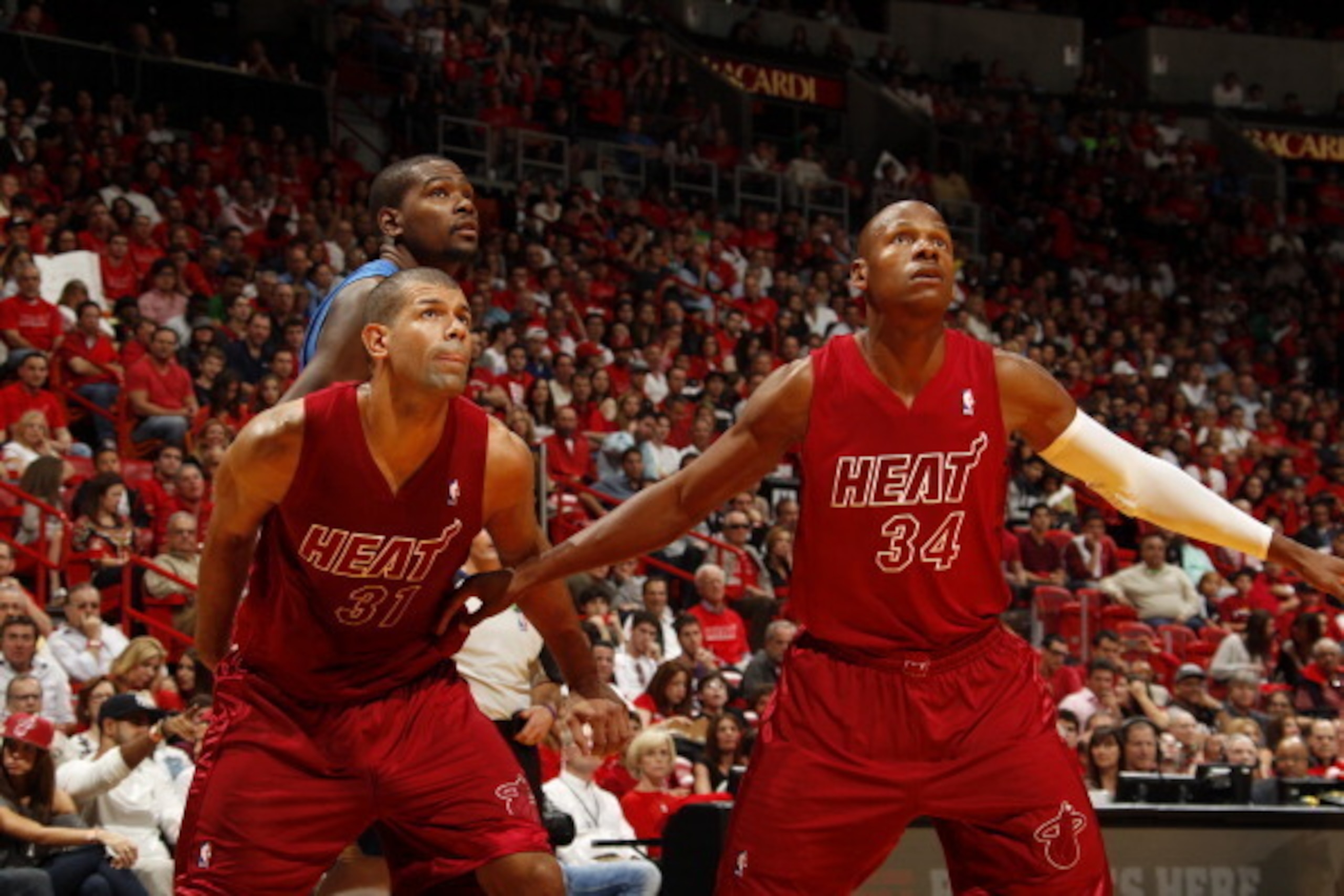
The Heat's success is all about spacing.
A large component of this is Miami’s expert use of the three-point line—and the corner-three in particular—to stretch opposing defenses and open lanes for LeBron James and Dwyane Wade.
The problem is that two of the key players who fulfill those responsibilities have declined considerably in 2013-14. And given their advanced age, it’s a decline that seems unlikely to reverse itself.
Ray Allen, though still productive, has shown signs of slippage thus far in his age-38 season. Jesus Shuttlesworth is shooting 37.2 percent from deep—a rate most players would love to connect on—but this is down from 45.3 and 41.9 percent in 2011-12 and 2012-13, respectively. At 0.101, he is also posting the lowest win shares per 48 minutes since his rookie season, according to Basketball-Reference.
Shane Battier has been worse. The forward, at 35, is shooting 38.2 percent from the floor and 33.5 percent from beyond the arc. His 2013-14 stat line looks like a typo. In 20.5 minutes per night, he’s averaging 4.3 points, 1.9 rebounds and 0.9 assists.
By measure of win shares per 48 minutes, according to Basketball-Reference, Battier is at 0.82, which, like Allen, is the lowest mark he’s posted since his rookie season.

Getting Defensive
4 of 5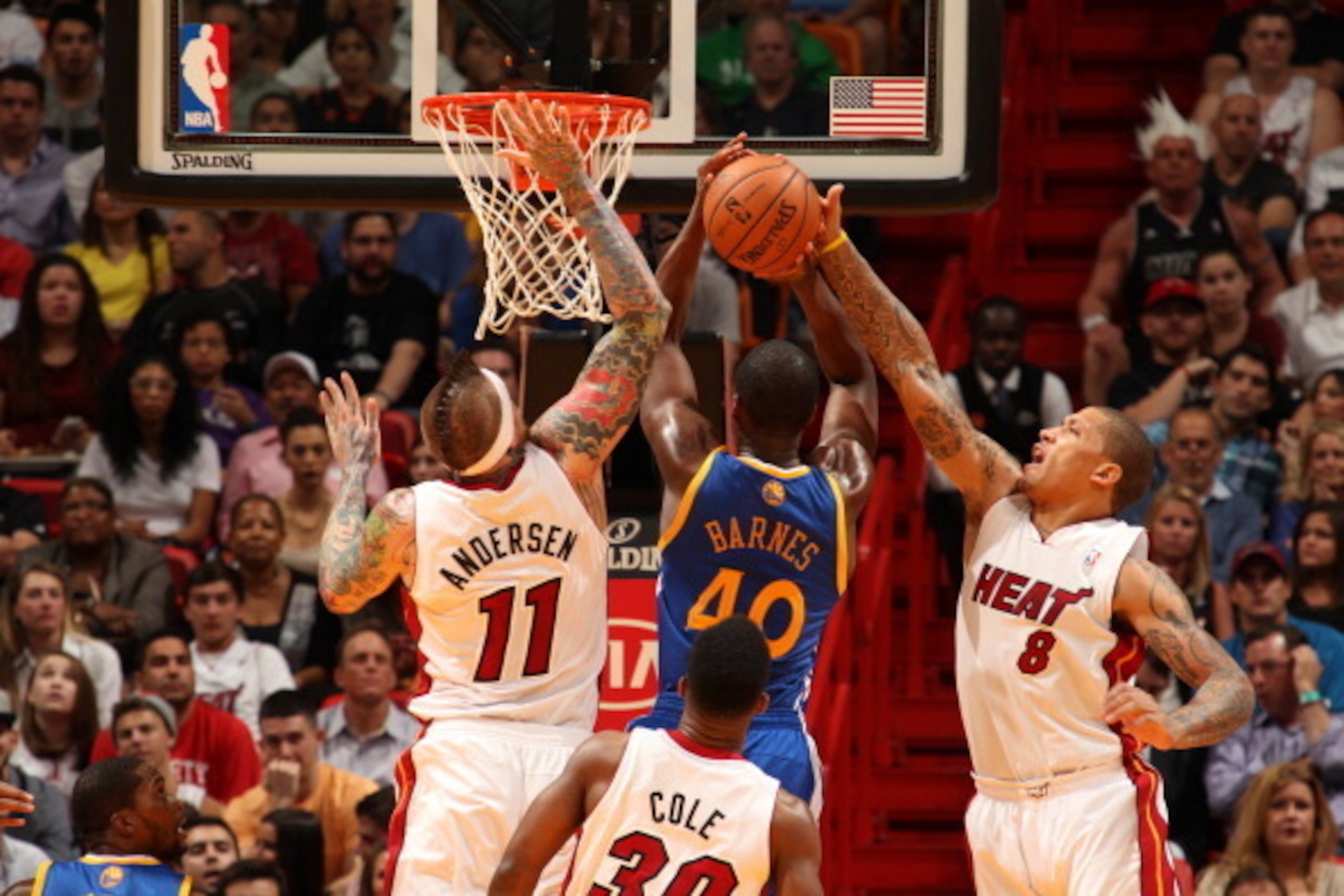
The Miami defense was a top-seven unit for the first three seasons of the Big Three’s reign. So far in 2013-14, the team has slipped to 12th.
Part of the issue, as Grantland’s Zach Lowe and others have spelled out, is that the Heat defense, when it plays at peak level, requires so much running around and trapping—in other words, serious effort—that an old, tired team can’t sustain it for a full 82-game regular season.
Miami should endeavor to replenish its roster with a cadre of (ideally younger) able defenders. Fortunately for the Heat brain trust, there are some attractive—and potentially cost-effective—options on the market.
Avery Bradley is a restricted free agent who, if the price is right, would be a nice fit. (This is a rather large “if.”) Shawn Marion, Danny Granger, Trevor Ariza, Al-Farouq Aminu, Andrei Kirilenko, Thabo Sefolosha and others will likewise be, with various restrictions, available to Miami this summer.
As long as LeBron is in tow, Miami will be able to score. But a Heat team that’s fortified by one or a few of the above additions would likely manage to elbow its way back to the top of the Association’s defensive rankings as well.
Big Three, 2.0
5 of 5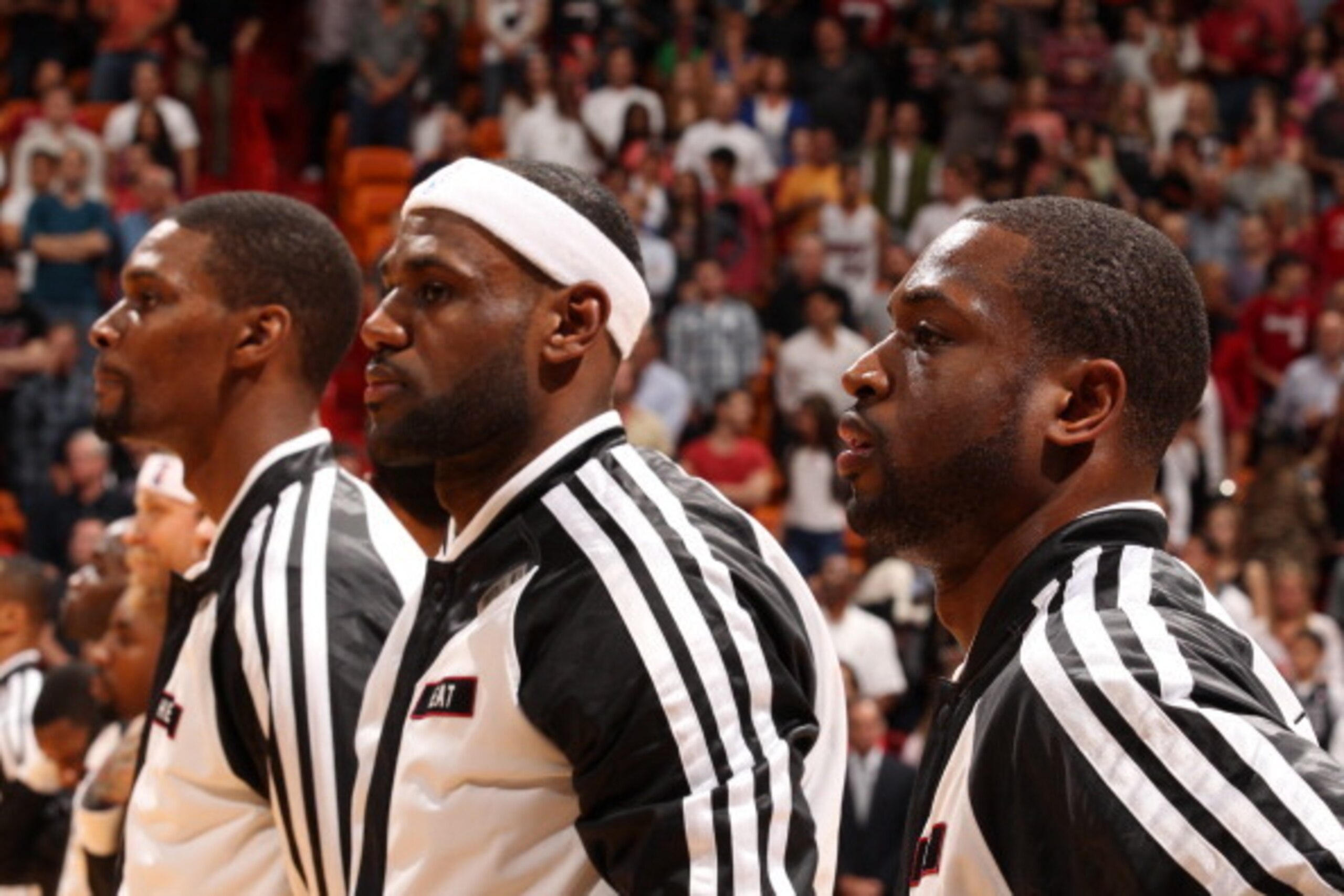
The conventional wisdom—which is likely correct—is that Dwyane Wade is a lock to return to Miami, LeBron is almost certainly coming back to South Beach to pad his Hall of Fame resume with a few more rings, and if the first two re-up, Chris Bosh is exceedingly likely to follow suit.
But what if they don’t?
Pat Riley is a shrewd and unsentimental executive. Assuming LeBron returns, there’s a chance Riley tries to surround him with a pair of more able superstars. And as well as the Big Three play together, this may not be an impossible task.
Consider the unhappy superstar that plays in New York. Carmelo Anthony has an early termination option in his contract with the New York Knicks that he can activate this summer. Melo, at 29, is three years younger than Wade, and while he misses games from time to time, he has nothing like the injury history the Marquette product is saddled with.
Granted, Wade has been better than Melo since they both entered the Association in 2003—Wade has a career win shares per 48 minutes and player efficiency rating of 0.193 and 25.3 to Anthony’s 0.138 and 21.2, per Basketball-Reference—but Anthony seems a better bet to perform at a high level over the next, say, three seasons than his more decorated counterpart.
Chris Bosh could also be replaced.
Though head coach Erik Spoelstra has, on several occasions, told reporters that Bosh is the Heat’s most important player—and the 29-year-old has, in part, justified this lavish praise with an unusually efficient mid-range game that opens things up for Wade and LeBron—it wouldn’t be a shock if Miami tried to better use the $20 million he’s due to earn in 2014-15 if he picks up his option.
And while Wade and Bosh have, obviously, been very productive in Miami—they have true shooting percentages of 59 and 60.6, respectively, per Basketball-Reference—it’s possible that a lot of this success is attributable to the defensive attention that LeBron commands.
Wade and Bosh, at the moment, seem indispensable in Miami. But the graveyards, as the old saying goes, are full of indispensable men.
.jpg?w=2560 "WWE Raw Live Grades 🔠")
.png?w=2560 "Allen's BRUTAL 1H Stats 🫤")
.jpg?w=2560 "Monday Night Raw Blog 🔴")