

Where Would Chicago Bulls Be If They Had Kept Luol Deng?
Since trading their two-time All-Star small forward, Luol Deng, the Chicago Bulls have won more games than any team in the Eastern Conference and the third-most in the NBA. It kind of makes you wonder: Where would they be if they had held on to him?
After all, Deng was, and still is, the Bulls’ leader in points per game this season, at 19.0. He’s also one of the better perimeter defenders in the league, with a 2011-12 All-Defensive team credential to his name. Certainly, his presence would help the Bulls be even better, right?
In some ways, Chicago might be feeling the impact of losing Deng. The best defensive lineup the Bulls had with at least 50 minutes played was what would have been their starting lineup if they’d kept Deng.

The quintet, which also included Kirk Hinrich, Jimmy Butler, Carlos Boozer and Joakim Noah, had an offensive rating of 102.9 and a defensive rating of 75.3. Their 27.5 net rating is good for 12th among lineups with at least 50 minutes played according to Basketball Reference.

Furthermore one of the few lineups ahead of them is composed primarily of what would have been the Bulls’ bench, with Noah being joined by D.J. Augustin, Mike Dunleavy, Taj Gibson and Tony Snell. That group is a whopping 33.0 points per 100 possessions better than their opponents. So it would have all been gravy if Deng had stuck around, right?
Not so fast. This is where looking at plus/minus stats can border on facetious. The problem with both of those numbers is the minutes involved are very slight. The Deng lineup played together for just 52 minutes. The bench lineup has just 64.4 together on the season.
That’s a total of 116 minutes, or .7 percent of the total minutes Chicago has been on the court this year.
There’s ample reason the Bulls wouldn’t be able to sustain that kind of success with their woulda-been starters.
The top lineup with at least 200 minutes only ranks 33rd among those with 50. There’s not a lineup with 500 minutes until we get all the way down to 44th. Clearly, such success is very difficult to sustain over a larger number of minutes, and it’s improbable the Bulls would do so.
Looking at when Deng and Butler shared the court together gives us a much bigger sample size of minutes and highlights the problems the roster faced, with neither player being a particularly adept three-point shooter.
Here’s the Bulls’ shot chart with that duo on the court together.
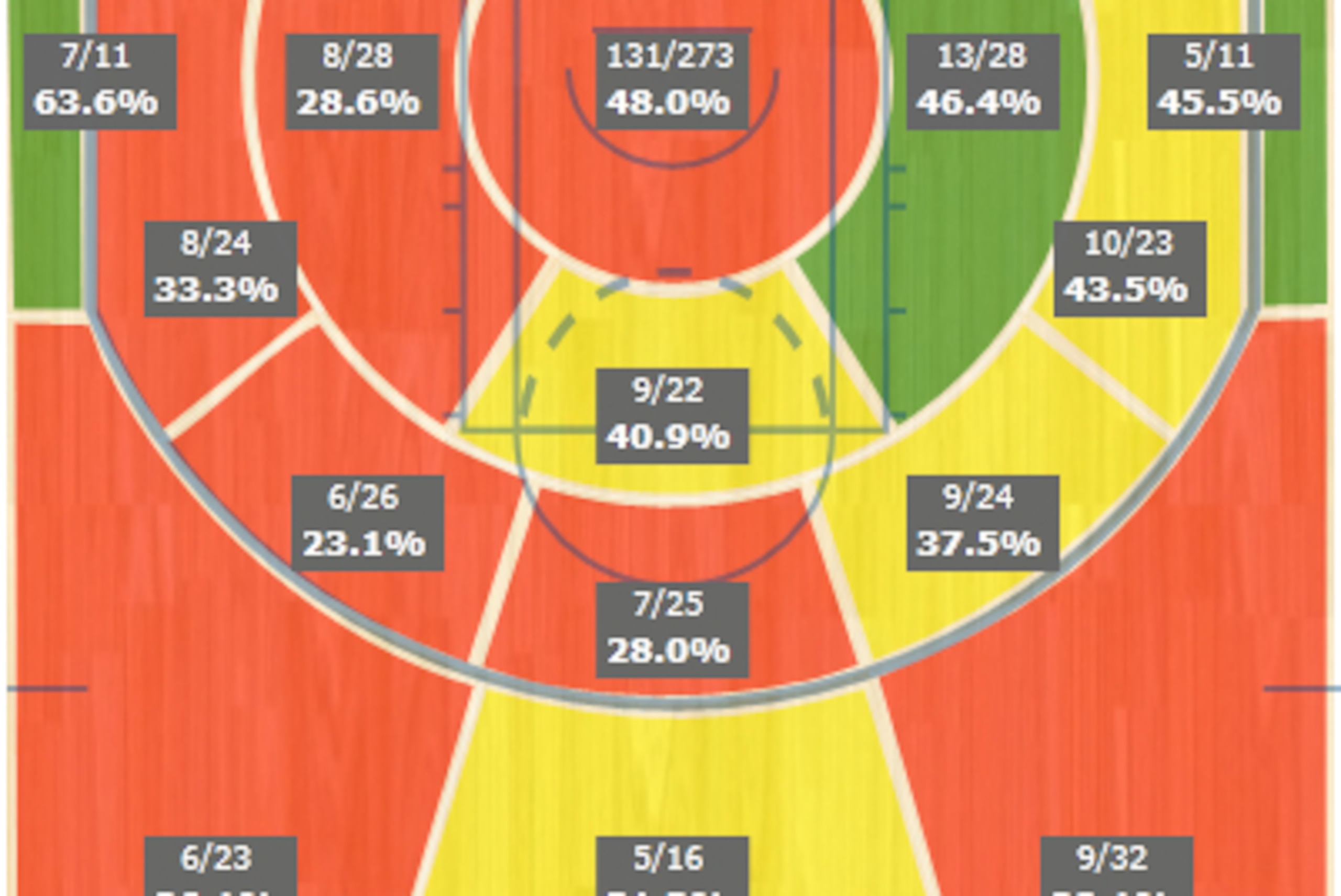
Now this is the shot chart when Butler and three-point sharpshooter Mike Dunleavy, who has stepped into Deng’s starting role, are on the court.
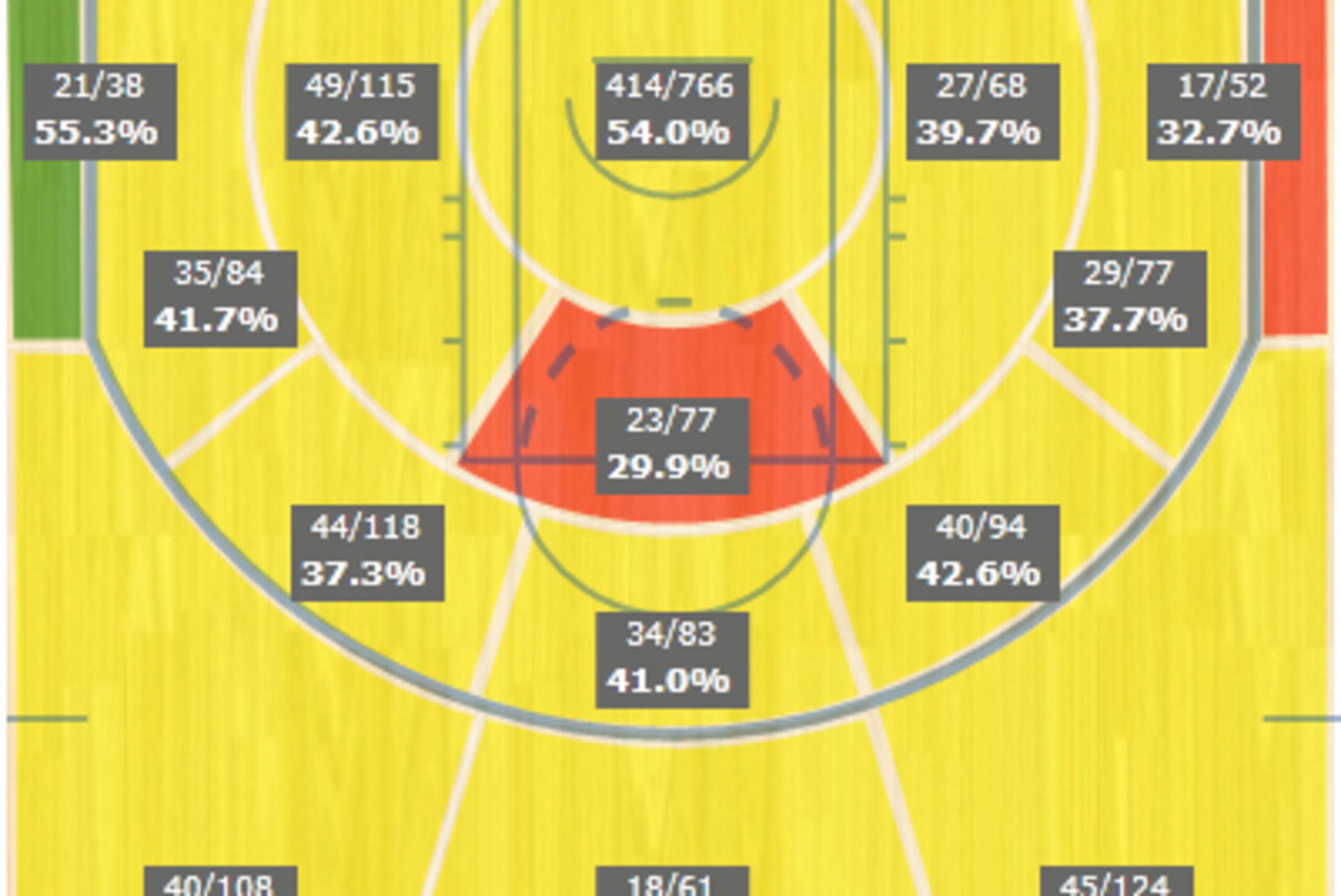
The offense isn’t exactly shooting the lights out with Butler and Dunleavy on the court together, but at least it’s not like they’re shooting in the dark anymore. The shot chart goes from being predominately red to mostly yellow. They’re a bit worse along the right baseline, but other than that they’re a better shooting team from every area.
So why is that? It helps to see not just the charts, but where the shots are coming from. Here is the shot distribution with Deng and Butler playing together.
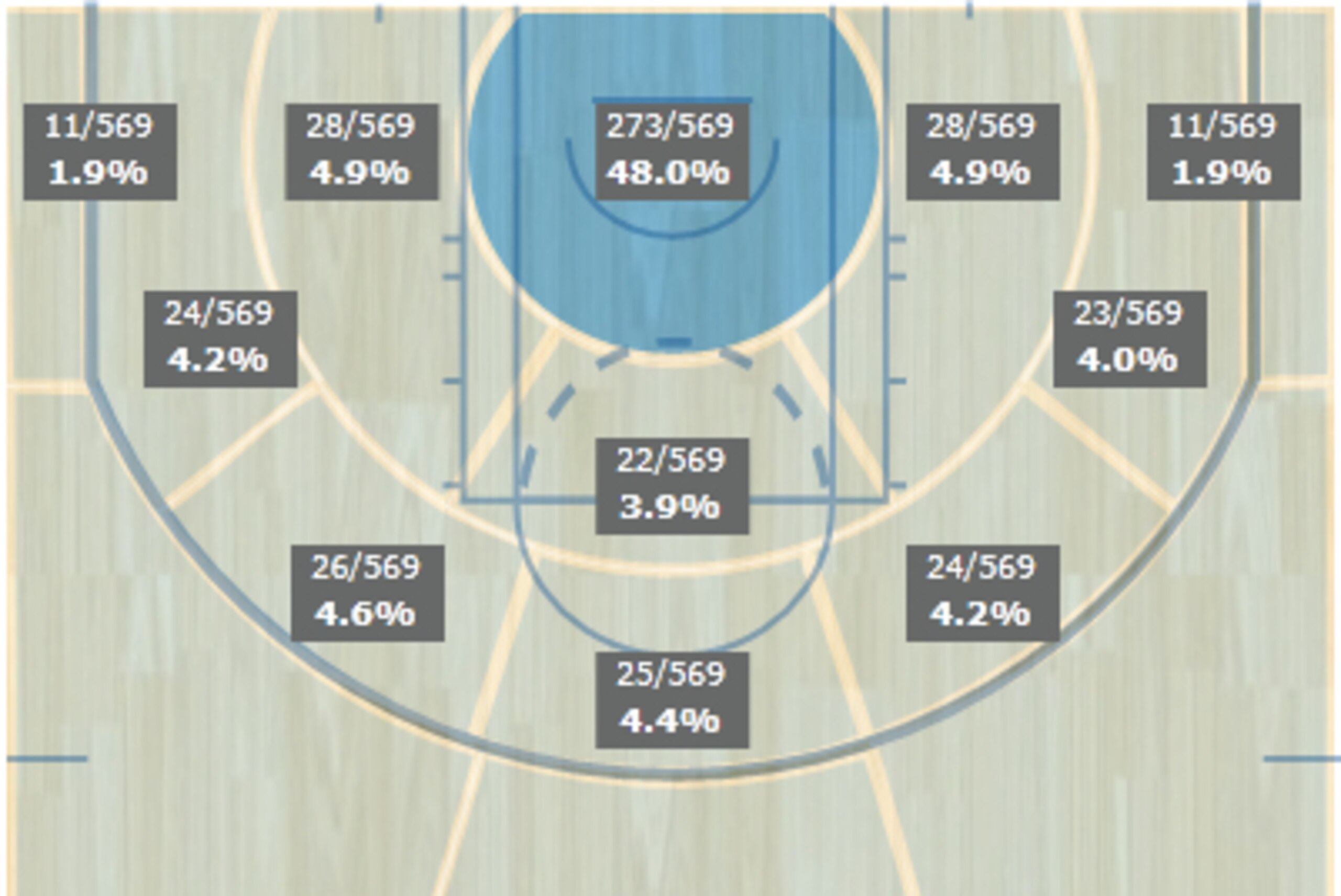
And here is the shot distribution with Butler and Dunleavy on the court.
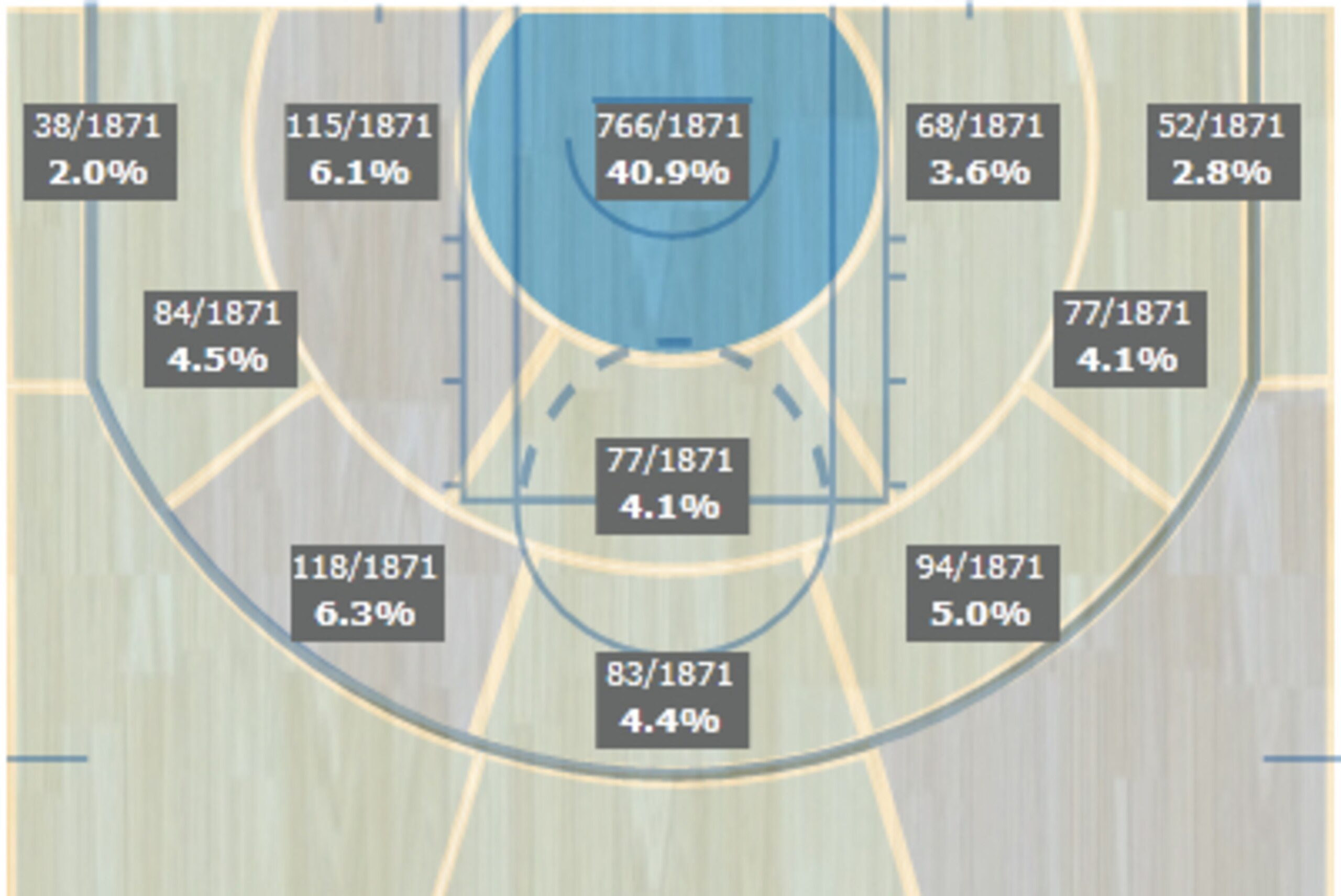
Pay particular attention to the restricted area and the three-point area. With the Butler/Deng combo, the Bulls attempted 48.0 percent of their shots in the restricted area and only 16.2 percent of their attempts from three.
With the Butler/Dunleavy pairing, they’re attempting only 40.9 percent of their shots from the rim, while 20.5 percent of their attempts come from deep.
Without a wing to spread the court, the Bulls were forcing the ball inside with Deng, constantly trying to pound the rim. This would give brutal returns. It was clearly a case where quantity was distinct from quality.
In fact, while the Bulls are attempting eight percent fewer shots from the restricted area with Butler and Dunleavy, that’s only resulting in one fewer make out of every 100 shots—a difference comfortably offset by the increase of the two three-pointers made on those shots.
That’s what analysts mean when they talk about spreading the court. And, with the court spread, the Bulls’ frontcourt is more efficient, no longer trying futilely to pound the ball. They were only ranked 19th in net efficiency for the month of December, according to Hoops Stats.
By contrast, they’re second since the All-Star break.
The profit extends to the backcourt too. With Dunleavy helping to open the court, Hinrich’s shooting is coming around. Prior to the trade, his effective field-goal percentage was 40.4 according to NBA Stats. Since then, it’s 49.1 percent. When he’s shared the court with Dunleavy in that time frame, it’s 50.2 percent.
This is also in part due to the Bulls shifting so much of the distributing responsibilities to Joakim Noah. Hinrich’s effective field-goal percentage is 56.1 percent on catch-and-shoot attempts compared to 41.3 percent on pull-up shots.
Prior to the trade, just 9.7 percent of Hinrich’s points off field goals (15 of 155) were off of Noah’s assists, as charted by Basketball Reference. Since the trade, that percentage has more than doubled to 20.1 percent (58 of 281).
While this doesn’t provide conclusive evidence, it does strongly suggest allowing Hinrich to play off the ball more is making him effective—particularly with Noah distributing it.
That Deng’s departure has helped Chicago is backed by the overall numbers too. Since the Bulls traded him, their offensive rating is 101.6. That is still only tied for 26th in the NBA. But it's is still a massive improvement over 95.6, which is what it was in the period between when Rose was injured and before the trade.
And surprisingly, Chicago’s defense hasn’t really been impacted much without Deng. It was 97.4 pre-trade, and it’s 98.1 post-Deng. Dunleavy is not a great on-the-ball defender, but Butler is actually better. Butler has been taking the primary responsibility for the best wing on the opposition in Deng's absence.
And, Dunleavy is actually a solid team defender. The Bulls are actually .6 points per 100 possessions better with him on the court, per 82.games.com.
He rotates well, draws charges and fills his role. He's certainly not going to end up on the All-Defensive team, but with Hinirch, Noah, Butler and Gibson often around him, he's able to do just enough to keep the defensive system intact.
So, while there has been a very slight drop-off, it’s dwarfed by the rise in the offense. That appears to be the reason the Bulls have turned things around, and it seems like that is likely a result of the changes necessitated by the Deng trade.
At a minimum, the Bulls are not the worse for wear sans Deng. In fact, as counterintuitive as it sounds, trading him might have actually even made them better.
Data from Basketball-Reference.com, NBA.com/STATS, the NBA's media site, Hoopsstats.com and 82games.com was used in this article and is referenced when accordingly.
.jpg?w=2560 "WWE Raw Live Grades 🔠")
.png?w=2560 "Allen's BRUTAL 1H Stats 🫤")
.jpg?w=2560 "Commanders OL HEATED After Tie ▶️")
.jpg?w=2560 "Monday Night Raw Blog 🔴")