

Film Focus: Bayern Munich See off Brave Arsenal to Progress in Champions League
Pep Guardiola's FC Bayern Munich are through to the quarter-finals of the Champions League at the expense of Arsene Wenger's Arsenal. The defending champions look on course to become the first team to hold onto the "cup with big ears" after seeing off the Gunners over two legs in the round of 16.
Arsenal are out to the same club, at the same venue and at the same stage as last season.


Bayern dominated the first half to an incredible extent, where Arsenal could only thank their lucky stars for Munich's profligate finishing in front of goal. The inevitable opener came at the start of the second period from the boot of Bastian Schweinsteiger after he was played in by Franck Ribery, who had left Bacary Sagna with "twisted blood," the latter had been turned that easily.
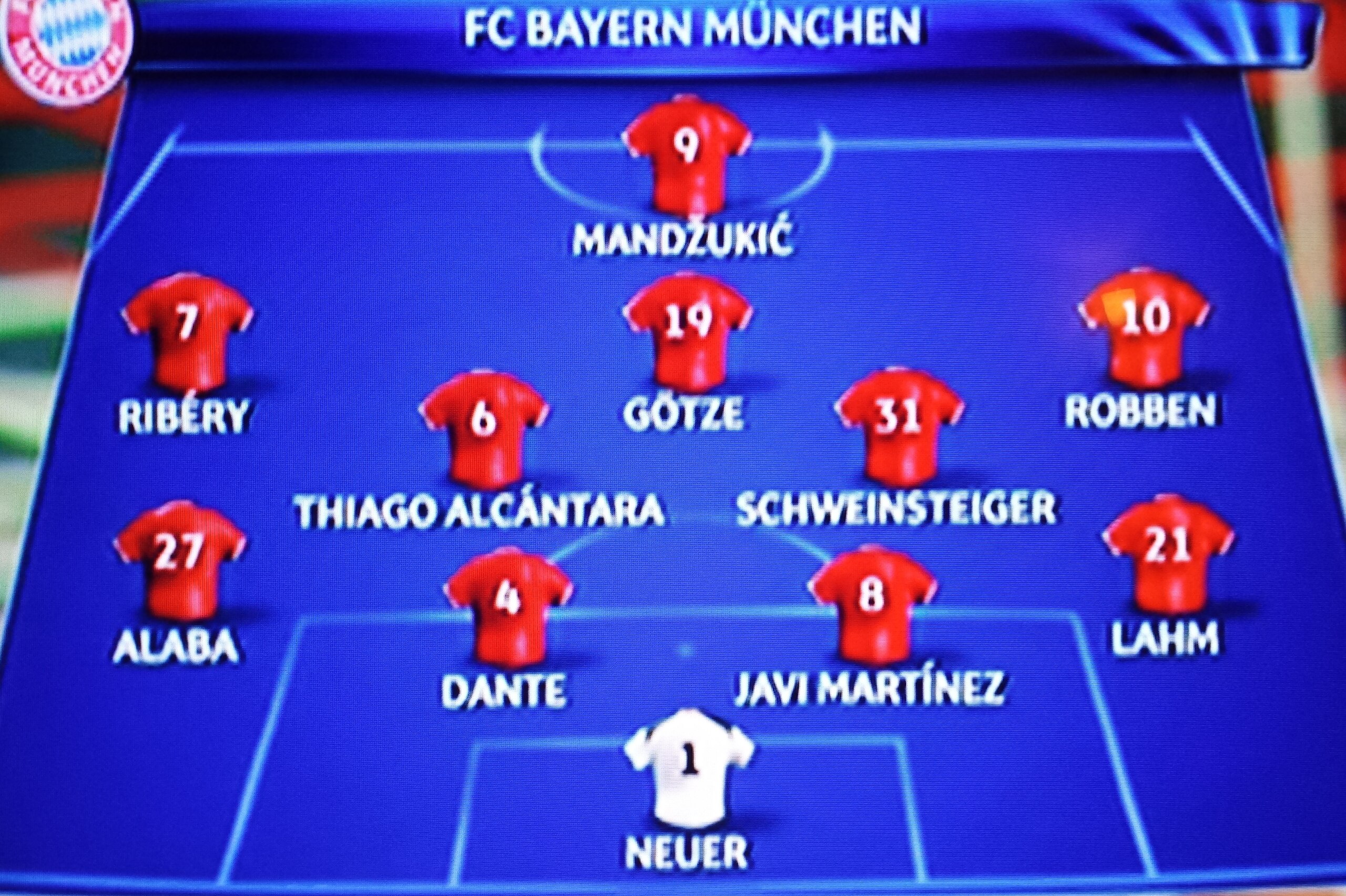
With Munich practically through at 3-0, the Gunners decided to make a match of it and had the temerity to actually score with their first real attack. The goal from Lukas Podolski came after a foul on Philipp Lahm, but smacked of a team who came to life after they had nothing left to lose.
From there, Arsenal competed on an even keel with Bayern, and the game became a more interesting affair.

In the end, Bayern went through, but not before they had missed a penalty and received more than one fright.
Munich were not as clinical as we have seen this season, and they were very casual after they opened the scoring. That being said, Arsenal deserve credit for their second-half performance. However, as ever with the Gunners, had they taken their chances in the group stage, they would not have played Bayern. And had they taken their chances over the two legs—remember that missed penalty—they might have progressed.
Arsene Wenger will think about what might have been, but the simple truth is that Bayern had been just too clinical in the first leg and too professional in the second leg to lose.
Here, we take a look at the key tactical decisions that shaped the game.
There is a growing belief that Bayern Munich are set to dominate European football and the Champions League for years to come. Pep Guardiola, the man who orchestrated the great Barcelona team's dominance at the turn of the decade, now manages Bayern and has brought a certain elegance and tactical fluidity to the great club. This has joined with Munich's indomitable spirit and fundamental belief that they are a real power in the game to make them a more than formidable opponent.
Arsenal, on the other hand, have no such beliefs, and only the most foolhardy of their fans would even dream about placing the London-based giants on the same pedestal as Bayern.
Guardiola has improved upon an already-phenomenal side by making huge physical and mental demands of his charges. The 43-year-old former midfielder insists that his team is 100 percent focused in every single moment of the game and that they are supremely match-fit.
He is ruthless in the requirements he places on the team. One only has to see Jerome Boateng being removed from play after 45 minutes of the Champions League first leg game against Arsenal for a perfect example. Boateng was simply not switched on and gave away a sloppy early penalty that Manuel Neuer fortunately saved.
With standards set extremely high, Guardiola then inflicts his footballing philosophy on his opponent. Pep spoke of how he wanted to inflict Bayern's game on Arsenal in the pre-match press conference (h/t the Mirror):
"We have to make sure we have the ball, that we really attack well and go through to the next phase. They have a lot of quality, so we have to make sure we have a lot of possession. We have to make sure they do not score a goal.
"
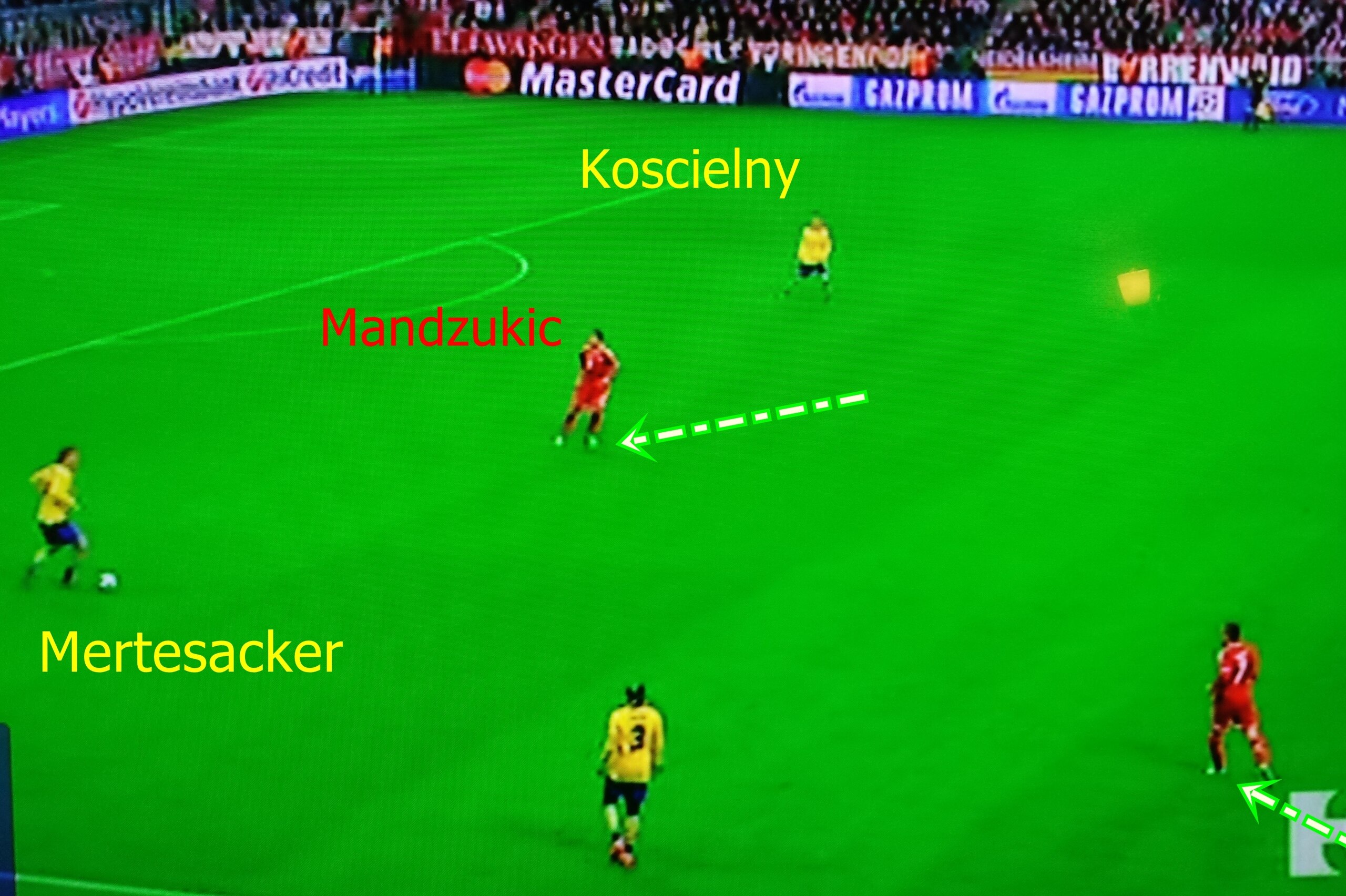
The first part in making sure the Gunners were blunt in attack was in making sure they had no space to play in. This, in turn, forced Arsenal to go long to Olivier Giroud as their only out ball. It also created a very real opportunity of winning back the ball, which they duly did on most occasions. This was achieved by forcing the Gunners to give away possession through defensive positioning and through closing down the play.
Closing down the opposition has been around for as long as football has been played. However, it is rarely understood. It is not simply enough for the closest man to close down the play. It must be done in a conjoined and carefully thought-out manner. Most of all, it can only be effectively achieved through teamwork.
When closing down the opposition, players generally work in twos and threes. It is achieved through the use of an imaginary elastic band which links each player. In essence, the players stay as close together as the band will allow, and push and pull at the right moment. Thus, the nearest man to the ball closes it down rapidly while the next man moves into a covering position where he can cover the pass to the next opponent and his own player, should his own player be beaten by an attacking dribble.
This simple tactic, when employed correctly, also sets the team up perfectly to attack when they win the ball back, as players are automatically positioned and supported to take full advantage.
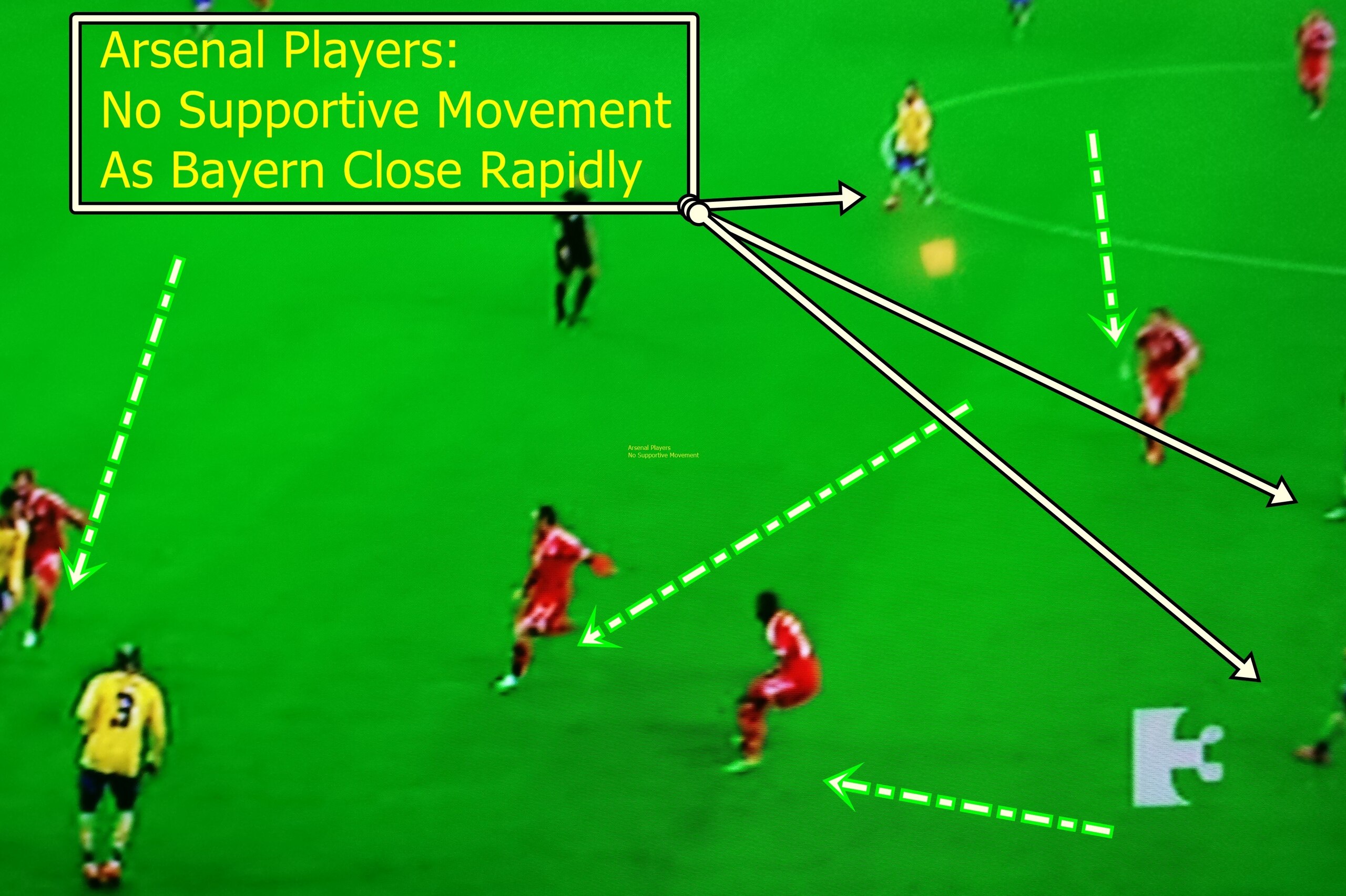
When Bayern did regain possession, they swiftly moved the ball into wide positions to the likes of Arjen Robben and Franck Ribery. There, Bayern set about isolating Arsenal's full-backs, Bacary Sagna and Thomas Vermaelen.
This was achieved mainly by overloading Vermaelen on the left. Mario Goetze and Thiago Alcantara drifted out to support Robben. This then caused confusion, as Arteta had to remain in the centre to mind Bastian Schweinsteiger. As Podolski did not track back to help, Vermaelen was constantly overworked.
Time and time again, Bayern got around the defense to cross, but their final ball and their finishing let them down. It must be said, Laurent Koscielny, up until his lazy attempted tackle and nudge on Robben, was superb all night. His speed of thought and fleet of foot got Arsenal out of trouble on many occasions. As a player, he has grown incredibly over the last 12 months, and if he can get rid that impulsive and undisciplined need to tackle, especially in the box, he will be a great defender.
Santi Cazorla, Podolski and Mesut Ozil were simply terrible in the first half and especially poor at assisting their defense. Ozil eventually paid the price after another lackluster display. He was rightly substituted for the impressive Tomas Rosicky.
The same, however, could not be said of Bayern's team, who defended with vigour and tenacity.
At Barcelona, legend has it that Guardiola tasked his players with "the four second rule."
Basically, it meant that when they lost the ball, Barca had four seconds to regain possession. Given the defensive work-rate of Bayern, it would be fair to suggest that the reigning Champions League champions now employ the same rule.
By contrast, Arsenal did not close down Munich at all. They allowed the German league leaders to dictate the ebb and flow of the game. Of all the Gunners players on show, only Alex Oxlade-Chamberlain impressed in terms of possession and work-rate.
The English international has a great future in the game, and if he can continue this standard of play, he will go a long way. Ozil was, once again, anonymous. Although it did emerge after the game that the German had suffered an injury of some kind during the first 45.
He was ably joined by Mikel Arteta and Lukas Podolski in doing next to nothing before the Germans hammered home the equalizer, following a foul on Philipp Lahm.
Wenger's tactical decision to allow Bayern to dictate the game meant that his team lived on their nerves until Munich opened the scoring. When that eventually and inevitably happened, all the fear left Arsenal and they actually started to attack with some conviction.
At 3-0 down, the tie was dead and buried. In these types of conditions, players with weak mentalities can thrive because they are no longer under pressure. Within minutes of going three-down, the Gunners scored and all of a sudden Bayern were rattled.
For the next 10 minutes, Arsenal attacked and forced the pace of the game, and Munich panicked.
It was only when Toni Kroos was introduced for Mario Goetze that Bayern regained some control of the game. Even then, Arsenal defended with confidence and attacked with more ambition. Munich's professional approach saw them through in the end, but it was far less comfortable than it could have been.
Therefore, one must ask the questions: Would Arsenal have done better had they attacked with conviction from the start? Would they have done better with no injuries? Would they have done better if Mesut had scored "that" penalty?
Wenger is a master in the art of psychological self-denial and picking his team up after such defeats, but even he must be wondering: what if?

.jpg?w=2560 "Commanders OL HEATED After Tie ▶️")
.jpg?w=2560 "WWE Raw Live Grades 🔠")
.jpg?w=2560 "49ers LB Suspended for Headbutt")
.jpg?w=2560 "Harbaugh's Jameis Comps 🤨")