

Why NY Knicks Regressed So Terribly from Last Season
You can build the biggest, brashest, most gleaming and gilt-studded tower on the block, but unless it sits atop a sustainable foundation, the collapse is merely a question of when.
That’s the reality with which the New York Knicks—one year removed from a 54-win, playoff-series winning respite—are currently grappling.
The view, briefly hopeful, has returned to something more familiar: the twisted wreckage of a basketball Babel lucky enough to sway a moment in the stratosphere, before a stiff breeze leveled it all asunder.
TOP NEWS

LeBron's Special Helicopter Deal

MJ Makes Record-Setting Donation 🙌
Shams: KAT, Hart Could Be Trade Names
Following an embarrassing 106-101 home loss to the lowly Sacramento Kings—a team that entered Wednesday’s contest having dropped seven straight games—the ruins were thrown into even starker relief.
So much for the must-win, which is what Carmelo Anthony called the game during the team's Tuesday practice session (per Peter Botte of the New York Daily News):
"“We gotta win. We gotta win tomorrow,” Anthony said after practice Tuesday in Greenburgh. “We have to win. There’s nothing more than that. We have to win."
"
Through it all, the reaction has been as predictable as it is simple: How?
How could a team returning this much of last year’s core struggle so mightily to score?
How does a defense that was already middling morph almost overnight into a league laughingstock?
How could the camaraderie that once so defined the Knicks’ tenor and temperament dissipate so quickly?
There's been speculation-a-plenty, of course, one of the foremost examples being that the loss of Jason Kidd, Kurt Thomas, Marcus Camby and Rasheed Wallace deprived head coach Mike Woodson a quartet of critical locker-room voices.
Here’s what we know: While they’ve regressed somewhat in a number of key areas, the Knicks’ offense hasn’t exactly fallen off a cliff.
| Season | O-Efficiency | D-Efficiency | TS% | REB% |
| 2012-13 | 108.6 | 103.5 | .550 | 49.3 |
| 2013-14 | 103.8 | 105.8 | .531 | 49.2 |
As you can see, the stats are down pretty much across the board, though not to what anyone would consider a shocking degree.
In many ways, the Knicks’ offensive struggles in some ways exist beyond the box score: A combination of intermittent ball stoppage and awkward lineup configurations that have undermined the chemistry of a season ago.
A big part of said success a season ago: New York’s use of lineups featuring two of Raymond Felton, Pablo Prigioni or Jason Kidd in the backcourt.
According to stats provided by NBA.com, of the 10 five-man lineups that logged at least 50 minutes last season and held a net-positive rating, two featured a pair of point guards: the unit of Jason Kidd, Raymond Felton, J.R. Smith, Carmelo Anthony and Tyson Chandler (a team-high plus-26.9 over 269 minutes), and that of Felton, Pablo Prigioni, Iman Shumpert, Anthony and Kenyon Martin (plus-17.4 over 80 minutes).
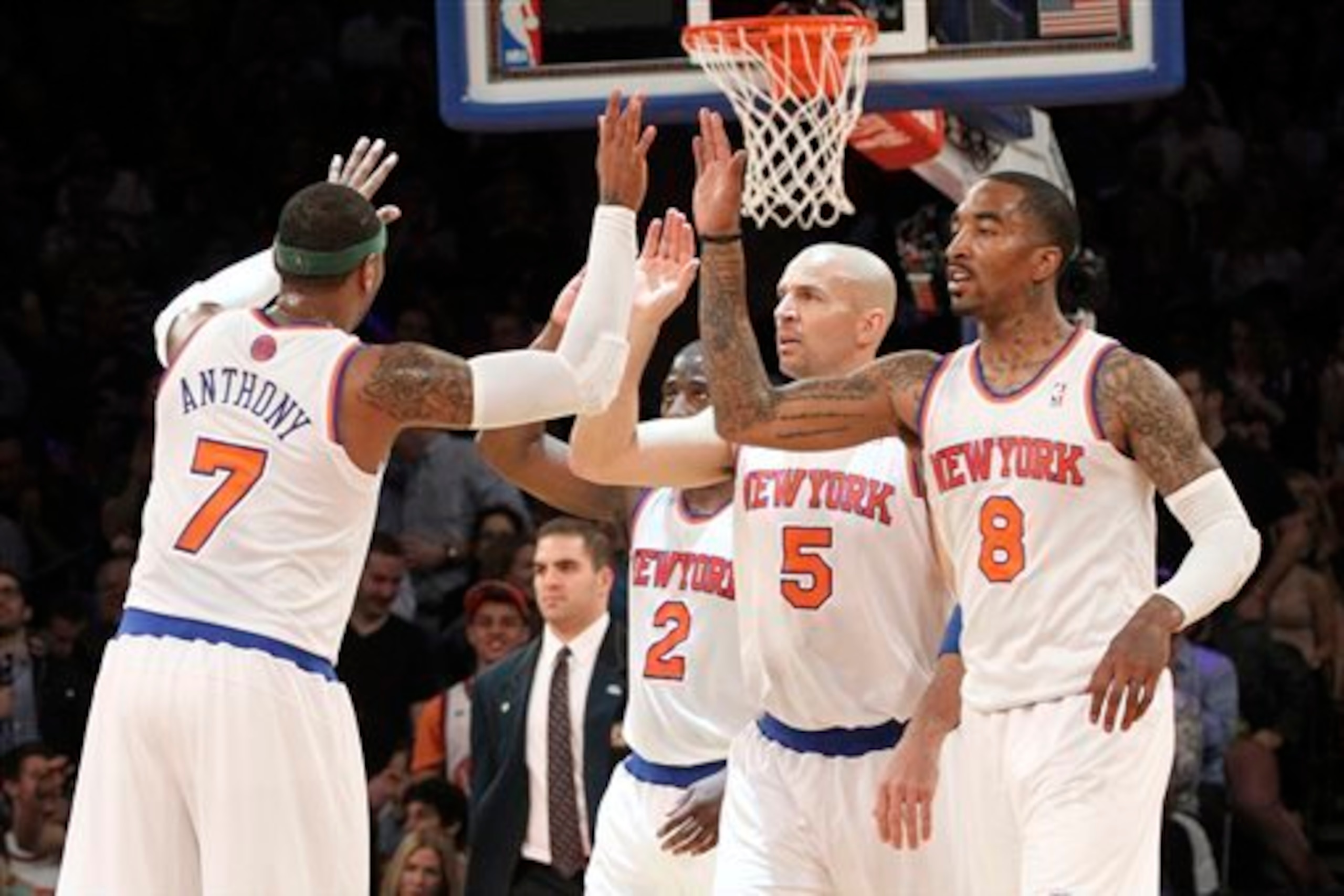
So far this season, the lineup of Prigioni, Felton, Iman Shumpert, Anthony and Chandler has managed to keep the two-point guard mantle alight, having netted a plus-20.5 rating over 110 minutes, making it the Knicks’ third most oft-used unit to date.
After that, you’d have to scroll 17 lineups down the list—many of them heavy in the red—before you come across another featuring a pair of point guards: the aforementioned Prigioni, Felton, Smith, Anthony and Chandler lineup, which has tallied a plus-36 in 28 minutes thus far.
How much of that lineup’s dearth of playing time can be chalked up to Woodson’s seeming reluctance to go small, versus how many physical setbacks the team has sustained (each of that unit’s players have missed at least five games due to injury), is difficult to say.
Given the team’s bigger problem, it might not even matter. Indeed, the Knicks’ offensive woes pale in comparison to their performance at the defensive end, which has been consistently, mind-numbingly atrocious.
Back in early January, the Wall Street Journal’s Chris Herring got into the specifics of what’s been killing New York at the defensive end, where they currently rank 24th in the NBA in overall efficiency (per ESPN.com).
"At times—and this is perhaps the biggest indictment of Woodson, who bills himself a defensive-minded coach—the Knicks look flat-out confused on the court with all their defensive switching. Too often, the result is no one protecting the rim.
In fact, according to SportVU player-tracking technology, the Knicks' half-court defense is surrendering more than four unguarded attempts at the rim every night (meaning no defender within four feet of the layup).
The constant defensive breakdowns make Woodson's preseason talk—when he said the Knicks were capable of being a top-10 defensive unit—sound silly. Last year's Knicks could handle the offensive burden that came along with being so poor on defense, but this year they don't have that sort of firepower.
"
If you’re looking for a succinct, three-paragraph explainer as to why the Knicks are entering this year’s All-Star break 12 games below .500 and 11 off their pace from a season ago, this might well be it.
The following two videos go a long way in illustrating Herring’s points. The first is a clip from New York’s embarrassing 103-80 home loss to the Brooklyn Nets on January 20:
You could find a group of high-school players capable of playing better pick-and-roll defense than Pablo Prigioni and Andrea Bargnani just displayed. Even Anthony—not exactly Bruce Bowen in the defense department—was left shaking his head in disbelief.
The next video is interesting more for its awkward nuances than its glaring defensive abominations, although there are indeed plenty of those (go to the 1:52 mark).
That’s former Defensive Player of the Year Tyson Chandler giving Tim Duncan zero resistance—almost as a kind of passive-aggressive punishment for Bargnani so badly botching his rotations.
It's been a familiar trope for the injured Bargnani, whom Woodson has insisted on shoehorning into lineups regardless of fit or flow.
Finger-pointing and bad body language permeate the video—as good a sign as any that the tight-knit team of a season ago has vanished, replaced by a collection of consistently confused and confounded individuals more interested in deflecting blame than properly defending the perimeter.
In reality, New York’s issues—and the reasons for their confounding implosion—run much deeper than any data table or YouTube clip. From the archaic strategies of their coach to the front office’s shortsighted financial philosophies, the Knicks are little more than victims of the chickens once again coming home to roost.
Heading into this season, New York was expected to build on the template that made last year such a resounding success—if not by dint of improved record, then certainly by sheer chemistry carry-over.
Instead, fans have been left to ponder what four months ago would’ve seemed impossible: that examined in the context of their franchise’s recent history, perhaps last year’s performance was the one truly out of the ordinary.

.jpg?w=2560 "Grading WWE Raw 🔠")

.jpg?w=2560 "Viral Rams Coach Vid 🖕")

.jpg?w=2560 "Injury-stricken Seahawks signing veteran RB")
.jpg?w=2560 "Bijan's INSANE 1st Half 🤩")