

UCLA Basketball: Frontcourt Needs to Step Up or Disappointment Is Looming
UCLA dropped another conference game on Sunday, coming up short to Oregon State in its second game of a three-game road trip.
With a chance to jump to within one game of first place after Arizona was upset by Cal, the Bruins failed to capitalize on the opportunity and played their worst basketball since falling to Utah in Salt Lake City.
Coach Steve Alford chided the team after the game for its lack of energy and enthusiasm, which was apparent to anyone watching the game.

.jpg?w=2560)
However, those were just minor shortcomings in the broader story of UCLA’s 2013-14 season.
The Bruins shot 38.6 percent in Sunday's 71-67 loss, including 28.6 percent from downtown, their worst shooting effort during Pac-12 play this season.
The poor shooting performance was helmed by UCLA’s top scorer, Jordan Adams (16.8 PPG), who didn’t score a field goal (0-of-9) for only the second time in his career. The Bruins’ key bench player, Zach LaVine (11.2 PPG), also couldn’t find the net, making only one of his seven field-goal attempts.
Together, Adams and LaVine accounted for 43 percent of UCLA’s missed shots, including 67 percent of its missed shots from beyond the arc.
One might assess looking at the box score that it was just an off-day for the Bruins, especially for Adams and LaVine, who have been tremendous contributors to the team’s offense.
Equating that road loss to UCLA’s prior loss against Utah on the road, it might also be worthwhile to note that the Bruins have twice fallen in the second game of a road trip, which may entail they need better preparation heading into those games.
Those are valid evaluations, but they’re infinitesimal in comparison to the Bruins’ ongoing shortcoming: the frontcourt.
UCLA lost on Sunday because of poor shooting and lackluster play, but it could have won the game if its frontcourt would’ve stepped up and helped filled the void.
Against Oregon State, Travis Wear, David Wear and Tony Parker combined for 20 points—a decent collective performance for the Bruins frontcourt—but only tallied a total of 10 rebounds, which was equaled by guards Adams and LaVine.
Under Alford’s run-and-gun offense, UCLA relies heavily upon guard play—as evidenced by four of its guards averaging double figures in scoring—but its frontcourt still plays an integral role in the Bruins’ success.
That’s distressing for UCLA, which hasn’t received the slightest scrap of consistency from its frontcourt this season.
Parker put up 22 points against Stanford and then a polished goose egg against Cal. David Wear put up 18 points and seven rebounds against Cal and followed it up with five and three against Oregon and five and seven against Oregon State.
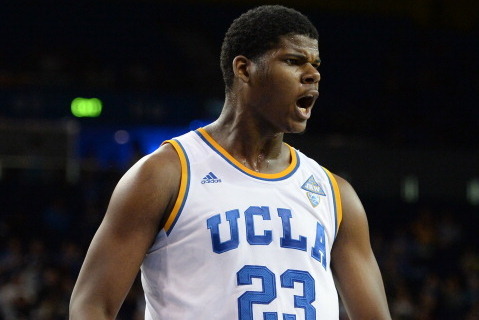
Travis Wear has been the most consistent of the Bruins forwards, but not in the way they’d like him to be. After averaging 11 points and five rebounds for UCLA last season, he is scoring six points and three rebounds per game, only once grabbing a season high of six rebounds.
Both Wears are good jump-shooters, but they don’t have the physicality UCLA needs on both ends to command the paint.
The Bruins hoped sophomore center Parker would provide the low-post presence they’ve needed, but he’s been bogged down by foul trouble and erratic performances.
Fortunately for UCLA, its guards are talented enough to carry the team most games.
Nonetheless, because the frontcourt is so ineffective, the guards often have to overcompensate, particularly on offense, which forces guards like Kyle Anderson and Adams to try to single-handedly take over on the offensive end.
When the team is shooting poorly, as it was on Sunday, it’s difficult for the Bruins to win close games.
UCLA doesn’t need its frontcourt to put up astronomical numbers. It doesn’t need Parker to have a double-double every game. It doesn’t necessarily need Travis Wear to turn his senior season around, either.
What it does need, though, is a frontcourt that can make the easy buckets at the rim and, above all, a frontcourt that has a presence.
Parker and the Wears have answered that calling on a few occasions, but their impactful performances have been few and far between.
Regardless of how good their guards are, the Bruins won’t have any success in the month of March if the frontcourt doesn’t become a consistent force in their remaining conference games.
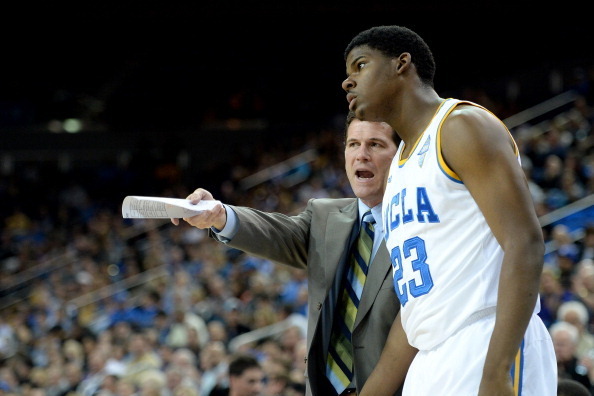
To his credit, Parker has improved from last season and the Wears have struggled to find their niche in Alford’s offensive scheme; nevertheless, UCLA’s frontcourt needs to fortify and unify in the coming weeks.
UCLA needs constant defensive pressure and at least 15 rebounds each game from its frontcourt.
Improvement is possible, but judging from what they’ve displayed so far this season, it’s very unlikely, which leaves UCLA trending toward another disappointing conclusion to the season.
There are still enough games remaining to work out the kinks, but there’s decreasingly smaller room for error for UCLA’s frontcourt, particularly for Parker, who is the Bruins’ most physical inside presence.
The time is now.
Otherwise, the Bruins will be sedentary in March, rebounding from another mediocre finish.


.jpg?w=2560 "Viral Rams Coach Vid 🖕")

.jpg?w=2560 "Injury-stricken Seahawks signing veteran RB")
