

Projecting Tony Snell's Actual Ceiling with Chicago Bulls
With Tony Snell putting the first half of his rookie season behind him, we can start projecting what his ceiling is with the Chicago Bulls.
He hasn’t been dominating the league, but that’s to be expected of a rookie playing under Tom Thibodeau, who doesn’t play his freshmen a lot.
Let’s start with a snapshot of Snell’s season through the end of January based on his Basketball-Reference.com game score—a single-number metric devised by ESPN's John Hollinger to measure overall performance.
TOP NEWS

Predicting MVP Candidates in 5 Years 🔮
Ranking Lakers Trade Targets 🎯

Ranking 5 NBA Teams With the Worst Salary-Cap Situations 😖
As you can see, Snell’s performance has been a bit of a roller coaster—actually a very scary roller coaster. However, as the trend line indicates, he is gradually improving.
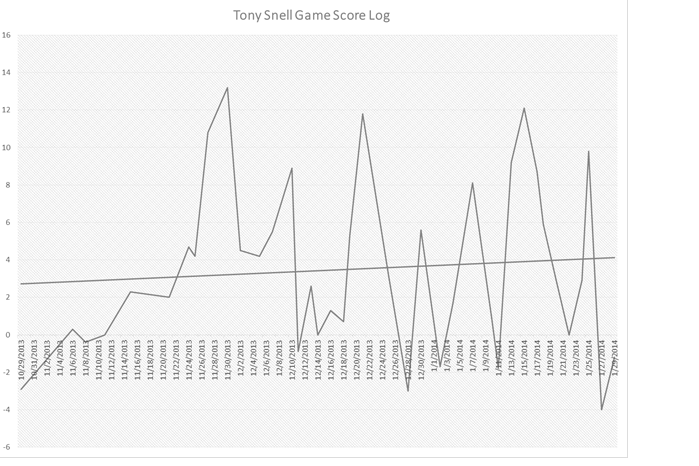
This has value because it shows us something the averages can’t—a gradual improvement in Snell’s game, which is the main thing you want to see in a rookie. That’s important when considering a player’s ceiling.
Snell’s average game score is about 60 percent better now than it was at the start of the season, indicating a fairly rapid learning curve.
From that, we can derive that he still has more room to improve.
It doesn’t tell us any specifics, though, and it doesn’t tell us what the ceiling is. To do that, let’s consider what Snell is expected to do and how he is progressing in those specific areas.
The Bulls drafted Snell to be a three-and-D player—the type of wing who can stretch the court with a three-point shot while playing outstanding defense. Therefore, the two most important parts of his game for his ceiling are going to be his shooting and defense.
Looking at those two aspects, we’ll analyze where he’s been, where he is and where he can go.
Shooting
Through the course of the season, there are two apparent things regarding Snell’s shot. First, it’s a beautiful thing. Second, he needs more confidence in it.
When he just catches the ball and shoots it, it’s pure money, but often he’ll hesitate, which costs him points.
Initially, Snell was reluctant to shoot, often passing out of shots or waiting too long to take them, giving the defender a chance to close. In fact, it took almost a month for him to even bury his first trey. He then only went 1-for-5 from deep against the Utah Jazz on November 25.

When he is decisive, he’s fluid with the ball and a better shooter. According to the NBA.com’s tracking data, when he pulls up off the dribble, his effective field-goal percentage is 40.7 percent. When he just catches and shoots, it’s 50.4 percent.
Experience seems to be helping, as this is the area of his game where arguably the most improvement has come since the trade of Luol Deng.
According to Basketball-Reference.com, he shot 30.3 percent from deep prior to the trade. Since the deal, that’s gone up to 36.2 percent. His attempts have also gone up from 2.9 to 3.6. While the tracking data doesn’t provide splits, the eye test suggests that he’s growing confident and deliberate, and that’s helping him.
It appears that Snell is settling into the system and his role in it, as well as the NBA in general. As he acclimates, his percentage and attempts should continue to rise correspondingly.
The mechanics of his shot are nearly perfect, so as he grows more aggressive, he should improve both his makes and percentages.
This bodes well for his ceiling. Confidence and decision-making are the easiest things to improve upon. It is not hard to envision Snell among the three-point leaders in two or three years. A ceiling of 2.8 three-pointers per game with over 40-percent shooting is reasonable.
Defense
Through the first two months of the season, Snell was a player who showed good defensive instincts, but was constantly lost in Thibodeau’s complex system. It served as a perfect example of why it’s not a good idea to throw rookies into his defense and expect them to immediately learn to swim.
The system, in its essence, is not complicated to understand. The Bulls like to overload the strong side—the side where the ball is—to prevent penetration. They cut off passing lanes and close out on threes while encouraging long twos, which are the most inefficient shots.
Conceptually it’s easy to understand, but in the specifics it’s not so simple.
It requires every player to know what his responsibilities are and where they need to be at any given moment. This can be especially demanding of the wings, who are often asked to defend multiple positions because of the reliance on rotations and help defense.
Knowing where he needs to be and what his responsibilities are can be a lot to absorb—especially for a rookie—and Snell had a horrible start.
NBA.com (subscription required) indicates that, prior to the Deng trade, the Bulls' defensive rating with Snell on the court was 101.2 and just 96.1 with him on the bench. Since the trade, it’s been 96.4 with him on the court and 100.2 off. That’s almost a complete reversal.
It appears that he’s getting the hang of things.

He still has things to work on, though—particularly in the pick-and-roll, where he seemingly gets surprised by screens. When defending the ball-handler, mySynergySports (subscription required) reveals that Snell gives up 1.02 points per play, which needs to come down. As he continues to grow and increases his court awareness, it should.
He often has a tendency to over-help, losing track of his man. When his assignment then drifts back to the three, he’s not able to close in time. As a result, mySynergySports indicates that opponents are hitting 51.9 percent from deep when he’s the primary defender on the play.
On the positive side, he has great on-the-ball instincts and uses them well. He has a 7’0” wingspan, quick hands and is not afraid to body up.
That combination is helping him to generate steals. We’ve seen an improvement there since the trade too, as he was averaging just 0.7 steals per 36 minutes prior and is getting 1.2 since.
Most importantly, and this is hard to measure, it seems he enjoys playing defense. He actually often seems more engaged on the defensive end than on the offensive end, particularly as he’s grown more comfortable.
The great defenders like defending, and Snell fits into that mold. That’s something he has in common with Joakim Noah, Jimmy Butler and Taj Gibson, whom Snell could be starting alongside in the years to come.
His love of defense is certainly something shared by Thibodeau, the best defensive guru in the league. He’s been the architect of a top-six defense every year since the 2003-2004 season.
Because of who he’ll be playing with, who his coach is and his affinity for defense, it’s not hard to see him on the All-Defense team at some point in the future—or at least as a top-10 wing defender in the league.
Snell does have some other aspects to his game which show promise. He’s a respectable passer (1.9 assists per 36 minutes) and a solid rebounder (3.6). He’s also a surprisingly decent ball-handler. In fact, he may have the best dribble of any Bull other than the team's point guards.
And he will occasionally shock you by doing things like this.
Between those abilities and his shooting, his ceiling is probably somewhere around 15 points, three assists and five boards per game.
He does have some aspects to his game that can complement the whole three-and-D thing, but in his essence, that’s what he’s going to be. It’s hard to envision him ever becoming a true playmaker, but he will make some plays. He just doesn’t have enough there to be an All-Star.
Let’s not diminish what he is by concentrating on what he isn’t, though. In a rising niche where teams are valuing shooting guards who can shoot and guard, he could be among the best—if not the very best—in an increasingly essential specialty.

.jpg?w=2560 "Rams troll Jameis, Giants on social media")


.jpg?w=2560 "WWE Raw Live Grades 🔠")